Plux
Plux is a free terminal multiplexer written in Rust for Unix systems.
What Plux is
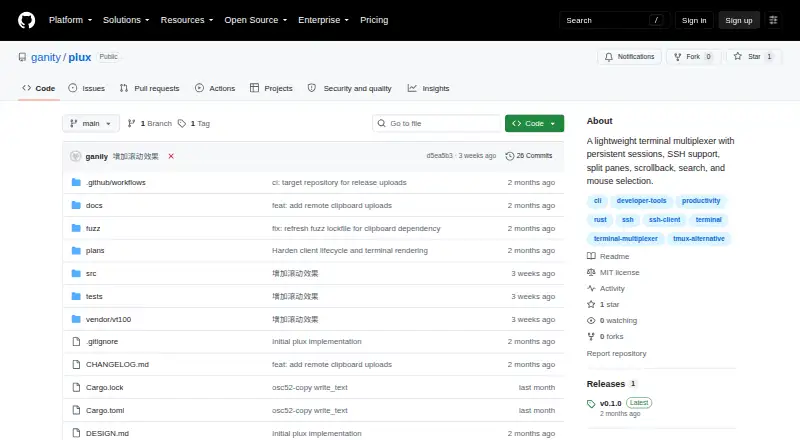
Plux is a free terminal multiplexer written in Rust for Unix systems. It keeps shell processes and terminal state in a background daemon, so named sessions can be detached and reattached, or taken over by a new client. Sessions support horizontal and vertical pane splits, focus changes, zoom, split-ratio adjustments, and pane closing. Scrollback, history search, and coordinate selection help find and copy terminal text. Remote attachment uses SSH as an encrypted bridge and requires a compatible Plux binary on the server, either on PATH or at ~/.cargo/bin/plux. Optional clipboard integration uses wl-copy, xclip, xsel, or macOS pbcopy. The project targets Unix systems with a native PTY and UTF-8 outer terminal; Windows is unsupported. It does not restore shells after a daemon crash or reboot and does not support terminal graphics protocols. Its persistence is local, with no session synchronization or collaboration features. The repository includes an MIT license. Remote clipboard image and file uploads have a default 64 MiB limit, configurable through clipboard_upload_max_bytes.
Good
- Free and includes an MIT license
- Named sessions can be detached and reattached
- Supports horizontal and vertical pane splits
- Optional clipboard integration supports common system tools
Watch out
- Windows is unsupported
- Shells are not restored after daemon crash or reboot
- Terminal graphics protocols are unsupported
- No session synchronization or collaboration features
Who it suits
Plux is for Unix terminal users who want detachable local sessions, pane management, and SSH-based remote attachment. It expects a native PTY and a UTF-8 outer terminal.
Verdict
Plux covers persistent local sessions, pane controls, and remote attachment over SSH in a Unix-first tool. Its stated platform and recovery limits matter if you need Windows support or shells restored after a daemon failure.
The facts
Each one read from Plux's own pages, with the date it was checked.
What it does
- Build and runtime
- The only build dependency is the Rust toolchain, and runtime requires a Unix-like system with a native PTY and a UTF-8 terminal.checked 7 Oct 2001
- Clipboard
- Optional clipboard integration uses wl-copy, xclip, xsel, or macOS pbcopy; remote clipboard image or file uploads have a default 64 MiB limit.checked 7 Oct 2001
- Clipboard integration
- System clipboard integration can use wl-copy, xclip, xsel, or macOS pbcopy, and these tools are optional.checked 7 Oct 2001
- Compatibility
- The documented target is Unix systems with a native PTY and UTF-8 outer terminal; the project says it does not automatically detect GBK or Big5.checked 7 Oct 2001
- Compatibility limits
- The compatibility notes say GBK/Big5 detection, direct TCP listeners, and plugins are outside the current scope.checked 7 Oct 2001
- Configuration
- Configuration supports settings including the default shell, key prefix, scrollback limits, mouse input, refresh rate, and clipboard command.checked 7 Oct 2001
- License
- The repository provides the software under the MIT License, which grants permission to use, copy, modify, and distribute it free of charge.checked 7 Oct 2001
- Pane controls
- Plux supports vertical and horizontal splits, pane focus, zoom, resizing split ratios, and closing panes.checked 7 Oct 2001
- Pane management
- Plux supports vertical and horizontal splits, pane focus, zoom, ratio adjustment, and pane closing.checked 7 Oct 2001
- Product
- Plux is a lightweight Unix-first terminal multiplexer implemented in Rust.checked 7 Oct 2001
- Purpose
- Plux is a small Unix-first terminal multiplexer written in Rust that keeps shell processes and terminal state in a background daemon.checked 7 Oct 2001
- Remote access
- Remote attach uses SSH as an encrypted bridge and requires a compatible Plux binary on the server.checked 7 Oct 2001
- Scrollback and search
- It provides scrollback, history search, and coordinate selection for copying terminal text.checked 7 Oct 2001
- Security
- Remote attach uses SSH; remote copies use mode 0600, and session metadata is stored with mode 0600.checked 7 Oct 2001
- Sessions
- Named sessions can be detached and reattached, and a new client can take over from the older attached client.checked 7 Oct 2001
- SSH
- Remote attach uses SSH as an encrypted bridge, and the server needs a compatible Plux binary available on PATH or at ~/.cargo/bin/plux.checked 7 Oct 2001
- Support
- The README asks issue reporters to include a reproduction command, TERM, terminal size, shell, OS, and PLUX_DEBUG output.checked 7 Oct 2001
- Terminal limits
- The current implementation does not restore shells after a daemon crash or reboot and does not support terminal graphics protocols.checked 7 Oct 2001
- Upload limit
- The default remote clipboard image and file upload limit is 64 MiB and can be changed with clipboard_upload_max_bytes.checked 7 Oct 2001
Money
- Free plan
- Yeschecked 20 Sep 2001
Where it runs
- Platform limits
- The project lists Windows, terminal graphics protocols, and shell restoration after daemon crashes or reboot among its current limits.checked 7 Oct 2001
- Platform support
- The project targets Unix systems with a native PTY and UTF-8 outer terminal; its README says Windows is unsupported.checked 7 Oct 2001