
LayerFlow
LayerFlow is an AI orchestration platform for automating business workflows with agents.
What LayerFlow is
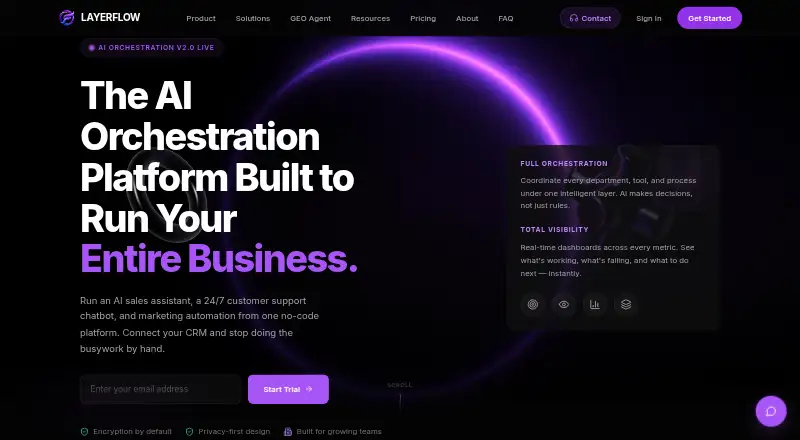
LayerFlow is an AI orchestration platform for automating business workflows with agents. Its specialized agents support sales, marketing, customer support, and custom workflows. Rather than relying only on fixed if/then rules, LayerFlow says workflows can assess context, reason, and adapt. The platform includes real-time dashboards, automated insights, anomaly detection, and reporting. Connections use REST APIs, webhooks, and scoped connectors for CRM, help desk, email, chat, and analytics tools; the maker does not promise a fixed catalog of pre-built apps for every tool. Listed safeguards include encryption in transit and at rest, role-based access, audit-friendly logs, and privacy-minded defaults. Enterprise deployments add support for SSO/SCIM, custom AI models, dedicated infrastructure, and SLA-backed uptime guarantees. Standard agents can be configured in hours; custom solutions typically take 1–2 weeks depending on complexity. Optional on-premise deployment is available.
Good
- Free plan and free trial available
- Agents cover sales, marketing, and support
- Dashboards include insights and anomaly detection
- Optional on-premise deployment is available
Watch out
- Connectors are scoped during setup
- Custom solutions typically take 1–2 weeks
Who it suits
It suits businesses, including small and mid-sized companies, seeking AI agents for sales, marketing, customer support, or custom workflows. Enterprise teams may value its deployment and security options.
Verdict
LayerFlow combines workflow agents with analytics and scoped integrations for business use. Consider the connector setup and paid-plan starting price when assessing fit.
Plans and prices
From LayerFlow's own pricing page, checked 4 Oct 2026.
| Plan | Price | What it gives you |
|---|---|---|
| Free | Free | Free to start · no credit card required |
| Paid plans | $49 a month | Enterprise pricing available for teams with 100+ users · Paid plans start at $49/month |
| Starting paid plan | $49 a month | Paid plans start at this amount; enterprise pricing is available for teams with 100+ users |
| Sales Agent | Priced on request | Lead qualification and scoring · automated follow-ups · CRM synchronization · pipeline analytics · meeting scheduling |
| Marketing Agent | Priced on request | Campaign automation · content scheduling · audience segmentation · performance analytics · A/B testing |
| Customer Agent | Priced on request | Always-on AI triage · knowledge-base integration · smart escalation · satisfaction tracking · multichannel support |
| Custom Agent | Priced on request | Custom workflows · API integrations · custom AI models · implementation help · scoped support access |
The facts
Each one read from LayerFlow's own pages, with the date it was checked.
What it does
- Agents
- Its specialized agents support sales, marketing, customer support, and custom workflows.checked 4 Oct 2026
- AI agents
- The platform offers specialized sales, marketing, customer-support, lead-generation and custom agents.checked 15 Oct 2026
- Analytics
- LayerFlow advertises real-time dashboards, forecasting, anomaly detection, automated reports and AI-generated insights.checked 15 Oct 2026
- API
- The resources page describes a REST API v3 with 50 endpoints and an OpenAPI 3.0 specification.checked 15 Oct 2026
- Business results claim
- LayerFlow says it has helped businesses in eight countries automate more than 10,000 hours of repetitive work.checked 15 Oct 2026
- Customer support
- The customer agent performs ticket triage, uses a knowledge base, escalates complex cases and tracks satisfaction across channels.checked 15 Oct 2026
- Deployment
- The about page says optional on-premise deployment is available.checked 4 Oct 2026
- Documentation
- LayerFlow advertises 84 documentation articles, 62 tutorials, 85 videos, 120 templates, 28 playbooks and 16 case stories.checked 15 Oct 2026
- Enterprise security
- Enterprise deployments may include SSO or SCIM, dedicated infrastructure, multitenant architecture and SLA-backed uptime guarantees.checked 15 Oct 2026
- Implementation time
- The FAQ says standard agents can be configured in hours, custom solutions usually take one to two weeks, and enterprise deployments two to four weeks.checked 15 Oct 2026
- Independent social presence
- A LinkedIn page named LayerFlow Solutions says it is building AI workflows spanning ideation, design, development, quality assurance, deployment and analytics.checked 15 Oct 2026
- Integration limitation
- The company says integrations are scoped during setup and does not publish a fixed catalog of native apps for every product.checked 15 Oct 2026
- Integrations
- Integrations are delivered through REST APIs, webhooks and scoped connectors for CRM, help-desk, email, chat and analytics systems.checked 15 Oct 2026
- Integration scope
- The maker says integrations are scoped during setup and does not claim a fixed list of 50+ pre-built native apps for every tool.checked 4 Oct 2026
- Intended users
- LayerFlow says it builds pre-built, customizable AI agents for businesses, including small and mid-sized businesses.checked 4 Oct 2026
- Knowledge engine
- The product page describes document indexing, retrieval-augmented search, vector search and institutional memory.checked 15 Oct 2026
- Marketing automation
- The marketing agent automates campaigns, schedules content, segments audiences, measures performance and supports A/B testing.checked 15 Oct 2026
- Name collision
- GitHub hosts a separate LayerFlow research repository for layer-aware video generation from the University of Hong Kong and Alibaba's DAMO Academy.checked 15 Oct 2026
- Name-collision activity
- The unrelated GitHub repository shows 98 stars, five forks and 20 commits.checked 15 Oct 2026
Where it runs
- App-store mismatch
- Apple lists a different LayerFlow education app by Manuel Schaer with a 5.0 out of 5 rating from one rating; the listing is not identified as the layerflow.org business platform.checked 15 Oct 2026
The company
- Company founding
- The maker says LayerFlow was founded in 2024 by engineers with Fortune 500 AI experience.checked 15 Oct 2026
- Company leadership
- The About page identifies Muzamil as founder and CEO, alongside engineering, AI-specialist and automation-lead roles.checked 15 Oct 2026
- Founded
- 2024checked 28 Sep 2026
- Independent company-data mismatch
- Crunchbase's LayerFlow profile describes a different Australian web-design and IT business, so it does not verify the AI company at layerflow.org.checked 15 Oct 2026
The full review of LayerFlow
LayerFlow is a business AI orchestration platform for teams automating workflows across sales, marketing, and customer support. It is best suited to small and mid-sized businesses that want configurable agents alongside analytics. Its adaptive approach is appealing, but connector scoping and a $49/month paid starting point deserve close consideration.
Overview
LayerFlow’s agents are designed to evaluate context and adjust their actions, rather than rely solely on fixed if/then rules. That flexibility can suit variable business processes, while teams that need tightly predictable steps may prefer more conventional automation. Real-time dashboards, automated insights, anomaly detection, and reporting provide ways to monitor activity and surface irregularities.
Key features
- Specialized agents: Pre-built, customizable agents address sales, marketing, and customer support, with custom workflows for other business needs.
- Adaptive workflows: Agents assess context and reason as a workflow runs. This can accommodate changing inputs, though businesses should consider whether that flexibility fits the level of control their processes require.
- Analytics: Live dashboards, automated insights, anomaly detection, and reporting help teams follow workflow activity and identify exceptions.
- Integrations: REST APIs, webhooks, and scoped connectors cover CRM, help desk, email, chat, and analytics tools. Connector scope is settled during setup; teams should confirm their specific tools and requirements before committing rather than assume a broad fixed catalog.
- Security and deployment: LayerFlow lists encryption in transit and at rest, role-based access, audit-friendly logs, and privacy-minded defaults. Optional on-premise deployment is available. Enterprise deployments add SSO/SCIM, custom AI models, dedicated infrastructure, and SLA-backed uptime guarantees.
- Setup and support: Standard agents can be configured in hours, while custom solutions typically take 1–2 weeks depending on complexity. Email support aims to respond within one business day; closer engineering access may be included for custom projects by agreement.
Pricing
LayerFlow uses a freemium model and offers a free trial. The free plan costs nothing, is free to start, and requires no credit card.
Paid plans start at $49 a month, billed monthly. Enterprise pricing is available for teams with 100+ users. The lack of plan-level limits makes it important to clarify costs and capacity against the team’s use case before moving beyond the free tier.
Platforms
LayerFlow supports Android, iOS, web, API, and self-hosted deployments. That range suits teams that need mobile access, programmatic integration, or a self-managed deployment option alongside web use.
Who it's for
LayerFlow is a reasonable fit for small and mid-sized businesses seeking configurable AI agents for business workflows, particularly where processes vary and teams want analytics in the same platform. It is less compelling for buyers who require a clearly defined native connector catalog, firm plan quotas before evaluation, or strictly deterministic workflow behavior.
Pros and cons
Pros
- Broad workflow scope: Agents target sales, marketing, support, and custom processes, giving businesses room to address more than one function.
- Monitoring features: Dashboards, insights, anomaly detection, and reporting help teams keep watch on workflow activity.
- Deployment and enterprise options: Self-hosting and optional on-premise deployment, plus enterprise SSO/SCIM and dedicated infrastructure, suit organizations with specific deployment or security needs.
- Accessible starting point: A no-card free plan lets teams begin without an initial charge.
Cons
- Connector fit needs confirmation: Integrations are scoped during setup, so teams cannot assume every desired tool is covered by a fixed native-app catalog.
- Paid-plan details are thin: The $49/month starting point is clear, but plan-specific seats and quotas are not, complicating cost assessment.
- Custom work takes longer: Custom solutions typically require 1–2 weeks, which is a longer path than configuring standard agents in hours.
Alternatives
For a broader set of lead-generation options, see AI Lead Generation Software.
- Clay may suit teams focused on lead enrichment; its free plan includes 500 actions per month and 100 data credits per month.
- Apollo is worth considering for prospecting workflows: its free plan includes 900 credits per seat per year, granted monthly, plus two sequences, API access, and one intent topic.
- Koala may be a better match for teams wanting a free trial of all features, with two seats and 100 credits per month on its free plan.
- Leadfeeder offers a visitor-focused alternative, with its free Lite plan including seven days of visitor history and up to 100 identified companies per month.
- Lusha may suit a single-seat user seeking a permanent free option; its plan includes 40 credits per month.
- Persana AI offers a free plan with 50 credits, 50 emails, five phones, and searches for up to 500 people per company.
- QuickOn may fit a simpler lead-capture use case: its free plan provides 100 leads per month, one lead source plus a JavaScript widget, and one project.
- Surfe is another freemium alternative for teams evaluating lead data tools.
Verdict
Choose LayerFlow if your business wants configurable agents that can adapt to workflow context, with analytics and deployment options in the same platform. Its strongest case is breadth across business functions; look elsewhere if you need connector coverage, paid-plan limits, and costs fully pinned down before you start.
Getting started
- Visit the LayerFlow website.
- Start with the free plan without providing a credit card, or choose a paid plan starting at $49.00 per month.
- Scope the required integrations during setup.
- Configure standard agents, which may take hours, or custom solutions, which typically take 1–2 weeks depending on complexity.
- For an enterprise deployment, discuss SSO/SCIM, custom AI models, dedicated infrastructure, or optional on-premise deployment.
Limits worth knowing
The free plan is free to start and requires no credit card. Paid plans start at $49.00 per month; enterprise pricing is available for teams with 100+ users.
Questions
Is there a free plan?
Yes. The Free plan costs $0.00 and requires no credit card.
What do paid plans cost?
Enterprise pricing is available for teams with 100+ users.
What kinds of workflows can its agents handle?
Specialized agents support sales, marketing, customer support, and custom workflows.
How does LayerFlow connect to other tools?
It supports REST APIs, webhooks, and scoped connectors for CRM, help desk, email, chat, and analytics tools. Integrations are scoped during setup.
Can LayerFlow be deployed on-premise?
Optional on-premise deployment is available. Enterprise deployments also support SSO/SCIM, custom AI models, dedicated infrastructure, and SLA-backed uptime guarantees.
How long does setup take, and what support is offered?
Standard agents can be configured in hours; custom solutions typically take 1–2 weeks depending on complexity. Email support aims to reply within one business day, and closer engineering access may be included for custom projects as agreed.
Alternatives to LayerFlow
- 1
Factors.ai
Free planWebAPI7.7From $199 a month - 2
Chili Piper
AndroidiOSWebAPI7.6From $12 a month - 3

Leadfeeder
Free planWebAPIExtension7.6From €79 a month - 4

Surfe
Free planWebAPIExtension7.5From $39 a month - 5

Apollo
Free planWebAPIExtension7.2From $49 a month - 6

Clay
Free planWebLinuxmacOS7.2From $167 a month