
Kusion
Kusion is a free, open-source platform orchestrator designed for the core of an internal developer platform.
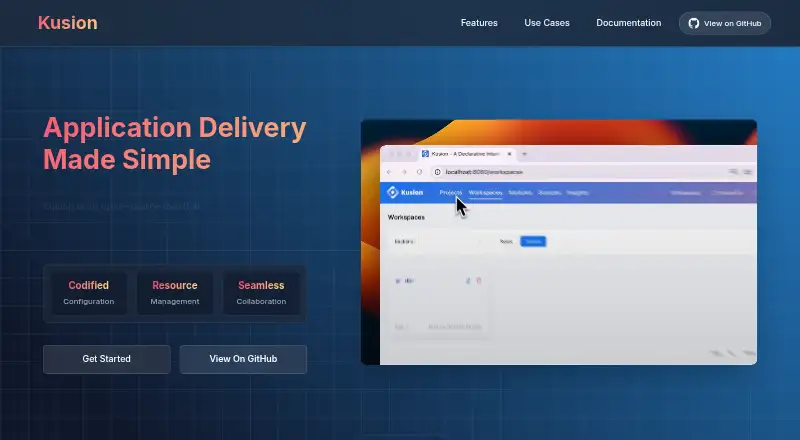
What Kusion is
Kusion is a free, open-source platform orchestrator designed for the core of an internal developer platform. Its AppConfiguration specification lets developers describe application workloads and their resource dependencies without putting environment-specific values in the definition. The model combines workloads, accessories, pipelines and dependencies in a declarative format independent of infrastructure. Kusion’s workflow proceeds through Write, Generate and Apply, with a three-way diff preview before applying changes. It currently applies operations to Kubernetes, Terraform and on-premises infrastructure. Platform engineers can create reusable modules to standardize deployments and support developer self-service. The built-in delivery pipeline can be extended with plugin steps managed by platform owners. The project describes security and compliance support through base models, policy-as-code guardrails and automatic injection of accessory secrets into workloads. External secret-store guides cover AWS, Alibaba Cloud and Viettel Cloud. Kusion is described as a lightweight client-side solution with APIs for integration and automation. CLI installation methods are listed for macOS, Linux and Windows. The project calls itself early and rapidly iterated; support is available through Slack or GitHub issues.
Good
- AppConfiguration separates workload definitions from environment values.
- A three-way diff preview precedes applying changes.
- Reusable modules support standardized deployments and self-service.
- Supports Kubernetes, Terraform and on-premises infrastructure.
- CLI installation methods cover macOS, Linux and Windows.
Watch out
- The project describes itself as early and rapidly iterated.
- The documented workflow supports three infrastructure categories.
Who it suits
Kusion is intended for application developers and platform engineers maintaining application infrastructure. It may suit teams seeking reusable deployment modules and a declarative workflow across Kubernetes, Terraform and on-premises environments.
Verdict
Kusion combines declarative application configuration, reusable modules and a preview-before-apply workflow. Its own project overview describes it as early, so teams should consider that status when evaluating it.
Plans and prices
From Kusion's own pricing page, checked 4 Oct 2026.
| Plan | Price | What it gives you |
|---|---|---|
| Kusion | Free | Open source platform orchestrator · project page provides a Helm installation command |
The facts
Each one read from Kusion's own pages, with the date it was checked.
Where it runs
- Application specification
- AppConfiguration lets developers describe an application workload and its resource dependencies without supplying environment-specific values.checked 4 Oct 2026
What it does
- Cloud secret integrations
- The secrets guide documents external secret-store support for AWS, Alibaba Cloud, and Viettel Cloud.checked 4 Oct 2026
- Configuration model
- AppConfiguration brings workload, accessory, pipeline, and dependency concepts together in an infrastructure-independent declarative specification.checked 4 Oct 2026
- Extensibility
- Kusion describes itself as a lightweight, pure client-side solution with APIs for integration and automation and an expanding model ecosystem.checked 4 Oct 2026
- Installation
- The Kusion CLI installation page lists macOS, Linux, and Windows installation methods.checked 4 Oct 2026
- Intended users
- Kusion is intended to help application developers and platform engineers who maintain application infrastructure.checked 4 Oct 2026
- Pipeline customization
- Kusion provides a built-in delivery pipeline and supports customized pipeline steps implemented as plugins managed by platform owners.checked 4 Oct 2026
- Product
- Kusion describes itself as an intent-driven platform orchestrator at the core of an internal developer platform.checked 4 Oct 2026
- Project status
- The project overview calls Kusion an early project that is being iterated on quickly.checked 4 Oct 2026
- Reusable modules
- Kusion modules are reusable building blocks made by platform engineers to standardize deployments and enable developer self-service.checked 4 Oct 2026
- Security
- The overview describes built-in security and compliance support through base models, third-party policy-as-code guardrails, and automatic injection of accessory resource secrets into workloads.checked 4 Oct 2026
- Support
- The documentation directs users to Slack or GitHub issues for help and feedback.checked 4 Oct 2026
- Supported infrastructure
- The overview says Kusion currently applies operations to Kubernetes, Terraform, and on-premises infrastructures.checked 4 Oct 2026
- Workflow
- The documented workflow has Write, Generate, and Apply steps, with a three-way diff preview before changes are applied.checked 4 Oct 2026
The company
- Founded
- 2020checked 28 Sep 2026
The full review of Kusion
Kusion is an open-source platform orchestrator for teams building an internal developer platform. It suits platform engineers who standardize infrastructure and application developers who need a controlled self-service path. The strongest reason to choose it is its shared declarative model with reviewable changes; teams wanting a mature, narrowly focused infrastructure-as-code tool may prefer an alternative.
Overview
Kusion's AppConfiguration lets developers define an application workload and its resource dependencies without entering environment-specific values in each project. Workloads, accessories, delivery pipelines, and dependencies are represented together in an infrastructure-independent declaration. This separation can reduce duplicated configuration, provided platform engineers maintain useful modules and models for the organization.
The workflow is Write, Generate, then Apply, with a three-way diff preview before execution. That makes proposed changes visible before they reach infrastructure and gives teams a defined review point. Kusion currently applies operations to Kubernetes, Terraform, and on-premises infrastructure, with support for AWS, AliCloud, Azure, and Google Cloud. It can also run self-hosted, which fits organizations that need execution under their own control.
Key features
Reusable modules and pipelines
Platform engineers create reusable Kusion modules as standardized deployment building blocks. Developers can consume those patterns rather than assembling every infrastructure detail themselves, making Kusion a better fit for centralized platform teams than for isolated personal projects. A built-in delivery pipeline covers the standard path, while platform owners can add customized steps through plugins. That extension point preserves organizational control, but it also makes the platform team's design and maintenance work central to the result.
Declarative workflow and guardrails
The Write-Generate-Apply sequence and three-way diff put a concrete checkpoint before infrastructure changes. Kusion also describes security and compliance support through base models, third-party policy-as-code guardrails, and automatic injection of accessory resource secrets into workloads. External secret-store integrations are documented for AWS, Alibaba Cloud, and Viettel Cloud, useful where credentials must remain in a managed secret service rather than application configuration.
Client-side extensibility
Kusion presents itself as a lightweight, pure client-side solution with APIs for integration and automation and an expanding model ecosystem. That approach can simplify embedding Kusion in existing tooling and automation, while leaving teams responsible for the surrounding delivery and operational setup.
Pricing
Kusion costs nothing under its open-source plan. The Kusion plan is an open-source platform orchestrator, and the project page provides a Helm installation command. There are no paid tiers or seat quotas described, so it is a practical option for teams evaluating a platform orchestrator without a software license charge. Infrastructure and cloud-service costs remain separate from the tool itself.
Platforms
Kusion is available through API, Linux, macOS, self-hosted, web, and Windows environments. The CLI installation documentation covers macOS, Linux, and Windows. Self-hosted execution and client-side APIs suit organizations that want to integrate orchestration into their own platform rather than depend on a hosted control plane.
Who it's for
Kusion is aimed at application developers and platform engineers maintaining application infrastructure. It is particularly appropriate when a platform team needs reusable deployment modules, centralized pipeline customization, and a common application specification across Kubernetes, Terraform, or on-premises targets. It is less compelling for a team seeking only a conventional infrastructure-as-code language with minimal platform-layer design, or for organizations unwilling to accommodate an early, rapidly iterated project.
Pros and cons
- Pros: AppConfiguration keeps workload and dependency intent separate from environment-specific values, reducing repetition across deployments.
- Pros: Reusable modules and plugin-based pipeline steps let platform owners standardize delivery while enabling developer self-service.
- Pros: Three-way diff preview provides a reviewable checkpoint before Apply.
- Pros: Open-source licensing, self-hosted execution, APIs, and integrations spanning Kubernetes, Terraform, on-premises infrastructure, and four named clouds provide deployment flexibility.
- Cons: Kusion's early project status introduces adoption and ecosystem risk for teams choosing long-lived infrastructure foundations.
- Cons: The model depends on platform engineers building and maintaining modules, policies, plugins, and base models; without that investment, the self-service benefit is limited.
Alternatives
For a broader survey of infrastructure tooling, see Infrastructure as Code Tools.
- Terraform is the better choice when you want a freemium service with a free tier capped at 500 managed resources, one concurrent remote run, and one concurrent agent run.
- Pulumi fits teams preferring a freemium platform whose free plan includes one user, unlimited projects, stacks, and environments, and unlimited updates and history.
- AWS CloudFormation is the direct option for AWS-centered deployments; CloudFormation itself is free, while deployed AWS resources are billed separately.
- Cloudify suits teams wanting a no-time-limit community plan that requires Docker or a VM and access to a cloud provider.
- Terramate is preferable when a free Community plan's limits of two users, 1,000 resources, and 30-day data retention match your needs.
- Terragrunt is an alternative with a free plan supporting up to 25 infrastructure units and unlimited runs.
- AWS CDK is the no-charge choice for defining AWS deployments, with AWS resource charges still applying.
- OpenTofu is the straightforward free, open-source infrastructure-as-code alternative.
Verdict
Choose Kusion if you are building an internal developer platform and want reusable, centrally governed application configuration with a preview before changes apply. Its open-source, self-hosted model and cross-infrastructure scope are strong advantages. Look elsewhere if project maturity is a decisive requirement or if you need a simpler, established infrastructure-as-code tool without the platform engineering investment.
Alternatives to Kusion
- 1

Cloudify
Free planOpen sourceWebAPILinuxmacOS8.4From $395 a month - 2

Terraform
Free planWebAPILinuxmacOS8.0Free plan - 3

Terramate
Free planOpen sourceWebAPIExtensionLinux8.0From $449 a month - 4

AWS CloudFormation
Free planiOSWebAPILinux7.7Free plan - 5

Pulumi
Free planWebAPILinuxmacOS7.4From $40 a month - 6

Oracle Cloud Infrastructure Container Registry
Free planWebAPILinux7.0Free plan