
AWS CloudFormation
AWS CloudFormation models, provisions, and manages related AWS and third-party resources as infrastructure as code.
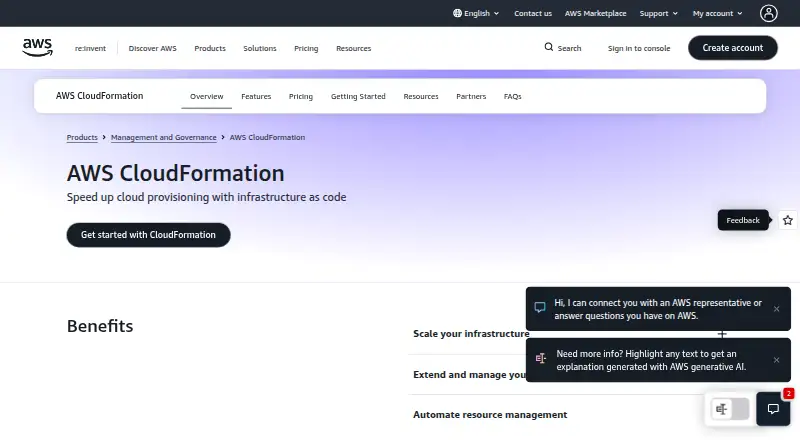
What AWS CloudFormation is
AWS CloudFormation models, provisions, and manages related AWS and third-party resources as infrastructure as code. You describe AWS resources and their properties in YAML or JSON templates, then use those templates to manage stacks. Change Sets preview proposed changes, including possible resource deletion or replacement, and Drift Detection identifies changes made outside CloudFormation. StackSets provision a common set of resources across multiple AWS accounts and Regions. Authoring options include AWS CDK, which supports TypeScript, Python, Java, and .NET, and AWS SAM, whose shorthand YAML for serverless resources is converted to CloudFormation syntax during deployment. The Registry supports third-party resources and modules, and stacks can be updated from remote Git repositories. IAM can control access, while CloudTrail logs API calls. CloudFormation data is encrypted at rest and service communications use encrypted channels; AWS recommends TLS 1.3 and requires TLS 1.2. The service itself has a free plan, but AWS resources created through it are billed at their standard rates. Third-party provider and custom hook operations may also incur charges.
Good
- Templates use YAML or JSON.
- Change Sets preview possible deletions or replacements.
- StackSets deploy across accounts and Regions.
- Drift Detection tracks outside changes.
- CDK supports four listed programming language options.
Watch out
- Created AWS resources incur standard charges.
- Third-party provider and custom hook operations may incur charges.
- TLS 1.2 is required; AWS recommends TLS 1.3.
Who it suits
It suits teams managing AWS infrastructure as code, from individual instances to complex multi-Region applications, and automating infrastructure templates in CI/CD workflows. It can also suit users who need cross-account deployments or previews of proposed stack changes.
Verdict
CloudFormation brings template-based provisioning, change previews, drift tracking, and multi-account deployments together for AWS resources. The service itself is free for AWS and Alexa resource providers, but the resources it creates and some other operations may be billed.
Plans and prices
From AWS CloudFormation's own pricing page, checked 30 Sep 2026.
| Plan | Price | What it gives you |
|---|---|---|
| AWS CloudFormation | Free | Free service for CloudFormation itself; underlying AWS resources are billed at their own rates. Third-party provider and custom hook operations may incur charges; first 1,000 operations are included in the Free Tier, and the first 30 seconds of each operation have no additional charge. |
| CloudFormation service | Free | No minimum fees · No upfront commitments · No additional CloudFormation charge for AWS::* and Alexa::* resource types; pay for provisioned AWS resources |
| Third-party resource providers | Free | First 30 seconds per operation free · Free tier includes hook and third-party provider operations · per second above 30 seconds of handler-operation duration |
The facts
Each one read from AWS CloudFormation's own pages, with the date it was checked.
What it does
- Access and audit
- AWS documents using IAM to control CloudFormation access and CloudTrail to log API calls.checked 30 Sep 2026
- API documentation
- AWS publishes detailed API operation descriptions with sample requests, responses, and errors.checked 20 Oct 2026
- Authoring options
- AWS CDK supports defining cloud environments with TypeScript, Python, Java, and .NET, and provisions through CloudFormation.checked 30 Sep 2026
- Automatic rollback
- CloudFormation can automatically roll a deployment back to the last known good state when errors occur.checked 20 Oct 2026
- Change previews
- Change Sets let users preview proposed stack changes, including whether resources may be deleted or replaced, before execution.checked 30 Sep 2026
- Change Sets
- Change Sets preview proposed stack changes before execution, including possible resource replacement or deletion.checked 20 Oct 2026
- CodePipeline integration
- CodePipeline can create, update, replace, and delete CloudFormation stacks or change sets during pipeline runs.checked 20 Oct 2026
- Development workflow
- CloudFormation supports updating a stack from a template in a remote Git repository.checked 30 Sep 2026
- Documentation breadth
- The documentation set includes user, template-reference, CLI, API, Hooks, Guard, and CloudFormation CLI guides.checked 20 Oct 2026
- Drift detection
- Drift detection compares supported resource properties with template expectations to identify out-of-band changes.checked 20 Oct 2026
- Extension toolkit
- The CloudFormation CLI toolkit lets developers build custom resource providers and modules.checked 20 Oct 2026
- Getting started
- Users can start from the AWS console with an example template; the service itself is free while included AWS resources incur their normal charges.checked 20 Oct 2026
- Hook and policy tooling
- Official documentation includes CloudFormation Hooks and the open-source Guard policy-as-code tool.checked 20 Oct 2026
- Interfaces
- CloudFormation is available through the AWS Management Console, API, AWS CLI, and AWS SDKs.checked 20 Oct 2026
- Limit: debugging
- Reviewers report vague error messages and difficult troubleshooting of failed or complex stacks.checked 20 Oct 2026
- Limit: learning curve
- G2 and Capterra reviewers describe template syntax and initial setup as difficult for beginners.checked 20 Oct 2026
- Limit: multi-cloud scope
- TrustRadius reviewers say CloudFormation is less suitable for hybrid or multi-cloud infrastructure than cloud-agnostic tools.checked 20 Oct 2026
- Limit: slow or fragile operations
- TrustRadius reviewers report slow creates or deletes, difficult dependent-resource removal, and failures in nested stacks.checked 20 Oct 2026
- Multi-account deployments
- StackSets provision a common set of AWS resources across multiple accounts and Regions from one template.checked 30 Sep 2026
Money
- Cost limitation
- There is no additional CloudFormation charge for AWS::* and Alexa::* resource providers, though the AWS resources created are billed at their standard rates.checked 30 Sep 2026
The company
- Founded
- 2006checked 28 Sep 2026
- Maker company facts
- LinkedIn lists Amazon Web Services as a public company headquartered in Seattle, founded in 2006, with 10,001+ employees.checked 20 Oct 2026
- Maker legal name
- AWS site terms identify the provider as Amazon Web Services, Inc. and/or its affiliates.checked 20 Oct 2026
- Maker ownership
- AWS states that Amazon Web Services operates as part of Amazon.checked 20 Oct 2026
The full review of AWS CloudFormation
AWS CloudFormation is an infrastructure-as-code service for defining and managing related AWS resources. It is best suited to teams standardizing deployments within AWS, from individual stacks to multi-account environments. Its AWS-specific focus is a clear advantage for AWS estates and a poor fit for teams seeking a common provisioning tool across clouds.
Overview
CloudFormation groups related resources into stacks described by templates, letting teams provision and manage infrastructure through repeatable definitions rather than resource-by-resource setup. It supports use cases from a single EC2 instance to complex multi-Region applications, including CI/CD automation. Managed state, resource import, policy as code, and self-hosted execution make it useful across different operating models, but its supported cloud is AWS.
CloudFormation itself is free for AWS and Alexa resource providers; the resources it creates are billed at their standard AWS rates. Third-party provider and custom hook operations may also incur charges, so a free service does not mean a free deployment.
Key features
Templates and authoring choices
Templates describe AWS resources and their properties in YAML or JSON. Teams that prefer programming languages can define environments with AWS CDK in TypeScript, Python, Java, or .NET, with deployment still passing through CloudFormation. AWS SAM provides a shorter YAML form for serverless functions, APIs, databases, and event source mappings, transforming it into CloudFormation syntax during deployment. These options accommodate different authoring preferences while keeping provisioning within the same AWS service.
Safer updates and drift visibility
Change Sets preview proposed stack changes and flag resources that may be deleted or replaced before execution. That makes potentially disruptive updates easier to assess, though teams still need to judge whether the proposed changes are acceptable. Drift Detection tracks changes made outside CloudFormation, helping teams find when actual resources diverge from the managed definition.
Multi-account and third-party resources
StackSets deploy a common set of AWS resources across multiple accounts and Regions from one template, which is useful when environments need consistent baselines. The CloudFormation Registry extends the model to third-party resources and modules, with examples including MongoDB, Datadog, Atlassian Opsgenie, JFrog, and Splunk. Stacks can also be updated from templates in a remote Git repository, supporting repository-based workflows.
Security and governance
CloudFormation data is encrypted at rest and service communications use encrypted channels; AWS recommends TLS 1.3 and requires TLS 1.2. IAM can control access to the service, while CloudTrail logs API calls. These controls give AWS administrators familiar ways to manage access and audit activity, rather than a separate security model.
Pricing
AWS CloudFormation
The AWS CloudFormation plan costs nothing. There is no CloudFormation charge for AWS and Alexa resource providers, but created AWS resources still carry their standard charges. Third-party provider and custom hook operations may be billable; the first 1,000 operations are included in the Free Tier, and the first 30 seconds of each operation have no additional charge. There is no free trial. This pricing suits teams that want CloudFormation's core provisioning workflow without a separate service fee, provided they budget for infrastructure and any chargeable operations.
Platforms
CloudFormation is available through API and web, with support for Linux, macOS, and Windows. Its configuration languages are YAML and JSON, and it supports AWS rather than other clouds.
Who it's for
CloudFormation is a strong fit for teams already building on AWS that need repeatable infrastructure, controlled stack updates, or consistent deployments across accounts and Regions. CI/CD teams can use templates to automate infrastructure changes, while administrators can combine IAM access control and CloudTrail logging with stack management. Organizations that need to provision resources across multiple cloud providers should choose a tool with broader cloud support.
Pros and cons
- Pros: Change Sets identify possible deletion or replacement before execution, giving teams a chance to assess risky stack updates.
- Pros: StackSets deploy one common resource set across accounts and Regions, reducing the need to manage each deployment independently.
- Pros: CDK, SAM, YAML, and JSON provide different authoring paths while retaining CloudFormation deployment.
- Pros: The service has no charge for AWS and Alexa resource providers, although infrastructure and some operations remain billable.
- Cons: CloudFormation supports AWS, not a multi-cloud estate, limiting its role for teams standardizing across providers.
- Cons: Created resources incur standard AWS charges, and third-party provider or custom hook operations may add costs.
Alternatives
For adjacent infrastructure work, consider these related tools and categories:
- Conftest is a free option for readers considering a policy-focused tool; CloudFormation is the better fit when the need is AWS resource provisioning and stack management.
- Test Kitchen is a free option for readers considering a testing tool; CloudFormation is the choice for defining and deploying AWS resources.
- cfn-lint is a free, MIT-0 licensed option supporting Python 3.10–3.14; choose it when a free tool is preferable, and CloudFormation when the goal is provisioning AWS resources.
- Chef InSpec has a free plan limited to non-production workloads and personal, non-commercial use, plus a 30-day free trial; consider it when those terms suit the intended workload.
- Cinc Auditor is a free distribution of Chef InSpec without formal warranties or support; consider it if that distribution suits your requirements.
- kubeconform is free with no paid plans or usage limits stated on its official site; consider it as a free alternative.
- OpenSCAP offers free, open-source tools; consider it if that is the kind of tool you need.
- TFLint is a free, open-source command-line Terraform linter; consider it when a Terraform linter is the requirement.
- Infrastructure Testing Tools may help readers comparing options for infrastructure testing.
- Infrastructure as Code Tools may help readers comparing infrastructure-as-code options.
- Infrastructure Policy as Code Tools may help readers comparing policy-as-code software.
- Cloud Orchestration Software may help readers comparing cloud orchestration options.
- IT Configuration Management Software may help readers comparing configuration management tools.
- Infrastructure as Code Security Software may help readers comparing infrastructure security tools.
Verdict
Choose AWS CloudFormation if your team needs managed, repeatable AWS provisioning, especially across stacks, accounts, or Regions. Its previews, drift tracking, and varied authoring options make that AWS workflow coherent, while the service fee is zero for AWS and Alexa providers. Look elsewhere if you need multi-cloud provisioning or if AWS resource and provider-operation costs make the overall deployment unsuitable.
Getting started
- Open the CloudFormation website.
- Describe AWS resources and properties in a YAML or JSON template.
- Use the template to manage a stack.
- Preview proposed updates with a Change Set before execution.
- Use StackSets when provisioning a common resource set across accounts and Regions.
Limits worth knowing
CloudFormation itself has no additional charge for AWS and Alexa resource providers, but created AWS resources are billed at their standard rates. Third-party provider and custom hook operations may incur charges; the first 1,000 operations are included in the Free Tier, and the first 30 seconds of each operation have no additional charge.
Questions
Is AWS CloudFormation free?
CloudFormation is listed as free. There is no additional CloudFormation charge for AWS and Alexa resource providers, but created AWS resources are billed at their standard rates.
Can third-party operations cost extra?
Third-party provider and custom hook operations may incur charges. The first 1,000 operations are included in the Free Tier, and the first 30 seconds of each operation have no additional charge.
What template formats does CloudFormation use?
Templates describe AWS resources and their properties in YAML or JSON.
Can CloudFormation deploy across multiple AWS accounts and Regions?
Yes. StackSets provision a common set of resources across multiple accounts and Regions from one template.
What languages can I use with AWS CDK?
AWS CDK supports TypeScript, Python, Java, and .NET, and provisions cloud environments through CloudFormation.
How are access and API activity handled?
AWS documents IAM for controlling CloudFormation access and CloudTrail for logging API calls. CloudFormation data is encrypted at rest and service communications use encrypted channels.
Alternatives to AWS CloudFormation
- 1
Chef InSpec
Free planOpen sourceAPILinuxmacOSSelf-hosted8.0From $59 a year - 2

CIS-CAT Pro Assessor
Free planAPILinuxmacOSSelf-hosted7.7From $2,400 a year - 3
Test Kitchen
Free planOpen sourceAPILinuxmacOSSelf-hosted7.2Free plan - 4
kube-score
Free planWebLinuxmacOSSelf-hosted7.0Free plan - 5
Conftest
Free planLinuxmacOSWindows6.8Free plan - 6
Kubetest2
Free planOpen sourceAPISelf-hosted6.8Free plan