kube-score
kube-score statically analyzes Kubernetes object definitions and recommends changes intended to improve application security and resilience.
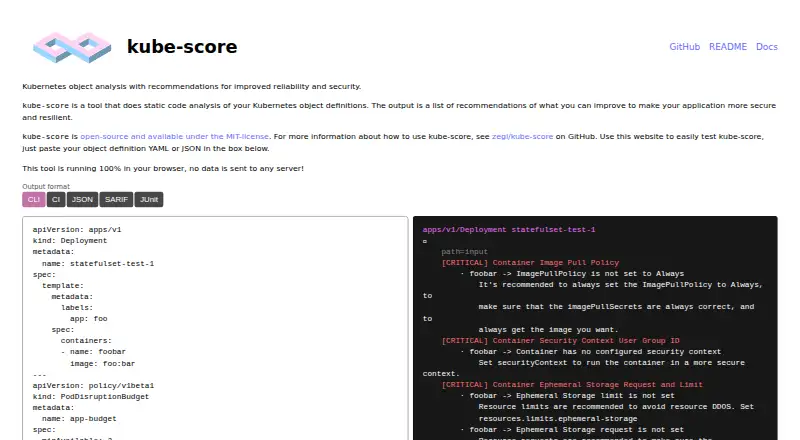
What kube-score is
kube-score statically analyzes Kubernetes object definitions and recommends changes intended to improve application security and resilience. Its checks cover container limits, NetworkPolicy targeting, PodDisruptionBudget, Pod anti-affinity, container probes, security context, and stable APIs. Optional checks include matching resource requests and limits, container ports, and seccomp profile configuration. Users can ignore tests or enable optional ones globally or for individual objects. Results can be produced in human-readable, JSON, CI, or SARIF formats. kube-score can run in CI/CD: critical errors return exit code 1, and warnings can be selected as the exit threshold. The documentation shows workflows with Helm, Kustomize, static YAML files, Docker, and resources retrieved from a Kubernetes cluster. Its online demo accepts Kubernetes YAML or JSON and runs in the browser without sending data to a server. For local use, prebuilt binaries are listed for Linux, macOS, and Windows; Docker, Homebrew, and Kubernetes Krew are also installation options. The project is free and MIT-licensed. The documentation recommends including all applications deployed to the same namespace for the best results, while building from source requires Go 1.21 or later.
Good
- Free and open source under the MIT license
- Checks container probes and security context
- Supports human-readable, JSON, CI, and SARIF output
- Can run in CI/CD with configurable exit thresholds
- Browser demo runs without sending data to a server
Watch out
- Best results require including all applications in the same namespace
- Building from source requires Go 1.21 or later
Who it suits
kube-score suits teams reviewing Kubernetes definitions for security and resilience issues, particularly those incorporating checks into CI/CD. It also offers a browser demo for analyzing YAML or JSON without sending it to a server.
Verdict
kube-score offers configurable checks and several output formats for Kubernetes analysis, including CI/CD use. Its documentation recommends analyzing namespace workloads together, a point to consider when preparing input.
Plans and prices
From kube-score's own pricing page, checked 8 Oct 2026.
| Plan | Price | What it gives you |
|---|---|---|
| Free and open source | Free | MIT-licensed tool; no paid plans listed |
The facts
Each one read from kube-score's own pages, with the date it was checked.
What it does
- Analysis input
- The README says results are best when input includes all applications deployed to the same namespace.checked 4 Oct 2026
- Build requirement
- Building from source requires Go 1.21 or later.checked 8 Oct 2026
- Checks
- Default checks include container resource settings, network policies, disruption budgets, probes, security contexts, and stable APIs.checked 8 Oct 2026
- CI use
- kube-score can run in CI/CD and can exit with code 1 when it finds a critical error, or on warnings when configured to do so.checked 8 Oct 2026
- Configuration
- Users can ignore tests globally or per object and enable optional tests globally or per object.checked 4 Oct 2026
- Distribution
- The maker lists Docker, Homebrew, and Kubernetes Krew as installation options.checked 8 Oct 2026
- Install options
- The project provides prebuilt binaries for macOS, Linux, and Windows, plus Docker, Homebrew, and Krew installation options.checked 4 Oct 2026
- Integrations
- The README demonstrates use with Helm, Kustomize, static YAML files, existing clusters, and Docker.checked 4 Oct 2026
- License
- The project is open source under the MIT license.checked 8 Oct 2026
- Open source
- The project is available under the MIT license.checked 4 Oct 2026
- Optional checks
- Optional checks include matching resource requests and limits, container ports, and seccomp profile configuration.checked 8 Oct 2026
- Output formats
- The CLI supports human, JSON, CI, and SARIF output formats.checked 8 Oct 2026
- Purpose
- kube-score statically analyzes Kubernetes object definitions and recommends improvements to security and resilience.checked 8 Oct 2026
- Scope limit
- The documentation recommends analyzing all applications deployed to the same namespace together for the best result.checked 8 Oct 2026
- Workflow integrations
- The documentation shows use with Helm, Kustomize, static YAML files, Docker, and resources retrieved from a Kubernetes cluster.checked 8 Oct 2026
Where it runs
- Browser demo
- The website offers a browser demo for testing kube-score.checked 8 Oct 2026
- Browser privacy
- The maker’s website says the browser tool runs entirely in the browser and sends no data to a server.checked 8 Oct 2026
- Platforms
- The maker lists prebuilt binaries for macOS, Linux, and Windows.checked 8 Oct 2026
- Supported platforms
- Prebuilt binaries are listed for macOS, Linux, and Windows.checked 4 Oct 2026
The full review of kube-score
Overview
kube-score is a free static analyzer for Kubernetes object definitions, built around checks that flag ways to strengthen security and resilience. It suits teams reviewing manifests before deployment, especially those who want to put the checks into a CI/CD workflow.
Its MIT license and configurable checks make it a practical fit for teams that want an adaptable Kubernetes review tool without a paid plan. Its most important constraint is that it gives its best results when related applications in a namespace are analyzed together.
Key features
Checks cover several concrete deployment concerns, including container limits, security context, probes, stable APIs, NetworkPolicy targeting, PodDisruptionBudget and Pod anti-affinity. Optional checks include matching resource requests and limits, container ports and seccomp profile configuration. This breadth makes kube-score useful for catching common configuration weaknesses; teams needing a different policy can ignore tests or enable optional ones globally or per object.
The tool works with Helm, Kustomize, static YAML, Docker and resources retrieved from an existing cluster. In CI/CD, critical errors return exit code 1, and warnings can be chosen as the failure threshold. Human-readable, JSON, CI and SARIF outputs serve different workflows; SARIF is intended to ease integration with CI platforms.
The browser demo accepts YAML or JSON. The maker says it runs entirely in the browser and sends no data to a server, making it a convenient option for inspecting definitions without uploading them to the service. For local or automated use, prebuilt binaries are available for Linux, macOS and Windows, alongside Docker, Homebrew and Kubernetes Krew installation options. Building from source requires Go 1.21 or later.
Analysis quality depends on scope: the project recommends including all applications deployed to the same namespace in the input. A narrow selection may therefore miss context that matters to the results.
Pricing
Free and open source: free. The MIT-licensed tool has no paid plans, so there is no tier that trades away features for a lower price. It is a strong fit for individuals and teams able to install and operate the tool themselves; those seeking a paid service or plan-based support should look elsewhere.
Platforms
kube-score supports Linux, macOS and Windows through prebuilt binaries, as well as Docker and browser-based use. Homebrew and Kubernetes Krew provide additional installation routes. The project is also marked for self-hosted use.
Who it's for
kube-score is best for Kubernetes teams that want configurable manifest checks in development or CI/CD, and can provide workloads together by namespace for analysis. Its open-source distribution and several installation methods suit teams comfortable choosing their own workflow. It is less suitable when the intended review scope is only isolated workloads and cannot include their namespace peers.
Pros and cons
- Pro: Security and resilience checks cover deployment settings such as probes, security context, disruption budgets and network policy targeting.
- Pro: Global or per-object configuration lets teams tune which tests run and which findings to ignore.
- Pro: CI/CD exit behavior and several output formats make results usable in automated workflows as well as direct review.
- Pro: The browser demo is described as processing YAML or JSON entirely in the browser without sending data to a server.
- Con: The recommended namespace-wide input can make preparing a representative analysis more involved than checking one object alone.
- Con: Source builds require Go 1.21 or later, a requirement for users who prefer not to use prebuilt binaries or the listed installers.
Alternatives
Conftest is another free, open-source option for readers comparing infrastructure testing tools; its listed platforms are Linux, macOS and Windows.
AWS CloudFormation is a freemium alternative for readers considering an AWS service; CloudFormation itself is free, while underlying AWS resources are billed at their own rates.
Test Kitchen is a free, open-source alternative for readers looking at infrastructure testing, with Linux, macOS and Windows support.
cfn-lint is a free, MIT-0-licensed alternative for readers evaluating a linter in the infrastructure tooling category; it supports Linux, macOS, self-hosted and Windows use.
Chef InSpec offers a free plan and trial, but its free plan is limited to non-production workloads and personal, non-commercial use.
Cinc Auditor is a free distribution of Chef InSpec for readers who can accept no formal warranties or support.
kubeconform is another free Kubernetes-focused option for readers comparing tools in this area.
OpenSCAP is a free, open-source alternative for readers considering tools in the OpenSCAP project umbrella.
For more options, see Infrastructure Testing Tools and Infrastructure as Code Security Software.
Verdict
Choose kube-score if you want free, configurable Kubernetes checks that can feed into CI/CD and multiple output workflows. Its principal advantage is practical deployment coverage without a paid tier; its main caveat is that useful results call for analyzing namespace workloads together. Look elsewhere if you cannot assemble that broader input for the workloads you need to review.
Getting started
- Open the browser demo and provide Kubernetes YAML or JSON.
- For local use, choose a prebuilt binary for macOS, Linux, or Windows.
- Alternatively, install through Docker, Homebrew, or Kubernetes Krew.
- Use it with Helm, Kustomize, static YAML files, Docker, or resources retrieved from a cluster.
- Configure ignored tests and optional tests globally or per object.
Questions
How much does kube-score cost?
It is free and open source under the MIT license. The listed plan is free.
Is there a free trial?
No. kube-score is free, and no free trial is listed.
Which platforms does it support?
Prebuilt binaries are available for macOS, Linux, and Windows. Docker, Homebrew, Krew, and a browser demo are also available.
Is kube-score open source?
Yes. The project is available under the MIT license.
Can I use it in CI/CD?
Yes. Critical errors return exit code 1, and warnings can be set as the exit threshold. CI and SARIF are among the supported output formats.
Which tools and inputs can it work with?
The documentation shows use with Helm, Kustomize, static YAML files, Docker, and resources retrieved from a Kubernetes cluster. The browser demo accepts Kubernetes YAML or JSON.
Alternatives to kube-score
- 1
Chef InSpec
Free planOpen sourceAPILinuxmacOSSelf-hosted8.0From $59 a year - 2

AWS CloudFormation
Free planiOSWebAPILinux7.7Free plan - 3

CIS-CAT Pro Assessor
Free planAPILinuxmacOSSelf-hosted7.7From $2,400 a year - 4
Test Kitchen
Free planOpen sourceAPILinuxmacOSSelf-hosted7.2Free plan - 5
Conftest
Free planLinuxmacOSWindows6.8Free plan - 6
Kubetest2
Free planOpen sourceAPISelf-hosted6.8Free plan