Chef InSpec
Chef InSpec checks applications and infrastructure against a desired state described in InSpec code.
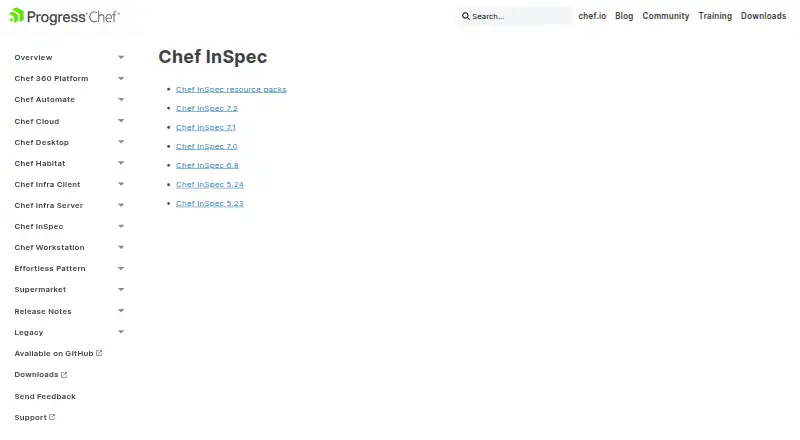
What Chef InSpec is
Chef InSpec checks applications and infrastructure against a desired state described in InSpec code. Its runtime framework and rule language let teams express compliance, security, and policy requirements. Controls can be grouped into reusable profiles with versioning, platform requirements, and dependencies. Resources cover AWS, Azure, AliCloud, and GCP, and users can create their own resources. Checks can run locally or against cloud services and infrastructure, including Linux in Docker containers. Results can be written as JSON, HTML, or plain text, or sent to Chef Automate; the kitchen-inspec verifier also lets profiles run through Test Kitchen. Chef offers premium CIS- and STIG-based profiles. The free plan is for non-production workloads and personal, non-commercial use; a 30-day trial is available for evaluation. InSpec 7 requires EULA acceptance, and license-key requirements depend on the distribution source. Telemetry is enabled for free and trial tiers, but not commercial users.
Good
- Reusable profiles organize versioned controls.
- Tests can target AWS, Azure, AliCloud, and GCP.
- Results support JSON, HTML, and plain text.
- Can run profiles through Test Kitchen.
Watch out
- Free use excludes production workloads.
- Free use is limited to personal, non-commercial use.
- Telemetry is enabled for free and trial tiers.
- InSpec 7 requires EULA acceptance.
Who it suits
It suits teams that need to express compliance or security requirements as code and assess cloud or other infrastructure. The free plan is limited to non-production, personal, non-commercial use.
Verdict
Chef InSpec combines policy-as-code checks with reusable profiles, cloud resources, and several reporting options. Check the usage limits, telemetry terms, and license requirements for the distribution you plan to use.
Plans and prices
From Chef InSpec's own pricing page, checked 14 Oct 2026.
| Plan | Price | What it gives you |
|---|---|---|
| Free | Free | Personal/non-commercial use · Scan up to 10 targets · Unlimited duration |
| Trial | Free | Trial users may scan unlimited targets for 30 days · 30 days |
| Business | $59 a year | Node management · Job orchestration · Configuration management · Standard support · 10 pooled monthly jobs per node · 10 concurrent jobs · 30-day data/log retention · per node, per year |
| Enterprise | $189 a year | Business features · Desktop management · Compliance audit · Standard support · 10 pooled monthly jobs per node · 10 concurrent jobs · 30-day data/log retention · per node, per year |
| Commercial | Priced on request | Renewable · production and non-production workloads · entitlements based on purchase order |
| Enterprise Plus | Priced on request | Continuous compliance · Cloud security posture management · Application delivery · Premium support · 50 concurrent jobs · Up to 60-day retention with dedicated instance · Contact us for a customized quote |
The facts
Each one read from Chef InSpec's own pages, with the date it was checked.
What it does
- Acquisition
- Progress announced completion of its Chef Software acquisition on October 6, 2020, paying $220 million in cash.checked 14 Oct 2026
- Automate API integration
- The Automate reporter sends results to a data-collector URL using an Automate API token and node identity fields.checked 14 Oct 2026
- Cloud coverage
- Official resources target AWS, Azure, Alibaba Cloud and Google Cloud Platform services.checked 14 Oct 2026
- Compliance as code
- InSpec is a runtime framework and rule language for specifying compliance, security, and policy requirements.checked 29 Sep 2026
- Controls
- A control represents a regulatory recommendation or system-state requirement, and profiles can contain many controls.checked 14 Oct 2026
- Custom resources
- Users can create custom resources when the built-in resource collection does not cover a required test.checked 14 Oct 2026
- Documentation depth
- The documentation includes installation, supported platforms, profiles, resource packs, reporters, plugins, licensing and Test Kitchen integration guides.checked 14 Oct 2026
- Installation
- Chef documents native installers for Windows and Linux distributions and Habitat packages for macOS, Windows, and Linux distributions.checked 29 Sep 2026
- Installation formats
- Official installers include macOS ARM64 DMG, Windows MSI, Debian DEB and RPM packages, plus Habitat packages.checked 14 Oct 2026
- Integrations
- The kitchen-inspec verifier lets users run InSpec profiles through Test Kitchen.checked 29 Sep 2026
- License-key requirement
- InSpec 7 installations from the Progress portal, Habitat or Commercial Downloads API do not require a license key, while external sources may require one.checked 14 Oct 2026
- License requirements
- Chef InSpec 7 requires EULA acceptance, and whether a license key is needed depends on the distribution source.checked 29 Sep 2026
- Licensing model
- The source repository is Apache-2.0, while packaged Progress Chef distributions are governed by the Chef EULA.checked 14 Oct 2026
- Limit: complexity
- G2 reviewers report difficult setup, a steep learning curve, confusing documentation and extra operational work for smaller environments.checked 14 Oct 2026
- Limit: pricing
- A G2 reviewer says hosted and premium editions cost more than they can afford and that management-console, analytics and high-availability features are excluded from the free edition.checked 14 Oct 2026
- Limit: scanning behavior
- A TrustRadius reviewer reports that scheduled scans covered only instances present when a job was created and did not continuously discover new account assets.checked 14 Oct 2026
- Notable release
- Chef InSpec 7.1.7 was released May 11, 2026 and moved the 7.1 line to Chef Habitat builds rather than traditional Omnibus builds.checked 14 Oct 2026
- Open-source activity
- The InSpec GitHub organization shows public repositories for the core framework, documentation, Train transport layer and cloud/database resource packs, with recent updates in 2026.checked 14 Oct 2026
- Plugin extensibility
- InSpec plugins can add reporters, input sources, CLI commands, DSL extensions and custom resources, while Train plugins add transports for new hosts or APIs.checked 14 Oct 2026
- Praise: automation
- G2 reviewers repeatedly praise reusable cookbooks, infrastructure automation, configuration consistency and InSpec testing in deployment pipelines.checked 14 Oct 2026
- Praise: enterprise integration
- TrustRadius reviewers say InSpec auditing, Chef Automate visibility and Habitat integrate well for managing large datacenters.checked 14 Oct 2026
- Premium compliance content
- Chef offers curated profiles aligned with CIS and DISA STIG benchmarks plus remediation content for Chef Compliance and InSpec.checked 14 Oct 2026
- Profiles
- Profiles package reusable controls with metadata, versioning, platform declarations and dependencies.checked 14 Oct 2026
The company
- Company profile
- LinkedIn lists Progress Chef as a privately held Seattle company founded in 2008 with 201–500 employees.checked 14 Oct 2026
The full review of Chef InSpec
Chef InSpec is a compliance-as-code framework for teams that need to test applications and infrastructure against defined policy. It is best suited to practitioners who want reusable controls across local, cloud, and container targets. Its strength is a flexible, code-driven audit workflow; buyers should weigh the license terms and free-tier telemetry before adopting it.
Overview
InSpec expresses security, compliance, and policy requirements as code, then compares them with the actual state of systems. That makes it a natural fit for teams that treat infrastructure testing and compliance checks as part of an engineering workflow, rather than as a separate, manual audit.
Assessments can run locally or target cloud services and infrastructure, including Linux in Docker containers. The hybrid deployment model suits varied environments, though organizations should check which distribution and license terms apply before standardizing on it.
For readers comparing Infrastructure Testing Tools or Security Configuration Management Software, InSpec stands out for organizing policy checks as reusable code.
Key features
Reusable profiles
Profiles bundle controls into versionable artifacts with platform requirements and dependencies. This gives teams a way to maintain and reuse collections of checks across environments instead of rebuilding each audit from scratch.
Cloud and custom resources
Resources cover AWS, Azure, AliCloud, and GCP, and custom resources can extend assessments to additional needs. That breadth is useful for mixed-cloud estates, while the value depends on teams being willing to define and maintain their controls.
Reporting and test integration
Results can be emitted as JSON, HTML, or plain text, or sent to Chef Automate. The kitchen-inspec verifier also runs InSpec profiles through Test Kitchen, linking policy checks with infrastructure testing. These options support different workflows, but teams should choose an output path that fits their existing review and reporting process.
Compliance coverage
Chef offers premium CIS- and STIG-based profiles for scanning enterprise assets. InSpec also supports CIS benchmarks, configuration drift checks, automated remediation, and agentless assessment. The premium profiles are a separate consideration for organizations seeking those packaged standards.
Pricing
Chef InSpec uses a freemium model: Free and Trial plans cost nothing, while Commercial pricing is custom pricing. The Free plan has unlimited duration and covers non-production workloads for personal and non-commercial use. It suits individual learning or ongoing non-commercial work, but not production deployment or commercial use.
The Trial also costs nothing, lasts 30 days, and is limited to non-production product evaluation. It offers a time-limited way to assess the product, not an ongoing production tier. Commercial licenses cover production and non-production workloads, are renewable, and carry entitlements based on the purchase order. The $59/yr starting price and 30-day trial are stated in the pricing note; confirm the applicable commercial terms for the distribution and entitlements you need.
Free and Trial tiers include community Slack support. Commercial licenses include contract support. Chef InSpec 7 requires EULA acceptance, and whether a license key is needed depends on the distribution source. The Chef Licensing Telemetry service gathers activation, usage, environment, and bug data for Free and Trial users; it is not enabled for commercial users.
Platforms
Chef InSpec supports API, Linux, macOS, self-hosted, and Windows. Chef documents native installers for Windows and Linux distributions, plus Habitat packages for macOS, Windows, and Linux distributions. Its ability to target local systems, cloud services, and infrastructure such as Linux in Docker containers makes it applicable across more than one deployment setting.
Who it's for
InSpec is a strong fit for infrastructure and security teams that want policy expressed as code, reusable across systems, and reportable in several formats. Its cloud resources and Test Kitchen integration also suit teams bringing compliance checks into infrastructure testing. It is less suitable for commercial production use on a no-cost plan, or for buyers who prefer not to accept the EULA or free-tier telemetry terms.
Pros and cons
- Reusable, versionable profiles: Teams can manage controls with declared platform requirements and dependencies rather than treating each assessment as a one-off.
- Broad assessment targets: Cloud resources span AWS, Azure, AliCloud, and GCP, with custom resources available for additional needs.
- Flexible reporting: JSON, HTML, plain text, and Chef Automate output provide several ways to handle results.
- Free-plan boundaries: The unlimited-duration Free tier is restricted to non-production, personal, non-commercial workloads.
- Terms and telemetry require attention: InSpec 7 requires EULA acceptance, license-key needs vary by distribution, and telemetry is enabled on Free and Trial tiers.
- Commercial terms depend on purchase: Commercial pricing is custom and entitlements are based on the purchase order.
Alternatives
Mondoo CSPM is worth considering for teams seeking free scanning across cloud, Kubernetes, operating systems, SaaS, and APIs, with a Kubernetes operator and extensible provider system.
OpenSCAP is the simpler choice for readers who want open-source tools that can be downloaded and used for free across the OpenSCAP umbrella projects.
Qualys External Attack Surface Management offers a no-cost, 30-day CSAM with EASM period for readers evaluating that specific asset-management offering.
Kubescape is an open-source, self-hosted option with a CLI and Kubernetes operator under Apache 2.0.
Lynis is a free and open-source GPLv3 option, with a SaaS premium plan also available.
Prowler Cloud offers a 15-day trial with no cloud-account limit and access to every check and compliance framework, alongside an open-source plan.
Tanium Deploy requires a Tanium license that includes Deploy and Tanium Core Platform servers.
DigitalOcean Cloud Security Posture Management is an alternative for readers comparing cloud security posture management plans.
Verdict
Choose Chef InSpec if your team wants reusable, code-defined compliance checks that can reach cloud and local infrastructure and feed established reporting or Test Kitchen workflows. Its main advantage is the combination of profiles, resources, and reporting choices; look elsewhere if the EULA and Free or Trial telemetry terms do not fit, or if you need production use without custom commercial licensing.
Getting started
- Open https://docs.chef.io/inspec/
- Choose the Free tier, 30-day Trial, or a Commercial license
- Install using a documented native installer for Windows or Linux, or Habitat package for macOS, Windows, or Linux distributions
- Accept the EULA when using Chef InSpec 7
- Write desired-state checks in InSpec code and organize controls into a profile
- Run tests locally or against a target, then export results or send them to Chef Automate
Limits worth knowing
The Free plan lasts indefinitely but is restricted to non-production workloads and personal, non-commercial use. The Trial lasts 30 days and is for product evaluation on non-production workloads.
Questions
Is Chef InSpec free?
Yes. The Free plan costs nothing and has unlimited duration, but is for non-production workloads and personal, non-commercial use.
Does Chef InSpec have a free trial?
Yes. The Trial costs nothing and lasts 30 days for product evaluation on non-production workloads.
Which platforms does Chef InSpec support?
Listed platforms are API, Linux, macOS, self-hosted, and Windows. Chef documents native installers for Windows and Linux distributions and Habitat packages for macOS, Windows, and Linux distributions.
What cloud infrastructure can it test?
Resources support AWS, Azure, AliCloud, and GCP infrastructure. Users can also create custom resources.
What support is available?
The licensing page lists community Slack support for Free and Trial tiers, and contract support for Commercial licenses.
Alternatives to Chef InSpec
- 1

AWS CloudFormation
Free planiOSWebAPILinux7.7Free plan - 2
CIS-CAT Pro Assessor
Free planAPILinuxmacOSSelf-hosted7.7From $2,400 a year - 3
Test Kitchen
Free planOpen sourceAPILinuxmacOSSelf-hosted7.2Free plan - 4
kube-score
Free planWebLinuxmacOSSelf-hosted7.0Free plan - 5
Conftest
Free planLinuxmacOSWindows6.8Free plan - 6
Kubetest2
Free planOpen sourceAPISelf-hosted6.8Free plan