Nullstone
Nullstone is a developer platform for launching and managing applications on cloud providers such as AWS.
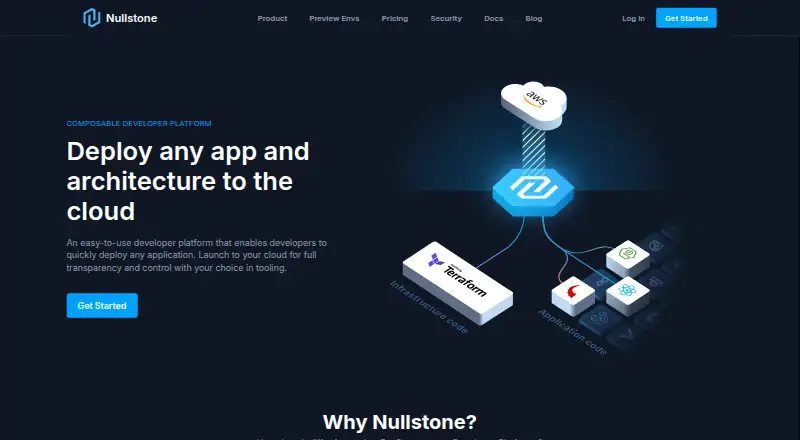
What Nullstone is
Nullstone is a developer platform for launching and managing applications on cloud providers such as AWS. Teams can deploy containers, serverless applications, static sites, or workloads on servers. Preview environments can be created from a pull request or branch and removed after review or testing. Infrastructure is provisioned through Terraform modules that teams can fork, customize, or create from scratch. Nullstone launches infrastructure in customers’ cloud accounts and says it does not access their data; secrets are stored in a vault such as AWS Secrets Manager within the customer account. The platform supports role-based access controls, and its security page states SOC 2 Type II certification. Listed integrations include Datadog, NewRelic, SumoLogic, CircleCI, Jenkins, and GitHub Actions. The open-source CLI supports deployments, infrastructure provisioning, data retrieval, and module management on macOS, Windows, and Linux. The Individual plan costs nothing. Startup costs $50 a month and includes two users, two environments, and 30 deploys per week. The SaaS service is hosted only and cannot be independently run or installed by customers.
Good
- Supports containers, serverless apps, static sites, and server workloads.
- Preview environments can be tied to pull requests or branches.
- Infrastructure runs in customers’ cloud accounts.
- CLI supports deployments and infrastructure management.
- Individual plan costs nothing.
Watch out
- Startup costs $50 a month.
- SaaS service cannot be independently run or installed.
- Enterprise price is not listed.
Who it suits
Nullstone suits development teams launching applications on AWS or GCP and managing infrastructure through Terraform modules. Its plans include options for individuals and startups, with Growth adding unlimited environments and deploys.
Verdict
Nullstone combines application deployment, preview environments, and Terraform-based infrastructure management, while keeping workloads and secrets in customer cloud accounts. It is a hosted service rather than software customers can install and run independently.
Plans and prices
From Nullstone's own pricing page, checked 15 Oct 2026.
| Plan | Price | What it gives you |
|---|---|---|
| Individual | Free | 1 user · 1 environment · 10 deploys/week · AWS or GCP · community forum |
| Startup | $50 a month | 2 users · 2 environments · 30 deploys/week · 3 active preview environments · custom domains · AWS or GCP · community forum · per user per month |
| Growth | $100 a month | Up to 100 users · unlimited environments · unlimited deploys · bring-your-own Terraform · RBAC · AWS or GCP · dedicated Slack channel · per user per month; starts at $500/month |
| Enterprise | Priced on request | Unlimited users · SSO · multi-cloud · self-hosted runners · self-hosted state backend · SLAs |
The facts
Each one read from Nullstone's own pages, with the date it was checked.
What it does
- Accelerator status
- Y Combinator lists Nullstone as an active Winter 2022 company founded in 2020 and located in Atlanta, Georgia.checked 15 Oct 2026
- Access controls
- Nullstone supports role-based access controls to help enforce least-privilege access.checked 30 Sep 2026
- API and webhooks
- Nullstone exposes an API and webhooks for custom workflows in addition to its web interface and CLI.checked 15 Oct 2026
- API authentication
- CLI and automation access uses personal or organization API keys, with organization keys intended for unattended CI/CD.checked 15 Oct 2026
- CI/CD integration
- Nullstone documents a GitHub Action for installing the CLI and deploying or publishing modules from GitHub Actions.checked 15 Oct 2026
- CLI
- The open-source CLI handles deployments, infrastructure provisioning, data retrieval, object management and infrastructure-module publishing.checked 15 Oct 2026
- CLI installation
- The CLI has installation paths for Homebrew, Scoop, Linux/macOS scripts and Go install.checked 15 Oct 2026
- Datastore capabilities
- Documented datastore capabilities include PostgreSQL, MySQL, Redis and other database services.checked 15 Oct 2026
- Deployment automation
- Applications can be automatically built and deployed from repository pushes, deployed through custom CI/CD, or launched with the CLI.checked 15 Oct 2026
- Deployment targets
- The platform supports containers, serverless applications, static sites and virtual machines.checked 15 Oct 2026
- Documentation depth
- Public documentation includes getting-started guides, application quickstarts, datastore and environment guides, RBAC, integrations, extensibility and a CLI command reference.checked 15 Oct 2026
- Encryption
- Nullstone says its datastore modules use encryption at rest and TLS in transit where possible.checked 15 Oct 2026
- Funding
- CB Insights reports $500,000 raised in a March 29, 2022 convertible-note round from Y Combinator.checked 15 Oct 2026
- GitOps
- Nullstone can keep application and infrastructure code synchronized in the same repository through GitOps workflows.checked 15 Oct 2026
- Hosted-only limitation
- The terms state that the SaaS service is available only on a hosted basis and customers may not independently possess, run or install it.checked 15 Oct 2026
- Hosting limit
- The Terms of Service state that the SaaS service is hosted only and customers may not independently possess, run, or install it.checked 30 Sep 2026
- Infrastructure
- Nullstone provisions infrastructure using Terraform modules, which teams can fork, customize, or create from scratch.checked 30 Sep 2026
- Integrations
- The documentation lists Datadog, NewRelic, and SumoLogic for logging and metrics, and CircleCI, Jenkins, and GitHub Actions for CI/CD.checked 30 Sep 2026
The company
- Cloud ownership
- Nullstone launches infrastructure in customers’ cloud accounts and says it does not have access to their data.checked 30 Sep 2026
- Company founding and headquarters
- LinkedIn lists Nullstone as founded in 2020 and headquartered in Alpharetta, Georgia.checked 15 Oct 2026
- Company size
- LinkedIn lists Nullstone as a privately held software-development company with 2–10 employees.checked 15 Oct 2026
- Headquarters
- Alpharetta, Georgia, USAchecked 28 Sep 2026
- Independent company profile
- Dealroom lists Nullstone as a 2020-launched B2B SaaS company in Alpharetta with 2–10 employees.checked 15 Oct 2026
- Infrastructure ownership
- Infrastructure is provisioned in the customer’s AWS or GCP account, while Nullstone says it cannot access customer data.checked 15 Oct 2026
The full review of Nullstone
Overview
Nullstone is a cloud application delivery platform for teams working across deployment and infrastructure workflows. It suits developers who want pull-request previews and Terraform-based provisioning alongside application deployment. Its strongest case is the combination of flexible workload support and customer-owned cloud infrastructure; its hosted service cannot be installed independently.
Teams can launch containers, serverless applications, static sites, or software on servers. Nullstone provisions infrastructure with Terraform modules that teams can fork, customize, or build from scratch. Its documented Git source is GitHub, and preview environments can be created from a pull request or branch, then removed after review or testing.
The managed control plane provisions resources in customer cloud accounts. Nullstone says it does not access customer data; its security page states that it is SOC 2 Type II certified and that secrets stay in the customer account in a vault such as AWS Secrets Manager. Role-based access controls help teams enforce least-privilege access. An open-source CLI handles deployments, infrastructure provisioning, data retrieval, and module management, but it does not make the hosted service self-hostable.
Key features
Preview environments make Nullstone particularly relevant to teams that need to review changes in temporary deployments before merging or releasing. The ability to destroy them afterward helps avoid leaving test environments running indefinitely, though the lower paid plan caps active previews at three.
Terraform-based infrastructure management offers teams room to adapt modules rather than accept a fixed set of infrastructure patterns. Growth explicitly includes bring-your-own Terraform; Individual and Startup do not list that entitlement. Integrations documented for logging and metrics include Datadog, NewRelic, and SumoLogic, while CI/CD integrations include CircleCI, Jenkins, and GitHub Actions.
The customer-account model keeps workloads and secrets in the customer’s cloud environment, a useful distinction for teams that want cloud ownership. The trade-off is that Nullstone remains a hosted SaaS control plane: customers cannot independently possess, run, or install the service.
Pricing
Nullstone uses freemium pricing. Individual costs nothing and is limited to 1 user, 1 environment, and 10 deploys per week, with AWS or GCP support and community forum support. It is a practical starting point for a solo user, but its deployment and environment caps leave little room for a team or frequent preview work.
Startup costs $50 a month and includes 2 users, 2 environments, 30 deploys per week, 3 active preview environments, custom domains, AWS or GCP, and community forum support. It is the clearest fit for a small team that needs a modest preview workflow. The caps on users, environments, weekly deployments, and active previews will constrain heavier use.
Growth is shown at $100 a month, with billing starting at $500/month. It includes 5 to 100 users, unlimited environments and deployments, bring-your-own Terraform, RBAC, AWS or GCP, and a dedicated Slack channel. The page’s displayed price and billing statement differ, so teams should confirm the applicable charge before choosing it. Its larger capacity and access controls suit growing teams, but its stated starting bill is a substantial step up from Startup.
Enterprise has custom pricing and includes unlimited users, single sign-on, multi-cloud support, self-hosted runners, a self-hosted state backend, and SLAs. It is aimed at organizations that need those controls or commitments rather than a standard team plan. The pricing note also advertises a 14-day trial; the Individual plan is free, subject to its caps.
Platforms
Nullstone lists API, Linux, macOS, web, and Windows platforms. Its CLI has installation instructions for Linux, macOS, and Windows. Supported cloud providers are AWS and GCP on the Individual, Startup, and Growth plans; Enterprise adds multi-cloud support. Deployment targets include AWS, GCP, Kubernetes, ECS, and Lambda.
Who it's for
Nullstone is best suited to development teams that want application deployment, temporary pull-request environments, and infrastructure management in one workflow while keeping cloud resources and secrets in their own accounts. Teams that rely on Terraform customization, RBAC, or larger deployment volumes have clearer reasons to move beyond the entry plans.
It is a weaker fit for organizations that require a self-hosted Nullstone service, since the hosted product cannot be installed independently. Teams needing more than GitHub as a Git source should also check fit carefully: GitHub is the supported source.
Pros and cons
- Customer-owned cloud resources and secrets: infrastructure and vault-held secrets remain in the customer account, which supports teams prioritizing cloud ownership.
- Broad workload and deployment coverage: containers, serverless apps, static sites, and servers can use the same platform, with AWS, GCP, Kubernetes, ECS, and Lambda among the targets.
- Useful temporary previews: pull-request or branch environments can be removed after review, but Startup limits active previews to three.
- Entry-plan constraints: Individual allows one user and ten deploys per week; Startup allows two users and thirty deploys per week, so neither is built for a larger or high-throughput team.
- No independent installation: the SaaS service is hosted-only, despite the open-source CLI and Enterprise options for self-hosted runners and state backend.
Alternatives
For a different infrastructure-as-code workflow, choose Pulumi: its free plan includes one user and unlimited projects, stacks, environments, updates, and history, with up to 500 workflow minutes. Choose Argo CD instead for declarative GitOps delivery to Kubernetes with a self-managed installation. KubeVela is another free, self-hosted Kubernetes control plane under the Apache-2.0 license.
GitLab Package Registry is a freemium package registry whose free plan caps groups at five users, compute at 400 minutes per month, and adjustable storage at 10 GiB. PipeCD is a free Apache 2.0 open-source option. Portainer offers a free Business Edition tier for up to three nodes, with no time limit or credit card requirement. Devtron Release Orchestration has a free tier for up to 50 vCPUs, 10 users, and one cluster. Flux CD is a free open-source Kubernetes delivery project that requires a Kubernetes cluster.
For category browsing, see GitOps Tools and Preview Environment Software.
Verdict
Choose Nullstone if your team wants temporary previews and Terraform-based application infrastructure while keeping cloud resources and secrets in its own accounts. The combination is compelling for teams consolidating deployment and infrastructure workflows, and the free plan offers a bounded way to start. Look elsewhere if you need to host the control plane yourself, or if the Individual and Startup quotas cannot support your team’s users, environments, and deployment pace.
Getting started
- Visit the Nullstone website.
- Choose the free Individual plan or review the paid plans.
- Use the web or API, or install the CLI for Linux, macOS, or Windows.
- Connect a GitHub source and select a supported deployment target.
Limits worth knowing
The free Individual plan supports one user, one environment, and 10 deploys per week, with AWS or GCP and community forum support. Startup costs $50 a month and supports two users, two environments, 30 deploys per week, and three active preview environments.
Questions
Is Nullstone free?
Yes. The Individual plan is free and includes one user, one environment, and 10 deploys per week.
What does Startup cost?
Startup costs $50 a month.
Is there a free trial?
Yes. The pricing note lists a 14-day trial.
Which platforms does Nullstone support?
The listed platforms are API, Linux, macOS, web, and Windows. CLI installation instructions are available for Linux, macOS, and Windows.
Is Nullstone open source?
The Nullstone CLI is open source. The SaaS service is hosted only and customers may not independently possess, run, or install it.
Which integrations and deployment targets are listed?
Documented integrations include Datadog, NewRelic, SumoLogic, CircleCI, Jenkins, and GitHub Actions. Supported targets include AWS, GCP, Kubernetes, ECS, and Lambda.