
Devtron Release Orchestration
Devtron Release Orchestration is a Kubernetes-native control plane for application builds, deployments, security and governance across microservices and AI/M…
What Devtron Release Orchestration is
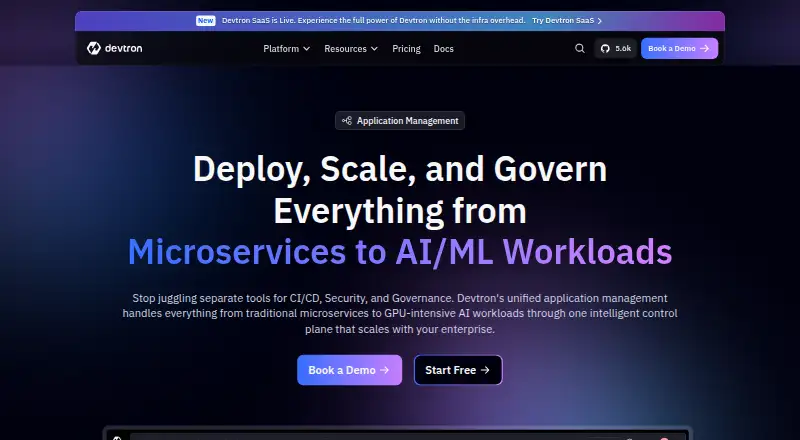
Devtron Release Orchestration is a Kubernetes-native control plane for application builds, deployments, security and governance across microservices and AI/ML workloads. It coordinates releases across applications with semantic versioning, staged rollouts, approval routing, dependency awareness, cross-environment promotion and live tracking. Build settings can be configured per application, including CPU, memory, timeouts, node selectors and tolerations; teams can also use caching and build for AMD64 and ARM64. Devtron describes a GitOps workflow for EKS, GKE, AKS and on-premise clusters, with deployment history, audit trails and automatic failure recovery. Security capabilities cover code, image, manifest and runtime scanning, policy enforcement, role-based access and pre-deployment validation. Teams can bring existing CI tools. The Freemium plan supports up to 50 vCPUs, 10 users and one cluster with community support; multiple clusters require a paid plan.
Good
- Coordinates releases across multiple applications.
- Supports EKS, GKE, AKS and on-premise clusters.
- Works with existing CI tools.
- Includes audit trails and failure recovery.
Watch out
- Freemium is limited to one cluster.
- Freemium includes community support.
Who it suits
It is aimed at DevOps, developer and platform teams managing Kubernetes workloads. The free tier fits smaller setups within its stated cluster, user and vCPU limits.
Verdict
Devtron combines release coordination with build configuration, deployment history and security controls for Kubernetes teams. Its free plan is constrained to one cluster, while multiple-cluster use requires a paid plan.
Plans and prices
From Devtron Release Orchestration's own pricing page, checked 29 Sep 2026.
| Plan | Price | What it gives you |
|---|---|---|
| Freemium | Free | Up to 50 vCPUs · 10 users · 1 cluster · Community support |
| OSS Plus | $499 a month | Self-hosted · $499/mo |
| Starter | $999 a month | Up to 500 vCPUs · 50 users · 5 clusters · Basic Support + Standard SLA · $999 /mo |
| Growth | $2,000 a month | Up to 1500 vCPUs · 75 users · 10 clusters · Basic Support + Standard SLA · $2,000 /mo |
| Accelerate | — | Up to 5000 vCPUs · 200 users · 25 clusters · Basic Support + Standard/Enterprise SLA + White-gloved Support · $4,000 – $6,000 /mo |
| Scale | — | Up to 2500 vCPUs · 125 users · 15 clusters · Basic Support + Standard/Enterprise SLA · $2,500 – $3,500 /mo |
| Enterprise Plus | Priced on request | > 5000 vCPUs · > 200 users · > 25 clusters · Basic Support + Standard/Enterprise SLA + White-gloved Support · Custom |
The facts
Each one read from Devtron Release Orchestration's own pages, with the date it was checked.
What it does
- Build features
- Teams can configure CPU, memory, timeouts, node selectors, and tolerations per application, use caching, and run multi-architecture builds for AMD64 and ARM64.checked 29 Sep 2026
- Deployment
- Devtron describes one GitOps workflow for EKS, GKE, AKS, and on-premise clusters, with deployment history, audit trails, and automatic failure recovery.checked 29 Sep 2026
- Existing CI tools
- Devtron says teams can bring their existing CI tools and use Devtron's deployment orchestration capabilities.checked 29 Sep 2026
- Integrations
- The integrations page lists ArgoCD, FluxCD, Helm, GitHub Actions, Jenkins, GitLab CI, Prometheus, Grafana, Slack, Trivy, Clair, and AWS Inspector among its integrations.checked 29 Sep 2026
- Purpose
- Devtron provides a Kubernetes-native control plane for managing application builds, deployments, security, and governance across microservices and AI/ML workloads.checked 29 Sep 2026
- Release orchestration
- It coordinates multi-application releases with semantic versioning, staged rollouts, approval routing, dependency awareness, cross-environment promotion, and real-time release tracking.checked 29 Sep 2026
- Security
- The page describes scanning at code, image, manifest, and runtime stages, policy enforcement, role-based access control, and pre-deployment validation.checked 29 Sep 2026
- Support
- The pricing page lists community support for Freemium, support with standard or enterprise SLAs on paid plans, and white-gloved support on higher tiers.checked 29 Sep 2026
- Who it is for
- Devtron says it serves teams from startups to enterprises and presents the platform for DevOps teams, developers, and platform teams managing Kubernetes.checked 29 Sep 2026
The company
- Company history
- Devtron says it has been building an open-source, Kubernetes-native platform since 2019.checked 29 Sep 2026
Money
- Plan limits
- The pricing page lists Freemium limits of up to 50 vCPUs, 10 users, and 1 cluster, and says connecting multiple clusters requires a paid plan.checked 29 Sep 2026
- Trial
- The pricing comparison lists a 30 days trial for the SaaS managed option.checked 29 Sep 2026
The full review of Devtron Release Orchestration
Devtron Release Orchestration is a Kubernetes-native control plane for coordinating releases and managing builds, deployments, security, and governance. It suits DevOps, developer, and platform teams operating Kubernetes applications across clusters. Its strength is bringing release coordination and deployment controls together; the free plan’s single-cluster ceiling makes it a limited starting point for larger environments.
Overview
Devtron coordinates releases across multiple applications, with semantic versioning, dependency awareness, approval routing, staged rollouts, and promotion across environments. Real-time tracking, deployment history, audit trails, and automatic failure recovery give teams a way to follow changes through delivery and see what happened when a deployment fails.
The platform also reaches into build configuration and security rather than focusing only on release steps. Teams can tune resources and build settings per application, while scanning and policy controls cover several stages from code through runtime. That breadth may appeal to organizations consolidating Kubernetes delivery workflows; teams seeking only a lightweight release calendar may find the control-plane scope more than they need.
Key features
Release and deployment control
Approval gates, dependency-aware coordination, staged rollouts, and cross-environment promotion help teams manage releases that span applications and environments. Devtron describes one GitOps workflow for EKS, GKE, AKS, and on-premise clusters. Existing CI tools can remain in place while Devtron handles deployment orchestration, which is useful for teams that do not want to replace their build pipeline to improve release management.
Build configuration and security
Per-application CPU, memory, timeout, node selector, and toleration settings provide control over how builds run. Caching and AMD64 and ARM64 multi-architecture builds address common build needs, though the broad configuration is most relevant to teams managing varied Kubernetes workloads.
Security checks span code, images, manifests, and runtime, alongside policy enforcement, role-based access, and pre-deployment validation. Integrations include ArgoCD, FluxCD, Helm, GitHub Actions, Jenkins, GitLab CI, Prometheus, Grafana, Slack, Trivy, Clair, and AWS Inspector. This range supports teams combining delivery, observability, and scanning tools, rather than requiring a single vendor stack.
Pricing
Devtron has a free plan and paid plans, with paid entry at 999 /mo. The pricing comparison gives SaaS managed users a 30 days trial. Freemium includes up to 50 vCPUs, 10 users, and one cluster, with community support. That is a practical evaluation or small-team tier, but connecting multiple clusters requires a paid plan.
- OSS Plus: $499 a month (billed $499/mo), self-hosted. It is the lower-cost paid option for teams that want a self-hosted deployment; the listed plan details do not give its resource or user quotas.
- Starter: $999 a month (billed $999 /mo), up to 500 vCPUs, 50 users, and 5 clusters, with basic support and a standard SLA. This is the clearest step up for teams whose cluster count exceeds the free cap.
- Growth: $2,000 a month (billed $2,000 /mo), up to 1500 vCPUs, 75 users, and 10 clusters, with basic support and a standard SLA. It raises capacity for larger deployments without moving to a custom tier.
- Scale: Custom pricing, billed $2,500 – $3,500 /mo, up to 2500 vCPUs, 125 users, and 15 clusters, with basic support and standard or enterprise SLA.
- Accelerate: Custom pricing, billed $4,000 – $6,000 /mo, up to 5000 vCPUs, 200 users, and 25 clusters, with basic support, standard or enterprise SLA, and white-gloved support.
- Enterprise Plus: Custom pricing for more than 5000 vCPUs, more than 200 users, or more than 25 clusters, with standard or enterprise SLA options and white-gloved support.
The free tier gives up multi-cluster access and paid-plan SLA support. Starter and Growth add cluster, user, and compute capacity, while the higher tiers make sense when those limits or more involved support requirements matter. OSS Plus is priced below Starter but is identified as self-hosted, so it is the alternative for teams prioritizing that deployment model over Starter’s stated quotas.
Platforms
Devtron is available through API, self-hosted, and web platforms. The self-hosted OSS Plus option is distinct from the SaaS managed trial noted in the pricing comparison.
Who it's for
Devtron is aimed at DevOps teams, developers, and platform teams managing Kubernetes applications, from startups to enterprises. It is a stronger fit for teams coordinating multi-application releases across several environments or clusters than for organizations without Kubernetes workloads.
Pros and cons
- Pro: Release approvals, staged rollouts, dependency awareness, and environment promotion address complex releases across multiple applications.
- Pro: Teams can keep existing CI tools and use Devtron for deployment orchestration, avoiding a forced pipeline replacement.
- Pro: Build controls and security checks extend beyond release tracking to workload configuration and pre-deployment safeguards.
- Con: Freemium is capped at one cluster, so teams with multiple clusters must pay to connect them.
- Con: The entry paid Starter tier begins at $999 a month, a substantial step from the free plan for teams needing more than one cluster.
- Con: Community support is the free tier’s support level; paid plans add SLA support, and white-gloved support is reserved for higher tiers.
Alternatives
For other options, browse Release Management Software, Release Orchestration Software, Kubernetes Deployment Tools, GitOps Tools, Progressive Delivery Software, and Platform Engineering Software.
- Runway is worth considering for a smaller release-management setup: its free Basic plan covers up to 2 apps and 4 read-write users, with core release-cycle steps.
- ReleaseOwl may suit SAP Cloud ALM customers: its free tier is limited to eligible customers and includes 100 SAP Cloud ALM Features, one SAP landscape, and five cloud users.
- Enov8 Release Manager is another option for teams considering a release manager across API, Linux, self-hosted, or web environments.
- Veloptra is a Salesforce-focused alternative, with a free Starter plan for connecting Salesforce orgs and managing pipelines, user stories, and promotions.
- Blue Canvas may be a better fit for browser-based Salesforce profile and permission-set comparison; its free Profiles & Permissions plan includes field-level security differences and requires no installation.
- Relicta is a free alternative available across API, desktop, web, and self-hosted platforms.
- ReARM may suit teams focused on software-bill-of-materials workflows: its free self-hosted CE plan includes core SBOM/XBOM storage and retrieval.
- Flagsmith is an alternative to consider for open-source feature flag functionality across web, mobile, desktop, and self-hosted platforms.
Verdict
Choose Devtron if your team needs coordinated Kubernetes releases alongside build configuration, deployment history, and security controls, especially when existing CI tools should stay in place. Its main trade-off is the cost of moving beyond a one-cluster free setup: teams that need multi-cluster access must step into paid pricing, while teams outside Kubernetes should look elsewhere.
Alternatives to Devtron Release Orchestration
- 1

Octopus Deploy
Free planWebAPILinuxSelf-hosted7.3From $4,330 a year - 2

MidVision RapidDeploy
Free planWebAPILinuxmacOS7.1From $50 a year - 3
Planview AdaptiveWork
AndroidiOSWebAPI6.9 - 4

Copado
Free planWebAPI6.7From $99 a year - 5
Ozone
Free planWebSelf-hosted6.6From $1,000 a month - 6

Automic Continuous Delivery Automation
WebAPILinuxSelf-hosted6.5