Flagsmith
Flagsmith manages feature flags and remote configuration for web, mobile, and server-side applications.
What Flagsmith is
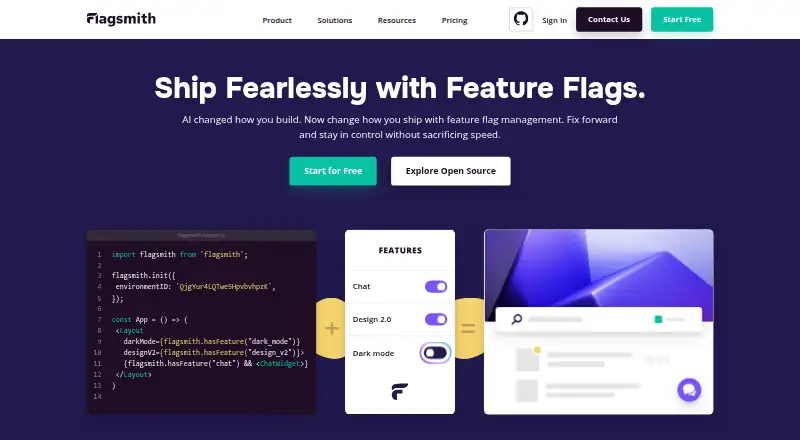
Flagsmith manages feature flags and remote configuration for web, mobile, and server-side applications. Teams can target releases by environment, individual user, segment, or percentage of users, and use percentage splits across variations for A/B and multivariate testing. Remote configuration lets teams change properties such as text, colors, and behavior without deploying new code. Flagsmith is available as hosted cloud, private cloud, or self-hosted software. Its integrations include Amplitude, Datadog, GitHub, GitLab, Grafana, Jira, Mixpanel, OpenFeature, Segment, Sentry, Slack, and Terraform; environment-level webhooks can send events to a team's own infrastructure. The maker says core feature-flag functionality is open source and most of the product is under the BSD-3 licence. The free plan includes up to 50,000 monthly requests and one team member. If the request limit is exceeded, users have seven days to upgrade before action is taken.
Good
- Targets flags by user, segment, environment, or percentage.
- Supports A/B and multivariate percentage splits.
- Remote configuration changes properties without a new deployment.
- Offers hosted, private-cloud, and self-hosted deployment.
- Free plan includes 50,000 requests per month.
Watch out
- Free plan is limited to one team member.
- Free requests are limited to 50,000 per month.
- Exceeding the free request limit starts a seven-day upgrade window.
- Start-Up costs $40 a month, billed 12 months paid up front.
Who it suits
Flagsmith suits development teams that want to control staged releases or adjust app properties without deploying new code. Its cloud, private-cloud, and self-hosted options support teams with different deployment preferences.
Verdict
Flagsmith brings gradual rollouts, testing flags, and remote configuration together, with multiple hosting options. The free request and team-member limits, and the paid plan’s upfront annual billing, are important considerations.
Plans and prices
From Flagsmith's own pricing page, checked 15 Oct 2026.
| Plan | Price | What it gives you |
|---|---|---|
| Free | Free | 50,000 API requests/month · 1 team member · unlimited flags, environments, identities and segments · API access |
| Start-Up (annual billing) | $40 a month | 1,000,000 API requests/month · 3 team members · unlimited projects · scheduled flags · 2FA · A/B and MVT testing · integrations · 14-day trial · 12 months paid up front |
| Start-Up | $40 a month | 1,000,000 requests/month · 3 team members · unlimited projects, flags and environments · email technical support · 12 months paid up front; yearly pricing |
| Start-Up (monthly billing) | $45 a month | 1,000,000 API requests/month · 3 team members · unlimited projects · scheduled flags · 2FA · A/B and MVT testing · integrations · 14-day trial · monthly |
| Scale-Up | $250 a month | 5,000,000+ requests/month · 5 team members included, up to 20 · SAML/SSO · governance features · priority email and chat support · 12 months paid up front; yearly pricing |
| Scale-Up (annual billing) | $250 a month | 5,000,000+ API requests/month · 5 team members included · up to 20 members · SAML/SSO · roles and permissions · change requests · audit logs · priority support · 14-day trial · 12 months paid up front |
| Scale-Up (monthly billing) | $300 a month | 5,000,000+ API requests/month · 5 team members included · up to 20 members · SAML/SSO · roles and permissions · change requests · audit logs · priority support · 14-day trial · monthly |
| Enterprise | Priced on request | 5,000,000+ API requests/month · 20+ team members · cloud, private-cloud or self-hosted deployment · tailored hosting including air-gapped instances · real-time support · advanced security |
The facts
Each one read from Flagsmith's own pages, with the date it was checked.
What it does
- API security
- Server-side API keys must be kept secret and never exposed in client-side code.checked 15 Oct 2026
- Changelog
- Release 2.277.0 dated 2026-09-29 added mandatory SaaS email verification, billing-period usage visibility and fixes for flag-dependency races and API validation.checked 15 Oct 2026
- Deployment
- Flagsmith offers hosted cloud, private cloud, and self-hosted deployment options.checked 30 Sep 2026
- Documentation and support
- Documentation covers quickstarts, concepts, SDKs, REST API, integrations, administration, self-hosting, release notes and contribution guidance; support channels include email/helpdesk, knowledge base, chat and Discord.checked 15 Oct 2026
- Experimentation
- Flagsmith supports A/B and multivariate testing and reports experiment impact metrics.checked 15 Oct 2026
- Experiments
- Multivariate flags support percentage splits across variations for A/B and multivariate testing.checked 30 Sep 2026
- Feature flags
- Flags can be boolean or multivariate and decouple deployment from release.checked 15 Oct 2026
- Governance
- Scale-Up includes SAML/SSO, roles, permissions, change requests, and audit logs.checked 30 Sep 2026
- Integrations
- Native integrations include Amplitude, Datadog, Dynatrace, GitHub, GitLab, Grafana, Jira, Mixpanel, New Relic, Segment, Sentry, Slack, Terraform and warehouse tools.checked 15 Oct 2026
- License
- The public Flagsmith repository is identified as BSD-3-Clause licensed.checked 15 Oct 2026
- Limit: G2 users
- Reported drawbacks include wanting more built-in analytics, incomplete SDK conveniences, dashboard environment switching, segment-limit confusion, feature-flag cleanup work and missing Vercel or on-prem Jira integrations.checked 15 Oct 2026
- Limit: Gartner users
- Gartner reviewers cite limited integrations, missing GitHub integration, dashboard workflow friction and areas needing polish.checked 15 Oct 2026
- Limit: Software Advice users
- One reviewer reported occasional management-dashboard bugs, while another called on-premises installation expensive at enterprise pricing.checked 15 Oct 2026
- Limit: TrustRadius users
- The sole TrustRadius reviewer wanted the ability to search users by traits.checked 15 Oct 2026
- OpenFeature
- Flagsmith provides an OpenFeature provider for SaaS, on-premises and private-cloud deployments.checked 15 Oct 2026
- Open source
- The maker says core feature flag functionality is open source and most of the product is under the BSD-3 licence.checked 30 Sep 2026
- Praise: G2 users
- Reviewers repeatedly praise the clear UI, easy integration, targeted rollouts, open-source model, low latency, self-hosting and responsive support.checked 15 Oct 2026
Where it runs
- Bootstrapped status
- Flagsmith says it chose to bootstrap without venture capital and describes the business as profitable and sustainable.checked 15 Oct 2026
The company
- Company
- The site identifies Bullet Train Ltd. as the company behind Flagsmith.checked 30 Sep 2026
- Company size and HQ
- LinkedIn lists Flagsmith as a privately held London software company with 11–50 employees.checked 15 Oct 2026
- Founded
- LinkedIn lists the company as founded in 2018.checked 15 Oct 2026
- Funding and ownership
- Crunchbase lists one funding round backed by Polychrome and identifies Ben Rometsch as co-founder and CEO; the amount is undisclosed.checked 15 Oct 2026
- Headquarters
- London, Englandchecked 23 Sep 2026
- Legal maker
- The pricing page copyright identifies the maker as Bullet Train Ltd.checked 15 Oct 2026
The full review of Flagsmith
Flagsmith is a feature-management platform for teams releasing web, mobile, and server-side software. It suits developers who want to manage rollouts and configuration in one place, particularly if they need a choice of cloud or self-hosted deployment. Its strongest case is the combination of targeting, experimentation, and remote configuration; the free plan’s one-seat cap and the paid plans’ annual upfront billing deserve attention.
Overview
Flagsmith lets teams control feature availability by environment, individual user, segment, or percentage of users. That makes it useful for staged releases, while multivariate flags support splitting users among variations for A/B and multivariate tests. Teams can also adjust feature properties such as text, colors, and behavior without deploying new code.
Deployment options include hosted cloud, private cloud, and self-hosting. The maker says core feature-flag functionality is open source and most of the product is under the BSD-3 licence. It also states that Flagsmith is SOC 2 Type 2 accredited, and that its self-hosted instance supports HIPAA, FedRAMP, and ISO 27001. Bullet Train Ltd., the company behind Flagsmith, is based in London, England.
Key features
- Gradual rollouts: Target flags by environment, user, segment, or percentage. Teams can limit a release to selected users before widening access.
- Experimentation: Percentage splits across multivariate flag variations support A/B and multivariate testing.
- Remote configuration: Change supported feature properties without shipping new code, which is useful for adjustments to text, colors, or behavior.
- Integrations and webhooks: Listed integrations include Amplitude, Datadog, GitHub, GitLab, Grafana, Jira, Mixpanel, OpenFeature, Segment, Sentry, Slack, and Terraform. Environment-level webhooks can send events to a team’s own infrastructure.
- Governance: Scale-Up includes SAML/SSO, roles, permissions, change requests, and audit logs—controls that are more relevant to teams managing access and approvals than to solo developers.
- SDK coverage: Languages and frameworks include JavaScript, React, Next.js, Android/Kotlin, iOS/Swift, Flutter, Python, Java, .NET, Node.js, Ruby, PHP, Go, Rust, and Elixir.
Pricing
Flagsmith has a free plan, paid plans from $40/mo on annual terms, and a 14-day trial. The free tier is a practical way for an individual to start, but its single team-member allowance makes it a poor fit for a group working together. It includes 50,000 requests per month, one project, and unlimited flags, environments, identities, and segments. If the request limit is exceeded, users have seven days to upgrade before action is taken.
- Free — free: 50,000 requests/month, one team member, and one project, with unlimited flags, environments, identities, and segments. Best for evaluation or a small individual workload within the request cap.
- Start-Up — $40 a month: Billed 12 months paid up front, with yearly pricing. It includes 1,000,000 requests/month, three team members, unlimited projects, flags, and environments, plus email technical support. This is the entry paid tier for a small team that needs more request capacity and projects; the annual prepayment is a meaningful commitment.
- Scale-Up — $250 a month: Billed 12 months paid up front, with yearly pricing. It includes 5,000,000+ requests/month, five team members with capacity up to 20, governance features, SAML/SSO, and priority email and chat support. It is aimed at teams that need access controls and approval processes, but costs substantially more than Start-Up and still requires annual prepayment.
- Enterprise — custom pricing: Contact Sales; includes 5,000,000+ requests/month, 20+ team members, cloud, private cloud, or self-hosted deployment, tailored hosting, and an enterprise SLA. Its deployment flexibility and tailored terms suit larger teams, while the price requires a sales conversation.
Platforms
Flagsmith supports Android, iOS, Linux, macOS, Windows, web, API, and self-hosted deployments. The broad SDK language coverage gives teams options across common mobile, web, and server stacks.
Who it's for
Flagsmith is a strong fit for development teams that need staged feature releases, experiments, and configuration changes without code deployments, especially when they value deployment choice or need governance controls as the team grows. The free tier can serve an individual or an evaluation, but its 50,000-request cap and one-member limit make it restrictive for shared use. Teams that do not need the governance and hosting choices, or that want to avoid paying a year upfront for the entry paid plan, should compare alternatives.
Pros and cons
- Pro: Combines targeted rollouts, multivariate experiments, and remote configuration, covering several release-management needs in one product.
- Pro: Hosted, private-cloud, and self-hosted choices let teams select a deployment model, with tailored hosting on Enterprise.
- Pro: Scale-Up’s SAML/SSO, permissions, change requests, and audit logs add concrete governance controls for larger teams.
- Con: Free is limited to one team member and 50,000 monthly requests, so collaborative or higher-volume use will require a paid plan.
- Con: Start-Up and Scale-Up are billed for 12 months paid up front, limiting flexibility compared with a monthly commitment.
- Con: Scale-Up includes five members and allows up to 20; teams beyond that threshold need Enterprise, whose price is custom.
Alternatives
ConfigCat is worth considering for teams that want a free plan with up to 5 million config JSON downloads/month, 20 GB network traffic/month, and limits of 10 flags, two environments, and two products.
Flipt suits teams drawn to an open-source, Git-native workflow: its free plan includes unlimited flags, a UI with Git sync, and real-time updates.
feat may suit smaller projects that can work within its free limits of 7,500 MAU, 100 server connections, and two projects, with unlimited environments and flags.
Featureflow is another free option, with up to five seats, one project, two environments, 1M SDK requests/month, and a seven-day audit trail.
DevCycle offers a free plan with separate client-side MAU, cloud config request, and server config request allowances, which may suit teams whose usage fits those quotas.
GrowthBook is a fit to consider for self-hosted use, with a free open-source plan that includes one project, unlimited feature flags, experiments, and traffic.
LaunchDarkly Experimentation offers a free Developer plan with 100K experimentation MAU/month, one project, three environments, and five service connections/month.
Rollgate may appeal to teams seeking a free-forever plan with 500K requests/month, unlimited flags, three environments, three projects, and three seats.
Browse Feature Flag Software and Release Management Software for more options.
Verdict
Choose Flagsmith if your team needs controlled rollouts, experimentation, and remote configuration, with the added flexibility of hosted, private-cloud, or self-hosted deployment. The main reason to look elsewhere is commercial fit: the free plan is tightly capped for teams, while the paid entry plan requires a year paid up front.
Getting started
- Visit the Flagsmith website.
- Choose hosted cloud, private cloud, or self-hosted deployment.
- Start with the free plan or select a paid plan.
- Connect using an SDK for your platform or language.
- Configure flags and targeting for your environments, users, or segments.
Limits worth knowing
The free plan allows 50,000 requests per month, one team member, and one project. Users who exceed the request limit have seven days to upgrade before action is taken. Start-Up includes 1,000,000 monthly requests and three team members for $40 a month, billed 12 months paid up front.
Questions
Is there a free plan?
Yes. Free includes 50,000 requests per month, one team member, one project, and unlimited flags, environments, identities, and segments.
How much do paid plans cost?
Start-Up is $40 a month and Scale-Up is $250 a month; both are billed 12 months paid up front. Enterprise pricing is available by contacting sales.
Which platforms does Flagsmith support?
Listed platforms are Android, API, iOS, Linux, macOS, self-hosted, web, and Windows. SDK languages and frameworks include JavaScript, React, Next.js, Android/Kotlin, iOS/Swift, Flutter, Python, Java, .NET, Node.js, Ruby, PHP, Go, Rust, and Elixir.
Is Flagsmith open source?
The maker says core feature-flag functionality is open source and most of the product is under the BSD-3 licence.
Which integrations are listed?
Integrations include Amplitude, Datadog, GitHub, GitLab, Grafana, Jira, Mixpanel, OpenFeature, Segment, Sentry, Slack, and Terraform.
Who makes Flagsmith?
The company behind Flagsmith is identified as Bullet Train Ltd., headquartered in London, England.
Alternatives to Flagsmith
- 1
Unleash
Free planOpen sourceAndroidiOSWebAPI8.5Free plan - 2
Zoho Sprints
Free planAndroidiOSWebAPI8.2From $1 a month - 3

Statsig
Free planAndroidiOSWebAPI8.1From $150 a month - 4

LaunchDarkly Experimentation
Free planAndroidiOSWebAPI7.4$108.33 usage-based - 5

Blue Canvas
Free planWebAPI7.3From $129 a month - 6
ConfigCat
Free planAndroidiOSWebAPI7.3From $110 a month