
LaunchDarkly Experimentation
LaunchDarkly Experimentation helps teams measure how changes affect user behavior and use the results to inform what they ship.
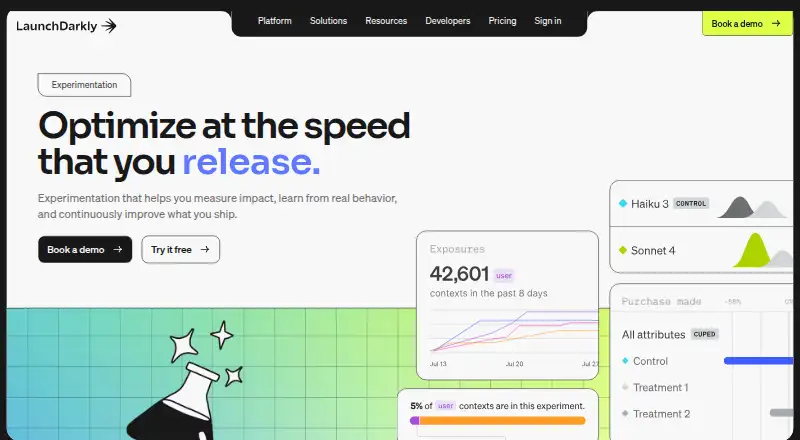
What LaunchDarkly Experimentation is
LaunchDarkly Experimentation helps teams measure how changes affect user behavior and use the results to inform what they ship. Experiments can cover features, models, prompts, page layouts, and AI-powered systems. Results can be segmented by cohort, device, geography, or attribute, then exported to a warehouse for further analysis. Statistical methods include CUPED variance reduction, sequential testing, sample ratio mismatch detection, and multi-armed bandits. Mutual exclusion and holdout groups can separate experiments and measure longer-term impact. Warehouse-native experimentation supports Snowflake, Redshift, and Databricks, among other connections. Listed integrations also include Amplitude, Datadog, Slack, and Microsoft Teams. Client-side and mobile SDKs include JavaScript, iOS, and Android, with a separate API for programmatic product interactions. The free Developer plan includes 100K experimentation MAU per month, one project, three environments, and five service connections per month. LaunchDarkly lists security measures and certifications including encryption in transit, MFA, and SOC 2 Type II.
Good
- Free plan includes A/B tests and experiments
- Supports holdout experiments and multi-armed bandits
- Results can be segmented and exported to warehouses
- Mobile SDKs include iOS and Android
- Supports mutual exclusion and holdout groups
Watch out
- Free Developer plan is limited to one project
- Free plan allows five service connections monthly
- Foundation is billed yearly
- Visual editor is not available
Who it suits
It suits product, marketing, and business teams as well as developers, including product managers and data scientists. Teams wanting to test across web and mobile or export results to a data warehouse may find its scope relevant.
Verdict
LaunchDarkly Experimentation offers a broad set of testing methods, segmentation, and warehouse options for teams measuring product changes. Review the Developer plan's project and connection limits, and the yearly billing for Foundation.
Plans and prices
From LaunchDarkly Experimentation's own pricing page, checked 29 Sep 2026.
| Plan | Price | What it gives you |
|---|---|---|
| Developer | Free | 100K experimentation MAU/month · 1 project · 3 environments · 5 service connections/month · A/B tests and experiments · forever |
| Foundation | $108.33 a month | First 5 service connections/month included · 5K AI runs/month included · additional runs $5 per 1k · unlimited projects and environments · Billed yearly; 14-day trial, then pay as you go |
| Enterprise | Priced on request | Everything in Foundation · custom AI run count · 100 days data retention · advanced targeting, roles, teams, workflows and approvals · Custom pricing |
The facts
Each one read from LaunchDarkly Experimentation's own pages, with the date it was checked.
What it does
- Analysis
- Results can be segmented by cohort, device, geography, or attribute, and exported to a warehouse for further analysis.checked 29 Sep 2026
- Experiment controls
- Users can use mutual exclusion and holdout groups to isolate experiments and measure long-term impact.checked 29 Sep 2026
- Experiment scope
- Teams can test features, models, prompts, page layouts, and AI-powered systems.checked 29 Sep 2026
- Integrations
- Listed integrations include Databricks, Snowflake, Redshift, Amplitude, Datadog, Google Cloud Pub/Sub, Slack, and Microsoft Teams.checked 29 Sep 2026
- Privacy and residency
- LaunchDarkly says it does not require personally identifiable information and offers an EU hosted region supporting EU data residency.checked 29 Sep 2026
- Purpose
- Experimentation helps teams measure impact, learn from real behavior, and improve what they ship.checked 29 Sep 2026
- SDKs and API
- LaunchDarkly lists client-side and mobile SDKs including JavaScript, iOS, and Android, and documents a separate API for programmatic product interactions.checked 29 Sep 2026
- Security
- The company lists SOC 2 Type II, ISO 27001, FedRAMP authorization, and Data Privacy Framework participation, along with encryption in transit, MFA, SAML SSO, and audit logging.checked 29 Sep 2026
- Statistical methods
- Experimentation includes CUPED variance reduction, sequential testing, sample ratio mismatch detection, and multi-armed bandits.checked 29 Sep 2026
- Support
- The site links to a Help Center and a direct support request channel.checked 29 Sep 2026
- Warehouse support
- Warehouse-native experimentation supports Snowflake, Redshift, and Databricks, among others.checked 29 Sep 2026
- Who it serves
- LaunchDarkly says its platform serves product, marketing, and business teams as well as developers, and names product managers and data scientists among its target teams.checked 29 Sep 2026
The company
- Company
- LaunchDarkly was founded in 2014 in Oakland, California, by Edith Harbaugh and John Kodumal.checked 29 Sep 2026
- Founded
- 2014checked 28 Sep 2026
- Headquarters
- Oakland, California, United Stateschecked 28 Sep 2026
The full review of LaunchDarkly Experimentation
Overview
LaunchDarkly Experimentation is a product-measurement platform for teams testing changes across web and mobile experiences, including AI systems. It suits product and data teams that need rigorous experiment controls and warehouse analysis; its breadth is a strength, but the free tier is tightly capped and the first paid tier is billed yearly.
Tests can cover features, models, prompts and page layouts, with feature flags, audience targeting and server-side testing in the same toolkit. Results can be segmented by cohort, device, geography or attribute and exported for further analysis. LaunchDarkly was founded in Oakland in 2014.
Key features
Experiment design and measurement
The mix of A/B and A/A testing, multi-armed bandits and holdout experiments reaches beyond basic conversion testing. CUPED variance reduction, sequential testing and sample ratio mismatch detection support sounder measurement, while mutual exclusion helps keep concurrent experiments from interfering with one another. Holdout groups are especially useful when teams need to judge longer-term impact rather than a short-term lift.
Testing models, prompts and AI-powered systems makes this a better fit for broad product experimentation than for a site focused only on page optimization. There is no visual editor, so teams seeking a point-and-click page testing workflow should look elsewhere.
Analysis and connections
Teams can break results down by audience attributes and send them to a warehouse. Warehouse-native experimentation supports Snowflake, Redshift and Databricks, while listed integrations also include Amplitude, Datadog, Google Cloud Pub/Sub, Slack and Microsoft Teams. Client-side and mobile SDKs include JavaScript, iOS and Android, and a separate API supports programmatic product interactions.
Security and privacy
LaunchDarkly lists SOC 2 Type II, ISO 27001 and FedRAMP authorization, as well as Data Privacy Framework participation. Encryption in transit, MFA, SAML SSO and audit logging address core organizational controls. The company says it does not require personally identifiable information and offers an EU-hosted region for EU data residency.
Pricing
The Developer plan costs nothing, billed forever. It includes 100K experimentation MAU/month, one project, three environments, five service connections/month and A/B tests and experiments. That is a useful way to begin, but the project and connection limits make it a constrained fit for teams running several products or building a wider integration footprint.
Foundation costs $108.33 a month, billed yearly, with a 14-day trial followed by pay-as-you-go billing. It includes the first five service connections/month, 5K AI runs/month, unlimited projects and environments; additional AI runs cost $5 per 1k. The jump removes the free plan's project and environment caps, but the yearly billing term and included AI-run allowance matter for teams with variable usage.
Enterprise has custom pricing and includes everything in Foundation, a custom AI run count, 100 days of data retention, and advanced targeting, roles, teams, workflows and approvals. It is the relevant tier for organizations needing those governance and retention options, rather than a published fixed-cost upgrade.
Platforms
LaunchDarkly supports Android, iOS, web and API access. Mobile SDKs and server-side testing broaden its use beyond browser-only experiments, though the absence of a visual editor makes it less suited to teams that want to build page tests without developer involvement.
Who it's for
Product managers, data scientists, developers, and marketing or business teams can use the platform to evaluate changes across products and audiences. It is strongest for organizations combining feature experimentation with statistical controls and warehouse analysis. Small teams with one project can start on Developer, while teams needing more projects, environments or advanced governance should weigh the paid tiers against their budgets and usage.
Pros and cons
- Pros: Several test methods and statistical safeguards suit teams doing more than simple A/B comparisons.
- Pros: Cohort segmentation and warehouse-native support for Snowflake, Redshift and Databricks connect experiment results to broader analysis.
- Pros: Developer is free indefinitely and includes experimentation for up to 100K MAU/month.
- Cons: The free plan limits users to one project, three environments and five service connections/month.
- Cons: Foundation's $108.33 a month price is billed yearly, and its included AI runs are capped at 5K/month.
- Cons: No visual editor means page-focused teams may need a more visual testing workflow.
Alternatives
GrowthBook is worth considering for teams that want a free self-hosted option with one project, unlimited feature flags, experiments and traffic. Statsig may suit teams prioritizing a generous free event allowance, unlimited seats and year-long analytics retention. Zoho PageSense offers a free tier capped at 5,000 monthly tracked users, one project, one month of retention and five goals.
Omniconvert Explore has a free plan for 50,000 website visitors with its full Explore feature set and no credit card required. Confidence by Spotify is an alternative for teams seeking a free tier with 75,000 credits/month, unlimited flags and seats, and up to five surfaces. Optimizely Experimentation offers a free Rollouts plan with unlimited feature flags but only one experiment at a time.
Harness Feature Management & Experimentation may suit teams looking for its free plan's Harness Open Source and Litmus Chaos inclusion. Experimently offers a free self-hosted preview on an AWS account with all features included.
Browse A/B Testing Tools, Feature Flag Software or Release Management Software to compare broader categories.
Verdict
Choose LaunchDarkly Experimentation if your team needs disciplined experiments across product features and AI systems, with controls and warehouse analysis in one platform. Its free Developer plan is a practical entry point, but the project cap limits its reach; teams scaling beyond it should be comfortable with Foundation's annual billing or Enterprise custom pricing. For page-only testing or teams unwilling to commit to that paid structure, a narrower alternative is likely a better fit.
Alternatives to LaunchDarkly Experimentation
- 1

Terraform
Free planWebAPILinuxmacOS8.0Free plan - 2
Teploy Arcade
Free planOpen sourceWebAPILinuxmacOS7.5Free plan - 3

CircleCI
Free planWebAPILinuxmacOS7.3From $15 a month - 4

Octopus Deploy
Free planWebAPILinuxSelf-hosted7.3From $4,330 a year - 5
Argo Rollouts
Free planLinuxmacOSSelf-hostedWindows6.9Free plan - 6

Bytebase Enterprise
Free planWebAPISelf-hosted6.8From $20 a month