
Statsig
Statsig is an experimentation and product platform for assigning experiments, analyzing results, and managing feature releases.
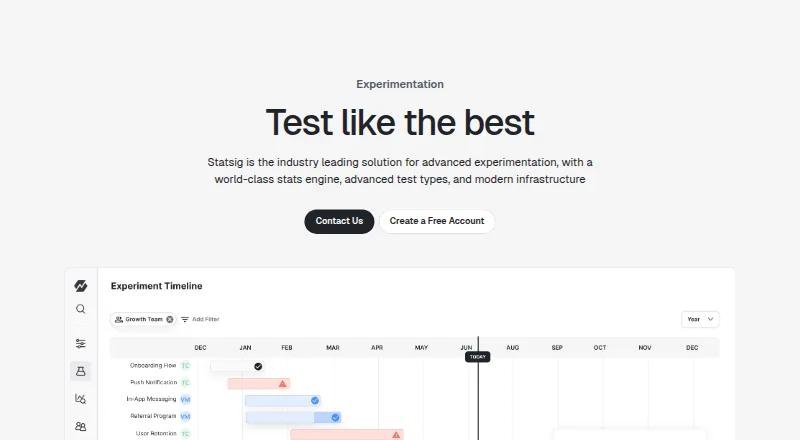
What Statsig is
Statsig is an experimentation and product platform for assigning experiments, analyzing results, and managing feature releases. Its testing options include A/B/n, multivariate, sequential, switchback, non-inferiority, holdout, and multi-arm bandit tests, with Bayesian and frequentist methods available. Feature controls include flags, dynamic configurations, audience targeting, staged or scheduled rollouts, and release impact monitoring. Product analytics cover funnels, retention, user journeys, dashboards, and web and mobile session replays. Statsig lists client SDKs for JavaScript, React, React Native, iOS, Android, .NET, Roku, Unity, Dart/Flutter, and C++, as well as server SDKs for Node.js, Java, Python, Go, Ruby, .NET, PHP, Rust, and C++. The Developer plan is free and includes 2 million metered events per month; metric-lift computations stop after the limit unless the customer upgrades. Pro costs $150 a month. Statsig supports one data connection at a time, and warehouse-native deployment is an Enterprise offering.
Good
- Free Developer plan includes 2 million metered events monthly.
- Supports multiple experiment methods and test types.
- Includes feature flags, targeting, and rollout controls.
- Provides product analytics and session replays.
- SDKs span many client and server environments.
Watch out
- Metric-lift computations stop after the Developer event limit.
- Only one data connection is supported at a time.
- Warehouse-native deployment is limited to Enterprise.
- Pro costs $150 a month.
Who it suits
Statsig suits teams that need experimentation, feature controls, and product analytics across web and mobile. Its range of SDKs also suits developers working across the listed client and server environments.
Verdict
Statsig brings experimentation, release management, and product analytics together, with a broad SDK selection. Check the Developer event limit and data-connection restriction against your needs before choosing a plan.
Plans and prices
From Statsig's own pricing page, checked 14 Oct 2026.
| Plan | Price | What it gives you |
|---|---|---|
| Developer | Free | 2M events/month · unlimited flag/config checks · 50,000 session replays/month · 1-year analytics retention · unlimited seats · monthly usage allowance |
| Pro | $150 a month | 5M events included · $0.05 per additional 1K events · unlimited flag/config checks · 100,000 session replays/month · unlimited analytics retention · API controls · monthly |
| Enterprise | Priced on request | event- or experiment-based contracts · volume discounts · Warehouse Native · SSO/RBAC/teams · priority support · HIPAA eligibility with BAA · custom billing and payment terms |
The facts
Each one read from Statsig's own pages, with the date it was checked.
What it does
- Advanced experiment methods
- Advanced experimentation includes holdouts, multi-arm bandits, CUPED, sequential testing, switchback tests and non-inferiority tests.checked 14 Oct 2026
- Analytics and replay
- The platform includes product analytics such as funnels, retention, user journeys, dashboards, and web and mobile session replays.checked 29 Sep 2026
- API key model
- Statsig documents client keys, server secret keys and console API keys with different read, logging and CRUD permissions.checked 14 Oct 2026
- Documentation and support
- The documentation includes product guides, SDK quickstarts, API references and Warehouse Native instructions, while support is available through a Statsig Slack community.checked 14 Oct 2026
- Enterprise identity
- SSO through OIDC is available on selected packages, with additional enterprise options for SAML, SCIM and role-based access controls.checked 14 Oct 2026
- Experimentation
- The platform supports A/B/n and multivariate tests with both Bayesian and frequentist analysis methods.checked 14 Oct 2026
- Feature management
- Feature management provides flags, dynamic JSON configs, parameter stores, percentage rollouts, scheduled rollouts and attribute or segment targeting.checked 14 Oct 2026
- Funding
- Statsig announced a $100 million Series C in May 2025 at a $1.1 billion valuation, led by ICONIQ Growth with Sequoia and Madrona participating.checked 14 Oct 2026
- Integration limit
- Statsig states that it supports only one data connection at a time.checked 29 Sep 2026
- Integrations
- Documented integrations include Segment, Snowflake, Amplitude, Bugsnag, Fivetran, Google Analytics, Heap, Mixpanel, RevenueCat, mParticle, RudderStack, webhooks, GTM and Braze, plus Datadog, Discord, LogDNA, Teams, PagerDuty, Slack and Jira notifications.checked 14 Oct 2026
- Limit: Capterra onboarding and coherence
- Capterra reviewers report that engineering-oriented documentation makes non-engineer self-service harder and that rapidly added analytics features can feel disconnected.checked 14 Oct 2026
- Limit: G2 onboarding and UI
- G2 reviewers mention a learning curve, dense screens, setup overwhelm, many server requests and awkward sharing of experiments or gates with colleagues.checked 14 Oct 2026
- Limit: TrustRadius complexity
- A TrustRadius reviewer describes the interface as complex and focused on data-science users.checked 14 Oct 2026
- Notable outage
- Statsig reported delayed experiment and feature-gate exposure results for some Warehouse Native customers on August 26–27, 2026, with data later backfilled.checked 14 Oct 2026
- Open-source components
- Statsig advertises 30-plus open-source SDKs; the published React and .NET SDK repositories use the ISC license.checked 14 Oct 2026
- Praise: Capterra experimentation velocity
- Capterra reviewers say Statsig increased experiment velocity, made cloning and analytics easy, and helped teams make faster data-backed decisions.checked 14 Oct 2026
- Praise: G2 usability and analysis
- G2 reviewers repeatedly praise the intuitive interface, easy experiment setup, statistical engine, real-time analytics and responsive support.checked 14 Oct 2026
- Praise: TrustRadius experimentation insight
- TrustRadius reviewers value clear experiment-health information, statistical analysis and the ability to replace separate Mixpanel and LaunchDarkly tools.checked 14 Oct 2026
- Privacy
- Statsig says its data protection practices support GDPR and CCPA compliance and that it provides a Data Processing Addendum.checked 29 Sep 2026
The company
- Company
- Statsig says it was founded in February 2021 with an office in Kirkland, Washington.checked 29 Sep 2026
- Company identity
- LinkedIn lists Statsig as a San Francisco software-development company founded in 2021 by former Facebook engineers, with 51–200 employees.checked 14 Oct 2026
- Founded
- 2021checked 23 Sep 2026
- Headquarters
- Bellevue, Washington, United Stateschecked 23 Sep 2026
- Legal name and ownership
- Crunchbase lists the legal name as Statsig, Inc. and identifies OpenAI as its acquirer and parent relationship.checked 14 Oct 2026
The full review of Statsig
Overview
Statsig is an experimentation, feature-management, and product-analytics platform for teams measuring and managing changes across web and mobile products. It suits product and engineering teams that want testing, rollout controls, and behavioral analysis in one system; its main trade-offs are a strict Developer event cap and support for only one data connection at a time.
Founded in February 2021, Statsig offers Android, iOS, web, and API support. Its broad client and server SDK selection makes it relevant to teams working across multiple platforms and languages.
Key features
Experimentation and analysis
Statsig supports A/B/n and multivariate tests, as well as sequential, switchback, non-inferiority, holdout, and multi-arm bandit methods. Bayesian and frequentist approaches give teams flexibility in how they evaluate results. The visual editor, audience targeting, and server-side testing extend its options beyond basic client-side experiments.
Product analytics includes funnels, retention, user journeys, and dashboards, alongside web and mobile session replays. That combination can help teams connect experiment outcomes with patterns in user behavior, rather than relying on test results alone.
Feature management
Feature flags, dynamic configs, percentage-based and scheduled rollouts, targeting, and release impact monitoring make Statsig useful for coordinating controlled releases as well as experiments. Teams looking mainly for feature management may find this breadth helpful, but should weigh it against the event limits and plan structure.
SDKs, integrations, and security
Client SDKs cover JavaScript, React, React Native, iOS, Android, .NET, Roku, Unity, Dart/Flutter, and C++; server SDKs cover Node.js, Java, Python, Go, Ruby, .NET, PHP, Rust, and C++. Integrations include Segment, Snowflake, Amplitude, Google Analytics, Mixpanel, RudderStack, Braze, Datadog, Slack, Microsoft Teams, PagerDuty, and Jira. The one-connection-at-a-time restriction is a meaningful constraint for teams that need multiple data connections concurrently.
Enterprise offers warehouse-native deployment for Snowflake, Databricks, BigQuery, Redshift, Athena, and Fabric. Statsig says it is SOC 2 Type II audited and certified, encrypts stored data with AES-256 and data in transit with TLS, and supports GDPR and CCPA compliance with a Data Processing Addendum.
Pricing
Statsig has a free Developer tier and paid plans from $150 a month. The key difference between the lower tiers is not flag-check capacity, which is unlimited on both, but event volume, replay allowance, and whether the subscription is limited to one project.
| Plan | Price | What it includes |
|---|---|---|
| Developer | free | 2 million metered events per month, unlimited flag and config checks, 50,000 session replays per month, one-year analytics retention, and unlimited seats. |
| Pro | $150 a month, billed /mo | 5 million events included, then $0.05 per 1K events; unlimited flag and config checks; 100,000 session replays per month; one project per subscription. |
| Enterprise | Custom pricing | Event- or experiment-based contracts, large-volume discounts, warehouse-native deployment, SSO, role-based access controls, teams, and priority support. |
Developer is a substantial starting point for smaller teams: it includes unlimited seats and flag checks, but its 2 million monthly events are a hard practical boundary. After that limit, metric-lift computations stop unless the customer upgrades, so it is a poor fit for teams that cannot tolerate interrupted measurement. Pro raises the included event volume to 5 million and doubles the replay allowance, but adds a per-event overage charge and restricts each subscription to one project. Enterprise is the fit for larger deployments needing warehouse-native operation or organizational access controls; it also includes a four-business-hour support response and a 99.95% service SLA. Slack Community support is listed for Developer and Pro. Premium support and accelerated onboarding are offered as options.
Platforms
Statsig supports Android, iOS, web, and API. Mobile SDKs are available, and the SDK lineup spans client and server environments, including React Native, Flutter, Unity, and several backend languages.
Who it's for
Statsig is best suited to product and engineering teams that need experimentation, feature rollout controls, and product analytics to work together across web and mobile. It is especially compelling when a team can use its broad SDK coverage and remain within the applicable event allowance. Teams requiring multiple simultaneous data connections, or Developer users whose event volume may exceed the cap, should consider the constraints before committing.
Pros and cons
- Pro: A wide range of test designs, including Bayesian and frequentist methods, sequential tests, switchbacks, and multi-arm bandits, gives teams more than a basic A/B testing workflow.
- Pro: Flags, configs, scheduled rollouts, targeting, and release impact monitoring bring release management alongside experimentation.
- Pro: Broad client and server SDK coverage supports varied web, mobile, and backend stacks.
- Pro: Developer includes unlimited seats and flag checks, making it possible for a team to start without seat-based limits.
- Con: Developer metric-lift computations stop after 2 million metered events in a month unless the customer upgrades.
- Con: Only one data connection is supported at a time, limiting teams that need to connect multiple sources concurrently.
- Con: Pro includes only one project per subscription and charges $0.05 per 1K events beyond its 5 million included events.
Alternatives
For narrower needs, these options may be a better fit: SEO Testing Software, Experimentation Platforms, Release Management Software, A/B Testing Tools, Feature Flag Software, and Product Analytics Tools.
- Semrush is an alternative for SEO work, with a free plan that includes one demo project and 10 reports per day.
- Optux AI offers A/B and split testing alongside AI text personalization, with a Pro plan at $39 a month billed annually.
- MetaMonster is a freemium option with a free trial and a Starter plan at $149 a month.
- ovoSEO offers a free plan for one website with an SEO checklist, roadmap, and basic site audit.
- Rankerli has a free plan with unlimited websites and linked GSC accounts, plus one-time Site Audit and Content Changes checks.
- SEO A/B Tester is a free web option limited to one experiment.
- SERP Split is a free web option.
- Botify is a paid API option with Essential and Accelerate plans at custom pricing.
Verdict
Choose Statsig if your product team wants experimentation, rollout management, and analytics under one roof, with SDKs for a broad range of client and server stacks. Its free tier makes a capable starting point, but the 2 million-event ceiling and single-connection restriction matter; look elsewhere if those limits conflict with your data needs, or if Pro's one-project subscription does not suit your organization.
Getting started
- Visit https://www.statsig.com/experimentation.
- Choose the free Developer plan, Pro at $150 a month, or contact Statsig about Enterprise.
- Select the relevant client or server SDK for your platform and application.
- Connect one data source using an available integration.
- For warehouse-native deployment, choose an Enterprise contract.
Limits worth knowing
Developer includes 2 million metered events per month; metric-lift computations stop after that limit unless the customer upgrades. Pro includes 5 million events, then charges $0.05 per 1K events, and allows one project per subscription.
Questions
Does Statsig have a free plan?
Yes. Developer costs nothing and includes 2 million metered events per month.
What happens when Developer exceeds its event limit?
Metric-lift computations stop unless the customer upgrades.
How much does Pro cost?
Pro costs $150 a month and includes 5 million events; additional events cost $0.05 per 1K events.
Which platforms and SDKs does Statsig support?
Statsig supports Android, iOS, API, and web, and lists client and server SDKs across numerous languages, including JavaScript, React, Python, Go, and C++.
Can Statsig connect to a data warehouse?
Warehouse-native deployment is an Enterprise offering and supports Snowflake, Databricks, BigQuery, Redshift, Athena, and Fabric.
What security and privacy practices does Statsig describe?
Statsig says it is SOC 2 Type II audited and certified, encrypts stored data with AES-256 and communications in transit with TLS, and provides a Data Processing Addendum to support GDPR and CCPA compliance.
Alternatives to Statsig
- 1

Semrush
Free planAPI7.3From $10 a month - 2

Sitechecker
WebAPIExtension7.2From $83 a month - 3
Optux AI
Free planWeb6.7From $39 a month - 4

ovoSEO
Free planWebAPI6.6From €9.99 a month - 5
Rankerli
Free planWeb6.6From $29 a month - 6

SERPclimber
Free planWebAPI6.6From $99 a month