
SERP Split
SERP Split is a free web tool for comparing similar pages through SEO holdout experiments and measuring traffic changes.
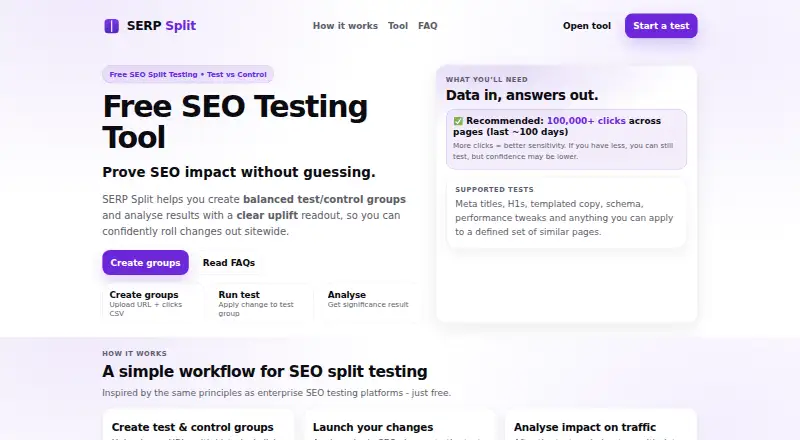
What SERP Split is
SERP Split is a free web tool for comparing similar pages through SEO holdout experiments and measuring traffic changes. Users upload a CSV with URL and click columns; stratified sampling creates test and control groups. For analysis, they provide daily traffic data with date, test_traffic, and control_traffic columns. The site says it measures uplift and confidence using Bootstrap Casual Inference. A results preview shows uplift, absolute clicks, a p-value, significance, and an exportable graph. Possible test changes include meta titles, H1s, internal links, templated copy, AI content, FAQs, schema, and performance fixes. The site recommends running experiments for about 21–30 days while isolating one main variable to the test group. Its data guidance suggests 100,000 or more clicks across pages over roughly the previous 100 days, while warning that lower volume may reduce confidence. The privacy policy says tool data is processed locally and temporarily, not retained or sent for storage, and that personal data is not collected, stored, or processed. It also notes limited non-personal tracking cookies for aggregated usage measurement and tool interaction insights.
Good
- Free web tool for holdout experiments.
- Creates groups using stratified sampling.
- Results preview includes uplift and significance.
- Privacy policy says tool data is not retained.
Watch out
- Lower click volume may reduce confidence.
- Recommended test duration is about 21–30 days.
- Limited non-personal tracking cookies are used.
Who it suits
SERP Split suits site owners or SEO practitioners comparing similar pages after a defined change. Its guidance is geared toward experiments with substantial click volume and a 21–30 day run.
Verdict
SERP Split provides a focused workflow for comparing test and control page groups using traffic data. Its guidance favors isolating one variable and having a substantial volume of clicks.
Plans and prices
From SERP Split's own pricing page, checked 7 Oct 2001.
| Plan | Price | What it gives you |
|---|---|---|
| Free | Free | Free SEO testing tool; no paid plan stated |
The facts
Each one read from SERP Split's own pages, with the date it was checked.
What it does
- Analysis input
- Users upload daily traffic data with date, test_traffic, and control_traffic columns to analyze results.checked 7 Oct 2001
- Cookies
- The privacy policy says limited non-personal tracking cookies are used for aggregated usage measurement and tool interaction insights.checked 7 Oct 2001
- Creator
- The site identifies Tara Bevan as the creator of SERP Split.checked 7 Oct 2001
- Data guidance
- It recommends 100,000+ clicks across pages over roughly the last 100 days, while noting that lower volume may reduce confidence.checked 7 Oct 2001
- Data handling
- The privacy policy says tool data is processed locally and temporarily and is not stored, retained, logged, or transmitted for storage.checked 7 Oct 2001
- Group creation
- Users upload a CSV with URL and click columns to generate test and control groups using stratified sampling.checked 7 Oct 2001
- Personal data
- The privacy policy says SERP Split does not collect, store, or process personal data.checked 7 Oct 2001
- Purpose
- SERP Split creates test and control groups and analyzes SEO changes to show traffic uplift and confidence.checked 7 Oct 2001
- Results
- The results preview includes uplift, absolute clicks, a p-value, significance, and an exportable graph.checked 7 Oct 2001
- Statistical method
- The site says results measure uplift and confidence using Bootstrap Casual Inference.checked 7 Oct 2001
- Terms
- The terms say users are responsible for maintaining the confidentiality of their data and that UK law governs the terms.checked 7 Oct 2001
- Testable changes
- Examples include meta titles, H1s, internal links, templated copy, AI content, FAQs, schema, and performance fixes.checked 7 Oct 2001
- Test duration
- The site recommends running tests for about 21–30 days and keeping one main variable isolated to the test group.checked 7 Oct 2001