Argo Rollouts
Argo Rollouts is a Kubernetes controller and set of custom resource definitions for progressive delivery.
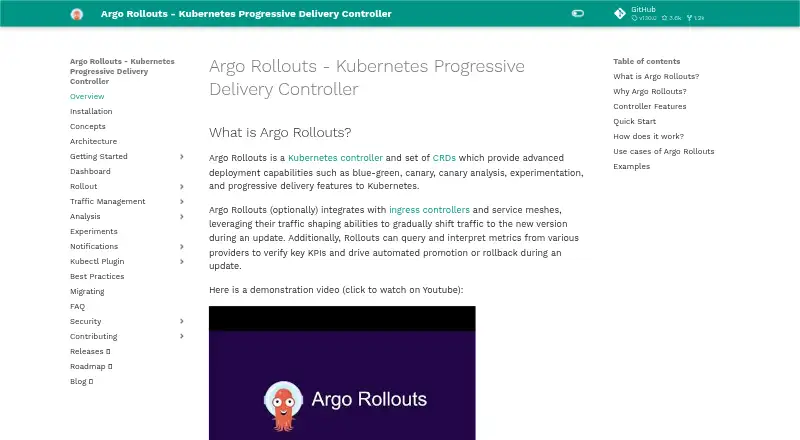
What Argo Rollouts is
Argo Rollouts is a Kubernetes controller and set of custom resource definitions for progressive delivery. It supports BlueGreen, Canary, and Rolling Update strategies, with weighted traffic shifting through supported ingress controllers and service meshes. It can query metrics to assess key performance indicators and automate promotion or rollback, while allowing manual judgment as well. Integrations include metric providers such as Prometheus, Datadog, New Relic, Graphite, and InfluxDB, plus traffic providers including NGINX, AWS ALB, Istio, and Traefik. Notifications can use configurable triggers and templates, including Slack and Microsoft Teams. The project is standalone and does not require Argo CD. It focuses on a single application in one Kubernetes cluster; each cluster using Rollout workloads needs its own controller and custom resource definition. A Rollout specification does not manage dependencies among multiple applications. Applications with shared resources or worker-style queue processing may not work well, and infrastructure applications are not recommended use cases. Argo Rollouts is free and open source, with self-hosted deployment.
Good
- Supports BlueGreen, Canary, and Rolling Update strategies.
- Can shift weighted traffic gradually.
- Metric analysis can drive promotions and rollbacks.
- Standalone; Argo CD is not required.
- Free and open source.
Watch out
- Each cluster needs its own controller and CRD.
- Focuses on one application in one cluster.
- Shared-resource or worker-queue applications may not work well.
- Infrastructure applications are not recommended use cases.
Who it suits
Argo Rollouts suits teams deploying application updates to Kubernetes that want progressive strategies and metric-driven promotion or rollback. It is intended for application-level rollouts rather than managing infrastructure or multi-application dependencies.
Verdict
Argo Rollouts gives Kubernetes teams several progressive delivery strategies and can use metric analysis to guide updates. Its per-cluster controller requirement and single-application scope matter when planning deployments.
Plans and prices
From Argo Rollouts's own pricing page, checked 2 Oct 2026.
| Plan | Price | What it gives you |
|---|---|---|
| Free and open source | Free | Kubernetes controller and CRDs · self-hosted installation |
The facts
Each one read from Argo Rollouts's own pages, with the date it was checked.
What it does
- Argo CD
- Argo Rollouts is a standalone project and does not require Argo CD, though the FAQ describes how the two can work together.checked 2 Oct 2026
- Argo CD dependency
- Argo Rollouts is standalone and does not require Argo CD or another Argo project.checked 1 Oct 2026
- Artifact verification
- Container images are cosign-signed and release artifacts have SLSA provenance that can be verified with cosign or slsa-verifier.checked 1 Oct 2026
- Automated analysis
- It can query metrics to assess KPIs and drive automated promotion or rollback during an update.checked 2 Oct 2026
- Automation
- Rollouts can perform automated promotions and rollbacks based on metric analysis, alongside manual judgement.checked 1 Oct 2026
- Cluster scope limit
- Each cluster using Rollout workloads needs its own Rollout CRD and controller; a central controller cannot manage Rollout resources in external clusters.checked 2 Oct 2026
- Compatibility limits
- Applications using shared resources or worker-style queue processing may not work well with Argo Rollouts, and infrastructure applications are not recommended use cases.checked 1 Oct 2026
- Dashboard
- An optional kubectl plugin provides command-line management and visualization, and the docs also list a dashboard installation manifest.checked 2 Oct 2026
- Deployment strategies
- It supports blue-green, canary, and rolling update strategies.checked 2 Oct 2026
- GitOps and CI/CD
- It reacts to Kubernetes manifest changes regardless of how they were made and can be used with traditional CI/CD that does not follow GitOps.checked 2 Oct 2026
- High availability
- The controller can run with multiple replicas for high availability by enabling leader election.checked 2 Oct 2026
- Installation
- The controller can be installed with standard cluster-level manifests or with a namespace-level installation that requires the CRDs to be installed separately.checked 2 Oct 2026
- Integrations
- Documented integrations include NGINX, AWS ALB, Apache APISIX, Istio, Linkerd, SMI, Prometheus, Datadog, New Relic, Graphite, and InfluxDB.checked 2 Oct 2026
- Metrics
- Metric provider integrations include Prometheus, Wavefront, Kayenta, Web, Kubernetes Jobs, Datadog, New Relic, Graphite, and InfluxDB.checked 1 Oct 2026
- Notifications
- The Notifications Engine supports configurable triggers and templates, including integrations such as Slack and Microsoft Teams.checked 1 Oct 2026
- Operational scope
- The project currently supports a single Kubernetes deployment or application within a single cluster and requires a controller in each cluster using Rollouts.checked 1 Oct 2026
- Purpose
- Argo Rollouts is a Kubernetes controller and set of CRDs for advanced deployment and progressive delivery.checked 2 Oct 2026
- Scope limit
- A Rollout specification focuses on a single application and does not manage dependencies among multiple applications.checked 2 Oct 2026
- Security
- The project documents cosign verification of signed container images and SLSA Level 3 provenance for container image attestations.checked 2 Oct 2026
- Traffic control
- It can gradually shift traffic to a new version using ingress controllers or service meshes, and can also adjust ReplicaSet counts when no traffic routing provider is configured.checked 2 Oct 2026
- Traffic management
- It supports fine-grained weighted traffic shifting and integrations with ingress controllers and service meshes.checked 1 Oct 2026
- Traffic providers
- Supported traffic providers include AWS ALB, Ambassador Edge Stack, Apache APISIX, Google Cloud, Gateway API, Istio, Kong, NGINX, SMI, and Traefik.checked 1 Oct 2026
Where it runs
- CLI platforms
- The installation docs provide kubectl plugin binaries for Linux and macOS, and the release artifact list also includes a Windows binary.checked 2 Oct 2026
- Release platforms
- Release assets include CLI binaries for macOS, Linux, and Windows in amd64 and arm64 variants where provided.checked 1 Oct 2026
The full review of Argo Rollouts
Overview
Argo Rollouts turns Kubernetes releases into controlled rollout processes, with options for traffic shifting, analysis and approval. It is most useful to teams already operating Kubernetes workloads that need more control over how application versions reach users. Its release controls are focused on one application at a time, not a coordinated system of dependent services.
Key features
Blue-green, canary and rolling-update strategies let teams choose how a new version is introduced. With an ingress controller or service mesh configured, Rollouts can shift traffic in fine-grained weights; without a traffic provider, it can adjust ReplicaSet counts instead. That flexibility makes it adaptable to different cluster setups, but the traffic-routing behavior depends on integrations the team already operates.
Supported traffic providers include AWS ALB, Ambassador Edge Stack, Apache APISIX, Google Cloud, Gateway API, Istio, Kong, NGINX, SMI and Traefik. Metric integrations include Prometheus, Wavefront, Kayenta, Datadog, New Relic, Graphite, InfluxDB, web queries and Kubernetes Jobs. Rollouts can use those measurements to promote or roll back an update automatically, while also supporting manual judgment and approval gates. This is a strong fit when release decisions can be tied to meaningful KPIs; it does not choose the right metrics or thresholds for a team.
Rollouts responds to Kubernetes manifest changes regardless of how they were made, so it can sit alongside traditional CI/CD as well as GitOps workflows. It is standalone: Argo CD is optional. The controller is installed with standard or namespace-scoped manifests, and an optional kubectl plugin provides command-line management and visualization. A dashboard has a separate installation manifest. Multiple controller replicas can be run with leader election for high availability.
Configurable notification triggers and templates can connect updates to tools such as Slack and Microsoft Teams. Container images are cosign-signed, and release artifacts carry SLSA provenance verifiable with cosign or slsa-verifier. The project accepts confidential vulnerability reports by email and publishes advisories through GitHub Security Advisories.
Pricing
Free and open source — free. The plan includes a Kubernetes controller and CRDs for self-hosted installation. There is no paid plan or trial in this offering. Teams provide and operate their own Kubernetes environment and deployment infrastructure; the free license does not turn Rollouts into a hosted service.
Platforms
Argo Rollouts is self-hosted and listed for Linux, macOS and Windows. Release assets include CLI binaries for those operating systems, with amd64 and arm64 variants where provided. Installation documentation provides kubectl plugin binaries for Linux and macOS, while the release artifacts also include a Windows binary.
Who it's for
Choose Rollouts when Kubernetes application releases need staged exposure, traffic weighting or metric-driven promotion and rollback. Its compatibility with ordinary manifest changes means teams do not have to adopt Argo CD or a GitOps-only pipeline to use it. It is less suitable for infrastructure applications, workloads sharing resources in ways that complicate release isolation, and worker-style queue processing. A Rollout specification covers one application and does not coordinate dependencies among applications.
Plan cluster operations accordingly: every cluster running Rollout workloads needs its own CRD and controller. A central controller cannot manage Rollout resources in external clusters, so multi-cluster users must install and maintain a controller in each one.
Pros and cons
- Pros: Blue-green, canary and rolling updates provide several ways to control exposure, including weighted traffic shifts when a supported routing provider is in place.
- Pros: Metric-based automated promotions and rollbacks can reduce reliance on manual release decisions, while manual judgment remains available.
- Pros: Standalone operation and manifest-change responsiveness let teams use Rollouts without adopting Argo CD or replacing traditional CI/CD.
- Pros: Multiple controller replicas with leader election support high availability, and signed images and verifiable provenance add artifact checks.
- Cons: Each cluster needs its own controller and CRD, increasing operational work for multi-cluster deployments.
- Cons: The single-application scope does not manage release dependencies across applications, and some shared-resource or queue-processing workloads may not work well.
- Cons: Traffic shifting requires a configured ingress controller or service mesh; without one, control is limited to ReplicaSet counts.
Alternatives
Flux CD is another free, open-source Kubernetes delivery project; choose it when a broader delivery project better fits the workflow than Rollouts' application-focused release controls.
Garden has a free tier with limited build minutes, cache hits and cache retention, plus an Enterprise plan with custom pricing. Consider it when those build and cache limits align with the team's needs.
Octopus Deploy offers a freemium option and a free trial, as well as paid machine and tenant add-ons. It is worth comparing when an add-on pricing model suits the deployment operation.
Cyclops is free, self-hosted open-source software that works with existing Helm charts; choose it when chart-based workflows are the priority.
Helm is a free, self-managed command-line tool under the Apache-2.0 license, a simpler fit when package-based Kubernetes deployment is the main need rather than progressive rollout controls.
KubeVela is a free, self-hosted Kubernetes control plane under Apache-2.0; compare it when a control-plane approach is a better fit.
PipeCD is a free, Apache 2.0-licensed open-source option for teams comparing Kubernetes delivery projects.
Weave GitOps offers an open-source edition requiring Kubernetes and Flux, alongside an Enterprise edition with custom pricing. Choose it when a Flux-based GitOps workflow is the priority.
Browse Kubernetes Deployment Tools, Progressive Delivery Software and Continuous Delivery Software for more options.
Verdict
Argo Rollouts is a strong choice for Kubernetes teams that want application-level canary, blue-green or rolling releases and can use metrics to automate promotion and rollback. Its standalone operation keeps it compatible with varied CI/CD practices, but the per-cluster controller burden and single-application scope are real constraints. Look elsewhere if you need coordinated multi-application releases or a workload that does not suit progressive rollout controls.
Getting started
- Open the Argo Rollouts website.
- Choose standard or namespace-scoped controller manifests for installation.
- Install the controller in each Kubernetes cluster that will use Rollout workloads.
- Optionally install the kubectl plugin for command-line management and visualization.
- Configure a supported traffic provider and metric integration if needed.
Limits worth knowing
The free plan is the self-hosted Kubernetes controller and CRDs. Each cluster using Rollout workloads needs its own controller and CRD, and a Rollout specification covers a single application rather than managing dependencies among applications.
Questions
How much does Argo Rollouts cost?
The listed Free and open source plan is free.
Is Argo Rollouts open source?
Yes. It is open source and listed as free.
Does it require Argo CD?
No. Argo Rollouts is standalone, though it can work alongside Argo CD.
Which deployment strategies does it support?
It supports BlueGreen, Canary, and Rolling Update strategies.
Which platforms are supported?
The listed platforms are Linux, macOS, self-hosted, and Windows. Release assets include CLI binaries for macOS, Linux, and Windows in amd64 and arm64 variants where provided.
How is it installed?
Install the controller with standard or namespace-scoped manifests. The kubectl plugin is optional.
Alternatives to Argo Rollouts
- 1

Terraform
Free planWebAPILinuxmacOS8.0Free plan - 2
Teploy Arcade
Free planOpen sourceWebAPILinuxmacOS7.5Free plan - 3

LaunchDarkly Experimentation
Free planAndroidiOSWebAPI7.4$108.33 usage-based - 4

CircleCI
Free planWebAPILinuxmacOS7.3From $15 a month - 5

Octopus Deploy
Free planWebAPILinuxSelf-hosted7.3From $4,330 a year - 6

Bytebase Enterprise
Free planWebAPISelf-hosted6.8From $20 a month