
CircleCI
CircleCI provides CI/CD tooling for engineering teams to ship code and validate changes.
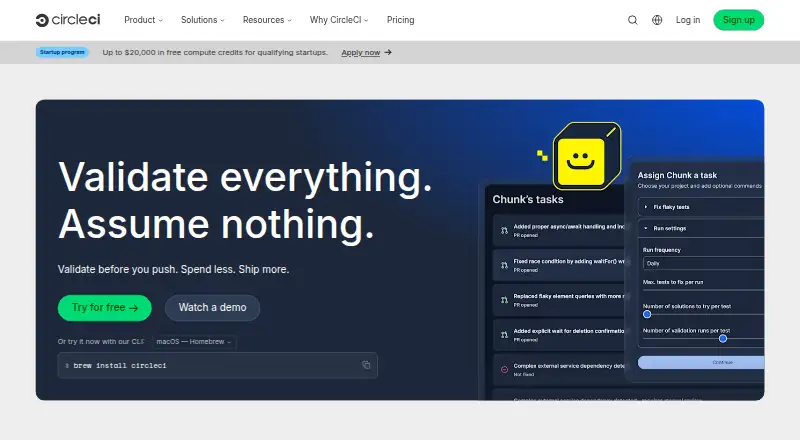
What CircleCI is
CircleCI provides CI/CD tooling for engineering teams to ship code and validate changes. Smarter Testing includes test impact analysis, dynamic test splitting, and automatic reruns of failed tests. Execution options include Docker, Linux, Arm, Windows, macOS, and self-hosted runners. CircleCI Cloud supports repositories on GitHub, GitLab, GitLab self-managed, Bitbucket Cloud, and Cursor Origin, which is in beta. Teams can use Orbs, shareable configuration packages; private orbs are available across listed plans. CircleCI Deploys lets teams monitor incremental releases and roll back automatically. Security controls include encrypted source-code communication, restricted contexts, audit logging, isolated build sandboxes, and OpenID Connect support. CircleCI says it is SOC 2 Type II compliant and has a FedRAMP Tailored designation. Its API supports programmatic interaction with pipelines, projects, and organizations. Free-plan credits expire after a month without rollover; paid credits roll over and expire after a year.
Good
- Supports multiple hosted and self-hosted execution options.
- Automatically reruns failed tests.
- Private Orbs are available across listed plans.
- API supports pipeline, project, and organization interaction.
Watch out
- Free-plan credits expire after a month without rollover.
- Cursor Origin support is in beta.
Who it suits
CircleCI describes its tools for developers, developer experience teams, and businesses seeking speed, focus, and control in software delivery. Teams that need varied execution environments or pipeline API access may find relevant capabilities here.
Verdict
CircleCI brings testing, execution, deployment visibility, and security controls into a CI/CD offering. Its free plan has a defined credit expiry, while Performance begins at $15 a month.
Plans and prices
From CircleCI's own pricing page, checked 30 Sep 2026.
| Plan | Price | What it gives you |
|---|---|---|
| Performance | $15 a month | 30,000 credits included free · 5 active users included free · 80x concurrency · 5 GB network · 2 GB storage · Larger resources · Starting at $15 /month |
| Free | — | Up to 6,000 build minutes using small Docker · Up to 5 active users/month · 30x concurrency · 1 GB network · 2 GB storage · $0 /month |
| Scale | Priced on request | Customizable plans · Enterprise controls · Unlimited concurrency · 50 GB network · 200 GB storage · All environments, including GPU · Billed annually; Get in touch |
The facts
Each one read from CircleCI's own pages, with the date it was checked.
What it does
- API
- CircleCI's API enables programmatic interaction with pipelines, projects, and organizations.checked 30 Sep 2026
- Compliance
- CircleCI states that it is SOC 2 Type II compliant and has a FedRAMP Tailored designation.checked 30 Sep 2026
- Deployment visibility
- The product page says CircleCI Deploys lets teams monitor incremental releases and roll back automatically.checked 30 Sep 2026
- Execution environments
- CircleCI pricing lists Docker, Linux, Arm, Windows, macOS, and self-hosted runners as supported execution options.checked 30 Sep 2026
- Product
- CircleCI provides CI/CD tooling to help engineering teams ship code and validate changes.checked 30 Sep 2026
- Reusable configuration
- Orbs are shareable configuration packages, and private orbs are available across all listed plans.checked 30 Sep 2026
- Security controls
- CircleCI describes encrypted source-code communication, restricted contexts, audit logging, isolated build sandboxes, and OpenID Connect support.checked 30 Sep 2026
- Support
- Community support is included across plans; ticket-based global support and 8x5 support SLAs are available on Performance and Scale, with 24x7 SLAs available on Scale.checked 30 Sep 2026
- Test optimization
- Smarter Testing includes test impact analysis, dynamic test splitting, and automatic reruns of failed tests.checked 30 Sep 2026
- Usage limits
- Free-plan credits expire after a month without rollover, while paid credits roll over and expire after a year.checked 30 Sep 2026
- Version control integrations
- CircleCI Cloud supports repositories hosted on GitHub, GitLab, GitLab self-managed, Bitbucket Cloud, and Cursor Origin; Cursor Origin is in beta.checked 30 Sep 2026
- Who it serves
- CircleCI describes its tooling as serving developers, developer experience teams, and businesses seeking speed, focus, and control in software delivery.checked 30 Sep 2026
The company
- Founded
- 2011checked 28 Sep 2026
- Headquarters
- San Francisco, California, United Stateschecked 28 Sep 2026
The full review of CircleCI
CircleCI is a CI/CD platform for teams that need to validate code changes and coordinate software delivery. It suits developers and developer-experience teams looking to tune test execution and choose among hosted or self-hosted runners. Its breadth of execution options and deployment controls is balanced by usage caps on the free plan and custom pricing for Scale.
Overview
CircleCI brings pipeline execution, testing, and deployment visibility into one service. Teams can connect supported code hosts, define pipelines in YAML, and use the API to interact with pipelines, projects, and organizations. Pull request checks and artifact or dependency caching support the everyday build loop; the practical appeal is strongest for teams that want more control over how tests run and where jobs execute.
Key features
Test execution and configuration
Smarter Testing combines test impact analysis, dynamic test splitting, and automatic reruns of failed tests. These tools target slow or unreliable test suites: splitting can distribute work, while impact analysis can focus validation and reruns can recover from failures without requiring an immediate manual restart. Orbs package reusable configuration for sharing across projects, and private orbs are available on every listed plan.
Environments and integrations
CircleCI supports Docker, Linux, Arm, Windows, macOS, and self-hosted runners. That range can accommodate teams with mixed build requirements or a need to run jobs on their own infrastructure, though the right fit depends on the resources and concurrency each plan allows. CircleCI Cloud integrates with GitHub, GitLab, GitLab self-managed, Bitbucket Cloud, and Cursor Origin; Cursor Origin is in beta.
Releases and safeguards
CircleCI Deploys is described as a way to monitor incremental releases and roll back automatically, adding release oversight beyond build completion. Security controls include encrypted source-code communication, restricted contexts, audit logging, isolated build sandboxes, and OpenID Connect support. CircleCI states that it is SOC 2 Type II compliant and has a FedRAMP Tailored designation.
Pricing
CircleCI uses a freemium model. The Free plan costs $0 /month and allows up to 6,000 build minutes using small Docker, up to 5 active users/month, 30x concurrency, 1 GB of network, and 2 GB of storage. That is a useful way to begin or support modest workloads, but the small-Docker limit and capped minutes, users, and concurrency constrain larger teams. Free credits expire after a month without rollover.
Performance starts at $15 a month, billed starting at $15 /month. It includes 30,000 credits and 5 active users free, 80x concurrency, 5 GB of network, 2 GB of storage, and larger resources. The included credits and higher concurrency make it the more suitable step up for teams whose builds exceed Free’s limits, while the five included active users and network allowance still matter when planning usage. Paid credits roll over and expire after a year.
Scale has custom pricing and is billed annually. Its customizable plans include enterprise controls, unlimited concurrency, 50 GB of network, 200 GB of storage, and all environments, including GPU. It is aimed at organizations needing broader capacity and controls, but the annual billing and custom quote make it a different commitment from the self-serve entry tiers.
Community support is included across plans. Performance and Scale add ticket-based global support and 8x5 support SLAs; Scale also offers 24x7 SLAs. That distinction matters for teams that need contracted response coverage rather than community help.
Platforms
CircleCI supports API, Linux, macOS, self-hosted, web, and Windows platforms. Hosted execution and self-hosted runners give teams a choice of operating their builds through CircleCI’s hosted option or running jobs on their own infrastructure.
Who it's for
CircleCI is a strong fit for engineering teams that want test optimization, reusable pipeline configuration, and a choice of execution environments in one CI/CD service. Performance is the clearest fit for growing usage that needs more concurrency than Free provides; Scale suits organizations seeking enterprise controls, larger allowances, or 24x7 support SLAs. Teams with light build needs may find Free sufficient, while teams that need predictable costs beyond the published Performance starting price should weigh Scale’s custom annual pricing carefully.
Pros and cons
- Pros: Smarter Testing offers test impact analysis, dynamic splitting, and automatic failed-test reruns, useful for teams trying to make validation more efficient.
- Pros: Docker, Linux, Arm, Windows, macOS, and self-hosted execution options accommodate varied build environments.
- Pros: Private orbs are available across plans, so reusable configuration is not reserved for higher tiers.
- Pros: Deployment monitoring, rollback capability, and multiple security controls extend the service beyond basic build execution.
- Cons: Free credits expire after a month and do not roll over, making unused allowance less forgiving than paid credits.
- Cons: Free caps include 6,000 build minutes, five active users, 30x concurrency, and 1 GB network, which can limit sustained team use.
- Cons: Scale requires custom annual pricing, so organizations cannot assess its cost from a fixed monthly price.
Alternatives
For a broader comparison, see Continuous Integration Software, Game Build Automation Software, Mobile CI/CD Software, and Test Flakiness Management Software.
- TeamCity is another freemium option with a free forever Professional (On-Premises) plan that includes unlimited users, three build agents, and 100 build configurations; consider it if those allowances suit your setup.
- Bitbucket Pipelines offers a free forever tier for up to five users, unlimited public and private repositories, 1 GB LFS storage, and 50 build minutes; it may suit teams whose needs fit those limits.
- Buildkite has a free plan for up to five users and 10 concurrent jobs, with monthly Linux vCPU-minute and test limits; consider it if those free allowances align with your workload.
- Travis CI has a free plan with 10,000 credits, unlimited unique users, private and open-source repositories, and Windows, Linux, and macOS support; it is worth comparing if those terms fit your needs.
- Codemagic has a free tier for one team member, 500 build minutes refilled monthly, and one parallel build; consider it if those limits fit your workload.
- AppVeyor offers a free Open-source plan with unlimited public projects, one concurrent job, five self-hosted jobs, and community support; it is an option for public-project workloads.
- Bitrise has a free forever Hobby tier for a team of one, with build credits for a small project a few times per month and community support; it may suit a solo, light-use case.
- Appcircle has a free Starter tier with one concurrent build, a 30-minute maximum per build, and 20 builds per month; consider it if that allowance is enough.
Verdict
Choose CircleCI if your team needs flexible execution environments alongside test optimization, reusable configuration, and release visibility. Performance is the practical upgrade when Free’s concurrency and usage caps become restrictive; look elsewhere if you need a firm Scale price before committing to annual custom pricing or if CircleCI’s free allowances do not match your workload.
Alternatives to CircleCI
- 1

Terraform
Free planWebAPILinuxmacOS8.0Free plan - 2
Teploy Arcade
Free planOpen sourceWebAPILinuxmacOS7.5Free plan - 3

LaunchDarkly Experimentation
Free planAndroidiOSWebAPI7.4$108.33 usage-based - 4

Octopus Deploy
Free planWebAPILinuxSelf-hosted7.3From $4,330 a year - 5
Argo Rollouts
Free planLinuxmacOSSelf-hostedWindows6.9Free plan - 6

Bytebase Enterprise
Free planWebAPISelf-hosted6.8From $20 a month