
Appcircle
Appcircle is an enterprise mobile CI/CD platform for building, testing, and publishing applications in cloud or self-hosted environments.
What Appcircle is
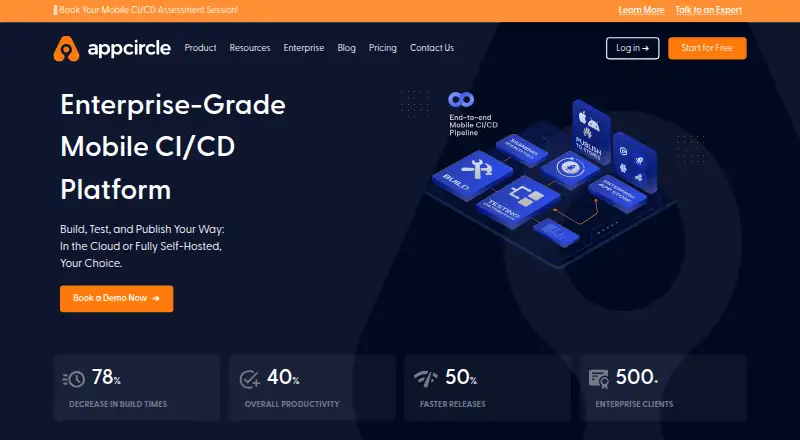
Appcircle is an enterprise mobile CI/CD platform for building, testing, and publishing applications in cloud or self-hosted environments. Its workflows cover iOS, Android, React Native, and Flutter, with modules for automated builds, advanced caching, unit and UI testing, and build monitoring. Additional modules handle testing distribution, an enterprise app store, signing identity management, binary re-signing, CodePush, and publishing to app stores and Microsoft Intune. Hundreds of ready workflow steps include integrations such as Fastlane, SonarQube, BrowserStack, Firebase App Distribution, and AWS Device Farm. Appcircle says source code is fetched only during builds, agents are isolated temporary virtual machines, and repository access uses read-only tokens. Self-hosted deployments support Docker, Podman, Kubernetes, and OpenShift, keeping source code, signing identities, and build artifacts within a customer network. Enterprise controls include role-based access, SSO, LDAP, usage audits, and notifications. The free Starter plan allows 20 builds per month, one concurrent build, 30 minutes per build, 1,000 CodePush updates, specified download quotas, and five store publishes monthly. Corporate licensing is annual with tailored limits.
Good
- Supports iOS, Android, React Native, and Flutter
- Cloud and self-hosted deployment options
- Automated builds with caching and testing
- Hundreds of ready workflow steps
- Self-hosted environments can retain build assets
- Enterprise SSO, LDAP, and role controls
Watch out
- Starter allows only 20 builds monthly
- Starter permits one concurrent build
- Starter builds have a 30-minute maximum
Who it suits
Appcircle suits mobile teams building iOS, Android, React Native, or Flutter apps that need automated build, test, and release workflows. Organizations requiring cloud or self-hosted deployment, repository isolation, enterprise controls, or integrations with mobile delivery tools can use its broader capabilities. Individuals can explore the service through the limited Starter plan.
Verdict
Pick Appcircle when a mobile team needs CI/CD spanning build, testing, signing, distribution, and store publishing, with cloud or self-hosted control. The Starter plan is suitable for limited exploration, while larger organizations can use enterprise deployment and governance features. Look elsewhere if the Starter quotas do not fit your build volume or if you need a stated Corporate price.
Plans and prices
From Appcircle's own pricing page, checked 30 Sep 2026.
| Plan | Price | What it gives you |
|---|---|---|
| STARTER | Free | 1 concurrent build · 30 minutes max per build · 20 builds/month · 1,000 CodePush updates/month · 100 Testing Distribution downloads/month · 100 Enterprise App Store downloads/month · 5 store publishes/month |
| CORPORATE | Priced on request | Tailored module limits · Public, private cloud, or on-prem deployment · selectable machine plans · SSO/LDAP · multi-tenancy · role-based access · dedicated SLA support · Annual licensing; monthly usage limits renew each month. |
The facts
Each one read from Appcircle's own pages, with the date it was checked.
Where it runs
- App delivery
- Modules include testing distribution, enterprise app store, signing identity management, binary re-signing, CodePush, and publishing to app stores and Microsoft Intune.checked 30 Sep 2026
Money
- Billing
- Appcircle says its licensing is annual, with payments by bank transfer due within 30 days of the invoice date.checked 30 Sep 2026
What it does
- Builds
- The Build module supports automated mobile builds, advanced caching, unit and UI testing, and build monitoring.checked 30 Sep 2026
- Compliance
- The enterprise page states ISO 27001 and SOC 2 Type II compliance.checked 30 Sep 2026
- Deployment
- Self-hosted deployments support Docker, Podman, Kubernetes, and OpenShift, and can keep source code, signing identities, and build artifacts within the customer's network.checked 30 Sep 2026
- Enterprise controls
- Enterprise capabilities include fine-grained role controls, SSO and LDAP, and team-based usage audits and notifications.checked 30 Sep 2026
- Frameworks
- The platform provides CI/CD workflows for iOS, Android, React Native, and Flutter.checked 30 Sep 2026
- Integrations
- Appcircle lists hundreds of ready workflow steps, including Fastlane, SonarQube, BrowserStack, Firebase App Distribution, and AWS Device Farm.checked 30 Sep 2026
- Product
- Appcircle describes itself as an enterprise-grade mobile CI/CD platform for building, testing, and publishing apps in the cloud or self-hosted.checked 30 Sep 2026
- Purpose
- Its stated mission is to simplify and automate mobile development workflows for teams of all sizes.checked 30 Sep 2026
- Security
- Appcircle says source code is fetched only during builds, build agents are isolated temporary virtual machines, and repository access uses read-only tokens.checked 30 Sep 2026
- Starter limits
- The Starter plan is described as intended for individuals exploring Appcircle and has limited usage, including 20 monthly builds and one concurrent build.checked 30 Sep 2026
- Support
- Appcircle offers documentation and community support, while dedicated SLA support includes ticketing, security and legal assessment assistance, prioritized feature requests, and a dedicated customer success manager.checked 30 Sep 2026
The company
- Headquarters
- Dover, Delaware, United Stateschecked 23 Sep 2026
The full review of Appcircle
Appcircle is an enterprise-oriented CI/CD platform for iOS, Android, React Native, and Flutter applications. It suits mobile teams that want builds, testing, signing, distribution, and publishing in one hosted or self-managed workflow. Starter is useful for trying the platform, while serious production use depends on whether its quotas and enterprise pricing fit your operation.
Overview
Appcircle combines continuous integration with the delivery work that follows a successful build. Pull-request checks, configurable pipelines, and artifact or dependency caching support regular development, while distribution and publishing modules carry releases toward testers, stores, and managed devices.
Hosted use is available, but teams can also deploy with Docker, Podman, Kubernetes, or OpenShift. Self-hosting can keep source code, signing identities, and build artifacts inside the customer network, a meaningful advantage for regulated or tightly governed environments. Appcircle says source is fetched only during builds, agents are isolated temporary virtual machines, and repository access uses read-only tokens. Its enterprise offering states ISO 27001 and SOC 2 Type II compliance.
Key features
Build and test workflows
The Build module automates mobile builds with advanced caching, unit and UI testing, and build monitoring. That combination is suited to teams that need repeatable checks rather than a simple one-off compiler. Hundreds of ready workflow steps, including Fastlane, SonarQube, BrowserStack, Firebase App Distribution, and AWS Device Farm, can connect familiar testing, quality, and device services without constructing every integration from scratch.
Delivery and release control
Testing Distribution and an Enterprise App Store provide controlled ways to deliver internal or pre-release binaries. Signing identity management and binary re-signing address a common source of release friction, while CodePush supports updates outside a full store submission. Publishing reaches app stores and Microsoft Intune, extending the platform from build server to distribution channel.
Governance and support
Enterprise controls include fine-grained roles, SSO and LDAP, team-based usage audits, and notifications. Dedicated SLA support adds ticketing, security and legal assessment assistance, prioritized feature requests, and a customer success manager; documentation and community support remain the lighter support path.
Pricing
STARTER
free with one concurrent build, a 30-minute maximum per build, and 20 builds per month. It also allows 1,000 CodePush updates, 100 Testing Distribution downloads, 100 Enterprise App Store downloads, and five store publishes per month. This is a sensible sandbox for an individual or a small evaluation, but the single build slot and low monthly allowances will constrain active teams, frequent pull-request validation, and regular releases.
CORPORATE
Custom pricing, billed under annual licensing; monthly usage limits renew each month. Corporate adds tailored module limits, public, private-cloud, or on-premises deployment, selectable machine plans, SSO/LDAP, multi-tenancy, role-based access, and dedicated SLA support. Licensing payments are by bank transfer within 30 days of the invoice date. It is the plan for organizations that need governance and deployment control, but the absence of a published price makes budgeting harder before a sales discussion.
Platforms
Appcircle supports Android, iOS, Linux, macOS, web, API, and self-hosted operation. The workflow scope covers native mobile projects plus React Native and Flutter, with both hosted operation and self-hosted runners available.
Who it's for
Choose Appcircle when a mobile engineering organization wants one system spanning build, automated tests, signing, tester distribution, enterprise app delivery, and store or Intune publishing. Self-hosting and enterprise identity, audit, and support controls make it particularly relevant where source and release materials must remain under internal control.
It is less suitable for a developer who only needs inexpensive build minutes, or for a team whose normal volume quickly exceeds 20 Starter builds, one concurrent build, or its download and publishing caps. Corporate can address scale, but requires custom pricing.
Pros and cons
- Pro: Build, test, signing, distribution, CodePush, and publishing modules cover most of a mobile release chain in one platform.
- Pro: Docker, Podman, Kubernetes, and OpenShift deployment lets customers retain source, identities, and artifacts inside their network.
- Pro: Read-only repository tokens, isolated temporary agents, and stated ISO 27001 and SOC 2 Type II enterprise compliance support governance requirements.
- Con: Starter's 20 monthly builds and one concurrent build are restrictive for a busy team or frequent pull-request checks.
- Con: Starter also caps build duration, downloads, CodePush updates, and store publishes, limiting it as a continuing production plan.
- Con: Corporate pricing is custom, so total cost cannot be compared from a published rate alone.
Alternatives
Codemagic is worth choosing when a free plan with one team member, 500 monthly build minutes, one parallel build, and 30 days of history better matches a small project's usage.
Bitrise fits a solo hobby project seeking a free-forever team-of-one plan with community support and occasional build credits.
GoCD is the straightforward choice for an open-source, downloadable continuous delivery server.
Argo Rollouts suits teams wanting a self-hosted Kubernetes controller and CRDs.
Flux CD is for an open-source Kubernetes delivery project when you already operate a Kubernetes cluster.
Octopus Deploy is an alternative for teams that prefer machine- and tenant-based add-ons with published annual options.
Argo CD offers a self-managed Kubernetes installation, while Argo CD provides declarative GitOps delivery for Kubernetes.
For broader category comparisons, see Mobile CI/CD Software, Continuous Integration Software, and Continuous Delivery Software.
Verdict
Appcircle is a strong choice for mobile teams that need an end-to-end CI/CD and release platform with hosted convenience or self-hosted control. Its breadth, governance features, and deployment flexibility are the main reasons to choose it. Look elsewhere if Starter's quotas cannot support your build volume or if you need a published Corporate price before committing.
Getting started
- Open https://appcircle.io/
- Choose the free Starter plan or request Corporate licensing
- Select cloud hosting or a self-hosted deployment
- Connect a mobile project using an available workflow step
- Configure build, testing, distribution, signing, or publishing modules
- Run builds within the plan's usage limits
Limits worth knowing
Starter includes one concurrent build, a 30-minute maximum per build, 20 builds per month, 1,000 CodePush updates per month, 100 Testing Distribution downloads, 100 Enterprise App Store downloads, and five store publishes monthly. Corporate plans have tailored module limits that renew monthly.
Questions
Does Appcircle have a free plan?
Yes. The free Starter plan includes defined build, update, download, and publishing quotas.
Which platforms and frameworks are supported?
Appcircle supports Android, iOS, Linux, macOS, self-hosted, and web access, with workflows for iOS, Android, React Native, and Flutter.
Can Appcircle be self-hosted?
Yes. Self-hosted deployments support Docker, Podman, Kubernetes, and OpenShift.
What integrations are available?
Ready workflow steps include Fastlane, SonarQube, BrowserStack, Firebase App Distribution, and AWS Device Farm.
Alternatives to Appcircle
- 1

Codemagic
Free planAndroidiOSWebAPI8.2From $99 a month - 2

Bitrise
Free planAndroidiOSWebAPI7.7From $89 a month - 3

PipeCD
Free planOpen sourceWebAPILinuxmacOS7.5Free plan - 4
OpsMx Intelligent Software Delivery Platform
Free planWebAPISelf-hosted7.4From $25 a month - 5

Octopus Deploy
Free planWebAPILinuxSelf-hosted7.3From $4,330 a year - 6
GoCD
Free planWebAPILinuxmacOS7.2Free plan