Unleash
Unleash is a feature management platform for changing software behavior and managing production releases without redeploying code.
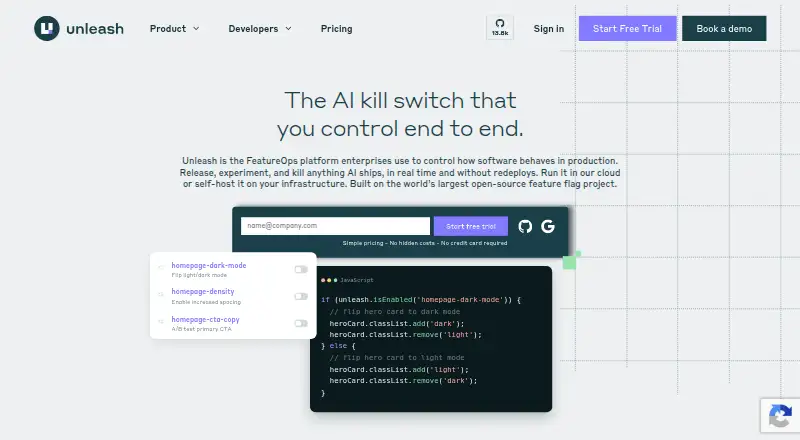
What Unleash is
Unleash is a feature management platform for changing software behavior and managing production releases without redeploying code. Teams can use progressive rollouts, instant rollbacks, release templates and kill switches. Its experimentation tools include A/B/n testing with flag variants, user segmentation and stickiness. Feature flags are evaluated in SDKs or at the edge, rather than on the Unleash server. The platform lists more than 25 SDKs for languages and frameworks including Node.js, Java, Go, Python, .NET, React, Android and iOS. Integrations include Slack, Teams, Datadog, Jira and generic webhooks, alongside Admin, Frontend and Client APIs. Listed security controls include SOC 2 Type II and GDPR compliance, SSO, role-based access control and audit log retention of up to two years. Enterprise deployments can be hosted, self-hosted or hybrid, and enterprise plans offer US or EU data residency. The free Open Source instance has no seat limit but is capped at one project, two environments and 5,000 feature flags. Pay-As-You-Go costs $75/user/mo and includes a 14-day trial without a credit card.
Good
- Supports progressive rollouts and instant rollbacks.
- Lists more than 25 SDKs.
- Free plan has no seat limit.
- Enterprise plans offer US or EU data residency.
- 14-day trial requires no credit card.
Watch out
- Free instance is limited to one project.
- Free instance is limited to two environments.
- Free instance lacks SSO and a support SLA.
- Pay-As-You-Go has a five-seat minimum for self-hosting.
Who it suits
Unleash suits software teams that need to control releases and feature behavior in production. Its enterprise deployment and governance options may suit teams with compliance, approval and scale requirements.
Verdict
Unleash combines release controls, experimentation and integrations, with hosted and self-hosted enterprise options. Review the free instance caps and Pay-As-You-Go request terms against your deployment needs.
Plans and prices
From Unleash's own pricing page, checked 8 Oct 2026.
| Plan | Price | What it gives you |
|---|---|---|
| Open Source | Free | 1 project · 2 environments · 5,000 feature flags per instance · no seat limit |
| Unleash Open Source | Free | 1 project · 2 environments · 2-day feature metrics · no support · free to self-host |
| Cloud-hosted Pay-as-you-go | $75 a month | 1 seat minimum · unlimited projects and environments · 90-day feature metrics · 99.9% uptime commitment · 14-day free trial · per seat/month; billed monthly by credit card |
| Pay-As-You-Go | $75 a month | 53M API requests/month, then $5 per million · unlimited client-side MAU, service connections, flags, projects, environments, and experiments · 90-day feature flag metrics · 5-seat minimum for self-hosted · Billed monthly by credit card; no contract |
| Self-hosted Pay-as-you-go | $75 | 5-seat minimum · unlimited projects and environments · 90-day feature metrics · standard support · 1-business-day response SLA · 14-day free trial · per seat/month billed annually by credit card |
| Enterprise custom | Priced on request | unlimited environments and projects · unlimited MAU · custom API allowance · standard or premium support · custom SLA · annual contract; invoice payment |
| Custom Enterprise | Priced on request | Unlimited client-side MAU and service connections · 90-day feature flag metrics · standard or premium support · 99.99% uptime commitment · optional private instance, multi-region Edge, access logs, and IP restrictions · Annual contract; invoiced |
The facts
Each one read from Unleash's own pages, with the date it was checked.
What it does
- Admin API
- The Admin API manages flags, projects, environments, users, roles, integrations and other resources and exposes an OpenAPI specification.checked 15 Oct 2026
- API authentication
- Unleash distinguishes backend, frontend, personal-access and service-account tokens, with project and environment scoping.checked 15 Oct 2026
- Compliance claims
- The maker states that its enterprise controls support SOC 2 Type II, FedRAMP and ISO 27001 requirements and that it provides a Trust Center with reports and policies.checked 15 Oct 2026
- Database requirement
- Unleash requires PostgreSQL; version 8 is officially tested with PostgreSQL 15 or later, while MySQL and MariaDB are unsupported.checked 15 Oct 2026
- Data residency
- Enterprise plans offer US or EU data residency, and Unleash says it can be self-hosted on customer infrastructure.checked 8 Oct 2026
- Deployment
- Unleash Enterprise is offered as hosted cloud, self-hosted, or hybrid, with a hosted private instance available as an Enterprise add-on.checked 8 Oct 2026
- Documentation and support
- The documentation includes quickstarts, tutorials, guides, Learning Lab content, SDK references, API references, integration pages and release notes.checked 15 Oct 2026
- Earlier funding
- TechCrunch reported Unleash's $14 million Series A led by Spark Capital on March 24, 2022, and said the company had 16 employees and 120 paying customers at that time.checked 15 Oct 2026
- Experimentation
- Variants carry weights and payloads for A/B or multivariate experiments with user stickiness.checked 15 Oct 2026
- Feature flags
- Flags belong to projects and can have different activation strategies in each environment.checked 15 Oct 2026
- Flag evaluation
- Feature flags are evaluated in SDKs or at the edge rather than on the Unleash server.checked 8 Oct 2026
- Funding news
- Unleash announced a $35 million Series B led by One Peak on March 4, 2026, with Spark Capital, Frontline Ventures and Firstminute Capital continuing as investors.checked 15 Oct 2026
- Governance
- Enterprise provides project and custom roles, user groups, change-request approvals and audit trails.checked 15 Oct 2026
- Integrations
- Official integrations include Datadog, Jira Cloud, Microsoft Teams, ServiceNow, Slack and generic webhooks; community integrations include Fastify, Quarkus, Vue and New Relic.checked 15 Oct 2026
- Intended users
- Unleash describes its platform as serving enterprise teams and highlights governance, approvals, compliance, and scale requirements.checked 8 Oct 2026
- Latest release
- Release notes list Unleash v8.2.0 on September 8, 2026, adding project-level release templates and creator filtering for flags.checked 15 Oct 2026
- License
- The main source repository uses AGPLv3 from version 8 onward; earlier source versions used Apache 2.0 and official open-source Docker images remain Apache 2.0.checked 15 Oct 2026
- Limit: advanced learning curve
- A G2 reviewer reports that advanced capabilities require training and that large flag inventories can cause minor UI performance issues.checked 15 Oct 2026
- Limit: analytics depth
- A G2 reviewer says built-in analytics are limited and may require a separate metrics tool.checked 15 Oct 2026
- Limit: pricing model
- A G2 reviewer requests viewer-only pricing because every user currently pays the full seat price.checked 15 Oct 2026
- Limit: SDK polling
- Two G2 reviews complain that aggressive default SDK polling can generate unexpectedly high request volume and consume API allowance.checked 15 Oct 2026
The company
- Company facts
- LinkedIn lists Unleash as privately held, founded in 2019, headquartered in Oslo, Norway, with 51–200 employees.checked 15 Oct 2026
- Company identity
- The maker is legally identified as Bricks Software AS, also known as Unleash.checked 15 Oct 2026
- Headquarters
- Oslo, Norwaychecked 28 Sep 2026
The full review of Unleash
Overview
Unleash is a feature management platform for changing software behavior in production without redeploying code. It is best suited to teams that need controlled releases and experimentation across multiple services. Its rollout controls and deployment options are compelling, but request charges and plan-level governance limits deserve scrutiny.
Key features
Progressive rollouts, instant rollbacks, release templates, and kill switches give teams options to pace a release and respond quickly when a change needs to be stopped. That breadth makes Unleash a strong fit for production release control, rather than only basic feature toggling.
For teams comparing product variants, it supports A/B/n testing, experiments, user segmentation, and stickiness. Flags are evaluated in SDKs or at the edge, not on the Unleash server. The platform lists more than 25 SDKs, including Node.js, Java, Go, Python, .NET, React, Android, and iOS; that range is useful across varied stacks, though teams should confirm the evaluation approach fits their architecture.
Integrations include Slack, Teams, Datadog, Jira, and generic webhooks, alongside Admin, Frontend, and Client APIs. Security provisions include SOC 2 Type II and GDPR compliance, SSO through SAML 2.0 or OpenID Connect, role-based access control, and audit log retention of up to two years. Those controls suit governed environments, but the free instance omits several important governance features.
Enterprise deployment can be hosted cloud, self-hosted, or hybrid; Enterprise also offers US or EU data residency, and Unleash can run on customer infrastructure. A hosted private instance is an Enterprise add-on. This flexibility is valuable for organizations with infrastructure or residency requirements, although the enterprise route comes with an annual contract.
Pricing
Open Source: free, with no seat limit, one project, two environments, and 5,000 feature flags per instance. It is a useful starting point for small deployments, but has no SSO, SCIM, granular RBAC, change request approvals, or support SLA.
Pay-As-You-Go: $75 a month, billed monthly by credit card with no contract; the plan has a 14-day trial without a credit card. It includes 53M API requests/month, then $5 per million, unlimited client-side MAU, service connections, flags, projects, environments, and experiments, plus 90-day feature flag metrics. Standard support has a one-business-day response target. The request allowance and overage fee are the key budgeting risk; self-hosted deployments also have a 5-seat minimum.
Custom Enterprise: custom pricing under an annual contract, invoiced. It includes unlimited client-side MAU and service connections, 90-day feature flag metrics, standard or premium support, and a 99.99% uptime commitment. Optional private instance, multi-region Edge, access logs, and IP restrictions make this the more suitable tier for teams with stringent operational or governance needs, but it is a larger contractual commitment.
Platforms
Unleash supports Android, iOS, Linux, macOS, Windows, web, API, and self-hosted deployments. Its SDK coverage across mobile and server-side stacks is a practical advantage for teams shipping across several kinds of clients.
Who it's for
Unleash is a good choice for engineering and product teams that need progressive release controls, experimentation, or enterprise governance across a broad deployment footprint. Smaller teams can start with the capped free instance; organizations that need more projects, environments, or governance controls will have to consider a paid plan. It is less suitable when predictable API costs or a low-commitment enterprise contract are priorities.
Pros and cons
- Pros: Progressive rollouts, rollbacks, templates, and kill switches support controlled releases and recovery.
- Pros: A/B/n testing and segmentation make the platform useful for experimentation as well as release management.
- Pros: Hosted, self-hosted, and hybrid Enterprise options accommodate different infrastructure and residency needs.
- Cons: The free instance is restricted to one project and two environments, and lacks several governance controls and an SLA.
- Cons: Pay-As-You-Go charges $5 per million requests after 53M API requests/month, so usage can affect the bill.
- Cons: Custom Enterprise requires an annual contract, while self-hosted Pay-As-You-Go has a 5-seat minimum.
Alternatives
Flagsmith is another freemium option with a free plan and free trial; its maker says core feature flag functionality is open source and most of the product is under the BSD-3 licence. ConfigCat may suit teams seeking a free entry point with a stated allowance of 10 feature flags, two environments, two products, five million config JSON downloads/month, and 20 GB network traffic/mo. LaunchDarkly Experimentation is worth considering for teams whose needs align with its free Developer plan: 100K experimentation MAU/month, one project, three environments, and five service connections/month.
Statsig offers a free Developer plan with 2M events/month, unlimited flag and config checks, 50,000 session replays/month, one-year analytics retention, and unlimited seats, making it a relevant option for teams prioritizing those allowances. Zoho Sprints is a project-management alternative with a free plan for three users and three projects; choose it when those limits fit your project needs. Devtron Release Orchestration offers a free self-hosted tier for up to 50 vCPUs, 10 users, and one cluster, so it is an alternative for teams focused on release orchestration within those constraints.
Blue Canvas focuses on profile and permission-set comparison, including field-level security differences, rather than Unleash's release controls. ReARM is a self-hosted option whose free CE plan centers on SBOM/XBOM storage and retrieval. For more options, browse Release Management Software.
Verdict
Choose Unleash if your team needs production-grade rollout controls, experimentation, and a choice of hosted or customer-managed deployment. Its main draw is the combination of release recovery tools and broad deployment flexibility; look elsewhere if the free plan's project and governance caps are too restrictive, or if API overages and an annual enterprise contract do not fit your budget.
Getting started
- Visit https://www.getunleash.io/
- Choose the free Open Source plan or Pay-As-You-Go; the latter has a 14-day trial without a credit card.
- Use the hosted service or self-host the Open Source instance; Enterprise also offers hosted cloud, self-hosted, and hybrid deployment.
- Connect through a listed SDK, such as Node.js, Java, Go, Python, .NET, React, Android, or iOS.
- Add listed integrations or use the Admin, Frontend, and Client APIs.
Limits worth knowing
The free Open Source instance allows one project, two environments, and 5,000 flags, with no seat limit. It excludes SSO, SCIM, granular RBAC, change request approvals, and a support SLA. Pay-As-You-Go includes 53 million API requests per month, then costs $5 per million; self-hosting requires at least five seats.
Questions
Is there a free plan?
Yes. Open Source costs nothing and has no seat limit, with limits of one project, two environments, and 5,000 flags.
How much does Pay-As-You-Go cost?
It costs $75 a month, billed monthly by credit card, with no contract. API usage beyond 53 million requests per month costs $5 per million.
Is there a free trial?
Yes. Pay-As-You-Go has a 14-day trial without a credit card.
Which platforms does Unleash support?
Listed platforms are Android, API, iOS, Linux, macOS, self-hosted, web, and Windows.
Can Unleash be self-hosted?
Yes. It can be self-hosted on customer infrastructure. Enterprise is available as hosted cloud, self-hosted, or hybrid; Pay-As-You-Go self-hosting has a five-seat minimum.
What security and compliance options are listed?
Unleash lists SOC 2 Type II and GDPR compliance, SSO via SAML 2.0 or OpenID Connect, role-based access control, and audit log retention up to two years. Enterprise plans offer US or EU data residency.
Alternatives to Unleash
- 1

Flagsmith
Free planOpen sourceAndroidiOSWebAPI8.6From $40 a month - 2
Zoho Sprints
Free planAndroidiOSWebAPI8.2From $1 a month - 3

Statsig
Free planAndroidiOSWebAPI8.1From $150 a month - 4

ConfigCat
Free planAndroidiOSWebAPI7.4From $110 a month - 5

LaunchDarkly Experimentation
Free planAndroidiOSWebAPI7.4$108.33 usage-based - 6

Blue Canvas
Free planWebAPI7.3From $129 a month