
MidVision RapidDeploy
MidVision RapidDeploy is an application release automation product for deploying and coordinating releases across middleware environments.
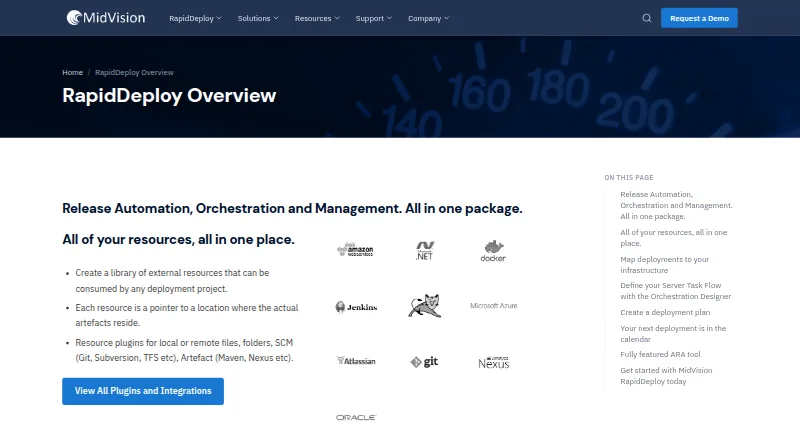
What MidVision RapidDeploy is
MidVision RapidDeploy is an application release automation product for deploying and coordinating releases across middleware environments. Teams can build a library of external resources and define logical servers with connection details, including setups using AWS, Azure, and VMware plugins. Its orchestration designer supports ordered tasks, dependencies, conditionals, loops, scoped variables, and failure branches. Job plans can combine parallel jobs, manual steps, triggers, schedules, notifications, approval gates, rollback pipelines, and failure pipelines. MidVision lists 55 plugins and 34 ready-made blueprints for connections to middleware, cloud platforms, source control, CI servers, and databases. Examples include Git, Jenkins, Kubernetes, Docker, Slack, Maven, and Nexus. The framework server is available for Linux, Windows, and Mac OS/X 64-bit downloads, as well as a Docker image; remote connections use SSH or an agent. The free usage tier is limited to 10 nodes and community support, which has no SLA. Community Support for up to 50 endpoints is listed at $50 a year per target endpoint.
Good
- Orchestration supports dependencies and conditional tasks.
- Job plans can include approval gates and rollback pipelines.
- 55 plugins and 34 ready-made blueprints are listed.
- Framework server is available as a Docker image.
Watch out
- Free tier is limited to 10 nodes.
- Community support has no SLA.
- IBM DataPower plugin requires a separate license.
- Paid endpoint pricing varies by plan and range.
Who it suits
RapidDeploy is aimed at mid-to-large companies with established, varied technology infrastructure seeking to improve release processes. It may suit teams managing deployments across middleware and cloud environments who need task orchestration, approvals, or rollback pipelines.
Verdict
RapidDeploy offers structured orchestration for application releases across middleware and connected environments. Review the endpoint limits, support terms, and applicable plugin licensing when considering a plan.
Plans and prices
From MidVision RapidDeploy's own pricing page, checked 29 Sep 2026.
| Plan | Price | What it gives you |
|---|---|---|
| Community Support (up to 10 endpoints) | Free | Up to 10 endpoints · Community support · Basic online support · Free; free usage tier license is issued for an initial three month or one year period |
| Standard Support (1000+ endpoints) | $50 a year | 1000+ endpoints · Standard support · Unlimited endpoint pricing by discussion · Per target endpoint per year; page marks price with an asterisk and says to ask about unlimited endpoint pricing |
| Community Support (up to 50 endpoints) | $50 a year | Up to 50 endpoints · Community support · Per target endpoint per year |
| Community Support (51–250 endpoints) | $50 a year | Between 51–250 endpoints · Community support · Per target endpoint per year |
| Standard Support (251–1000 endpoints) | $100 a year | Between 251–1000 endpoints · Standard support · Per target endpoint per year |
| Platinum Support (251–1000 endpoints) | $200 a year | Between 251–1000 endpoints · Platinum support · Per target endpoint per year |
| Standard Support (51–250 endpoints) | $200 a year | Between 51–250 endpoints · Standard support · Per target endpoint per year |
| Standard Support (up to 50 endpoints) | $250 a year | Up to 50 endpoints · Standard support · Per target endpoint per year |
| Platinum Support (51–250 endpoints) | $400 a year | Between 51–250 endpoints · Platinum support · Per target endpoint per year |
| Platinum Support (up to 50 endpoints) | $500 a year | Up to 50 endpoints · Platinum support · Per target endpoint per year |
The facts
Each one read from MidVision RapidDeploy's own pages, with the date it was checked.
The company
- Founded
- 2008checked 28 Sep 2026
- Headquarters
- London, United Kingdomchecked 28 Sep 2026
Where it runs
- Infrastructure mapping
- RapidDeploy stores logical server definitions with IP addresses or hostnames and connection details, and supports cloud-provider plugins including AWS, Azure, and VMware.checked 29 Sep 2026
What it does
- Integrations
- MidVision says RapidDeploy integrates with middleware, cloud platforms, source control, CI servers, and databases through 55 plugins, with 34 ready-made blueprints.checked 29 Sep 2026
- License limits
- The free usage tier is limited to 10 nodes with community support, and the IBM DataPower plugin requires a separate license.checked 29 Sep 2026
- Pipelines and scheduling
- Job plans can include parallel jobs, manual steps, triggers, schedules, notifications, approval gates, rollback pipelines, and failure pipelines.checked 29 Sep 2026
- Plugin examples
- Listed integrations include AWS, Azure, VMware, Git, Subversion, Jenkins, Kubernetes, Docker, Slack, Maven, Nexus, and multiple IBM products.checked 29 Sep 2026
- Product distribution
- The RapidDeploy 5.2 framework server is available as Linux, Windows, and Mac OS/X 64-bit downloads and as a Docker image.checked 29 Sep 2026
- Product purpose
- RapidDeploy is MidVision’s application release automation product for deploying, orchestrating, and managing releases across middleware environments.checked 29 Sep 2026
- Remote connectivity
- RapidDeploy connects to remote servers using SSH or an agent, and the download page says agents support Basic Auth or SSL in point-to-point or multicast modes.checked 29 Sep 2026
- Resource management
- It lets teams create a library of external resources, with plugins for local or remote files, folders, source control, and artifact repositories.checked 29 Sep 2026
- Security and privacy
- MidVision’s privacy policy says browser traffic is encrypted with HTTPS, access to personal data is restricted, and the website does not use analytics or tracking.checked 29 Sep 2026
- Support
- Community support has no SLA and uses a shared portal or forums; Platinum includes 24/7 telephone support and a dedicated technician for severity 1 incidents until resolution.checked 29 Sep 2026
- Target customers
- MidVision says its customers are generally mid-to-large companies with established, heterogeneous technology infrastructure seeking to improve release efficiency, pace, and reliability.checked 29 Sep 2026
- Task orchestration
- Its orchestration designer supports task ordering and dependencies, conditionals, loops, scoped variables, and failure branches.checked 29 Sep 2026
The full review of MidVision RapidDeploy
Overview
MidVision RapidDeploy is a release-automation platform for coordinating application deployments across middleware and connected infrastructure. It is best suited to mid-to-large organizations managing varied technology estates; its strongest case is workflow depth, while endpoint-based pricing and support tiers deserve close attention.
Teams can map resources and servers, then assemble release work with dependencies, conditions, approvals, schedules, and recovery paths. That breadth is useful when releases span multiple applications and environments, but may be more than a small team needs for a simple deployment process.
Key features
Resources and infrastructure
RapidDeploy can maintain libraries of local or remote files and folders, source-control locations, and artifact repositories. Logical server definitions hold hostnames or IP addresses and connection details, while cloud plugins cover AWS, Azure, and VMware. This gives teams a way to organize deployment inputs and targets across mixed infrastructure rather than treating each release as an isolated task.
Orchestration and release controls
The designer supports ordered tasks, dependencies, conditions, loops, scoped variables, and failure branches. Job plans can combine parallel work with manual steps, triggers, schedules, notifications, approval gates, rollback pipelines, and failure pipelines. Multi-application releases, environment promotion, dependency tracking, scheduling, audit trails, and both deployment strategies are supported. These controls suit teams that need governed, repeatable releases; teams seeking only a basic push-to-server tool may not need this level of orchestration.
Integrations and connectivity
MidVision describes 55 plugins and 34 ready-made blueprints spanning middleware, cloud, source control, CI servers, and databases. Examples include Git, Subversion, Jenkins, Kubernetes, Docker, Slack, Maven, Nexus, and IBM products. Remote connections use SSH or an agent; agents support Basic Auth or SSL in point-to-point or multicast modes. The IBM DataPower plugin requires a separate license, so its cost should be considered independently.
The RapidDeploy 5.2 framework server is offered as Linux, Windows, and Mac OS/X 64-bit downloads, as well as a Docker image. The broader platform list also includes API, web, and self-hosted use across Linux, macOS, and Windows.
Pricing
RapidDeploy has a free tier and paid annual endpoint pricing. The free usage license covers up to 10 endpoints with community support and basic online support; it is issued for an initial three-month or one-year period. Community support has no SLA and uses a shared portal or forums, which makes the free option most suitable for evaluation or smaller deployments that can tolerate community-level assistance.
| Plan | Price and terms | Best fit |
|---|---|---|
| Community Support (up to 10 endpoints) | free (billed Free); up to 10 endpoints | Small deployments needing the free usage tier. |
| Community Support (up to 50 endpoints) | $50 a year per target endpoint | Teams expanding beyond the free cap without a paid support tier. |
| Community Support (51–250 endpoints) | $50 a year per target endpoint | Mid-sized fleets that can rely on community support. |
| Standard Support (up to 50 endpoints) | $250 a year per target endpoint | Smaller fleets that need Standard rather than community support. |
| Standard Support (51–250 endpoints) | $200 a year per target endpoint | Growing fleets seeking Standard support. |
| Standard Support (251–1000 endpoints) | $100 a year per target endpoint | Larger deployments needing Standard support. |
| Standard Support (1000+ endpoints) | $50 a year per target endpoint; unlimited endpoint pricing by discussion | Very large deployments; ask about unlimited endpoint pricing. |
| Platinum Support (up to 50 endpoints) | $500 a year per target endpoint | Smaller fleets for which Platinum support is worth the premium. |
| Platinum Support (51–250 endpoints) | $400 a year per target endpoint | Mid-sized fleets needing the highest support tier. |
| Platinum Support (251–1000 endpoints) | $200 a year per target endpoint | Larger deployments needing Platinum support. |
Platinum includes 24/7 telephone support and a dedicated technician for severity 1 incidents until resolution, a meaningful step up for release operations where urgent incidents cannot wait on a shared channel. Per-endpoint annual billing means the listed rate applies to each target endpoint, so the total rises with the managed estate. The free tier's 10-endpoint cap is a firm distinction from the paid tiers.
Platforms
RapidDeploy supports API, Linux, macOS, self-hosted, web, and Windows environments. Its framework server downloads and Docker image provide several deployment formats, while SSH or agent connectivity supports remote targets.
Who it's for
RapidDeploy is aimed at organizations with established, heterogeneous infrastructure that want more efficiency, pace, and reliability in release work. It is a stronger fit where teams need reusable resources, cross-environment promotion, approval controls, and failure handling. A small team with few endpoints and no need for structured support can start on the free tier; teams requiring guaranteed service response should weigh Standard or Platinum against their endpoint count.
Pros and cons
Pros
- Deep workflow controls: dependencies, conditionals, loops, approval gates, rollback, and failure pipelines support complex release paths.
- Broad integration coverage: 55 plugins and 34 blueprints connect deployment work with a range of infrastructure and development tools.
- Free entry point: up to 10 endpoints can use the product with community support before moving to paid per-endpoint plans.
- Escalated incident support: Platinum provides round-the-clock telephone support and a dedicated severity 1 technician through resolution.
Cons
- Free tier is capped: the 10-endpoint limit can constrain even a modest production estate.
- Support quality depends on tier: community support has no SLA, so it may not suit teams needing a defined response commitment.
- Endpoint billing can scale quickly: annual per-target-endpoint pricing makes fleet size central to the cost decision.
- Some integration costs extra: IBM DataPower requires a separate plugin license.
Alternatives
Release Orchestration Software is a useful category view for comparing release tools. Consider Octopus Deploy if its machine and tenant add-ons better match your deployment model; its Machines add-on is $770 a year with a default of 10 machines and options up to 1,000. Copado may suit Salesforce-oriented deployment needs where a single-user free tier capped at 15 deployments monthly is sufficient, though it excludes shared deployments and team collaboration.
Devtron Release Orchestration is worth considering for a self-hosted setup that fits its free allowance of 50 vCPUs, 10 users, and one cluster, or for a team comparing its $499 a month OSS Plus plan. Ozone may appeal to a small self-hosted team needing its free allowance of five users and seven-day cluster monitoring retention. ReleaseOwl is an alternative for eligible SAP Cloud ALM customers: its free tier runs during Year 1 and covers 100 SAP Cloud ALM Features, one SAP landscape, and five cloud users.
ARCAD DROPS is another paid release-automation option. IBM Capacity Management Analytics is a paid alternative for teams considering distributed platforms or z/OS editions. Planview AdaptiveWork is a paid web and mobile option with pricing available by contacting an account executive.
Verdict
Choose MidVision RapidDeploy if your organization needs to coordinate controlled releases across a heterogeneous estate and will use its dependency, approval, promotion, and recovery workflows. Its principal advantage is orchestration depth paired with broad integrations; its principal drawback is the combination of endpoint-based annual cost and a community tier without an SLA. Teams with few targets can begin free, while organizations that need dependable incident response should budget for a support tier—or compare alternatives whose limits and deployment model fit better.
Getting started
- Visit the RapidDeploy overview website.
- Choose a framework server route: Linux, Windows, or Mac OS/X 64-bit download, or Docker image.
- Set up remote connectivity using SSH or an agent.
- Select a usage and support plan based on endpoint count.
- Build a resource library and define logical servers for deployment targets.
Limits worth knowing
The free usage tier is limited to 10 nodes and community support. Its license is issued for an initial three-month or one-year period. Community support has no SLA; the IBM DataPower plugin requires a separate license.
Questions
Is there a free plan?
Yes. The Community Support plan for up to 10 endpoints is free, billed Free, and includes basic online and community support.
What does the free tier include?
It is limited to 10 nodes and community support. The license is issued for an initial three-month or one-year period.
What platforms can run the framework server?
The framework server is available as Linux, Windows, and Mac OS/X 64-bit downloads, and as a Docker image.
How much does paid support cost?
Prices are per target endpoint per year and vary by endpoint range and support level. Listed examples include Community Support (up to 50 endpoints) at $50 a year and Platinum Support (up to 50 endpoints) at $500 a year.
What integrations are listed?
MidVision says RapidDeploy has 55 plugins and 34 ready-made blueprints. Examples include AWS, Azure, VMware, Git, Subversion, Jenkins, Kubernetes, Docker, Slack, Maven, and Nexus.
What support options are available?
Community support uses a shared portal or forums and has no SLA. Platinum includes 24/7 telephone support and a dedicated technician for severity 1 incidents until resolution.
Alternatives to MidVision RapidDeploy
- 1

Octopus Deploy
Free planWebAPILinuxSelf-hosted7.3From $4,330 a year - 2

Devtron Release Orchestration
Free planWebAPISelf-hosted6.9From $499 a month - 3
Planview AdaptiveWork
AndroidiOSWebAPI6.9 - 4

Copado
Free planWebAPI6.7From $99 a year - 5
Ozone
Free planWebSelf-hosted6.6From $1,000 a month - 6

Automic Continuous Delivery Automation
WebAPILinuxSelf-hosted6.5