
Port
Port is a cloud-native platform for engineering teams to build, govern, and operate their software development lifecycle.
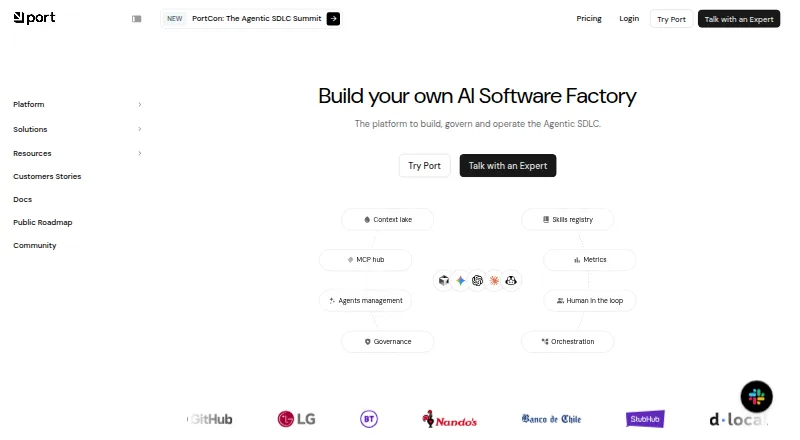
What Port is
Port is a cloud-native platform for engineering teams to build, govern, and operate their software development lifecycle. Its platform includes a Context Lake, Software Catalog, Actions, AI Agents, Scorecards, Access Controls, Workflows, and Interface Designer. Port maps environments into the Context Lake and orchestrates agentic workflows across the lifecycle with governance. It lists 86 integrations across Kubernetes, CI/CD, incident management, SSO, Git, cloud providers, and AI agents; examples include Prometheus, Azure Monitor, Rootly, n8n, Claude AI, OpenAI, Cursor, Jira, Slack, ServiceNow, and Wiz. The Free plan has no time limit and includes up to 15 seats, up to 10k entities, up to 400 runs, and community support. Port says data at rest is encrypted with AES-256 and data in transit uses HTTPS and TLS 1.2 or later where applicable. User-ingested data is kept until deleted; audit logs are retained for one year by default and sign-in and account access logs for 30 days.
Good
- Free plan has no time limit.
- Free plan includes up to 15 seats.
- Lists 86 integrations.
- Includes catalog, actions, workflows, and scorecards.
- States AES-256 encryption at rest.
Watch out
- Free plan limits runs to 400.
- Free plan AI agents are usage-limited.
- User-ingested data remains until deleted.
Who it suits
Port suits engineering teams looking to catalog software, coordinate workflows, and govern their development lifecycle. The Free plan may fit teams of up to 15 seats and 10k entities.
Verdict
Port combines software cataloging, workflows, controls, and AI agents for engineering teams, with a no-time-limit Free plan. Consider its seat, entity, run, and data-retention terms when assessing a fit.
Plans and prices
From Port's own pricing page, checked 29 Sep 2026.
| Plan | Price | What it gives you |
|---|---|---|
| Free | Free | up to 15 seats · up to 10k entities · up to 400 runs · community support |
| Basic | $30 a month | up to 50 seats · up to 50k entities · up to 400 runs · commercial support · billed annually |
| Standard | $40 a month | up to 200 seats · up to 250k entities · up to 1.6K runs · up to 5 workspaces · single sign-on · billed annually |
| Enterprise | Priced on request | unlimited seats · more than 1M entities · more than 8K runs · up to 20 workspaces · 99.9% uptime SLA |
The facts
Each one read from Port's own pages, with the date it was checked.
What it does
- AI workflows
- Port maps environments into a Context Lake and orchestrates agentic workflows across the software development lifecycle with governance.checked 29 Sep 2026
- Data retention
- User-ingested data is retained indefinitely unless deleted, audit logs are retained for one year by default, and sign-in and account access logs are retained for 30 days.checked 29 Sep 2026
- Deployment
- Port describes itself as a cloud-native SaaS platform and says Enterprise customers can discuss dedicated tenancy and Private Link connectivity.checked 29 Sep 2026
- Encryption
- Port states that data at rest is encrypted with AES-256 and that it uses HTTPS and TLS 1.2 or later for data in transit where applicable.checked 29 Sep 2026
- Integration examples
- Listed integrations include Prometheus, Azure Monitor, Rootly, n8n, Claude AI, OpenAI, Cursor, Jira, Slack, ServiceNow, and Wiz.checked 29 Sep 2026
- Integrations
- Port lists 86 integrations across categories including Kubernetes, CI/CD, incident management, SSO, Git, cloud providers, and AI agents.checked 29 Sep 2026
- Security certifications
- Port states that it is SOC 2 Type 2 certified, GDPR compliant, ISO 27001 compliant, and CCPA compliant, and follows OWASP best practices.checked 29 Sep 2026
- Support
- Support options include a support portal, email, Slack, documentation, and an AI assistant; available ticket options depend on the plan.checked 29 Sep 2026
- What it does
- Port is a platform for engineering teams to build, govern, and operate their software development lifecycle.checked 29 Sep 2026
Money
- Free plan limit
- The Free plan has no time limit and includes up to 15 seats, up to 10k entities, usage-limited AI agents, and community support.checked 29 Sep 2026
- Paid trials
- Port says it offers time-limited trials of paid plans for larger teams, but does not state a trial duration on the pricing page.checked 29 Sep 2026
The company
- Headquarters
- Tel Aviv, Israelchecked 28 Sep 2026
Where it runs
- Platform features
- The full platform includes a Context Lake, Software Catalog, Actions, AI Agents, Scorecards, Access Controls, Workflows, and Interface Designer.checked 29 Sep 2026
The full review of Port
Overview
Port is a cloud-based platform engineering portal for teams that want to catalog software, govern development workflows and coordinate AI agents in one place. It suits engineering organizations building shared processes across services and environments; its broad toolset is balanced by seat, entity and run limits on lower tiers.
Key features
Port’s Software Catalog brings software and environment context together, while Actions, Workflows and the Interface Designer support self-service operations. Scorecards and Access Controls add governance, and AI Agents can orchestrate lifecycle workflows using context mapped into Port’s Context Lake. That combination makes Port relevant to teams seeking more than a directory of services, though the Free plan’s AI usage is limited.
Port lists 86 integrations spanning Kubernetes, CI/CD, incident management, SSO, Git, cloud providers and AI agents. Examples include Prometheus, Azure Monitor, Rootly, n8n, Claude AI, OpenAI, Cursor, Jira, Slack, ServiceNow and Wiz. Engineering teams can connect a varied toolchain, but should check that the integrations they depend on are covered.
Port states that it is SOC 2 Type 2 certified and compliant with GDPR, ISO 27001 and CCPA, and follows OWASP best practices. It says data at rest uses AES-256 encryption and data in transit uses HTTPS and TLS 1.2 or later where applicable. User-ingested data is retained indefinitely unless deleted; audit logs are kept for one year by default, and sign-in and account access logs for 30 days. Those retention periods matter for teams with strict data lifecycle requirements.
Pricing
Port has a no-time-limit Free plan at no cost. It includes up to 15 seats, 10k entities and 400 runs, plus community support and usage-limited AI agents. It is a practical way for a small team to evaluate the platform or run a bounded catalog, but the entity and run caps can constrain broader adoption.
Basic costs $30 a month billed annually, with up to 50 seats, 50k entities and 400 runs, plus commercial support. It adds support and room for a larger user base, but not more runs than Free. Standard costs $40 a month billed annually and raises the limits to 200 seats, 250k entities and 1.6K runs, with up to five workspaces and single sign-on. It is the stronger fit for teams that need greater scale and SSO.
Enterprise has custom pricing and includes unlimited seats, more than 1M entities, more than 8K runs, up to 20 workspaces and a 99.9% uptime SLA. Larger teams can request time-limited paid-plan trials, although no trial duration is stated. Enterprise customers can also discuss dedicated tenancy and Private Link connectivity.
Port’s cloud-native SaaS model keeps deployment centered on its hosted service. Support options include a portal, email, Slack, documentation and an AI assistant, while ticket options depend on the plan.
Platforms
Port is available via API, extension and web. It is a cloud deployment rather than a self-hosted platform; Enterprise customers can discuss dedicated tenancy and Private Link.
Who it's for
Port is best suited to engineering teams that want a software catalog tied to self-service workflows, scorecards, access controls and AI orchestration. Its Free tier offers a meaningful starting point, while Standard and Enterprise better fit organizations that need higher quotas, SSO, more workspaces or a formal uptime commitment. Teams seeking self-hosting, or those whose usage outgrows lower-tier caps without an Enterprise budget, should weigh alternatives.
Pros and cons
- Pro: Catalog, workflows, scorecards, access controls and AI agents share a platform, supporting both discovery and governed operations.
- Pro: The Free plan has no time limit and includes up to 15 seats, 10k entities and 400 runs.
- Pro: Standard adds SSO and substantially higher entity and run limits than Basic.
- Con: Free AI-agent use is limited, and Free and Basic are both capped at 400 runs.
- Con: User-ingested data is retained indefinitely unless deleted, requiring teams to manage removal themselves.
- Con: Port is cloud-native SaaS; self-hosting is not among its deployment options.
Alternatives
Choose Backstage if an open-source framework with API, Linux, macOS, self-hosted and web platforms is a better fit; its official site states no price or plan limits. Consider Terraform for infrastructure provisioning, with a Free tier capped at 500 managed resources and one concurrent remote run and agent run. Pulumi is another infrastructure-as-code option; its Free plan includes one user and unlimited projects, stacks, environments, updates and history, with up to 500 workflow minutes.
Cycloid offers a Free SaaS tier for up to five users and one workspace, with blueprints, forms, orchestration, RBAC, SSO and MFA. Spacelift may suit teams looking at infrastructure orchestration, with a Free plan for two users and one public worker. For a paid internal developer portal with custom per-seat pricing, consider Cortex. Scalr has a Free allowance of 50 runs per month, with business usage at $0.99 per run and volume discounts. Upbound is another freemium option for teams evaluating infrastructure control planes.
For broader comparisons, browse Platform Engineering Software, Internal Developer Portals, Application Dependency Mapping Software or Preview Environment Software.
Verdict
Port is a strong choice for engineering organizations that want cataloging, governed self-service workflows and AI orchestration in one cloud platform. Its no-time-limit Free plan makes it approachable, and Standard adds meaningful scale and SSO; look elsewhere if self-hosting is essential or if indefinite data retention and lower-tier quotas are poor fits.
Alternatives to Port
- 1
Netdata
Free planOpen sourceAndroidiOSWebAPI8.7From $4.50 a month - 2

Jira
Free planAndroidiOSWebAPI8.4Free plan - 3
Lansweeper
Free planWebAPILinuxmacOS8.0Free plan - 4

ManageEngine Applications Manager
Free planAndroidiOSWebLinux7.1From $395 a year - 5

New Relic Session Replay
Free planAndroidiOSWeb7.1From $10 a month - 6

Backstage
Free planWebAPILinuxmacOS6.8Free plan