
GitLab Package Registry
GitLab Package Registry lets teams publish and share packages that downstream projects can use as dependencies.
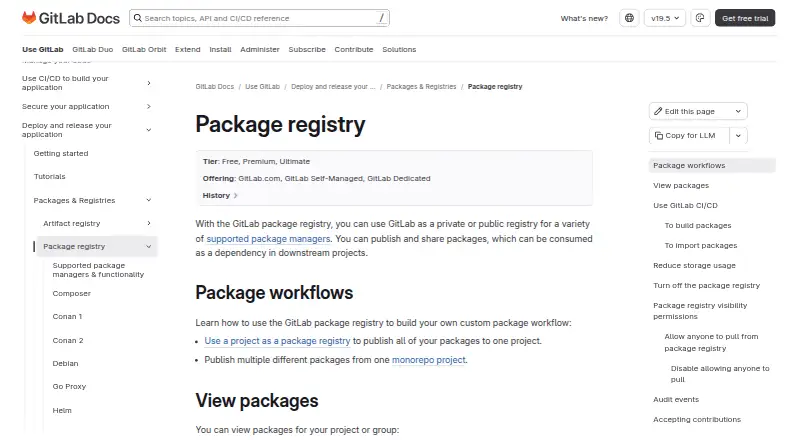
What GitLab Package Registry is
GitLab Package Registry lets teams publish and share packages that downstream projects can use as dependencies. It supports private and public registries for supported package managers and is available on GitLab.com, GitLab Self-Managed, and GitLab Dedicated. Generally available formats include Generic packages, Helm, Maven, npm, NuGet, and PyPI; Composer and Conan are beta, while Debian, Go, and Ruby gems are experimental. Conda, CRAN, RPM, and Swift are not supported. Projects can host several package types, including packages produced from a monorepo. GitLab CI/CD can build or import packages, and jobs can authenticate with CI_JOB_TOKEN. Project roles control access, while protection rules can restrict pushes or deletions for supported package formats. The registry has API administration and automation options. Package publication and deletion can create audit events when enabled, but that feature is limited to Premium and Ultimate. A dependency proxy is also available in beta on those paid tiers. GitLab offers a Free plan and a 30-day trial; Premium is listed at $29 a year, billed annually per user per month.
Good
- Supports private and public registries.
- CI/CD can build or import packages.
- Projects can host multiple package types.
- API supports registry administration and automation.
Watch out
- Conda, CRAN, RPM, and Swift are unsupported.
- Several listed formats remain beta or experimental.
- Audit events require Premium or Ultimate.
- Dependency proxy is beta and paid-tier only.
Who it suits
It suits teams that need package publishing alongside GitLab projects and CI/CD. Organizations should check supported formats and plan availability for features such as audit events and the dependency proxy.
Verdict
GitLab Package Registry covers package publishing, access controls, and CI/CD workflows within GitLab. Check format maturity and plan limits before relying on particular capabilities.
Plans and prices
From GitLab Package Registry's own pricing page, checked 29 Sep 2026.
| Plan | Price | What it gives you |
|---|---|---|
| Free | Free | 5 users per top-level group · 400 compute minutes/month · 10 GiB adjustable storage · per user/month |
| Premium | $29 | 10,000 compute minutes/month · 500 GiB storage · per user/month, billed annually |
| Ultimate | Priced on request | 50,000 compute minutes/month · 500 GiB storage · Custom pricing |
The facts
Each one read from GitLab Package Registry's own pages, with the date it was checked.
What it does
- Access controls
- Project roles govern package access; for private projects, Reporters can view and pull packages and Developers can publish them.checked 29 Sep 2026
- API and automation
- The registry can be administered through an API, and generic packages support API access for automation.checked 29 Sep 2026
- Audit events
- Package publication and deletion can generate audit events when the namespace setting is enabled; audit events are a Premium and Ultimate feature.checked 29 Sep 2026
- Availability
- The Package Registry is included in Free, Premium and Ultimate and is offered on GitLab.com, GitLab Self-Managed and GitLab Dedicated.checked 29 Sep 2026
- CI/CD integration
- GitLab CI/CD can build or import packages, and jobs can authenticate to the registry with CI_JOB_TOKEN.checked 29 Sep 2026
- Dependency proxy
- The dependency proxy caches copies of upstream packages to reduce external downloads and speed up builds; GitLab marks this feature beta and Premium/Ultimate.checked 29 Sep 2026
- Known limits
- GitLab lists Conda, CRAN, RPM and Swift among package formats that are not supported by the registry.checked 29 Sep 2026
- npm security behavior
- For npm audits, GitLab forwards requests to npmjs.com by default to retrieve vulnerability information, and warns that audit request bodies can include private package information.checked 29 Sep 2026
- Package protection
- Package protection rules can restrict who may push or delete matching packages, with support documented for npm, PyPI, Maven and Conan.checked 29 Sep 2026
- Package workflows
- A project can host packages for multiple package types, including packages built from a monorepo.checked 29 Sep 2026
- Purpose
- The registry lets users publish and share packages that downstream projects can consume as dependencies.checked 29 Sep 2026
- Support
- The Premium plan includes Priority Support; GitLab states paid-plan support is 24/7 for Emergency severity and 24/5 for other impact levels.checked 29 Sep 2026
- Supported formats
- Generally available formats include Generic packages, Helm, Maven, npm, NuGet and PyPI; Composer and Conan are beta, while Debian, Go and Ruby gems are experiments.checked 29 Sep 2026
- Visibility
- GitLab can be used as a private or public registry for supported package managers.checked 29 Sep 2026
The company
- Founded
- 2011checked 28 Sep 2026
- Headquarters
- No physical headquarters; GitLab is all-remotechecked 28 Sep 2026
The full review of GitLab Package Registry
Overview
GitLab Package Registry gives teams a place to publish packages for downstream projects to consume, either privately or publicly for supported package managers. It suits teams already building in GitLab who want publishing, permissions and CI/CD in the same workflow. Its strongest case is that integration; format maturity and the compute and storage caps on lower plans call for closer scrutiny.
Key features
Formats and project workflows
Generally available formats include Generic packages, Helm, Maven, npm, NuGet and PyPI. Composer and Conan remain beta, while Debian, Go and Ruby gems are experimental; Conda, CRAN, RPM and Swift are unsupported. That is a useful spread for common ecosystems, but teams dependent on beta or experimental formats should be cautious about making the registry a critical publishing path.
A project can host multiple package types, including packages built from a monorepo. The API supports registry administration, and Generic packages can use API access for automation. GitLab CI/CD can build or import packages, with jobs authenticating through CI_JOB_TOKEN, reducing the need to manage a separate publishing workflow.
Permissions, protection and auditing
Project roles control package access: in private projects, Reporters can view and pull packages while Developers can publish. Package protection rules can limit who may push or delete matching packages, with documented support for npm, PyPI, Maven and Conan. These controls help teams manage publishing rights, though protection coverage is not universal across formats.
Package publication and deletion can create audit events when the namespace setting is enabled, but audit events require Premium or Ultimate. The dependency proxy caches upstream packages to reduce external downloads and speed builds; it is beta and also limited to Premium and Ultimate. For npm audits, GitLab forwards requests to npmjs.com by default for vulnerability information, and warns that request bodies can include private package information. Teams should account for that behavior when assessing package privacy.
Pricing
GitLab uses a freemium model: Free is free, billed per user/month, and paid plans start at $29 a year per user/month billed annually. A 30-day trial is available.
- Free: Includes the registry, with a cap of 5 users per top-level group, 400 compute minutes/month and 10 GiB adjustable storage. It is a practical starting point for small teams, but the user and usage limits may constrain growing CI workloads.
- Premium: $29 a year per user/month, billed annually; includes 10,000 compute minutes/month, 500 GiB storage and Priority Support. GitLab says paid-plan support is 24/7 for Emergency severity and 24/5 for other impact levels. Premium is the step up for teams that need more capacity, audit events or the beta dependency proxy.
- Ultimate: Custom pricing, with 50,000 compute minutes/month and 500 GiB storage. It is the higher-capacity option, but the price requires a quote.
The registry is included in Free, Premium and Ultimate across GitLab.com, GitLab Self-Managed and GitLab Dedicated. Storage and compute allowances matter alongside the registry itself: package publishing may fit Free, while larger build pipelines can hit its 400-minute monthly allowance. Git LFS storage is 500 GB, and SAML/SCIM SSO, built-in CI/CD, wiki, merge queue, run comparison, artifact tracking and model registry capabilities are also included in the product offering.
Platforms
GitLab Package Registry is available on web, Linux, API and self-hosted platforms. The deployment choice spans GitLab.com, GitLab Self-Managed and GitLab Dedicated.
Who it's for
It is best suited to teams already using GitLab projects and CI/CD that want packages, access controls and automation close to their source workflows. It is less compelling for organizations whose essential package formats are unsupported or still experimental, or whose build usage exceeds Free plan limits without a budget for paid capacity.
Pros and cons
- Pro: CI/CD jobs can build or import packages and authenticate with CI_JOB_TOKEN, connecting publishing directly to GitLab pipelines.
- Pro: Multiple package types can share a project, and API access supports registry administration and Generic-package automation.
- Con: Several formats are beta or experimental, and Conda, CRAN, RPM and Swift are unsupported, narrowing its fit for some ecosystems.
- Con: Free caps groups at 5 users and 400 compute minutes/month; audit events and the beta dependency proxy require Premium or Ultimate.
- Con: Default npm audit forwarding sends requests to npmjs.com, and request bodies can include private package information.
Alternatives
For broader application lifecycle management, compare Application Lifecycle Management Software. Readers weighing GitLab's workflow scope against other delivery and development categories can also browse GitOps Tools, Model Registry Software, ML Experiment Tracking Software, Game Version Control Software and Preview Environment Software.
Choose Innoslate for an alternative with a free educator and student plan and a Windows platform. Rally Software has a free Starter Edition for 50 named users, available only to organizations in listed countries. ONES offers a free plan for up to 30 seats, with 20 AI credits per user each month and a 30 MB per-file limit. SAP Cloud ALM is a free option for eligible support customers, with one tenant per customer number. Tuleap offers cloud or on-premise commercial plans tailored to user count, hosting and support. Creo, Kovair ALM and TechExcel ProjectOne ALM are additional alternatives.
Verdict
Choose GitLab Package Registry if your team already relies on GitLab and its supported package formats: CI/CD authentication, project-level permissions and multi-format projects make it a natural fit for that workflow. Look elsewhere if your required ecosystem is unsupported or experimental, or if Free's compute and user limits are too tight and paid-plan capacity does not suit your budget.
Getting started
- Visit https://docs.gitlab.com/user/packages/package_registry/.
- Use the registry through GitLab.com, GitLab Self-Managed, or GitLab Dedicated.
- Choose Free, Premium, or Ultimate; the registry is included in all three.
- Publish or import packages with GitLab CI/CD, or use the API for administration and generic package automation.
- Set project roles to govern access; configure package protection rules for supported formats if needed.
Limits worth knowing
Free includes 5 users per top-level group, 400 compute minutes per month, and 10 GiB adjustable storage. Audit events for package publication and deletion require Premium or Ultimate and an enabled namespace setting. The dependency proxy is beta and also limited to Premium and Ultimate.
Questions
Is GitLab Package Registry free?
Yes. It is included in GitLab Free, as well as Premium and Ultimate.
What does Premium cost?
Premium is listed at $29 per user per year with annual billing.
Which package formats does it support?
Generally available formats include Generic packages, Helm, Maven, npm, NuGet, and PyPI. Composer and Conan are beta, while Debian, Go, and Ruby gems are experimental; Conda, CRAN, RPM, and Swift are unsupported.
Can packages be private?
Yes. GitLab can be used as a private or public registry for supported package managers. In private projects, Reporters can view and pull packages and Developers can publish them.
Can GitLab CI/CD use the registry?
Yes. CI/CD can build or import packages, and jobs can authenticate with CI_JOB_TOKEN.
Who makes GitLab, and where is it based?
GitLab was founded in 2011. It is an all-remote company with no physical headquarters.
Alternatives to GitLab Package Registry
- 1

Azure Test Plans
Free planWebAPIExtensionLinux8.1From $6 a month - 2
TechExcel ProjectOne ALM
AndroidiOSWebSelf-hosted7.0From $10 a month - 3
IBM Targetprocess
Free planWebAPI6.8Free plan - 4
ONES
Free planWebAPISelf-hosted6.6From $80.50 a year - 5

Innoslate
Free planWebAPISelf-hostedWindows6.4Free plan - 6
Rally Software
Free planWebAPISelf-hosted6.4Free plan