
OpenTofu
OpenTofu is a free infrastructure as code tool for defining cloud and on-premises resources in human-readable configuration files.
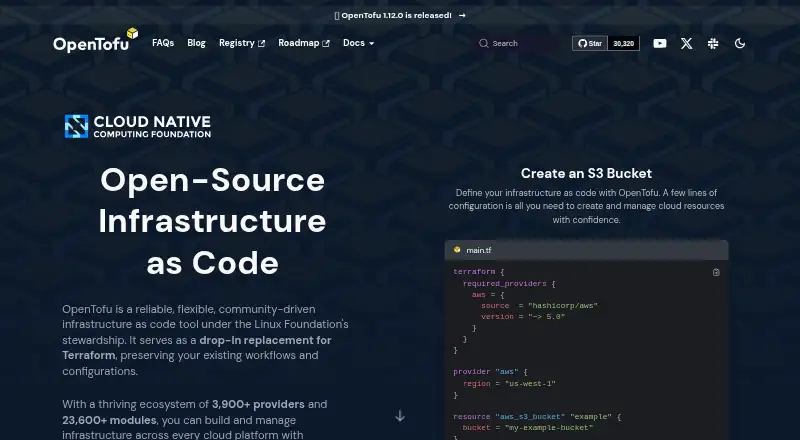
What OpenTofu is
OpenTofu is a free infrastructure as code tool for defining cloud and on-premises resources in human-readable configuration files. Users write configuration, generate an execution plan, then apply approved changes in dependency order. Providers connect it to cloud platforms, SaaS services, and APIs; listed examples include AWS, Azure, Google Cloud Platform, Kubernetes, Helm, GitHub, Splunk, and Datadog. Reusable modules and a public registry support configurable collections of infrastructure. OpenTofu tracks infrastructure in a state file, builds a dependency graph, and can create or modify independent resources in parallel. Built-in client-side state encryption supports key providers such as PBKDF2, AWS KMS, GCP KMS, and OpenBao. Providers can be installed from registries, local mirrors, or caches, including for air-gapped workflows. OCI registries support modules and secondary provider installation, but are not yet the primary provider source. OpenTofu is presented as a drop-in Terraform replacement that preserves existing workflows and configurations. Official installation methods cover Linux, macOS, Windows, FreeBSD, and OCI container images. The project is maintained under the Linux Foundation as a community-driven open-source project. The OpenTofu plan is free.
Good
- Plans changes before applying them
- Supports reusable modules and a public registry
- Can create independent resources in parallel
- Built-in client-side state encryption
Watch out
- OCI is not yet the primary provider source
- State tracking depends on a state file
Who it suits
OpenTofu suits teams defining infrastructure across cloud platforms, on-premises systems, and APIs through configuration files. It may also fit environments that need local provider mirrors, caches, or air-gapped installation workflows.
Verdict
OpenTofu offers a configuration-based workflow for planning and applying infrastructure changes, with providers, reusable modules, and state encryption. It is presented as a drop-in replacement for Terraform and is available at no cost.
Plans and prices
From OpenTofu's own pricing page, checked 30 Sep 2026.
| Plan | Price | What it gives you |
|---|---|---|
| OpenTofu | Free | open-source infrastructure as code tool |
The facts
Each one read from OpenTofu's own pages, with the date it was checked.
What it does
- Community support
- The project directs users to community Slack, GitHub discussions, issues, RFC discussions, and contributions.checked 30 Sep 2026
- Governance
- OpenTofu is hosted and maintained under the Linux Foundation as a community-driven, impartial open-source project.checked 30 Sep 2026
- Modules
- OpenTofu supports reusable modules for configurable collections of infrastructure and provides a public registry of modules and providers.checked 30 Sep 2026
- OCI integration
- OpenTofu supports OCI registries for modules and as a secondary provider installation source, but not yet as the primary provider source.checked 30 Sep 2026
- Parallel execution
- OpenTofu builds a resource dependency graph and creates or modifies non-dependent resources in parallel.checked 30 Sep 2026
- Project scale
- The official website reports an ecosystem of more than 3,900 providers and 23,600 modules.checked 30 Sep 2026
- Provider installation
- Providers can be installed from registries, local mirrors, or caches, and OpenTofu supports workflows for air-gapped environments.checked 30 Sep 2026
- Providers
- Providers let OpenTofu manage cloud platforms, SaaS providers, and other APIs, with examples including AWS, Azure, GCP, Kubernetes, Helm, GitHub, Splunk, and Datadog.checked 30 Sep 2026
- Purpose
- OpenTofu is an infrastructure as code tool for defining cloud and on-premises resources in human-readable configuration files.checked 30 Sep 2026
- State encryption
- Built-in client-side state encryption supports key providers including PBKDF2, AWS KMS, GCP KMS, and OpenBao.checked 30 Sep 2026
- State tracking
- OpenTofu stores infrastructure state in a state file that acts as the source of truth for determining required changes.checked 30 Sep 2026
- Supported systems
- Official installation methods cover Linux distributions, macOS, Windows, FreeBSD, and OCI container images.checked 30 Sep 2026
- Terraform compatibility
- OpenTofu is presented as a drop-in replacement for Terraform that preserves existing workflows and configurations.checked 30 Sep 2026
- Workflow
- Its core workflow consists of writing configuration, generating an execution plan, and applying approved changes in dependency order.checked 30 Sep 2026
The company
- Founded
- 2023checked 28 Sep 2026
Alternatives to OpenTofu
- 1

Puppet
Free planOpen sourceWebAPILinuxmacOS8.4From $120 a month - 2

Canonical MAAS
Free planOpen sourceWebAPILinuxSelf-hosted8.1From $30 a year - 3

Terraform
Free planWebAPILinuxmacOS8.0Free plan - 4

CFEngine
Free planOpen sourceWebAPILinuxmacOS7.8Free plan - 5

Apache CloudStack
Free planOpen sourceWebAPILinuxSelf-hosted7.4Free plan - 6

Foreman
Free planWebAPILinuxSelf-hosted6.9Free plan