
Puppet
Puppet Enterprise provides policy-driven configuration management and infrastructure automation for medium and large organizations handling complex cloud and…
What Puppet is
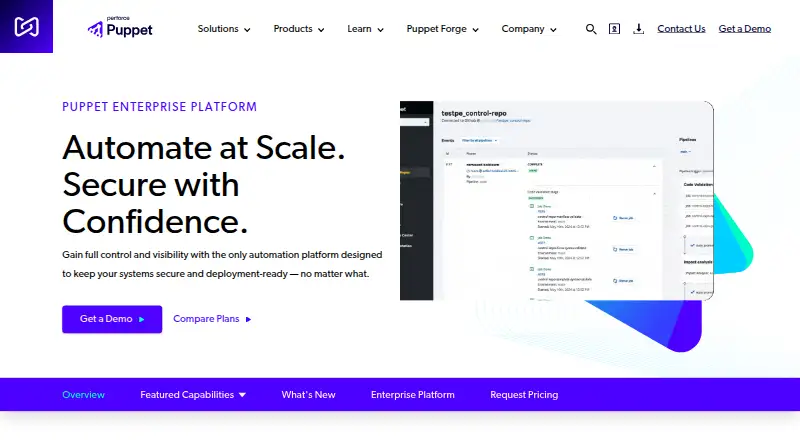
Puppet Enterprise provides policy-driven configuration management and infrastructure automation for medium and large organizations handling complex cloud and hybrid environments. It continuously enforces desired state through policy as code, and supports both agent-based and agentless management. A web interface and role-based access control provide centralized access. Puppet Enterprise Advanced adds continuous CIS Benchmark and DISA STIG enforcement, self-service automation, AI features, observability integrations and advanced patching. It can also integrate with third-party vulnerability scanners, including Nessus, for remediation. Listed integrations include GitHub, AWS, Microsoft Azure, Google Cloud Platform, HashiCorp Vault and ServiceNow. Agents are listed for Linux, Windows and macOS. A free trial runs on up to 10 nodes with no commitment or time limit. Pricing is custom. Network and edge device management is optional, and licensing for those devices requires contacting sales. Puppet offers support options ranging from weekday assistance to priority 24x7 response.
Good
- Enforces desired state continuously through policy as code.
- Supports agent-based and agentless management.
- Free trial covers up to 10 nodes with no time limit.
- Advanced includes CIS Benchmark and DISA STIG enforcement.
Watch out
- Pricing is custom and not listed.
- Network and edge device management is optional.
- Device licensing requires contacting sales.
Who it suits
It suits medium and large organizations managing complex hybrid environments that need centralized automation, security and compliance. Teams managing network or edge devices should note that this is optional and requires sales contact for licensing.
Verdict
Puppet Enterprise brings policy enforcement, configuration management and automation together for complex environments. Its no-time-limit trial covers up to 10 nodes, but pricing is custom.
Plans and prices
From Puppet's own pricing page, checked 15 Oct 2026.
| Plan | Price | What it gives you |
|---|---|---|
| Puppet Core | Free | open-source Puppet Core · download available · free development and testing edition; licensing options vary |
| Puppet Enterprise free trial | Free | 10 nodes · no commitment · no time limit stated |
| Puppet Enterprise listing price | $120 a month | third-party directory starting price; vendor pricing available on request · per feature |
| Puppet Enterprise | Priced on request | continuous desired-state enforcement · agent or agentless automation · web console · Linux, Windows and macOS agents · subscription pricing by node; contact sales |
| Puppet Enterprise Advanced | Priced on request | CIS/DISA STIG enforcement · vulnerability remediation · impact analysis · observability connectors · ServiceNow self-service · subscription pricing by node; contact sales |
The facts
Each one read from Puppet's own pages, with the date it was checked.
What it does
- Acquisition
- Perforce completed its acquisition of Puppet on May 18, 2022; transaction terms were not disclosed.checked 15 Oct 2026
- Advanced capabilities
- Puppet Enterprise Advanced adds continuous CIS Benchmark and DISA STIG enforcement, self-service automation, AI features, observability integrations, and advanced patching.checked 29 Sep 2026
- Agent models
- Deployments can use agent-based or agentless architecture and can combine declarative workflows with imperative tasks.checked 15 Oct 2026
- API
- Puppet and Puppet Enterprise expose HTTP APIs for application integrations, including inventory and orchestration services.checked 15 Oct 2026
- Configuration management
- The platform continuously enforces declared configuration state and records audit and correction information.checked 15 Oct 2026
- Deployment
- It supports agent-based and agentless automation and management of complex cloud and hybrid environments.checked 29 Sep 2026
- Desired state
- It continuously enforces desired state through policy as code.checked 29 Sep 2026
- Documentation
- Documentation covers Enterprise, Continuous Delivery, security compliance and Bolt task execution, with versioned installation and administration material.checked 15 Oct 2026
- Extensibility
- The product supports an extensible scanner architecture and open API framework, while Puppet Forge provides more than 7,000 reusable modules.checked 15 Oct 2026
- Funding
- A 2018 Series F raised $42 million led by Cisco, bringing reported aggregate venture funding to $127.5 million at that time.checked 15 Oct 2026
- Impact analysis
- Enterprise Advanced previews the infrastructure impact of Puppet code before deployment.checked 15 Oct 2026
- Integrations
- Official integration listings include ServiceNow, VMware, Argo CD, Jenkins, Dynatrace, Datadog, New Relic, Splunk, Tenable Nessus and CIS Benchmarks.checked 15 Oct 2026
- Intended users
- Puppet describes Puppet Enterprise as best suited to medium and large organizations managing complex hybrid environments that require security, compliance, and centralized automation.checked 29 Sep 2026
- Interface and access
- The platform includes a web-based interface and role-based access control.checked 29 Sep 2026
- License
- Open-source Puppet is released under Apache-2.0, while Puppet Enterprise adds proprietary commercial components, orchestration, console and support.checked 15 Oct 2026
- Limit: accessibility
- The vendor’s accessibility report says some console controls lack labels, keyboard operation and sufficient focus or contrast support.checked 15 Oct 2026
- Limit: learning curve
- Independent reviewers frequently describe Puppet’s Ruby-based language, setup and implementation as difficult for beginners.checked 15 Oct 2026
- Limits
- Puppet states that network and edge device management is optional, and its release notes say to contact sales for licensing those devices.checked 29 Sep 2026
- Limit: setup complexity
- Software Advice reviewers identify setup as more difficult than Ansible and say the broad feature set makes adoption complex.checked 15 Oct 2026
- Limit: UI gaps
- Reviewers report missing or limited visualization, multi-tenancy and in-console code editing compared with their expectations.checked 15 Oct 2026
The company
- Company founding
- Puppet was founded in 2005 in Portland, Oregon.checked 15 Oct 2026
- Company headquarters
- Puppet’s historical headquarters was Portland, Oregon; current Perforce company information lists Minneapolis as head office.checked 15 Oct 2026
- Company legal name
- Crunchbase identifies the legal entity as Puppet, Inc., also known as Reductive Labs.checked 15 Oct 2026
- Founded
- 2005checked 23 Sep 2026
The full review of Puppet
Puppet is a policy-driven configuration management and infrastructure automation platform for keeping complex infrastructure aligned with defined standards. It is best suited to medium and large organizations managing hybrid environments; smaller teams that need a free, permanently sized production tier should look elsewhere.
Overview
Puppet Enterprise uses policy as code to continuously enforce desired state and identify configuration drift. Agent-based and agentless management, a web interface and role-based access control give teams both automation flexibility and centralized oversight. Its scope is broad, but the trade-off is custom pricing rather than a published cost that smaller buyers can readily compare.
Key features
- Policy enforcement: Continuous desired-state enforcement and drift remediation make Puppet a fit for organizations that need infrastructure to remain aligned with policy, not just receive one-off configuration changes.
- Hybrid management: Agent-based and agentless approaches support complex cloud and hybrid environments. The comparison covers Linux, Windows and macOS agents, with supported systems including Debian, Fedora, Red Hat Enterprise Linux, Ubuntu, macOS and Windows Server.
- Compliance: Security Compliance Enforcement applies policy as code aligned to CIS Benchmarks and DISA STIGs to identify and remediate configuration drift. Puppet Enterprise Advanced adds continuous enforcement for those benchmarks and standards, alongside compliance-focused patching.
- Advanced automation: Advanced also adds self-service automation, AI features, observability integrations and integrations with third-party vulnerability scanners such as Nessus. These capabilities are aimed at larger teams combining infrastructure operations with vulnerability remediation.
- Integrations and access: Integrations include GitHub, AWS, Microsoft Azure, Google Cloud Platform, HashiCorp Vault and ServiceNow. Role-based access control and the web interface support centralized administration.
- Network and edge devices: Management of these devices is optional and requires contacting sales for licensing, so teams with that need should factor in a separate licensing conversation.
Pricing
Puppet Enterprise has custom pricing, with a no-commitment trial that runs on up to 10 nodes without a time limit. That is a useful way to evaluate the core platform on a small footprint, but the cap does not establish a free production tier for a larger deployment.
Puppet Enterprise Advanced also has custom pricing. It is the relevant choice for teams needing continuous CIS Benchmark and DISA STIG enforcement, self-service automation, AI features, observability integrations, advanced patching and vulnerability-scanner integrations. Support ranges from Monday-to-Friday assistance to priority 24x7 response; buyers should match the support level to their operational coverage needs.
Platforms
Puppet supports API, Linux, macOS, self-hosted, web and Windows environments. The self-hosted deployment model and agent-based or agentless management suit infrastructure teams that need to manage a mix of systems across cloud and hybrid estates.
Who it's for
Puppet is aimed at medium and large organizations that need centralized automation across complex hybrid environments, especially where security and compliance policies must be continuously enforced. Its broad platform coverage and drift remediation make it more compelling for teams managing varied infrastructure than for buyers seeking a lightweight, low-cost configuration tool.
It is a weaker fit for smaller teams that need transparent pricing before evaluation, or for organizations whose primary need is a narrow security scan rather than ongoing configuration management and automation.
Pros and cons
- Pros
- Continuous policy enforcement and drift remediation help keep complex estates aligned with security requirements.
- Agent-based and agentless management spans hybrid environments, while role-based access supports centralized administration.
- The 10-node trial has no time limit or commitment, allowing an extended evaluation of Puppet Enterprise.
- Advanced combines benchmark enforcement, patching, self-service automation and vulnerability-scanner integration for teams seeking a broader compliance workflow.
- Cons
- Both plans use custom pricing, making costs harder to assess before engaging with sales.
- The free trial is limited to 10 nodes, which may not represent a large production estate.
- Network and edge device management is optional and requires separate licensing through sales.
Alternatives
For a wider comparison, see Security Configuration Management Software, Configuration Management Tools, IT Configuration Management Software and IT Automation Software.
- Steampipe is a free, open-source option with a CLI that requires no database; consider it when that model better suits the job than Puppet's enterprise policy-management platform.
- Chef InSpec offers a free plan and trial, making it worth considering when a free entry point is a priority.
- Mondoo CSPM has free open-source tools for cloud, Kubernetes, OS, SaaS and API scanning; choose it when that scanning focus is closer to the need.
- OpenSCAP is a free suite of open-source tools for teams seeking that approach rather than a custom-priced enterprise platform.
- Kubescape is a free Apache 2.0 CLI and Kubernetes operator that can be self-hosted, making it an option when Kubernetes is the focus.
- Prowler Cloud offers a 15-day free trial with no cloud account limit and every check and compliance framework; it may suit teams evaluating cloud security posture coverage.
- DigitalOcean Cloud Security Posture Management has a free plan with unlimited manual scans for standard rules; its Basic plan costs $5 a month, billed per covered workload, with one workload scan per day.
- Sysdig Secure uses licensing based on the number of hosts in a customer environment, making it an alternative for teams comparing host-based licensing.
Verdict
Choose Puppet Enterprise if your organization needs continuous policy enforcement, configuration management and centralized automation across a complex hybrid estate. Its breadth, drift remediation and compliance capabilities are the main reasons to choose it. Look elsewhere if you need straightforward published pricing or a free plan that can cover more than a 10-node evaluation.
Alternatives to Puppet
- 1

OPSI
Free planOpen sourceWebAPILinuxmacOS8.4From €4.99 a year - 2

ManageEngine Mobile Device Manager Plus
Free planAndroidiOSWebAPI8.3From $495 a year - 3

ManageEngine Patch Manager Plus
Free planAndroidiOSWebAPI8.2From $245 a year - 4

Rudder
Free planOpen sourceWebAPILinuxSelf-hosted8.2From $40 a year - 5

Canonical MAAS
Free planOpen sourceWebAPILinuxSelf-hosted8.1From $30 a year - 6

PatchMon
Free planOpen sourceWebAPILinuxSelf-hosted8.1From $1 a month