Kubewarden
Kubewarden is an open-source security platform for Kubernetes workloads, with components that can be used together or independently.
What Kubewarden is
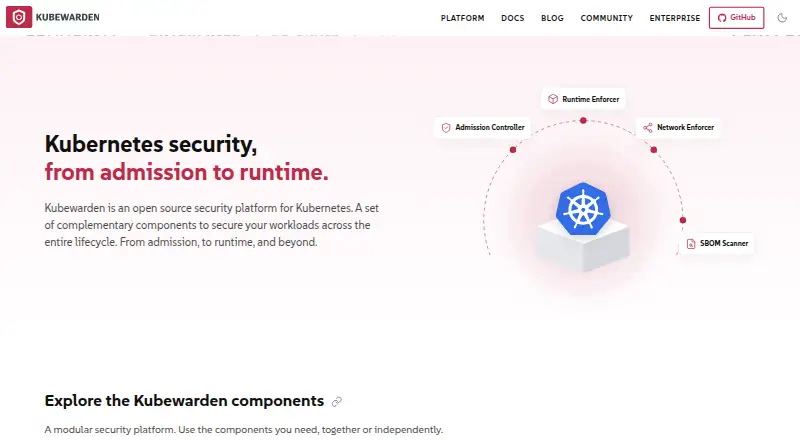
Kubewarden is an open-source security platform for Kubernetes workloads, with components that can be used together or independently. Its stable Admission Controller can block unsafe workloads before they enter a cluster. Operators can manage policies as Kubernetes resources, test them in monitor mode before enforcement, and audit workloads with PolicyReports. Policies can use WebAssembly-compatible languages such as Rust, Go, CEL, and Rego, and policies from OPA, Gatekeeper, and ValidatingAdmissionPolicy can be reused. A beta SBOM Scanner finds container-image vulnerabilities and supports VEX to identify findings that do not affect software. The beta Runtime Enforcer controls what can run inside pods. Its experimental Network Enforcer observes traffic and can produce Kubernetes NetworkPolicy or Istio AuthorizationPolicy rules. Policies can be distributed through OCI-compliant registries. Kubewarden is free, and its command-line tool has installation instructions for Linux, macOS, and Windows. The project provides Helm installation instructions and links to community meetings and its Kubernetes Slack community.
Good
- Stable Admission Controller blocks unsafe workloads.
- Policies support WebAssembly-compatible languages.
- Can reuse OPA and Gatekeeper policies.
- Components can be used independently.
- Free and open source.
Watch out
- Network Enforcer is experimental.
- Runtime Enforcer and SBOM Scanner are beta.
- Network Enforcer requires Kubernetes 1.30 or newer.
Who it suits
Kubewarden suits teams that want Kubernetes policy controls across admission, runtime, software bills of materials, or network activity. Teams can adopt its components separately, and enterprise support is available through SUSE Security Admission Controller.
Verdict
Kubewarden offers policy management and several layers of Kubernetes workload security, but component maturity differs. Consider the stable Admission Controller separately from beta and experimental components when assessing fit.
The facts
Each one read from Kubewarden's own pages, with the date it was checked.
What it does
- Admission control
- The stable Admission Controller evaluates built-in and custom Kubernetes resources before admission and can allow, modify, or deny requests.checked 2 Oct 2026
- Audit scanner
- The audit scanner actively and continuously checks policy enforcement over time.checked 1 Oct 2026
- Components
- Its components are the Admission Controller, Network Enforcer, Runtime Enforcer, and SBOM Scanner, which can be used together or independently.checked 2 Oct 2026
- Deployment
- The component pages provide Helm installation instructions for deploying Kubewarden components to Kubernetes.checked 2 Oct 2026
- Enterprise support
- SUSE provides full enterprise support through the SUSE Security Admission Controller, a curated version of Kubewarden.checked 1 Oct 2026
- Governance
- Kubewarden was accepted into the CNCF Sandbox on June 17, 2022.checked 1 Oct 2026
- Network enforcement
- Its Network Enforcer is experimental and discovers network activity to secure communication between workloads.checked 1 Oct 2026
- Network integrations
- Network Enforcer works with Calico, Cilium, or Istio Ambient to observe traffic and produce native Kubernetes NetworkPolicy or Istio AuthorizationPolicy rules.checked 2 Oct 2026
- Network providers
- The Network Enforcer supports Istio ambient, Calico, and Cilium providers on x86_64 and aarch64 architectures with Kubernetes 1.30 or newer.checked 1 Oct 2026
- Observability integrations
- Optional integrations include OpenTelemetry, Prometheus, Jaeger, and Policy Reporter.checked 1 Oct 2026
- Policy compatibility
- The Admission Controller supports reusing OPA, Gatekeeper, and ValidatingAdmissionPolicy policies.checked 2 Oct 2026
- Policy distribution
- Policies are compiled to WebAssembly and can be packaged and shared through standard OCI registries.checked 2 Oct 2026
- Policy languages
- Policies can be written in Rust, Go, Rego, CEL, and other familiar technologies.checked 2 Oct 2026
- Policy operations
- Operators can manage policies as Kubernetes resources, use monitor mode before enforcement, and audit workloads with PolicyReports.checked 2 Oct 2026
- Policy reuse
- Kubewarden supports reusing policies from other policy engines without rewriting them.checked 1 Oct 2026
- Product type
- Kubewarden is an open source security platform for Kubernetes.checked 1 Oct 2026
- Project status
- Kubewarden is a CNCF Sandbox Project; its Admission Controller is marked stable, Runtime Enforcer and SBOM Scanner beta, and Network Enforcer experimental.checked 2 Oct 2026
- Purpose
- Kubewarden is an open source security platform for Kubernetes that secures workloads across their lifecycle.checked 2 Oct 2026
- Risk context
- SBOM Scanner supports VEX to identify findings that do not affect software; its page says KEV and EPSS support is on the way.checked 2 Oct 2026
- Runtime enforcement
- The beta Runtime Enforcer uses Linux kernel eBPF to learn process execution and block executables outside a workload's allow-list.checked 2 Oct 2026
- SBOM scanning
- The beta SBOM Scanner generates software bills of materials and vulnerability reports for container registries, running workloads, and cluster nodes.checked 2 Oct 2026
- Supply-chain security
- Kubewarden documents SLSA-based verification and publishes signed artifacts and software bills of materials.checked 1 Oct 2026
- Support
- The project offers open monthly community meetings and links to its Kubernetes Slack community.checked 2 Oct 2026
Where it runs
- CLI platforms
- The kwctl CLI has installation instructions for Linux, macOS, and Windows.checked 1 Oct 2026
The full review of Kubewarden
Overview
Kubewarden is an open-source security platform for Kubernetes, aimed at teams that want to apply workload policies throughout a cluster’s lifecycle. Its strongest case is the stable Admission Controller; the surrounding security components add useful scope, but are at earlier stages of maturity.
Teams can adopt the components together or independently. Kubewarden is a CNCF Sandbox project, accepted on June 17, 2022, and SUSE offers enterprise support through its curated SUSE Security Admission Controller.
It belongs in Kubernetes Security Software, Cloud Governance Software, and Infrastructure Policy as Code Tools.
Key features
Admission policies and compatibility
The stable Admission Controller blocks unsafe workloads before they enter a cluster. Operators manage policies as Kubernetes resources and can use monitor mode before enforcing them, a practical way to assess policy effects before making them blocking rules. Policies can be written in WebAssembly-compatible languages such as Rust, Go, CEL, and Rego. Support for OPA, Gatekeeper, and ValidatingAdmissionPolicy policies can reduce migration work for teams already using those systems.
Policies can be distributed through OCI-compliant registries, and the audit scanner continuously checks policy enforcement over time. PolicyReports provide workload audit reporting. Testing and CI/CD integration support policy development and delivery, while integrations with OpenTelemetry, Prometheus, Jaeger, and Policy Reporter give operators optional observability paths.
Security across the workload lifecycle
The beta SBOM Scanner finds vulnerabilities in container images running in a cluster and supports VEX, which helps distinguish findings that do not affect the software. KEV and EPSS support is on the way. The beta Runtime Enforcer controls what can run inside Kubernetes pods. Both extend protection beyond admission, but their beta status makes them less suitable as the sole basis for mature production controls.
The experimental Network Enforcer discovers workload network activity and can produce native Kubernetes NetworkPolicy or Istio AuthorizationPolicy rules. It supports Istio ambient, Calico, and Cilium on x86_64 and aarch64 with Kubernetes 1.30 or newer. That narrow compatibility and experimental status make it a cautious choice for teams that need dependable network enforcement today.
Deployment and supply-chain safeguards
Component pages provide Helm installation instructions, and the kwctl CLI has installation instructions for Linux, macOS, and Windows. Kubewarden documents SLSA-based verification and publishes signed artifacts and software bills of materials. These practices help teams assess software provenance, though they do not change the maturity of the individual components.
Pricing
Kubewarden is free and open source, with a free plan. There are no paid Kubewarden tiers to compare. Teams seeking commercial support can turn to SUSE’s SUSE Security Admission Controller, a curated version of Kubewarden with enterprise support; its pricing is custom pricing.
Open monthly community meetings and a Kubernetes Slack community offer project-level support routes. Teams that require a formal enterprise support relationship should weigh SUSE’s offering rather than relying on community channels alone.
Platforms
Kubewarden is listed for Linux, macOS, Windows, and self-hosted environments. The kwctl CLI installation instructions cover Linux, macOS, and Windows, while the components are deployed to Kubernetes using Helm. Network Enforcer use additionally requires one of its supported providers, x86_64 or aarch64, and Kubernetes 1.30 or newer.
Who it's for
Kubewarden suits Kubernetes operators who want policy-as-code controls at admission and value policy reuse, registry-based distribution, audit reporting, and a free open-source platform. It is especially compelling for teams already invested in OPA, Gatekeeper, or ValidatingAdmissionPolicy that want to avoid rewriting policies.
It is a weaker fit for organizations that need every security layer to be stable today, or need broad network-provider compatibility beyond the stated choices. The stable Admission Controller can stand on its own, but beta and experimental components should be evaluated separately rather than treated as equally mature parts of a single dependable suite.
Pros and cons
Pros
- Stable admission control: blocks unsafe workloads before cluster entry, with monitor mode available before enforcement.
- Policy portability: supports WebAssembly-compatible languages and reuse of OPA, Gatekeeper, and ValidatingAdmissionPolicy policies.
- Free and modular: teams can use components independently and avoid paying for a bundled suite.
- Operational visibility: continuous audit scanning, PolicyReports, and optional observability integrations support ongoing policy oversight.
Cons
- Uneven maturity: the SBOM Scanner and Runtime Enforcer are beta, while the Network Enforcer is experimental.
- Network requirements are specific: the Network Enforcer is limited to Istio ambient, Calico, or Cilium, x86_64 or aarch64, and Kubernetes 1.30 or newer.
- Enterprise support is separate: SUSE’s curated supported version is a distinct route rather than support included with the free project.
Alternatives
Cloud Custodian is another free, open-source option, with an Apache 2.0 license and Linux, macOS, Windows, and self-hosted platforms; consider it when those characteristics suit your governance needs better than Kubewarden’s Kubernetes workload focus.
AWS Control Tower is worth considering for an AWS-oriented setup: it has no additional charge for Control Tower, though underlying AWS services are billed by usage.
OmniGCloud has a free plan with one connector, a single SaaS workspace, basic CSV export, and a basic audit trail; consider it if that starting point fits better than Kubernetes-native policy controls.
CGPulse offers a free plan with two cloud accounts, 10 scans per month, one tracked initiative, five auto-fixes per month, and watermarked PDF reports. Choose it instead when those cloud-account scanning and reporting limits match the task.
CoreStack Cloud Governance offers product, bundle, and assessment options with custom pricing.
Jamcracker is a cloud management platform for MSPs, system integrators, enterprises, and cloud teams working across AWS, Azure, Google Cloud, VMware, and private clouds.
MacroCloud Governance Center is a paid web product with pricing on request.
PolicyCortex is a paid web product with annual or monthly terms and commercial terms on request.
Verdict
Kubewarden is a strong choice for Kubernetes teams that want free, modular policy enforcement and a stable admission layer with broad policy-language and engine compatibility. Its main advantage is policy control without forcing a rewrite or paid platform commitment; its main reason to look elsewhere is the uneven maturity of its broader security layers. Adopt the Admission Controller confidently on its own, and treat beta and experimental components as additions to evaluate against your organization’s risk tolerance.
Alternatives to Kubewarden
- 1
Kubescape
Free planOpen sourceAPILinuxmacOSSelf-hosted8.2From $30 a month - 2
Kyverno
Free planOpen sourceWebAPILinuxmacOS7.7Free plan - 3

Open Policy Agent Gatekeeper
Free planOpen sourceAPILinuxSelf-hosted7.2Free plan - 4

Sysdig Secure
WebAPILinuxmacOS7.2From $20 a month - 5

Fairwinds Polaris
Free planWebLinuxmacOSSelf-hosted7.1Free plan - 6
Trivy Operator
Free planOpen sourceAPILinuxSelf-hosted6.9Free plan