
AWS Control Tower
AWS Control Tower sets up and governs secure, multi-account AWS environments.
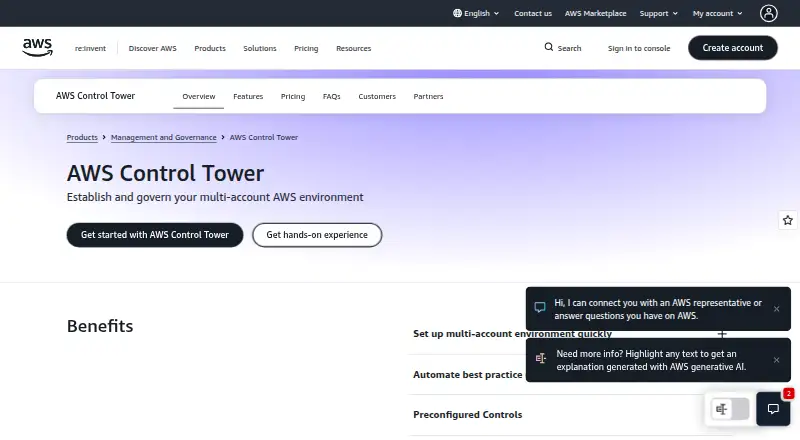
What AWS Control Tower is
AWS Control Tower sets up and governs secure, multi-account AWS environments. AWS says it can establish a well-architected multi-account environment in under 30 minutes. Landing zone setup works with new or existing AWS Organizations and automates account structure, identity, federated access, and central backup integrations. Account Factory provisions accounts from configurable templates, with support for custom resources and requirements. The Control Catalog contains more than 750 managed controls for security, cost, durability, and operations; organizations can use it without setting up a full landing zone. Controls may be detective, preventive, or proactive. Proactive controls use AWS CloudFormation Hooks to identify and block deployments that do not meet requirements. Predefined integrations include AWS Organizations, IAM Identity Center, AWS Config, AWS Backup, and AWS CloudTrail, and an API is available. AWS charges no additional fee for Control Tower itself, but underlying AWS services, optional controls, and configured resources may incur usage costs. The selected home Region cannot be changed after landing zone creation, and some controls are unavailable in some supported Regions.
Good
- Account Factory provisions accounts from configurable templates.
- The catalog includes over 750 managed controls.
- Controls include detective, preventive, and proactive types.
- Control Tower itself has no additional charge.
Watch out
- Underlying AWS service usage charges still apply.
- Optional controls and configured resources may add costs.
- The landing zone home Region cannot be changed.
- Some controls do not work in every supported Region.
Who it suits
It is intended for organizations managing multiple AWS accounts that need centralized governance and automated policy enforcement. Teams can also use its Control Catalog without creating a full landing zone.
Verdict
AWS Control Tower is suited to centralized governance across multiple AWS accounts, with landing zone automation and a broad control catalog. Its own charge is zero, but customers should account for underlying AWS usage and regional limitations; controls do not themselves establish regulatory compliance.
Plans and prices
From AWS Control Tower's own pricing page, checked 15 Oct 2026.
| Plan | Price | What it gives you |
|---|---|---|
| AWS Control Tower | Free | No additional Control Tower charge · underlying AWS services billed separately · Service Catalog, CloudTrail, Config and other enabled services may incur fees |
The facts
Each one read from AWS Control Tower's own pages, with the date it was checked.
What it does
- Account customization
- Account Factory Customization provisions customized accounts from the console after one-time setup without requiring users to write scripts or pipelines.checked 15 Oct 2026
- Account Factory
- Account Factory provides preapproved account templates and automates account creation, enrollment and policy application.checked 15 Oct 2026
- Account provisioning
- Account Factory automates account provisioning from configurable templates and supports custom resources and requirements.checked 29 Sep 2026
- API
- AWS Control Tower has an API, and AWS directs users to its API reference for available operations.checked 29 Sep 2026
- AWS integrations
- Predefined integrations include AWS Organizations, IAM Identity Center, AWS Config, AWS Backup, and AWS CloudTrail.checked 29 Sep 2026
- Compliance
- Control Tower controls can help organizations address compliance needs, but AWS says its resource compliance reporting does not itself mean compliance with government regulations.checked 29 Sep 2026
- Control Catalog API
- Controls have unique ARNs that can be used with the Control Tower and Control Catalog APIs; global ARNs are recommended.checked 15 Oct 2026
- Controls
- Controls are plain-language governance rules classified as preventive, detective or proactive, with mandatory, strongly recommended or elective guidance.checked 15 Oct 2026
- Control types
- Controls can be detective, preventive, or proactive, and proactive controls use AWS CloudFormation Hooks to identify and block noncompliant deployments.checked 29 Sep 2026
- Dashboard
- The dashboard shows provisioned accounts, enabled controls and noncompliant resources by account and organizational unit.checked 15 Oct 2026
- Detective controls
- Detective controls use AWS Config rules to identify events and record activity in CloudTrail.checked 15 Oct 2026
- Documentation
- AWS provides a user guide, controls reference, API reference, security guidance, pricing documentation, FAQs and release notes.checked 15 Oct 2026
- Integrations
- The service is built on AWS Organizations, AWS Service Catalog and AWS IAM Identity Center, and can integrate services such as Config, CloudTrail and Backup.checked 15 Oct 2026
- Intended users
- AWS describes Control Tower as designed for organizations managing multiple AWS accounts that need centralized governance and automated policy enforcement.checked 29 Sep 2026
- Landing zone
- It creates a well-architected landing zone containing organizational units, accounts, users and governed resources.checked 15 Oct 2026
- Limit: complexity
- G2 reviewers report that initial setup, configuration and troubleshooting can be difficult for newcomers and nontechnical users.checked 15 Oct 2026
- Limit: restrictive customization
- G2 reviewers report that controls and architecture can feel restrictive and that advanced customization often requires other AWS services or administrator involvement.checked 15 Oct 2026
- Notable 2025 updates
- The 2025 release summary lists landing-zone version 4.0, 279 additional Config controls, automatic account enrollment, IPv6 support and PrivateLink support.checked 15 Oct 2026
- Notable 2026 documentation update
- AWS document history records a September 16, 2026 change to the CloudWatch Logs resource pattern used by Control Tower.checked 15 Oct 2026
- Notable release
- AWS Control Tower reached general availability on June 24, 2019.checked 15 Oct 2026
- Praise: centralized governance
- G2 reviewers repeatedly praise centralized management of multiple AWS accounts and unified visibility.checked 15 Oct 2026
The company
- Company facts
- AWS's LinkedIn company page lists Amazon Web Services as founded in 2006, headquartered in Seattle, Washington, with more than 10,001 employees.checked 15 Oct 2026
- Legal maker
- The AWS Control Tower site footer identifies Amazon Web Services, Inc. or its affiliates as the copyright owner.checked 15 Oct 2026
Money
- Cost caveat
- AWS warns that enabling Control Tower can increase AWS Config costs and that external and Control Tower-managed CloudTrail trails can create duplicate charges.checked 15 Oct 2026
The full review of AWS Control Tower
AWS Control Tower is a governance service for organizations running multiple AWS accounts. It suits teams that need a common policy baseline, repeatable account creation and centralized oversight rather than a collection of separately managed accounts. The strongest case is an AWS-only estate where landing-zone automation and extensive controls justify adopting a managed governance layer.
Overview
Control Tower establishes and governs secure, multi-account AWS environments. It can configure a landing zone for a new or existing AWS Organization, bringing identity, federated access, central backup and account-structure integrations into one operating model. AWS says the initial setup can take under 30 minutes, which can shorten the path to a consistent foundation, although the home Region selected during creation cannot later be changed.
This is single-cloud governance, not a way to apply one policy model across different cloud providers. AWS also treats security as a shared responsibility: AWS protects the underlying infrastructure, while customers remain responsible according to the services they use. Controls can support compliance work, but resource-compliance reporting does not by itself establish compliance with government regulations.
Key features
Landing zone and account creation
Landing-zone automation connects with AWS Organizations, IAM Identity Center, AWS Config, AWS Backup and AWS CloudTrail. Account Factory provisions accounts from configurable templates and supports custom resources and requirements. That repeatability is valuable for expanding organizations that want every new account to start with the same guardrails; it is unnecessary overhead for a small estate with few accounts.
Control catalog
The Control Catalog contains more than 750 managed controls covering security, cost, durability and operations. Teams can use the catalog without deploying a complete landing zone, allowing a narrower adoption path. Controls can be detective, preventive or proactive. Proactive controls use AWS CloudFormation Hooks to identify and block noncompliant deployments, while detective controls help reveal drift after deployment. Some detective and proactive controls do not operate in every supported Region, so globally distributed organizations must verify regional coverage before relying on a control as a universal safeguard.
Extensibility and policy operations
Predefined AWS integrations provide a connected governance stack, and AWS Marketplace adds third-party options for identity management, security, networking, operational intelligence and SIEM use cases. An API exposes Control Tower operations for automation. The service supports policy as code, compliance frameworks, drift detection and approval workflows, giving platform teams mechanisms to standardize change rather than handle each exception manually.
Pricing
| Plan | Price | What it means |
|---|---|---|
| AWS Control Tower | free | No additional charge for Control Tower; underlying AWS services are billed based on usage. AWS service usage charges apply, and optional controls or configured resources may add costs. |
The zero-price plan fits organizations that want managed governance without a separate Control Tower license fee. It is not an all-in cost: services used by the landing zone, controls and configured resources can generate AWS charges. There are no published seat, quota or trial terms in this plan, so budgeting should focus on the AWS components the chosen controls and integrations activate.
Platforms
Control Tower is available through web and API interfaces. Its integrations and policy model are built for AWS Organizations, so teams seeking a provider-neutral control plane should look elsewhere.
Who it's for
AWS Control Tower is aimed at organizations managing multiple AWS accounts that need centralized governance and automated policy enforcement. It is particularly suitable for platform, security and compliance teams standardizing account baselines, approvals and ongoing drift management. A single-account deployment, a lightly governed AWS setup or a multi-cloud program is a weaker fit because the service's value comes from AWS-wide account coordination.
Pros and cons
Pros
- Managed multi-account foundation: landing-zone automation combines identity, backup and account structure instead of requiring each capability to be assembled manually.
- Repeatable provisioning: Account Factory templates reduce variation when creating new accounts and allow custom requirements.
- Broad control choice: more than 750 controls span security, cost, durability and operations, with detective, preventive and proactive enforcement.
- Flexible adoption: the catalog can be used without a full landing zone, useful for teams that want controls before a complete rollout.
Cons
- Region commitment: the landing-zone home Region is permanent, making initial architecture planning consequential.
- Uneven regional coverage: some detective and proactive controls do not work in every supported Region.
- Usage-based total cost: Control Tower itself is free, but AWS services, optional controls and configured resources can add ongoing charges.
- Compliance boundary: controls assist compliance programs but do not constitute regulatory compliance on their own.
Alternatives
For a broader category view, see Cloud Governance Software.
- Powerpipe is a free, open-source option available on Linux, macOS, Windows, self-hosted deployments and the web.
- OmniGCloud suits teams wanting freemium cloud governance across API, self-hosted and web environments; its free tier allows one connector and one SaaS workspace.
- Cloud Custodian is a free Apache 2.0 open-source choice for Linux, macOS, Windows and self-hosted use.
- Kyverno is a free Apache-licensed open-source policy project with API, desktop and self-hosted availability.
- CGPulse is a freemium API and web service with a free tier limited to two cloud accounts and 10 scans per month.
- Google Cloud Organization Policy is the natural alternative when governance is centered on Google Cloud.
- Open Policy Agent Gatekeeper is a free, self-hosted Kubernetes policy controller.
- CloudBolt offers a freemium cloud management platform, including a free tier for up to 100 resources.
Verdict
Choose AWS Control Tower when your organization is standardizing many AWS accounts and wants a managed landing zone, repeatable provisioning and a large catalog of enforceable controls. Look elsewhere if you need multi-cloud governance, universal regional control coverage or a total-cost model isolated from underlying AWS usage.
Alternatives to AWS Control Tower
- 1
Kyverno
Free planOpen sourceWebAPILinuxmacOS7.7Free plan - 2

CGPulse
Free planWebAPI7.3From €99 a month - 3

OmniGCloud
Free planWebAPISelf-hosted7.3From $39 a month - 4

Open Policy Agent Gatekeeper
Free planOpen sourceAPILinuxSelf-hosted7.2Free plan - 5
Google Cloud Organization Policy
Free planWebAPILinuxmacOS7.1Free plan - 6

Powerpipe
Free planWebLinuxmacOSSelf-hosted7.1Free plan