Google Cloud Organization Policy
Google Cloud Organization Policy gives administrators centralized, programmatic control over Google Cloud resources by applying constraints across an organiz…
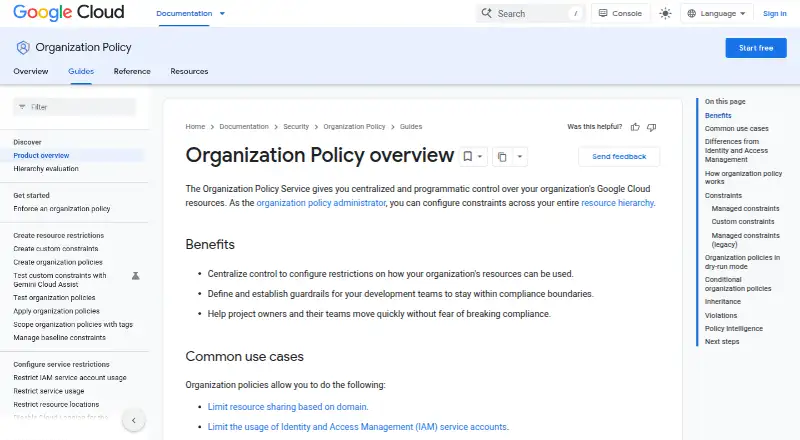
What Google Cloud Organization Policy is
Google Cloud Organization Policy gives administrators centralized, programmatic control over Google Cloud resources by applying constraints across an organization, folder, or project. Descendant resources inherit policies by default, allowing teams to establish guardrails throughout a resource hierarchy. Documented controls include limiting resource sharing by domain, restricting IAM service account use, and limiting locations for new resources. Organizations can also define custom constraints on resource creation and updates. Policies are managed in the Google Cloud console, CLI, or REST API. Dry-run policies log violations without blocking the action, allowing teams to monitor possible workflow effects before enforcement. Policy Intelligence tools can test proposed changes, locate non-compliant resources, monitor workflow impact, and show policy coverage. The service is free, with the Organization Policy Service API listed as free. Changes can take up to 15 minutes to take full effect, and most enforcement is not retroactive, so an existing action or state may continue. Basic Support is included for Google Cloud customers; paid technical support tiers are also available.
Good
- Policies apply at organization, folder, and project levels.
- Descendants inherit policies by default.
- Dry-run logs violations without denying actions.
- Policy Intelligence can test changes and find non-compliant resources.
- Console, CLI, and REST API management options.
Watch out
- Changes can take up to 15 minutes to take effect.
- Most enforcement is not retroactive.
- Paid technical support tiers are available.
Who it suits
Organization Policy suits administrators configuring organization-wide constraints, as well as project owners and teams that need compliance guardrails across Google Cloud resources.
Verdict
Google Cloud Organization Policy gives teams a way to apply and assess resource guardrails across a hierarchy. Its delayed and mostly non-retroactive enforcement is important to account for when changing policies.
Plans and prices
From Google Cloud Organization Policy's own pricing page, checked 14 Oct 2026.
| Plan | Price | What it gives you |
|---|---|---|
| Organization Policy Service API | Free | API usage free · Google Cloud workloads remain subject to their own service pricing · No charge |
The facts
Each one read from Google Cloud Organization Policy's own pages, with the date it was checked.
What it does
- API
- The Organization Policy API is exposed at orgpolicy.googleapis.com with REST v2 resources for folders, organizations, and projects.checked 14 Oct 2026
- Authentication
- Client libraries use Application Default Credentials, with gcloud authentication available for local development.checked 14 Oct 2026
- CLI management
- The Google Cloud CLI provides org-policies commands for setting, describing, listing, and deleting policies and constraints.checked 14 Oct 2026
- Common controls
- Documented use cases include limiting resource sharing by domain, restricting IAM service account usage, and limiting where newly created resources can be located.checked 7 Oct 2026
- Console management
- Administrators can create and manage policies through the Google Cloud console Organization policies page.checked 14 Oct 2026
- Constraint model
- Each policy controls one constraint, which defines the service behavior or configuration being restricted.checked 14 Oct 2026
- Custom constraints
- Organizations can define custom constraints for more granular restrictions on supported resource fields and operations.checked 14 Oct 2026
- Custom constraint versioning limit
- Custom constraints have no version history, so updating one overwrites the current definition immediately.checked 14 Oct 2026
- Documentation depth
- Documentation includes guides, quickstarts, constraint references, code samples, training, release notes, and quota guidance.checked 14 Oct 2026
- Dry-run mode
- Dry-run policies audit-log violations without denying the violating actions, so teams can monitor potential workflow impact before enforcement.checked 7 Oct 2026
- Enforcement timing
- Changes to organization policies can take up to 15 minutes to be fully enforced.checked 7 Oct 2026
- Guardrails
- Organization policies let teams set resource use restrictions and establish guardrails to stay within compliance boundaries.checked 7 Oct 2026
- Hierarchy enforcement
- Policies can attach to organizations, folders, or projects and normally flow to descendant resources.checked 14 Oct 2026
- Inheritance limitation
- Inherited managed constraints are not merged with child policies; a child policy overrides the inherited configuration.checked 14 Oct 2026
- Integration evidence
- Capterra lists integrations including Google Docs, Google Drive, Slack, Trello, Google Workspace, Jira, WordPress, and Gmail.checked 14 Oct 2026
- Intended users
- The documentation describes organization policy administrators as configuring organization-wide constraints and project owners and teams as benefiting from compliance guardrails.checked 7 Oct 2026
- Limit: Capterra complexity
- Capterra reviewers repeatedly mention steep learning curves, difficult troubleshooting across services, and complex pricing.checked 14 Oct 2026
- Limit: Gartner usability
- Gartner reviewers report that interface navigation and deployment of some newer services can be difficult.checked 14 Oct 2026
- Limit: Reddit documentation
- A platform engineer reported that organization-policy documentation was sparse, legacy constraints lacked dry-run support, and CEL custom constraints were touchy.checked 14 Oct 2026
- Managed constraints
- Google-managed constraints provide list or boolean controls and are being used in place of equivalent legacy constraints.checked 14 Oct 2026
- Management interfaces
- Policies can be viewed and managed in the Google Cloud console, and the documentation also provides Google Cloud CLI and API references.checked 7 Oct 2026
The company
- Company founding
- Google was officially established in August 1998 after an investment from Andy Bechtolsheim.checked 14 Oct 2026
- Company headquarters
- Google's current headquarters, the Googleplex, is in Mountain View, California.checked 14 Oct 2026
- Company status
- Gartner identifies Google as a public company founded in 1998 with headquarters in Mountain View, California.checked 14 Oct 2026
Alternatives to Google Cloud Organization Policy
- 1
Kyverno
Free planOpen sourceWebAPILinuxmacOS7.7Free plan - 2

CGPulse
Free planWebAPI7.3From €99 a month - 3

OmniGCloud
Free planWebAPISelf-hosted7.3From $39 a month - 4

Open Policy Agent Gatekeeper
Free planOpen sourceAPILinuxSelf-hosted7.2Free plan - 5

Powerpipe
Free planWebLinuxmacOSSelf-hosted7.1Free plan - 6

AWS Control Tower
Free planWebAPI6.7Free plan