Kyverno
Kyverno is a free, open-source policy engine designed for Kubernetes.
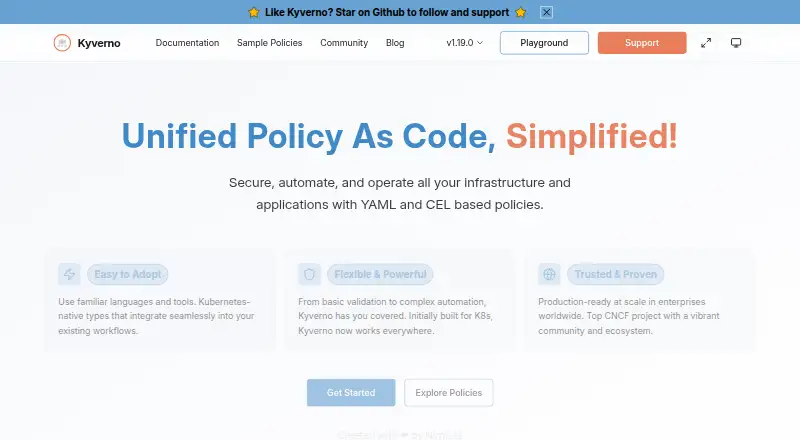
What Kyverno is
Kyverno is a free, open-source policy engine designed for Kubernetes. It lets platform engineering teams define and enforce policy as code: stable policy types can validate, mutate, generate, or delete resources, and verify container image signatures and attestations. The Kyverno CLI can test policies against Kubernetes resource manifests in CI pipelines before resources are applied to a live cluster. Documentation describes use with Helm, YAML manifests, GitHub Actions, and GitOps tools such as ArgoCD. Kyverno is installed in a Kubernetes cluster; Helm is recommended for production deployments, while YAML manifests are also available. A standard installation requires an admission controller, with background, reports, and cleanup controllers optional. Production installations should use high availability mode. Kyverno supports CEL-based policy types and describes applying Kubernetes-style policies beyond Kubernetes as part of its mission. The project documents Cosign signatures for container images and manifests, and lists CLI binaries for Linux, macOS, and Windows. Kyverno’s resource webhooks default to fail-closed, so matching requests can fail if the API server cannot reach Kyverno.
Good
- Free and open source
- Can validate, mutate, generate, or delete resources
- CLI tests policies against manifests in CI
- Works with Helm, YAML, and GitOps tools
Watch out
- Requires installation in a Kubernetes cluster
- Production deployments should use high availability mode
- Fail-closed webhooks can block matching requests if Kyverno is unreachable
- Legacy ClusterPolicy and CleanupPolicy types are deprecated
Who it suits
Kyverno is intended for platform engineering teams managing security, compliance, automation, and governance through policy as code. It suits teams working with Kubernetes clusters and policy checks in CI pipelines.
Verdict
Kyverno provides Kubernetes-native policy enforcement and pre-deployment testing, with support for several deployment and GitOps workflows. Teams should account for its cluster requirement and fail-closed webhook behavior when planning operations.
Plans and prices
From Kyverno's own pricing page, checked 4 Oct 2026.
| Plan | Price | What it gives you |
|---|---|---|
| Kyverno | Free | Open-source project · Apache License 2.0 |
| Open-source core | Free | Kubernetes policy engine · self-hosted deployment · No paid tier shown |
The facts
Each one read from Kyverno's own pages, with the date it was checked.
What it does
- API repository
- The CEL-based APIs are maintained in a separate kyverno/api repository to simplify importing Kyverno types into Go projects.checked 15 Oct 2026
- Availability
- A standard installation has a required admission controller and optional background, reports, and cleanup controllers; production installations should use high availability mode.checked 4 Oct 2026
- CI integration
- Official documentation provides GitHub Actions workflows for testing policies in continuous integration.checked 15 Oct 2026
- CI testing
- The Kyverno CLI can test policies in CI pipelines against Kubernetes resource manifests before they are applied to a live cluster.checked 4 Oct 2026
- Cleanup
- The current CEL policy model includes DeletingPolicy types for scheduled deletion of matching resources.checked 15 Oct 2026
- CLI
- The Kyverno CLI validates and tests policies against manifests before deployment and runs standalone or as a kubectl plugin.checked 15 Oct 2026
- CLI operating systems
- Release artifacts include CLI binaries for Linux, macOS and Windows architectures.checked 15 Oct 2026
- CNCF graduation
- CNCF announced Kyverno graduation on March 24, 2026 after production adoption, governance review and security assessment.checked 15 Oct 2026
- Deployment
- Kyverno is installed in a Kubernetes cluster, with Helm recommended for production deployments and YAML manifests also available.checked 4 Oct 2026
- Documentation
- The documentation covers installation, policy types, testing, reporting, monitoring, tracing, security, troubleshooting, high availability and CLI usage.checked 15 Oct 2026
- Exceptions
- PolicyException resources provide flexible exemptions from selected policies.checked 15 Oct 2026
- Generation
- Generate rules create resources from policy definitions and can continuously synchronize generated resources.checked 15 Oct 2026
- High availability
- Kyverno supports multiple replicas for selected controllers to improve availability and scalability.checked 15 Oct 2026
- Image verification
- ImageValidatingPolicy and legacy verifyImages rules verify container signatures and attestations, including Cosign and Notary authorities.checked 15 Oct 2026
- Installation
- Kyverno supports Helm and YAML installation, with Helm recommended for production customization and upgrades.checked 15 Oct 2026
- Integrations
- CNCF lists common integrations with Argo CD, Backstage, Flux and Kubernetes for GitOps and platform governance.checked 15 Oct 2026
- Intended users
- The project describes Kyverno as designed for platform engineering teams and enabling security, compliance, automation, and governance through policy as code.checked 4 Oct 2026
- Legacy policy limit
- The documentation marks legacy ClusterPolicy and CleanupPolicy types deprecated in v1.19 and says they are scheduled for removal in v1.20.checked 4 Oct 2026
- Licence
- The project is open source under the Apache License 2.0.checked 15 Oct 2026
- Limit: admission availability
- An independent architecture review warns that a slow or unavailable Kyverno webhook can block pod creation because it sits in the admission path.checked 15 Oct 2026
- Limit: complex logic expressiveness
- The same review says YAML policies can be less expressive than Rego for complex cross-resource validation and aggregation queries.checked 15 Oct 2026
The company
- Company headquarters and size
- LinkedIn lists Kyverno as a nonprofit software-development organization headquartered in San Jose, California, with 51–200 employees.checked 15 Oct 2026
- Company origin
- Nirmata created Kyverno in 2019 and donated it to CNCF in 2020.checked 15 Oct 2026
- Founded
- 2019checked 28 Sep 2026
The full review of Kyverno
Kyverno is a Kubernetes-native policy engine for platform teams that need to codify security, compliance, automation, and governance. Its range of policy actions and pre-deployment CLI testing is a strong combination; the trade-off is that it must run in a Kubernetes cluster and its default fail-closed webhooks require operational care.
Overview
Kyverno lets teams define policy as code using Kubernetes-style rules, with support for CEL-based policy types and a stated goal of extending that style of policy beyond Kubernetes. It is open source under the Apache License 2.0, and the CNCF records it as a Graduated project, with graduation in March 2026. The project also documents a 2023 third-party security audit and security assessments as part of its graduation process. These are useful project-level signals for teams assessing governance, but they do not replace evaluating how the software fits a particular cluster.
Key features
Enforcement and resource automation
Kyverno’s stable policy types can validate, mutate, generate, and delete resources, as well as verify container image signatures and attestations. That breadth suits teams that want policy to govern both admission decisions and resource workflows; teams seeking only a narrow validation check may not need the full range.
Pre-deployment testing
The Kyverno CLI can test policies in CI pipelines against Kubernetes resource manifests before they reach a live cluster. This gives teams a way to catch policy problems earlier in their delivery workflow, rather than relying solely on admission-time decisions.
Workflow integration
Kyverno’s documentation covers Helm, YAML manifests, GitHub Actions, and GitOps tools such as ArgoCD. That makes it relevant to teams already managing Kubernetes resources through those workflows, without requiring policy work to be detached from their delivery process.
Installation and operations
Kyverno runs inside a Kubernetes cluster. Helm is recommended for production, though YAML manifests are also available. A standard installation requires the admission controller; background, reports, and cleanup controllers are optional. Production installations should use high availability mode.
Resource webhooks default to fail-closed. If the API server cannot reach Kyverno, matching resource requests can fail, so teams should account for Kyverno availability in cluster operations rather than treating it as a noncritical add-on. The documentation marks legacy ClusterPolicy and CleanupPolicy types deprecated in v1.19 and scheduled for removal in v1.20; teams using those types should plan migration.
For image and manifest security, the project documents Cosign signatures. Its release artifacts include CLI binaries for Linux, macOS, and Windows. Users can seek support and discussion through the project’s Kubernetes Slack channels, GitHub, and mailing list.
Pricing
Kyverno costs nothing under the Kyverno plan. It is an open-source project under the Apache License 2.0, with no paid tier described. This fits teams able to install and operate the software themselves; Kyverno is self-hosted and requires a Kubernetes cluster, so it is not a hosted service for readers seeking managed deployment.
Platforms
Kyverno is self-hosted and installed in a Kubernetes cluster. Its platform coverage includes API, Linux, macOS, and Windows; the project lists CLI binaries for the three desktop operating systems, while policy enforcement itself depends on the cluster deployment.
Who it's for
Kyverno is best suited to platform engineering teams that need consistent policy enforcement across Kubernetes resources and want to connect security, compliance, governance, and automation to existing CI or GitOps workflows. It is less suitable for teams without Kubernetes operations capacity or those that cannot accommodate the availability implications of fail-closed admission webhooks.
Pros and cons
- Pros: One policy engine supports validation, mutation, generation, deletion, and image signature and attestation verification, covering more than admission checks alone.
- Pros: CLI testing against manifests can surface policy issues in CI before resources are applied to a live cluster.
- Pros: Helm, YAML, GitHub Actions, and ArgoCD are covered in the project documentation, supporting several common Kubernetes delivery workflows.
- Cons: Kyverno must be installed in a Kubernetes cluster, which rules it out for teams looking for a standalone or hosted policy service.
- Cons: Fail-closed webhooks can block matching requests when the API server cannot reach Kyverno, making availability planning important.
- Cons: Deprecated legacy policy types require migration planning for users who rely on them.
Alternatives
Kubescape is another free, Apache 2.0 option with a self-hosted CLI and Kubernetes operator, suited to readers comparing open-source Kubernetes security tools.
Monokle offers a free, open-source desktop application for Linux, macOS, and Windows; consider it when a desktop tool is a better fit than a cluster-installed policy engine.
KSPM Pro has a free plan for one Kubernetes cluster with real-time scans and CIS coverage, making it an option for readers whose needs center on that stated cluster-scanning offer.
Falco is a free, open-source option for Linux and self-hosted environments; compare it when those platform requirements match your needs.
KubeLinter is a free Apache 2.0 option for Linux, macOS, and self-hosted use, with no paid tiers listed.
Red Hat Trusted Artifact Signer is a paid alternative for Linux, macOS, self-hosted, web, and Windows environments.
Kubewarden is another free option with Linux, macOS, self-hosted, and Windows support.
Sysdig Secure is a paid alternative spanning API, Linux, macOS, self-hosted, web, and Windows, with licensing based on the number of hosts for its CSPM offering.
Explore more in Kubernetes Security Software, Cloud Governance Software, Container Security Software, Infrastructure as Code Security Software, and Infrastructure Policy as Code Tools.
Verdict
Choose Kyverno if your platform team wants Kubernetes-native policy with broad enforcement and automation actions, plus a way to test policies in CI before deployment. Its open-source price is compelling, but the cluster requirement and fail-closed webhook behavior make operational readiness the deciding factor; teams unable to own that responsibility should look elsewhere.
Alternatives to Kyverno
- 1

CGPulse
Free planWebAPI7.3From €99 a month - 2

OmniGCloud
Free planWebAPISelf-hosted7.3From $39 a month - 3

Open Policy Agent Gatekeeper
Free planOpen sourceAPILinuxSelf-hosted7.2Free plan - 4
Google Cloud Organization Policy
Free planWebAPILinuxmacOS7.1Free plan - 5

Powerpipe
Free planWebLinuxmacOSSelf-hosted7.1Free plan - 6

AWS Control Tower
Free planWebAPI6.7Free plan