
Joomla
Joomla! is a free, open-source content management system for publishing and managing website content.
What Joomla is
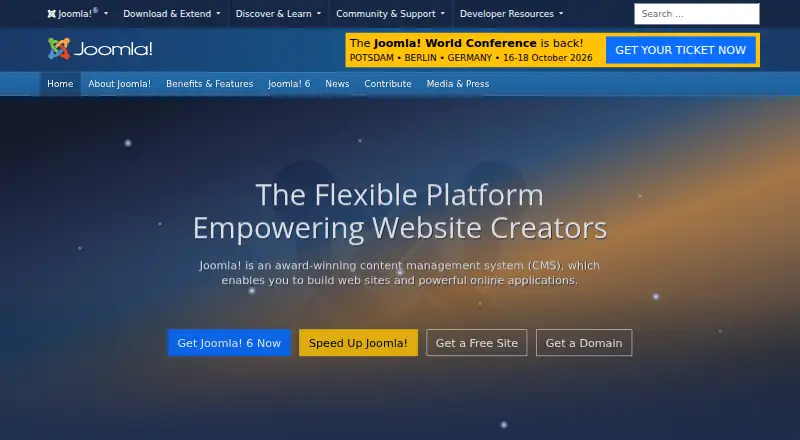
Joomla! is a free, open-source content management system for publishing and managing website content. It is built on an MVC web application framework that can also be used separately. Multiple users can create, edit, archive, publish, and distribute content with different permission levels; an Access Control List manages users, groups, and permissions. The CMS includes editorial workflows, custom content types, multilingual content, a media library, and SEO tools. Publishing features include article management, scheduled publishing, versioning, metadata, keywords, and search-engine-friendly URLs. Joomla! is used for corporate and small business sites, intranets, publications, e-commerce, government and community websites, and personal homepages. Its Extensions Directory offers thousands of extensions, most available free under the GPL, and the download site provides more than 70 accredited language packages. Joomla! lists built-in two-factor authentication and offers a community forum, online documentation, an issue tracker, and contextual in-app help. A fully functional free website is also available through launch.joomla.org without requiring users to install the CMS themselves.
Good
- Free, open-source CMS under the GPL-licensed plan.
- Supports user permissions, groups, and editorial workflows.
- Includes multilingual content and more than 70 language packages.
- Offers metadata, scheduled publishing, and content versioning.
- Free hosted website available without CMS installation.
Watch out
- The downloadable CMS requires users to install it themselves.
- Running a Joomla! website has technical requirements.
Who it suits
Joomla! suits individuals and organizations publishing websites that need multiple user roles, multilingual content, or editorial workflows. It also fits users who want a free hosted website without installing the CMS themselves.
Verdict
Joomla! provides a broad set of publishing and access-control features at no software cost. Users can choose between installing the CMS and using its free hosted website option.
Plans and prices
From Joomla's own pricing page, checked 5 Oct 2026.
| Plan | Price | What it gives you |
|---|---|---|
| Joomla! CMS | Free | 100% free CMS download · GPL-licensed software |
The facts
Each one read from Joomla's own pages, with the date it was checked.
What it does
- Access control
- Joomla! includes an Access Control List for managing site users, groups, and their permissions.checked 5 Oct 2026
- Accessibility
- The Joomla 6 feature page says its default templates align with WCAG 2.2 AA and include skip links and accessibility tools.checked 5 Oct 2026
- Content management
- The CMS supports multiple users with different permission levels to manage, create, edit, archive, publish, and distribute website content.checked 5 Oct 2026
- Custom content types
- Yeschecked 22 Sep 2026
- Custom user roles
- Yeschecked 22 Sep 2026
- Editorial workflows
- Yeschecked 22 Sep 2026
- Extensibility
- The Joomla Extensions Directory offers thousands of extensions, most available free under the GPL license.checked 5 Oct 2026
- Hosting option
- Joomla! offers a fully functional free website through launch.joomla.org without requiring users to install the CMS themselves.checked 5 Oct 2026
- Languages
- The download site offers more than 70 accredited Joomla! language packages.checked 5 Oct 2026
- Media library
- Yeschecked 22 Sep 2026
- Multilingual content
- Yeschecked 22 Sep 2026
- Requirements
- The downloads site provides a technical requirements page for running a Joomla! website.checked 5 Oct 2026
- Security
- Joomla! lists built-in two-factor authentication and says its volunteer Security Strike Team handles security issues; the security feed directs users to upgrade to 5.4.9 or 6.1.4 for listed vulnerabilities.checked 5 Oct 2026
- SEO and publishing
- Core features include metadata and keywords, SEF URLs, scheduled publishing, article management, and content versioning.checked 5 Oct 2026
- SEO tools
- Yeschecked 22 Sep 2026
- Support
- Joomla! provides an official community forum, online documentation, an issue tracker, and an in-app contextual help system.checked 5 Oct 2026
- Use cases
- Joomla! is used for corporate sites, intranets, small business sites, publications, e-commerce, government and community websites, and personal homepages.checked 5 Oct 2026
- What it is
- Joomla! is a free and open-source CMS for publishing web content, built on an MVC web application framework that can also be used independently.checked 5 Oct 2026
Money
- Free plan
- Yeschecked 22 Sep 2026
The company
- Headquarters
- New York, New York, United Stateschecked 28 Sep 2026
Where it runs
- Platform type
- hybridchecked 22 Sep 2026
The full review of Joomla
Overview
Joomla is an open-source content management system for building and managing websites, and its MVC framework can also be used independently. It is best suited to organizations that need structured publishing, distinct user permissions or multilingual content. Its range of capabilities is a strong fit for complex publishing needs, but self-hosting calls for technical setup and ongoing security attention.
Key features
Joomla supports multiple users with different permissions to create, edit, archive, publish and distribute content. Its Access Control List groups users and assigns permissions, while editorial workflows, custom roles, scheduled publishing and content versioning give teams control over both responsibilities and publishing cadence. That structure matters for sites with several contributors; a simple homepage may not need this level of administration.
Core SEO tools include metadata, keywords and search-engine-friendly URLs. A media library and custom content types support varied content structures, and more than 70 accredited language packages provide a basis for multilingual publishing. The Joomla Extensions Directory contains thousands of extensions, most available free under the GPL license. The breadth helps adapt the CMS to different site needs, though selecting and maintaining extensions adds work.
Joomla includes built-in two-factor authentication, and its volunteer Security Strike Team handles security issues. The security feed directs users to upgrade to versions 5.4.9 or 6.1.4 for listed vulnerabilities, underscoring that keeping a self-hosted site updated is part of operating it. Joomla 6's default templates align with WCAG 2.2 AA and include skip links and accessibility tools.
Users can turn to Joomla's official community forum, online documentation, issue tracker and contextual in-app help. A free hosted website at launch.joomla.org offers a way to use Joomla without installing the CMS, while the downloads site provides technical requirements for running a site.
Pricing
Joomla! CMS — free. The plan is a 100% free CMS download under the GPL license, with no software cost. It suits users willing to arrange installation and operation themselves; the free hosted website option is an alternative for those who do not want to install the CMS.
Platforms
Joomla is available for self-hosted Linux and web use, with API support. Its hybrid platform classification reflects both the downloadable CMS and hosted website option. Self-hosting gives users control over running the site but also makes meeting the technical requirements and applying security updates their responsibility.
Who it's for
Joomla can serve corporate and small-business sites, intranets, publications, e-commerce, government and community websites, and personal homepages. It is especially well matched to organizations that need permission levels, editorial workflows, custom content types or multilingual publishing. Those needs can justify its administrative depth; users seeking a site without installation or ongoing technical upkeep should consider the hosted option or a website builder.
Pros and cons
- Pros: Fine-grained access control and editorial tools help teams divide publishing responsibilities.
- Pros: Multilingual support, SEO tools, custom content types and a large extension directory accommodate varied publishing needs.
- Pros: The CMS download is free, and a free hosted website option avoids self-installation.
- Cons: Self-hosted users must meet technical requirements and keep the software current, including security updates.
- Cons: The breadth of extensions brings choices to assess and maintain, making Joomla a heavier fit for a basic personal site.
Alternatives
Choose Drupal instead if you want another free, GPL-licensed CMS and are prepared for self-hosting and technical setup. Webflow CMS is worth considering for exploring its CMS through a free plan that includes limited CMS, two static pages, 1 GB bandwidth and 50 form submissions.
HubSpot Content Hub offers a free plan for up to two users with no credit card required, which may suit a small team looking for a hosted option. django CMS is another open-source CMS with no license fees, while Prismic has a free plan aimed at developers building personal websites or a proof of concept.
Tiki Wiki CMS Groupware is a free, self-hosted open-source option. Umbraco CMS offers a free plan with content authoring, media and user management, multilingual setup, headless APIs and webhooks. MODX is an alternative to consider.
For broader browsing, see Content Management Systems, Website Template Marketplaces, Website builders and Nonprofit Website Builders.
Verdict
Choose Joomla if your organization needs a free, extensible CMS with real publishing controls, custom permissions and multilingual support. Its strongest reason to choose it is that combination of editorial depth and zero software cost; its main drawback is the technical and security upkeep of self-hosting. If that maintenance burden outweighs the control, use the free hosted option or look for a more managed website service.
Alternatives to Joomla
- 1
Enonic XP
Free planOpen sourceWebAPILinuxSelf-hosted9.0$990 usage-based - 2

CrafterCMS
Free planOpen sourceWebAPILinuxmacOS9.0Free plan - 3

Kiln
Free planOpen sourceWebAPISelf-hosted8.4From $4.99 a month - 4
Webflow CMS
Free planWebAPI8.3From $15 a month - 5
django CMS
Free planWebAPILinuxSelf-hosted8.3From $500 a year - 6

Tumblr
Free planAndroidiOSWeb8.3From $69.99 a year