HubSpot Content Hub
HubSpot Content Hub is hosted, AI-powered content marketing software from HubSpot Content Hub, a maker founded in 2006 and headquartered in Cambridge, Massac…
What HubSpot Content Hub is
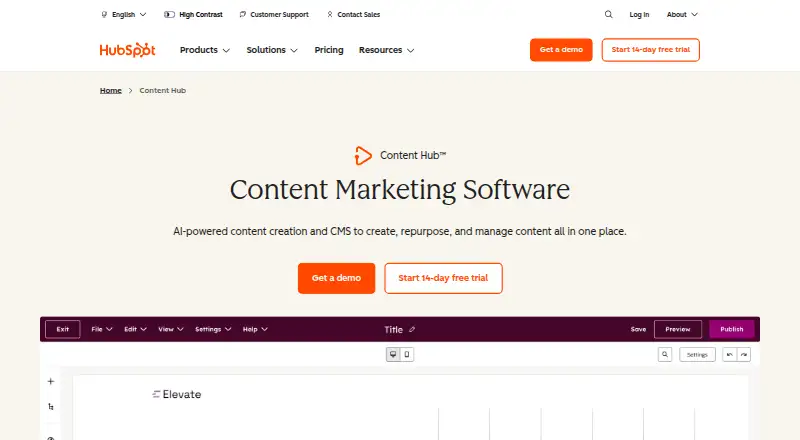
HubSpot Content Hub is hosted, AI-powered content marketing software from HubSpot Content Hub, a maker founded in 2006 and headquartered in Cambridge, Massachusetts, United States. It brings content creation, repurposing, and management into one place. Built-in AI agents can turn a content strategy into material for multiple channels, while Content Remix reshapes one piece into several marketing assets in a brand voice. The free edition includes landing pages, AI-assisted blog posts, and basic SEO guidance. Listed capabilities also include editorial workflows, custom user roles, multilingual content, SEO tools, a media library, and custom content types. Content Hub can complement an existing CMS through landing pages, blogs, podcasts, microsites, AI tools, embeds, forms, CTAs, and tracking code. HubSpot lists more than 2,000 available apps and web services, including Amplitude, Jira, Adobe Express, Aircall, and LinkedIn. Pricing is freemium, with Free, Starter, Professional, and Enterprise plans, plus a 14-day trial. Paid plans include monthly HubSpot Credits that reset monthly and do not roll over. Infrastructure uses TLS 1.2 or 1.3 in transit and AES-256 for stored data, with United States East hosting and a Frankfurt option.
Good
- Free plan supports up to two users
- AI agents and Content Remix support content repurposing
- Editorial workflows and custom user roles
- Multilingual content, SEO tools, and media library
- More than 2,000 listed app and web-service integrations
- Can complement an existing CMS
Watch out
- Free plan is limited to two users
- Paid HubSpot Credits reset monthly and do not roll over
- Higher-tier features such as podcasts and approvals require paid plans
Who it suits
Content Hub suits marketers from small businesses through enterprises who need hosted editorial workflows, multilingual publishing, SEO tools, and media management. It also fits teams that want AI-assisted repurposing or connections to an existing CMS and other business apps.
Verdict
Pick HubSpot Content Hub for a hosted marketing workspace combining AI content creation, editorial controls, multilingual content, and broad integrations. The Free plan provides a starting point for two users. Look elsewhere if you need credits to roll over or features reserved for higher plans without upgrading.
Plans and prices
From HubSpot Content Hub's own pricing page, checked 9 Oct 2026.
| Plan | Price | What it gives you |
|---|---|---|
| Free | Free | Free for up to 2 users · No credit card required · $0/mo |
| Starter | $7 a month | 500 HubSpot Credits · Starts at $7/mo/seat; $20/mo/seat when billed monthly |
| Professional | $450 a month | Includes 3 Core Seats · Additional Core Seats start at $45/mo · 3,000 HubSpot Credits · Starts at $450/mo; $500/mo when billed monthly |
| Enterprise | $1,500 a month | Includes 5 Core Seats · Additional Core Seats start at $75/mo · 5,000 HubSpot Credits · Starts at $1,500/mo |
The facts
Each one read from HubSpot Content Hub's own pages, with the date it was checked.
What it does
- AI content tools
- Built-in AI agents help turn a content strategy into multi-channel content, and Content Remix repurposes one piece into multiple marketing assets in a brand voice.checked 9 Oct 2026
- Audience
- HubSpot describes Content Hub as software for marketers and says its editions are designed for needs ranging from small businesses to enterprises.checked 9 Oct 2026
- Compliance
- HubSpot says its cloud infrastructure providers hold SOC 2 Type 2 and ISO 27001 certifications, among others.checked 9 Oct 2026
- Credits
- Paid Content Hub plans include monthly HubSpot Credits that reset each month, and unused credits do not roll over.checked 9 Oct 2026
- Custom content types
- Yeschecked 22 Sep 2026
- Custom user roles
- Yeschecked 22 Sep 2026
- Data hosting
- HubSpot says product infrastructure is hosted on AWS in the United States East region, with an EU data center option in Frankfurt for customer data.checked 9 Oct 2026
- Editorial workflows
- Yeschecked 22 Sep 2026
- Existing CMS support
- HubSpot says Content Hub can complement an existing CMS through landing pages, blogs, podcasts, microsites, AI content tools, embeds, forms, CTAs, and tracking code.checked 9 Oct 2026
- Integrations
- HubSpot says more than 2,000 leading apps and web services are available, including Amplitude, Jira, Adobe Express, Aircall, and LinkedIn.checked 9 Oct 2026
- Media library
- Yeschecked 22 Sep 2026
- Multilingual content
- Yeschecked 22 Sep 2026
- Paid features
- The product page lists brand removal and content personalization for Starter, podcasts for Professional, and multiple-site management and content approvals for Enterprise.checked 9 Oct 2026
- Purpose
- Content Hub is AI-powered content marketing software for creating, repurposing, and managing content in one place.checked 9 Oct 2026
- Security
- HubSpot says sensitive product interactions are encrypted in transit with TLS 1.2 or 1.3, and stored data uses AES-256 encryption on product server drives and AWS S3.checked 9 Oct 2026
- SEO tools
- Yeschecked 22 Sep 2026
- Support
- HubSpot says support options depend on the plan and that Starter includes email support.checked 9 Oct 2026
- Website and SEO
- The free edition includes landing pages, AI-assisted blog posts, and basic SEO tips.checked 9 Oct 2026
The company
- Founded
- 2006checked 4 Oct 2026
- Headquarters
- Cambridge, Massachusetts, United Stateschecked 4 Oct 2026
Money
- Free plan
- Yeschecked 22 Sep 2026
Where it runs
- Platform type
- hostedchecked 22 Sep 2026
The full review of HubSpot Content Hub
HubSpot Content Hub is a hosted, AI-assisted marketing workspace for creating, adapting and governing content. It fits marketers who need editorial structure, SEO and multilingual publishing across channels, particularly when an existing CMS still handles part of the site. The free edition makes a credible starting point, while paid tiers become a substantial commitment as seats and usage grow.
Overview
Content Hub combines editorial workflows, custom user roles, multilingual content, SEO tools, a media library and custom content types. That combination suits teams coordinating campaigns rather than publishers seeking only a conventional CMS. Built-in AI agents can turn a content strategy into assets for several channels, and Content Remix reshapes one item into multiple marketing assets while preserving a brand voice.
It can supplement an existing CMS with landing pages, blogs, podcasts, microsites, embeds, forms, calls to action, tracking code and AI content tools. HubSpot reports connections to more than 2,000 apps and web services, including Amplitude, Jira, Adobe Express, Aircall and LinkedIn. This makes it practical when content work must connect to a wider marketing stack. HubSpot was founded in 2006 and is headquartered in Cambridge, Massachusetts.
Key features
Creation and reuse
AI assistance and remixing target the expensive part of content marketing: producing variants for different channels. They are most useful to teams with a defined strategy and a steady stream of source material, not as a substitute for editorial judgment.
Editorial control
Workflows, custom roles and content types provide a way to separate responsibilities and standardize publishing. Multilingual support extends that structure across languages, while the media library keeps assets organized. The free edition includes landing pages, AI-assisted blog posts and basic SEO guidance, giving small teams a functional introduction rather than the full governance layer.
Marketing infrastructure
SEO tools, forms, CTAs, embeds and tracking code support demand generation around the content itself. Encryption uses TLS 1.2 or 1.3 in transit and AES-256 for stored data on product drives and AWS S3. HubSpot's cloud providers hold SOC 2 Type 2 and ISO 27001 certifications, and infrastructure is hosted in the United States East AWS region, with a Frankfurt EU data-center option.
Pricing
The freemium structure includes a 14-day trial. Free costs nothing, is billed at $0/mo, requires no credit card and supports up to two users. It is appropriate for a small operation testing the workflow, but it is capped at the entry feature set and does not provide the paid-tier additions.
Starter starts at $7/mo/seat, or $20/mo/seat when billed monthly, and includes 500 HubSpot Credits. It is the economical paid step for a small team that needs more than the free edition; brand removal and content personalization are listed for this tier. Per-seat billing means adding collaborators increases the recurring cost.
Professional starts at $450/mo, or $500/mo when billed monthly, with three Core Seats, additional Core Seats from $45/mo and 3,000 HubSpot Credits. Podcasts are added here, making it a better fit for established multi-channel programs than for occasional publishing.
Enterprise starts at $1,500/mo and includes five Core Seats; additional Core Seats start at $75/mo, with 5,000 HubSpot Credits. Multiple-site management and content approvals target larger organizations with formal governance. Paid plans' credits reset monthly, and unused credits do not roll over, so variable workloads should budget around the monthly allowance. Starter includes email support; support options otherwise depend on the plan.
Platforms
Content Hub is hosted and accessible through the web, with an API for integrations and custom connections. It is not presented as a self-hosted application.
Who it's for
Marketers at small businesses can start with the two-user Free plan, while growing teams may choose Starter for brand and personalization controls. Professional suits organizations producing podcasts and larger volumes of coordinated content. Enterprise is aimed at multi-site teams that require approvals and more seats. Choose it alongside an existing CMS when you want marketing capabilities without replacing that system.
Pros and cons
- Pros: AI agents and Content Remix extend one strategy into multiple assets, reducing repetitive adaptation work.
- Pros: Editorial workflows, roles, multilingual content and custom types support controlled team publishing.
- Pros: More than 2,000 integrations and existing-CMS support make it adaptable to established stacks.
- Pros: A no-card, two-user free plan lowers the barrier to evaluation.
- Cons: Paid credits expire each month, so unused capacity cannot be saved for a later campaign.
- Cons: Professional and Enterprise jump to $450 and $1,500 starting monthly prices, before extra seats.
- Cons: The free edition is limited to basic SEO, landing pages and AI-assisted blogging, leaving advanced capabilities behind upgrades.
Alternatives
For a free, open-source CMS that requires self-hosting and technical setup, choose Drupal. Plone is another forever-free, open-source option for teams comfortable managing their own platform.
Webflow CMS suits experimentation with a hosted free plan, limited CMS, two static pages, 1 GB bandwidth and 50 form submissions. Choose django CMS, Joomla or Contao when a free open-source, self-managed CMS is the priority. TYPO3 CMS offers a free open-source system, with an ELTS option at €3,200 a year. Prismic is a hosted, API-oriented alternative for developers building personal sites or a proof of concept on its free repository plan.
Browse more options in Content Management Systems.
Verdict
Pick HubSpot Content Hub if your marketing team wants one hosted workspace for AI-assisted creation, editorial governance, multilingual content, SEO and integrations, or needs to layer those capabilities onto an existing CMS. The two-user Free plan is a sensible starting point. Look elsewhere if expiring monthly credits, per-seat pricing or the large jump to Professional and Enterprise make the economics unsuitable for your workload.
Getting started
- Open the Content Hub website
- Start the Free plan or begin the 14-day trial
- Choose Starter, Professional, or Enterprise if needed
- Create content with landing pages, blogs, or other listed tools
- Connect available apps or an existing CMS
Limits worth knowing
The Free plan is for up to two users. Paid plans include monthly HubSpot Credits that reset each month, and unused credits do not roll over; listed higher-tier features include podcasts, multiple-site management, and content approvals.
Questions
Is there a free plan?
Yes. The Free plan costs nothing, supports up to two users, and requires no credit card.
Does Content Hub offer a trial?
Yes, a 14-day trial is listed.
Which platforms are supported?
Content Hub is hosted and lists web and API platforms.
What does the Free edition include?
It includes landing pages, AI-assisted blog posts, and basic SEO tips.
How many integrations are available?
HubSpot says more than 2,000 leading apps and web services are available, including Amplitude, Jira, Adobe Express, Aircall, and LinkedIn.
Alternatives to HubSpot Content Hub
- 1
Enonic XP
Free planOpen sourceWebAPILinuxSelf-hosted9.0$990 usage-based - 2

CrafterCMS
Free planOpen sourceWebAPILinuxmacOS9.0Free plan - 3

Kiln
Free planOpen sourceWebAPISelf-hosted8.4From $4.99 a month - 4
Webflow CMS
Free planWebAPI8.3From $15 a month - 5
django CMS
Free planWebAPILinuxSelf-hosted8.3From $500 a year - 6

Tumblr
Free planAndroidiOSWeb8.3From $69.99 a year