
Prismic
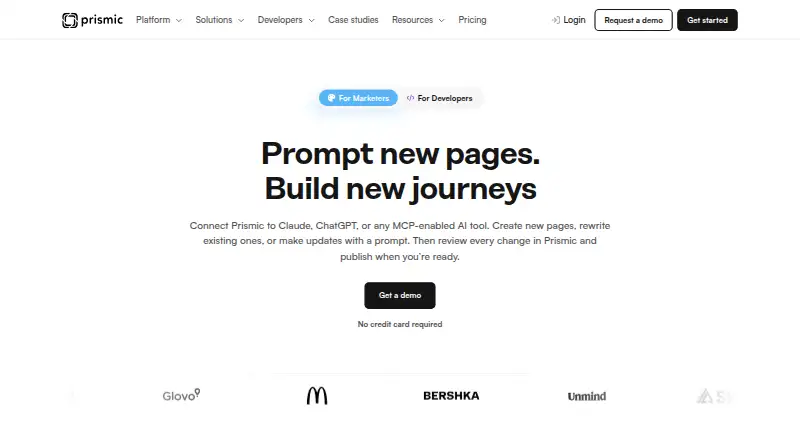
Prismic is a headless CMS with developer tools and a visual page builder for creating and managing website content within an existing stack.
What Prismic is
Prismic is a headless CMS with developer tools and a visual page builder for creating and managing website content within an existing stack. Its Visual Page Builder supports live editing, drag-and-drop layouts, and reusable slices. Slice Machine helps teams model content, sync changes, and generate TypeScript and component structure. Prismic lists integrations and SDKs for Next.js, Nuxt, and SvelteKit, and connections to Claude, ChatGPT, and other MCP-enabled AI tools. Teams can localize content, use custom roles, preview pages, review revision history, and roll back changes. Built-in Imgix integration optimizes images, while page schema support is included. APIs and webhooks support integrations, and the Migration API is available for content migrations. The free plan allows one user, two locales, 4 million API calls monthly, and 100 GB of monthly CDN bandwidth; exceeding that bandwidth automatically locks the project. Prismic was founded in 2013 and is headquartered in Paris, France.
Good
- Visual Page Builder supports live editing and reusable slices.
- Supports Next.js, Nuxt, and SvelteKit.
- Preview, revision history, and rollback are available.
- Free plan includes two locales and 4 million API calls monthly.
Watch out
- Free plan is limited to one user.
- Exceeding free-plan CDN bandwidth locks the project.
Who it suits
Prismic suits developers and content teams building websites with a supported framework and a headless content workflow. Its free plan is described for personal websites or proof-of-concept projects; larger teams can choose paid plans with higher user limits.
Verdict
Prismic brings content modeling, page building, and developer tooling together for supported web stacks. Keep the free plan’s user and bandwidth limits in mind when sizing a project.
Plans and prices
From Prismic's own pricing page, checked 29 Sep 2026.
| Plan | Price | What it gives you |
|---|---|---|
| Free | Free | For developers building personal websites or a PoC. · 1 user · 4 million API calls/month, no overages · 100 GB CDN bandwidth/month, no overages · 2 locales · unlimited documents, types, and assets · Per repository; paid annually |
| Starter | $10 a month | For teams ready to invest in a website with custom branding. · 3 users · 4 million API calls/month · 100 GB CDN bandwidth/month · paid bandwidth overages up to 500 GB at $0.30/GB · 3 locales · Per repository; paid annually |
| Small | $25 a month | For teams who are publishing more and need more users. · 7 users · 4 million API calls/month · 100 GB CDN bandwidth/month · paid bandwidth overages up to 500 GB at $0.30/GB · 4 locales · Per repository; paid annually |
| Medium | $150 a month | For teams who are scaling their content. · 25 users · 5 million API calls/month, no overages · 500 GB CDN bandwidth/month · paid bandwidth overages up to 1 TB at $0.30/GB · 5 locales · user roles · Per repository; paid annually |
| Platinum | $675 a month | For companies continuously adding features to their websites. · Unlimited users · 10 million API calls/month · paid API overages up to 20 million on yearly invoiced plans · 1 TB CDN bandwidth/month · paid bandwidth overages up to 5 TB at $0.25/GB · 8 locales · development environment · Per repository; paid annually |
| Enterprise | Priced on request | For large companies who need advanced security and support. · Custom usage quotas · 2 development environments · backups · custom roles · Customer Success Manager · SSO · Infosec and legal review · support and uptime SLAs · priority/premium support · custom training sessions · Per repository; paid annually |
The facts
Each one read from Prismic's own pages, with the date it was checked.
What it does
- AI connections
- Prismic connects to Claude, ChatGPT, and other MCP-enabled AI tools.checked 28 Sep 2026
- APIs and integrations
- The pricing comparison lists the Migration API, Document API, GraphQL, webhooks, and Integration for every plan.checked 29 Sep 2026
- API types
- bothchecked 20 Sep 2026
- Asset transformations
- Yeschecked 20 Sep 2026
- Content localization
- Yeschecked 20 Sep 2026
- Content preview
- Yeschecked 20 Sep 2026
- Content scale
- Prismic runs on more than 10,000 websites, powering over 70 million pages across 90+ countries.checked 28 Sep 2026
- Developer tools
- Slice Machine supports visual content modeling, code snippets, one-click syncs, automatic TypeScript, and generated component structure.checked 29 Sep 2026
- Enterprise security
- The Enterprise plan includes SSO, backups, Infosec and legal review, and support and uptime SLAs.checked 29 Sep 2026
- Frameworks
- Prismic lists integrations and official SDKs for Next.js, Nuxt, and SvelteKit.checked 29 Sep 2026
- Hosting and compliance
- Prismic says its services and customer data are hosted on AWS in the us-east-1 region, and lists AWS certifications including ISO/IEC 27001, SOC 1, SOC 2, and SOC 3.checked 29 Sep 2026
- Image optimization
- Prismic says its built-in Imgix integration compresses and optimizes images on the fly.checked 29 Sep 2026
- Intended users
- The pricing page describes Free as suited to developers building personal websites or a proof of concept, and Enterprise as for large companies needing advanced security and support.checked 29 Sep 2026
- Marketer adoption
- More than 4,800 marketers use Prismic, according to the homepage.checked 28 Sep 2026
- Migration support
- The Migration API supports large-scale replatforming and structured content migrations.checked 28 Sep 2026
- Page Builder
- The Visual Page Builder supports live editing, drag-and-drop page layouts, and reusable slices.checked 29 Sep 2026
- Paid from
- 10checked 20 Sep 2026
The company
- Founded
- 2013checked 28 Sep 2026
- Headquarters
- Paris, Francechecked 28 Sep 2026
Money
- Free plan
- Yeschecked 20 Sep 2026
- Free plan limits
- 1 user, 4 million API calls monthly, 100 GB CDN bandwidth monthly, and 2 locales.checked 28 Sep 2026
- Free plan overages
- The free plan has no overages; exceeding its CDN allowance automatically locks the project.checked 28 Sep 2026
- Free trial
- The Platinum plan offers a 30-day free trial.checked 28 Sep 2026
- Plan changes
- Plans can be upgraded or downgraded, with changes reflected at the next renewal cycle.checked 28 Sep 2026
The full review of Prismic
Prismic is a headless CMS and page-building platform for teams working with Next.js, Nuxt, or SvelteKit. It suits projects where developers want structured content and marketers need room to build pages within that existing stack. Its strongest case is shared control over content and presentation; its free tier’s single seat and bandwidth lock make it less comfortable for a growing team.
Overview
Prismic combines a CMS with a CLI, visual content modeling, and a page builder rather than bundling a complete website platform. Developers can use Slice Machine to define content, generate TypeScript and component structure, and sync changes; editors can use live editing, drag-and-drop layouts, and reusable slices. That division lets editors assemble pages while the implementation remains in a supported web framework.
Content localization, custom types, editorial workflows, previews, revision history, rollback, and webhooks cover much of the publishing cycle. Imgix integration optimizes images, and built-in schema support is intended for Google Search and AI discovery engines. For migration projects, the Migration API supports structured content moves. These capabilities are useful when the team will build around Prismic’s framework integrations; they are less compelling if the priority is a site platform independent of a web stack.
Key features
Page building and developer workflow
The Visual Page Builder’s live editing and reusable slices give marketers practical control over page composition without turning content into an unstructured free-for-all. Slice Machine supplies visual modeling, code snippets, one-click syncs, TypeScript, and generated component scaffolding. Official integrations and SDKs are available for Next.js, Nuxt, and SvelteKit, and Prismic connects to Claude, ChatGPT, and other MCP-enabled AI tools. The workflow is strongest for teams using those frameworks; the supported set is narrower than a framework-agnostic approach.
Publishing and delivery
Previews, full revision history, and rollback help teams review changes before publication and recover earlier content. Localization, custom roles, and webhooks support more involved editorial operations. The API can be configured as private and require client authentication. Prismic says its services and customer data are hosted on AWS in us-east-1 and cites AWS certifications including ISO/IEC 27001, SOC 1, SOC 2, and SOC 3; Enterprise adds security and support provisions for organizations that need them.
Pricing
Prismic charges per repository, with the listed paid prices billed annually. A 30-day trial is offered. The free plan is free and is aimed at personal websites or proofs of concept: it allows one user, 4 million API calls and 100 GB CDN bandwidth per month, two locales, and unlimited documents, types, and assets. It has no overages; exceeding the bandwidth allowance automatically locks the project. That makes it a useful solo starting point, but a poor shared workspace or a safe choice for traffic that may exceed the cap.
Starter is $10 a month, billed annually, and raises the allowance to three users and three locales while keeping 4 million monthly API calls and 100 GB bandwidth. Bandwidth overages cost $0.30/GB up to 500 GB. It is aimed at teams investing in a branded website, but the API and bandwidth allowances remain the same as Free.
Small is $25 a month, billed annually, and provides seven users and four locales, with the same 4 million API calls, 100 GB bandwidth, and $0.30/GB overages up to 500 GB. It fits a team publishing more and needing more collaborators, though it does not increase the core monthly quotas.
Medium is $150 a month, billed annually, with 25 users, user roles, five locales, 5 million API calls per month with no overages, and 500 GB bandwidth. Paid bandwidth overages are $0.30/GB up to 1 TB. This is the more substantive step up for scaling content and coordinating permissions.
Platinum is $675 a month, billed annually, for unlimited users, 10 million API calls per month, and 1 TB bandwidth. Paid API overages are available up to 20 million on yearly invoiced plans, while bandwidth overages cost $0.30/GB up to 5 TB. It suits organizations with large teams and higher delivery needs, but is a steep commitment relative to the lower tiers.
Enterprise has custom pricing, billed annually per repository, for large companies needing advanced security and support. It includes custom usage quotas, two development environments, backups, custom roles, a Customer Success Manager, SSO, InfoSec and legal review, and support and uptime SLAs with priority or premium support options. Plans can be upgraded or downgraded, with changes taking effect at the next renewal cycle.
Platforms
Prismic is an API and web platform. Its stated framework integrations and official SDKs cover Next.js, Nuxt, and SvelteKit; its page-building model is designed to fit into an existing web stack.
Who it's for
Prismic is a good fit for web teams that want developers to establish structured components while marketers handle routine page assembly and publishing. The free plan is most appropriate for a solo developer’s personal site or proof of concept. Teams needing more editors, locales, or predictable bandwidth should budget for a paid tier, and organizations requiring SSO, backups, custom roles, and formal support provisions should consider Enterprise.
It is a weaker fit for a team that needs several collaborators on a no-cost plan, or one whose traffic could push a free project beyond its strict CDN limit. It is also not the obvious choice for teams working outside its stated framework integrations.
Pros and cons
- Visual editing with developer control: reusable slices and live page editing let marketers compose pages while developers maintain the component structure.
- Useful publishing safeguards: previews, revision history, and rollback support review and recovery; localization and webhooks extend the workflow.
- Free tier has real breadth but little room for teams: unlimited documents, types, and assets are generous for a solo project, but one user and two locales constrain collaboration and reach.
- Free bandwidth risk is unusually direct: there are no overages, and crossing 100 GB monthly locks the project rather than simply charging for more usage.
- Lower paid tiers mainly expand seats and locales: Starter and Small retain the free tier’s 4 million API calls and 100 GB bandwidth, so they do not address every growth pressure.
- Higher tiers become costly: Medium and Platinum add substantial capacity and team controls, but the annual per-repository commitment is significant.
Alternatives
Sanity is worth considering for an individual or smaller project: its free plan offers 20 user seats, compared with Prismic’s one, alongside two permission roles and two public datasets.
Strapi may suit teams that prefer a self-hosted CMS; its Community plan is open-source under the MIT License and includes REST and GraphQL APIs, role-based access control, and unlimited usage.
Storyblok is another web CMS with a free Starter plan for testing and personal projects; it has one user seat and requires no credit card.
ButterCMS is an alternative for freelancers and developers launching a small project or MVP, with a free plan limited to 50,000 API calls per month.
CrafterCMS is another option to consider.
Directus offers a free Core plan with three user seats, 25 collections, and five flows; its Team plan is $499 a month on an annual commitment and includes 10 SSO seats.
dotCMS is another CMS alternative to consider.
DatoCMS is an API and web alternative whose free plan allows three projects, one collaborator per project, 300 records, 10 GB monthly bandwidth, and 100,000 monthly CDA API calls, with no overages.
Browse more options in Headless CMS or Content Management Systems.
Verdict
Choose Prismic if your team builds in Next.js, Nuxt, or SvelteKit and wants marketers to shape pages on top of developer-defined content components. The combination of visual editing, structured modeling, and publishing safeguards is its clearest advantage. Look elsewhere if a free project needs multiple collaborators or cannot tolerate a hard bandwidth lock; paid tiers are necessary to give teams more seats, locales, and delivery headroom.
Getting started
- Visit https://prismic.io/.
- Start with the free plan or use the 30-day trial.
- Choose a web or API workflow.
- Connect a supported framework such as Next.js, Nuxt, or SvelteKit.
- Use the page builder and Slice Machine to create and manage content.
Limits worth knowing
The free plan allows one user, two locales, 4 million API calls and 100 GB of CDN bandwidth monthly. It has no overages; exceeding its CDN allowance locks the project. Paid plans start at $10/mo (annual), billed per repository, and the Starter plan includes three users and three locales.
Questions
How much does Prismic cost?
The free plan costs $0 per repository.
What does the free plan include?
It includes one user, 4 million API calls monthly, 100 GB of CDN bandwidth monthly, two locales, and unlimited documents, types, and assets.
Which platforms and frameworks does Prismic support?
Its listed platforms are web and API. Official integrations and SDKs are available for Next.js, Nuxt, and SvelteKit.
Can Prismic handle localized content and user roles?
Yes. Content localization and custom roles are supported; plan features vary, and user roles are included on the Medium plan.
What APIs and integrations are included?
The pricing comparison lists the Migration API, Document API, GraphQL, webhooks, and Integration for every plan. Prismic also connects to Claude, ChatGPT, and other MCP-enabled AI tools.
Alternatives to Prismic
- 1
Enonic XP
Free planOpen sourceWebAPILinuxSelf-hosted9.0$990 usage-based - 2

CrafterCMS
Free planOpen sourceWebAPILinuxmacOS9.0Free plan - 3

Kiln
Free planOpen sourceWebAPISelf-hosted8.4From $4.99 a month - 4
Webflow CMS
Free planWebAPI8.3From $15 a month - 5
django CMS
Free planWebAPILinuxSelf-hosted8.3From $500 a year - 6

Tumblr
Free planAndroidiOSWeb8.3From $69.99 a year