
Strapi
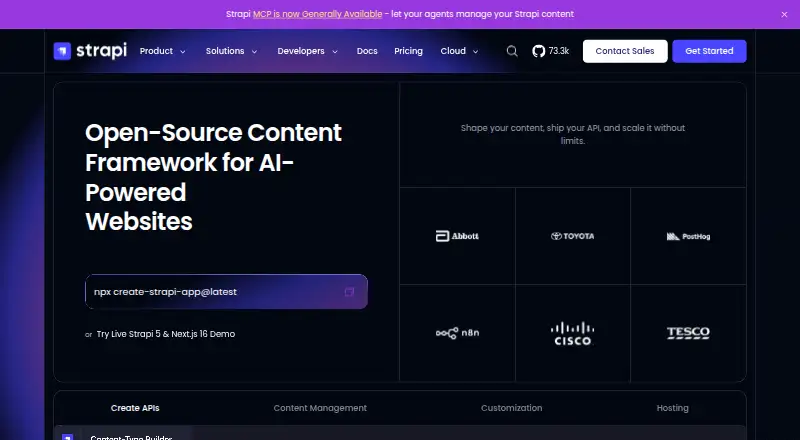
Strapi is an open-source, MIT-licensed headless CMS that generates REST and GraphQL APIs from content models.
What Strapi is
Strapi is an open-source, MIT-licensed headless CMS that generates REST and GraphQL APIs from content models. It supports custom content types, multilingual content, a media library, editorial workflows, previews, webhooks, and custom user roles. Developers can customize its admin panel, APIs, data layer, controllers, services, and middleware. Strapi can be self-hosted or run on Strapi Cloud, which includes Postgres, a CDN, and email. The Community plan is free forever and includes unlimited usage; the Community CMS plan also includes unlimited entries and API calls. Cloud Starter is $35 a month and includes 100,000 API requests, 50 GB asset storage, 50 GB asset bandwidth, unlimited database entries, and one environment. Cloud Business is $450 a month and includes 10 million API requests. Listed prices exclude applicable local taxes. A 30-day Growth trial is available for a self-hosted project without a credit card. Strapi was founded in 2015 and is listed as self-hosted software.
Good
- Open-source and MIT-licensed.
- Generates REST and GraphQL APIs from content models.
- Supports multilingual content and custom user roles.
- Cloud plans include unlimited database entries.
Watch out
- Cloud Starter costs $35 a month.
- Cloud Business costs $450 a month.
- Listed prices exclude applicable local taxes.
- Refund policy is not stated.
Who it suits
Strapi suits developers and teams building content-driven applications who want to define content models and generate REST or GraphQL APIs. It offers both self-hosting and a managed cloud deployment option.
Verdict
Strapi combines a customizable headless CMS with API generation and a choice of self-hosted or cloud deployment. Its free Community option and paid cloud tiers have distinct usage limits.
Plans and prices
From Strapi's own pricing page, checked 27 Sep 2026.
| Plan | Price | What it gives you |
|---|---|---|
| Community | Free | Free forever · Open-source under MIT License · REST and GraphQL API · Role-based access control · Unlimited usage |
| Growth | $45 a month | Includes 3 seats; additional seats cost $15/month/seat · 3 seats · Includes 3 seats; additional seats cost $15/month/seat |
| Enterprise | — | SSO · Review Workflows · Audit Logs · SOC 2 report · Standard Support |
| Starter | $35 a month | 100,000 API requests/month · 50 GB asset storage · 50 GB asset bandwidth · Unlimited database entries · 1 environment included · Prices exclude applicable local taxes |
| Pro | $90 a month | 1,000,000 API requests/month · 250 GB asset storage · 500 GB asset bandwidth · Unlimited database entries · 1 environment included · Prices exclude applicable local taxes |
| Business | $450 a month | 10,000,000 API requests/month · 1,000 GB asset storage · 1,000 GB asset bandwidth · Unlimited database entries · 2 environments included · Prices exclude applicable local taxes |
| Cloud Starter | $35 a month | Prices exclude applicable local taxes · $35 per project / month |
| Cloud Pro | $90 a month | Best value; prices exclude applicable local taxes · $90 per project / month |
| SSO Add-on | $150 a month | + $50/month/seat · $150/month |
| Cloud Business | $450 a month | Prices exclude applicable local taxes · $450 per project / month |
The facts
Each one read from Strapi's own pages, with the date it was checked.
What it does
- API generation
- Strapi generates REST and GraphQL APIs from content models.checked 27 Sep 2026
- API types
- bothchecked 20 Sep 2026
- Available integrations
- The site lists React, Next.js, TanStack, Vue.js, Nuxt.js, Astro, Flutter, Svelte, and React Native CMS integrations.checked 27 Sep 2026
- Business API limit
- Cloud Business includes 10 million API requests.checked 27 Sep 2026
- Cloud database entries
- Cloud plans include unlimited database entries.checked 27 Sep 2026
- Cloud included services
- Strapi Cloud includes Postgres, a CDN, and email.checked 27 Sep 2026
- CMS usage limits
- The Community CMS plan includes unlimited entries and API calls.checked 27 Sep 2026
- Content localization
- Yeschecked 20 Sep 2026
- Content preview
- Yeschecked 20 Sep 2026
- Customer count
- Strapi says it is trusted by more than 3,000 customers.checked 27 Sep 2026
- Deployment options
- Strapi can be self-hosted or deployed to Strapi Cloud.checked 27 Sep 2026
- Enterprise governance
- Enterprise features include audit logs, review workflows, content history, and SSO.checked 27 Sep 2026
- Framework customization
- Developers can customize the admin panel, APIs, data layer, controllers, services, and middleware.checked 27 Sep 2026
- Open-source license
- Strapi is open-source and MIT-licensed.checked 27 Sep 2026
- Paid from
- 35checked 20 Sep 2026
- Refund policy
- The provided pages do not state a refund policy.checked 27 Sep 2026
- Role permissions
- customchecked 20 Sep 2026
- Security compliance
- Strapi is SOC 2 certified and GDPR compliant.checked 27 Sep 2026
- Starter API limit
- Cloud Starter includes 100,000 API requests.checked 27 Sep 2026
- Starter storage
- Cloud Starter includes 50 GB asset storage and 50 GB asset bandwidth.checked 27 Sep 2026
The company
- Founded
- 2015checked 23 Sep 2026
- Growth team seats
- The Growth plan includes three seats; extra seats cost $15 per month each.checked 27 Sep 2026
Money
- Free plan
- Yeschecked 20 Sep 2026
- Growth trial
- Growth features can be tried for 30 days on a self-hosted project without a credit card.checked 27 Sep 2026
The full review of Strapi
Overview
Strapi is a headless CMS built around developer-defined content models and APIs. It is best suited to teams that want control over their content infrastructure, whether they host it themselves or use Strapi Cloud. Its strongest case is the combination of REST and GraphQL generation with a free, MIT-licensed Community option; cloud quotas and per-seat costs matter as projects grow.
Custom content types, a media library, localization, content preview and editorial workflows make Strapi useful beyond a bare API layer. Developers can customize the admin panel, APIs, data layer, controllers, services and middleware, a level of control that suits teams comfortable owning a more configurable system. React, Next.js, TanStack, Vue.js, Nuxt.js, Astro, Flutter, Svelte and React Native integrations give teams several ways to connect applications.
Self-hosting is available, while Strapi Cloud includes Postgres, a CDN and email. Strapi is SOC 2 certified and GDPR compliant. Its enterprise governance features include audit logs, review workflows, content history and SSO; those controls are most relevant to organizations with formal review or access requirements.
For category comparisons, see our Headless CMS and Content Management Systems lists.
Key features
- REST and GraphQL generation: Strapi creates both API types from content models, so teams can expose structured content through either approach rather than building those interfaces separately.
- Flexible content modeling and localization: Custom content types and multilingual content support sites and apps with varied structures and language needs.
- Editorial controls: Content preview, workflows and custom roles help teams manage publishing and access. Enterprise adds audit logs, review workflows, content history and SSO for organizations that need stronger governance.
- Customizable implementation: Developers can modify the admin panel and multiple backend layers. That flexibility is valuable when standard behavior is not enough, but makes Strapi a better fit for developer-led teams than for buyers seeking a fixed, low-customization service.
- Cloud services: Strapi Cloud bundles Postgres, a CDN and email, reducing the number of separate services a team must arrange for a cloud deployment.
Pricing
Community is free forever and MIT-licensed, with REST and GraphQL APIs, role-based access control and unlimited usage. The Community CMS plan also has unlimited entries and API calls. It is the strongest starting point for teams willing to self-host; it does not include the managed cloud quotas and services described in the paid cloud plans.
Cloud Starter costs $35 a month, billed at $35 per project / month, excluding applicable local taxes. It includes 100,000 API requests per month, 50 GB of asset storage, 50 GB of asset bandwidth, unlimited database entries and one environment. This fits a smaller production project with modest traffic, but the request and asset allowances are meaningful ceilings.
Cloud Pro is $90 a month, billed at $90 per project / month, with prices excluding applicable local taxes. It raises the included allowances to 1,000,000 API requests monthly, 250 GB of storage and 500 GB of bandwidth, while retaining unlimited database entries and one environment. It is a more suitable step for projects whose request or media use exceeds Starter, though teams still get only one included environment.
Cloud Business costs $450 a month, billed at $450 per project / month, before applicable local taxes. Its 10,000,000 monthly API requests, 1,000 GB of storage, 1,000 GB of bandwidth, unlimited database entries and two environments target larger workloads and teams that need a second environment. The much higher monthly price makes it difficult to justify for a small project.
Growth costs $45 a month and includes three seats; each additional seat costs $15/month/seat. A 30-day trial of Growth features is available on a self-hosted project without a credit card. The seat limit is an important consideration for teams beyond three people. Enterprise has custom pricing and includes SSO, review workflows, audit logs, a SOC 2 report and standard support. An SSO add-on costs $150 a month, billed at $150/month, plus $50/month/seat.
Cloud plan prices exclude applicable local taxes.
Platforms
Strapi can be self-hosted or deployed to Strapi Cloud. Its platform type is an open-source headless CMS; integrations span web frameworks and mobile technologies including Flutter and React Native. This makes it applicable to projects serving more than a single website, while deployment choice leaves hosting responsibility with the team unless it selects Cloud.
Who it's for
Strapi suits developers and organizations building content-driven websites or apps that need custom models, REST or GraphQL APIs, localization and control over implementation. Community is compelling for teams prepared to self-host and manage their own deployment. Cloud tiers suit teams that prefer bundled hosting services and can size their usage to the included quotas. Enterprise is the relevant fit when SSO and formal governance controls are needed.
It is a weaker fit for a small team that wants minimal configuration, or for a cloud project whose traffic, storage or bandwidth regularly exceeds its tier allowance. Teams should also account for Growth's three included seats and the cost of additional users.
Pros and cons
Pros
- Free, MIT-licensed Community plan: Unlimited usage, entries and API calls make self-hosting a viable path without a usage cap on the CMS plan.
- Two generated API types: REST and GraphQL support gives teams a choice in how applications consume modeled content.
- Substantial customization: Developers can adapt the admin panel and backend layers to project requirements.
- Cloud includes core services: Postgres, CDN and email come with Strapi Cloud, alongside unlimited database entries across cloud plans.
Cons
- Cloud quotas vary sharply by tier: Starter's 100,000 API requests and 50 GB each for storage and bandwidth may constrain a growing project.
- Growth seats can add cost: Only three seats are included, with each additional seat costing $15/month/seat.
- Business is a large price step: At $450 a month, its expanded quotas and second environment are aimed at materially larger projects.
- Customization favors technical teams: The breadth of adjustable components is a strength for developers, but less suited to buyers seeking a tightly prescribed CMS.
Alternatives
- Prismic is worth comparing for a personal site or proof of concept: its free plan includes one user and 4 million API calls per month.
- Sanity may suit individuals or smaller projects that value a free plan with 20 user seats, two permission roles, two public datasets and 10,000 documents.
- CrafterCMS offers a self-hosted, open-source Community edition with community support for teams considering another self-managed CMS.
- Squidex may fit a small team looking for a Starter plan with 20,000 API calls, 2 GB traffic, 500 MB storage and two contributors.
- Storyblok is an option for testing or personal projects through a free Starter plan with one space, one user seat and 100 GB of monthly traffic.
- ButterCMS may suit freelancers or developers launching a small project or MVP, with a free plan that includes 50K API calls per month and 100 GB/month.
- Directus offers a free Core plan with three user seats, 25 collections and five flows for teams comparing a different freemium option.
- dotCMS is another freemium CMS to consider.
Verdict
Choose Strapi if your team wants a customizable, developer-led headless CMS and values the choice between an unlimited-use Community CMS and managed cloud deployment. Its generated REST and GraphQL APIs, flexible implementation and cloud services are strong reasons to shortlist it. Look elsewhere if the cloud quotas, Growth seat charges or Business price do not fit your projected usage, or if you want less technical customization.
Alternatives to Strapi
- 1
Enonic XP
Free planOpen sourceWebAPILinuxSelf-hosted9.0$990 usage-based - 2

CrafterCMS
Free planOpen sourceWebAPILinuxmacOS9.0Free plan - 3

Kiln
Free planOpen sourceWebAPISelf-hosted8.4From $4.99 a month - 4
Webflow CMS
Free planWebAPI8.3From $15 a month - 5
django CMS
Free planWebAPILinuxSelf-hosted8.3From $500 a year - 6

Tumblr
Free planAndroidiOSWeb8.3From $69.99 a year