
Sanity
Sanity is a web-based content platform for teams building websites, mobile products, content applications, and customer-facing or internal agents.
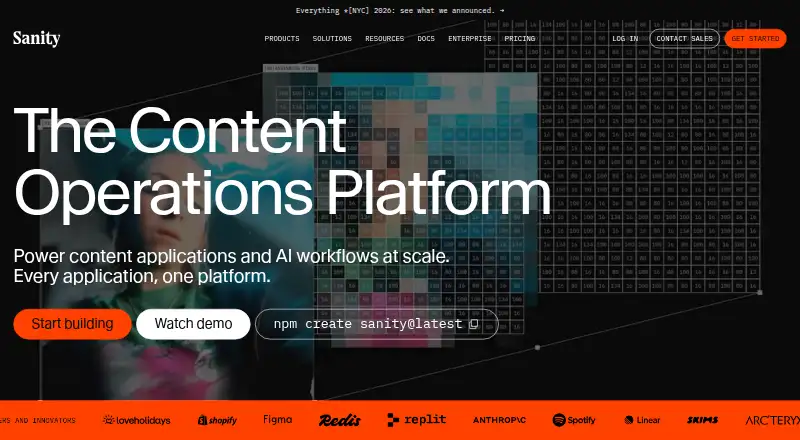
What Sanity is
Sanity is a web-based content platform for teams building websites, mobile products, content applications, and customer-facing or internal agents. It supports GraphQL and GROQ, content localization, custom role permissions, webhooks, content previews, and asset transformations. Real-time editing and multiplayer presence support collaboration, while document revisions preserve a history for each document. Functions can automate content operations and trigger from dataset changes. The Free plan costs $0 forever and includes up to 20 seats, two public-only datasets, unlimited content types and locales, and community support. Viewer-role users are free; other user types use a seat. Enterprise pricing is custom and includes SAML single sign-on, dedicated support, an uptime SLA, and custom usage quotas. Security compliance with SOC 2, GDPR, and CCPA is included across plans. The MCP Server connects Sanity to Cursor, Claude Code, v0, and more.
Good
- Supports both GraphQL and GROQ.
- Includes localization and custom role permissions.
- Real-time editing and multiplayer presence across plans.
- Free plan includes up to 20 user seats.
- SOC 2, GDPR, and CCPA compliance across plans.
Watch out
- Free plan datasets are public-only.
- Enterprise pricing is custom and not listed.
Who it suits
Sanity suits teams managing content across web, mobile, or other applications who need localization, collaboration, and APIs. Its free plan is also suited to individuals experimenting or shipping smaller projects.
Verdict
Sanity combines content management, APIs, collaboration, and automation in a web-based platform. The free plan has a defined seat allowance, while teams needing Enterprise features must request custom pricing.
Plans and prices
From Sanity's own pricing page, checked 27 Sep 2026.
| Plan | Price | What it gives you |
|---|---|---|
| Free | Free | For individuals experimenting or shipping smaller projects. · 20 user seats · 2 permission roles · 2 public datasets · 10k documents · 2 GROQ-powered webhooks · 1M API CDN requests per month · $0 forever; prices are per month |
| Growth | $15 a month | For teams with scaling projects and increasing collaboration needs. · 50 user seats · 5 permission roles · 2 datasets · 25k documents · 4 GROQ-powered webhooks · 1M API CDN requests per month · Prices are per month |
| Enterprise | — | Custom roles and access control · Single sign-on with SAML · Dedicated support and uptime SLA · Custom usage quotas |
The facts
Each one read from Sanity's own pages, with the date it was checked.
What it does
- API support
- The platform supports GraphQL and GROQ query languages.checked 27 Sep 2026
- API types
- bothchecked 20 Sep 2026
- Asset transformations
- Yeschecked 20 Sep 2026
- Community support
- Community support is included across Free, Growth, and Enterprise.checked 27 Sep 2026
- Content automation
- Functions automate content operations and can trigger from dataset mutations.checked 27 Sep 2026
- Content localization
- Yeschecked 20 Sep 2026
- Content preview
- Yeschecked 20 Sep 2026
- Document revisions
- Sanity stores revisions for every document.checked 27 Sep 2026
- Enterprise SSO
- Single sign-on with SAML is included on Enterprise.checked 27 Sep 2026
- Enterprise support
- Enterprise includes dedicated support and an uptime SLA.checked 27 Sep 2026
- Role permissions
- customchecked 20 Sep 2026
- Security compliance
- SOC 2, GDPR, and CCPA compliance are included across plans.checked 27 Sep 2026
- Tool integrations
- The MCP Server connects Sanity to Cursor, Claude Code, v0, and more.checked 27 Sep 2026
- Webhooks
- Yeschecked 20 Sep 2026
Money
- Free plan
- Yeschecked 20 Sep 2026
- Free tier content
- The Free plan includes unlimited content types and locales.checked 27 Sep 2026
- Free tier datasets
- The Free plan includes 2 public-only datasets.checked 27 Sep 2026
- Free tier seats
- Up to 20 user seats are included.checked 27 Sep 2026
- Growth trial
- The Growth plan can be tried for free.checked 27 Sep 2026
- Seat billing
- Viewer-role users are free; other user types consume a seat.checked 27 Sep 2026
Where it runs
- Supported platforms
- Sanity powers web, mobile, content applications, and customer-facing or internal agents.checked 27 Sep 2026
The company
- Team collaboration
- Real-time editing and multiplayer presence are included across plans.checked 27 Sep 2026
- Users and teams
- Sanity reports more than 1 million users and 6,000 teams.checked 27 Sep 2026
The full review of Sanity
Overview
Sanity is a content platform for teams building and maintaining digital products across several channels. It is best suited to groups that need shared editing and developer-facing APIs, with room to automate content workflows. Its free plan is a credible way to start, but public-only datasets and defined usage caps may make Growth a better fit for active team projects.
Key features
Sanity supports both GraphQL and GROQ, alongside localization, content previews, asset transformations, and webhooks. That breadth gives developers options for querying and delivering content, while localization and previews help editorial teams manage content for different markets and review it in context. Real-time editing and multiplayer presence are included across plans, as are revisions for every document—useful for teams that need to coordinate changes and revisit earlier versions.
Functions automate content operations and can run when a dataset changes, extending Sanity beyond a publishing workflow. Its MCP Server connects to Cursor, Claude Code, v0, and more. The platform supports web and mobile experiences, content applications, and customer-facing or internal agents. SOC 2, GDPR, and CCPA compliance apply across plans.
Seat accounting is more nuanced than a simple user count: viewers are free, while other user types consume seats. That can help teams include people who only need to view content, but active collaborators still count against the plan’s seat limit.
Pricing
Sanity is freemium, with paid plans from $15/user/mo. The Free plan costs nothing and is billed at $0 forever. It includes 20 user seats, 2 permission roles, 2 public-only datasets, 10k documents, 2 GROQ-powered webhooks, and 1M API CDN requests per month. Unlimited content types and locales make it flexible for experimentation, but public-only datasets are a meaningful constraint for teams that need private content environments.
Growth costs $15 a month, with prices billed per month. It raises the allowances to 50 user seats, 5 permission roles, 2 datasets, 25k documents, 4 GROQ-powered webhooks, and 1M API CDN requests per month. It is aimed at teams with growing projects and collaboration needs; the larger seat, role, document, and webhook allowances make it the more practical tier for scaling beyond a small project, though the listed CDN request allowance is unchanged. The Growth plan can be tried for free.
Enterprise has custom pricing. It adds custom roles and access control, SAML single sign-on, dedicated support, an uptime SLA, and custom usage quotas. It is the relevant step up for organizations that need those controls or support commitments, rather than teams that can work within Growth’s defined allowances. Community support is included on Free, Growth, and Enterprise.
Platforms
Sanity is web-based and supports content delivery to web, mobile, content applications, and customer-facing or internal agents. That makes it relevant to teams managing content for more than a conventional website, though it is not a desktop-platform offering.
Who it's for
Sanity suits product and editorial teams that want developers and content creators working against shared, structured content, especially when they need localization, multiple query options, or automated content operations. Smaller teams can begin on Free if public-only datasets and the included quotas fit. Teams that need private datasets, more capacity, or Enterprise-level access controls should consider a paid plan; those who want a simpler or self-hosted alternative may prefer another platform.
Pros and cons
- Pros: Free includes up to 20 seats, unlimited content types and locales, and real-time collaboration, giving smaller teams substantial room to start.
- Pros: GraphQL and GROQ, previews, localization, webhooks, and asset transformations cover several common content delivery needs.
- Pros: Every document has revisions, and Functions can automate operations triggered by dataset changes.
- Cons: Free datasets are public-only, which can rule out that tier for projects requiring private datasets.
- Cons: Both Free and Growth include 1M API CDN requests per month, so Growth’s higher seat and document allowances do not raise that listed request quota.
- Cons: Enterprise pricing is custom, and SAML SSO, dedicated support, an uptime SLA, and custom quotas require that tier.
Alternatives
For a broader category comparison, browse Headless CMS.
Choose Prismic if its free plan’s per-repository billing and 4 million API calls per month better suit a personal site or proof of concept. Choose Strapi if self-hosting and an open-source Community edition with REST and GraphQL APIs and unlimited usage matter more. Storyblok is another freemium option for testing and personal projects, with a free Starter plan limited to one space and one user seat. Consider ButterCMS if you want an alternative with Android and iOS platforms alongside web.
CrafterCMS is another option. Directus is another option. dotCMS is another option. DatoCMS is another option.
Verdict
Choose Sanity if your team needs collaborative, API-driven content with flexible querying and automation across multiple product surfaces. Its generous Free seat allowance and shared editing make it a strong starting point, but public-only datasets and capped requests can be decisive limitations; teams that need private datasets or higher usage should weigh Growth, while organizations needing SAML SSO and a support SLA will need custom-priced Enterprise.
Getting started
- Visit https://www.sanity.io/.
- Use the Free plan for $0 forever, or consider Growth, which has a free trial.
- Choose a plan based on its included seats, datasets, documents, and webhooks.
- Use Sanity's web platform and its GraphQL or GROQ API support for content work.
Limits worth knowing
The Free plan includes two public-only datasets, 10,000 documents, two GROQ-powered webhooks, and 1 million API CDN requests per month. It includes up to 20 seats; viewer-role users are free, while other user types consume a seat.
Questions
Is Sanity free?
Yes. The Free plan is $0 forever and includes up to 20 seats, two public-only datasets, and unlimited content types and locales.
How much does Growth cost?
Growth is $15 per user per month, and the plan can be tried for free.
Which platforms does Sanity support?
Sanity is listed for web. It powers web, mobile, content applications, and customer-facing or internal agents.
Which APIs does Sanity support?
The platform supports GraphQL and GROQ query languages.
Does Sanity support integrations with coding tools?
Its MCP Server connects Sanity to Cursor, Claude Code, v0, and more.
What does Enterprise include?
Enterprise includes SAML single sign-on, dedicated support, an uptime SLA, and custom usage quotas. Its price is custom.
Alternatives to Sanity
- 1

CrafterCMS
Free planOpen sourceWebAPILinuxmacOS9.0Free plan - 2
Enonic XP
Free planOpen sourceWebAPILinuxSelf-hosted8.8$990 usage-based - 3

Prismic
Free planWebAPI8.3Free plan - 4

ButterCMS
Free planAndroidiOSWeb8.3From $71 a month - 5

Contentstack
Free planAndroidiOSWebAPI8.3From $29 a month - 6

Storyblok
Free planWeb7.9From $99 a month