Drupal
Drupal is content management software for building websites and applications.
What Drupal is
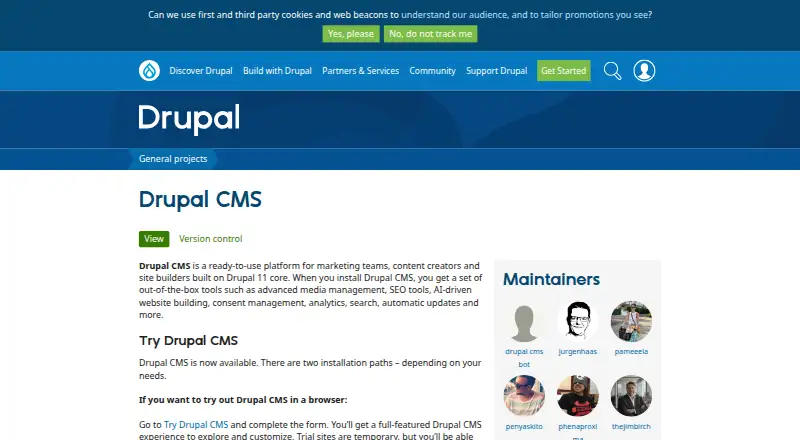
Drupal is content management software for building websites and applications. Drupal CMS is a ready-to-use option for marketing teams, content creators, and site builders built on Drupal 11 core. Its included tools cover media management, SEO, AI-driven website building, consent management, analytics, search, and automatic updates. Drupal supports structured content, multilingual publishing, editorial workflows, custom user roles, and web service APIs for delivering content to web, mobile, and other channels. Modules, themes, and distributions extend it, and it can connect with external services and organizational applications. Listed capabilities include accessibility, API-first architecture, security, performance, and scalability. It is free open-source software with no licensing fees, but self-hosting and technical setup are required. Drupal recommends Linux or a similar hosting system and supports Apache, Nginx, MariaDB, MySQL, PostgreSQL, and SQLite. Windows is supported for development only, not production hosting. Drupal CMS provides temporary browser-based trial sites; after setup, Drupal CMS itself is not updated, though installed modules and themes are updated like other Drupal sites.
Good
- Supports multilingual content and editorial workflows.
- Includes media management and SEO tools.
- Extensible through modules, themes, and distributions.
- Provides flexible web service APIs.
- Temporary browser-based trial sites are available.
Watch out
- Self-hosting and technical setup are required.
- Windows is not supported for production hosting.
- Drupal CMS itself is not updated after setup.
Who it suits
Drupal CMS is aimed at marketing teams, content creators, and site builders seeking a ready-to-use starting point. It also suits organizations that can handle self-hosting and technical setup.
Verdict
Drupal CMS offers a broad content-management starting point, with extension options and APIs for delivering structured content across channels. Its self-hosting requirements and post-setup update model are important considerations.
Plans and prices
From Drupal's own pricing page, checked 30 Sep 2026.
| Plan | Price | What it gives you |
|---|---|---|
| Drupal | Free | open-source GPL software · no licensing fees · self-hosting and technical setup required |
The facts
Each one read from Drupal's own pages, with the date it was checked.
What it does
- Built-in tools
- Drupal CMS includes advanced media management, SEO tools, AI-driven website building, consent management, analytics, search and automatic updates.checked 30 Sep 2026
- Community support
- Drupal says support is available from certified agency partners and a base of over 35,000 developers.checked 30 Sep 2026
- Content and APIs
- Drupal provides structured content and flexible web service APIs for serving web, mobile and other channels from one source.checked 30 Sep 2026
- Core capabilities
- Drupal lists accessibility, multilingual support, API-first architecture, editorial workflows, security and performance and scalability among its core capabilities.checked 30 Sep 2026
- Custom content types
- Yeschecked 22 Sep 2026
- Custom user roles
- Yeschecked 22 Sep 2026
- Drupal CMS audience
- Drupal CMS is a ready-to-use platform for marketing teams, content creators and site builders built on Drupal 11 core.checked 30 Sep 2026
- Editorial workflows
- Yeschecked 22 Sep 2026
- Extensibility
- Drupal can be extended with thousands of modules, themes and distributions.checked 30 Sep 2026
- Hosting requirements
- Drupal recommends Linux or a similar operating system for hosting, works on Apache, Nginx and other web servers, and supports databases including MariaDB, MySQL, PostgreSQL and SQLite.checked 30 Sep 2026
- Integrations
- Drupal can integrate with external services and other applications in an organization’s infrastructure.checked 30 Sep 2026
- Media library
- Yeschecked 22 Sep 2026
- Multilingual content
- Yeschecked 22 Sep 2026
- Product type
- Drupal is content management software used to make websites and applications.checked 30 Sep 2026
- Security process
- Drupal has an organized process for investigating, verifying and publishing possible security problems, supported by a dedicated security team.checked 30 Sep 2026
- SEO tools
- Yeschecked 22 Sep 2026
- Support
- Drupal CMS support is available through its user guide, Drupal Slack’s #drupal-cms-support channel and the project issue queue.checked 30 Sep 2026
- Update model
- Drupal CMS is a starting point for new sites and is not itself updated after setup; installed modules and themes are updated like other Drupal sites.checked 30 Sep 2026
The company
- Founded
- 2007checked 28 Sep 2026
Money
- Free plan
- Yeschecked 22 Sep 2026
- Trial access
- Drupal CMS offers a full-featured browser experience through temporary trial sites.checked 30 Sep 2026
Where it runs
- Platform limitation
- Windows is supported only for development environments, and running Drupal directly on Windows in production is not supported.checked 30 Sep 2026
- Platform type
- hybridchecked 22 Sep 2026
The full review of Drupal
Drupal is a content management system for building websites and applications, with a ready-to-use Drupal CMS option aimed at marketing teams, content creators and site builders. It suits organizations that need structured content, flexible delivery and room to tailor their setup; it is a less natural fit for anyone seeking managed hosting or a production site running on Windows.
Overview
Drupal’s central strength is treating content as structured information that can be managed in one place and served to websites, mobile experiences and other channels through APIs. External-service integrations let organizations connect it with other parts of their infrastructure. That flexibility is useful when content has to serve more than one destination, but it comes with a self-hosting and technical setup burden.
Drupal CMS is built on Drupal 11 core and packages tools for media management, SEO, AI-driven site building, consent management, analytics, search and automatic updates. The wider platform can be extended through thousands of modules, themes and distributions. This gives teams options to shape a site around their needs, although a broad extension ecosystem is not a substitute for planning and maintaining the resulting setup.
Key features
- Structured content and APIs: A single content source can serve web, mobile and other channels, making Drupal a strong candidate for organizations with multiple publishing destinations.
- Editorial controls: Editorial workflows and custom user roles let teams define publishing responsibilities rather than relying on a single undifferentiated author role.
- Content management: Custom content types, multilingual content, a media library and SEO tools cover common needs for substantial publishing operations.
- Drupal CMS tools: Search, analytics, consent management and AI-driven website building are bundled alongside media and SEO capabilities. A browser-based temporary trial site offers a full-featured way to explore the experience.
- Security and scale: Drupal identifies security, accessibility, performance and scalability as core capabilities. A dedicated security team investigates, verifies and publishes potential security issues, an organized process that matters to teams maintaining important sites.
- Updates and hosting: Drupal CMS is a starting point for new sites, not a product that updates itself after setup; installed modules and themes are updated like other Drupal sites. Hosting is recommended on Linux or a similar operating system, using servers such as Apache or Nginx and supported databases including MariaDB, MySQL, PostgreSQL and SQLite. Windows is for development only, not production hosting.
- Support: Drupal CMS support channels include a user guide, Drupal Slack’s #drupal-cms-support channel and the project issue queue. Certified agency partners and a community of more than 35,000 developers provide further support options.
Pricing
Drupal is free open-source GPL software, with no licensing fees. The free plan is the only plan described: it includes self-hosting, which means the license cost is zero but hosting and technical setup remain the user’s responsibility. Daily full-site backups include the database and one-click restore, with storage self-hosted; that backup arrangement does not remove the need to operate the hosting environment.
A free trial is available through temporary browser-based Drupal CMS sites. It provides a full-featured way to explore before committing to a self-hosted installation.
Platforms
Drupal supports API, Linux, macOS, self-hosted, web and Windows environments. The Windows qualification matters: it is supported for development, while production hosting should use Linux or a similar system.
Who it's for
Drupal is best suited to organizations with technical capacity or agency support that need structured, multilingual content, defined editorial workflows and API-based delivery across channels. It is also a credible choice for teams that want to begin with Drupal CMS tools and extend the platform as their requirements develop.
Look elsewhere if you need a managed service that removes hosting and technical setup from your responsibilities, or if Windows production hosting is a requirement. The post-setup update model also means teams must account for maintaining installed modules and themes.
Pros and cons
- Pros: Structured content and flexible APIs support delivery beyond a single website; custom roles and editorial workflows suit collaborative publishing; multilingual support, media management and SEO tools address core content operations.
- Pros: Thousands of modules, themes and distributions allow extensive customization, while the security team and established support channels give maintainers defined avenues for help.
- Cons: Self-hosting and technical setup are required, so Drupal is not a hands-off website service.
- Cons: Drupal CMS is a starting point rather than an ongoing automatic update mechanism; teams must update installed modules and themes themselves.
- Cons: Windows is not supported for production hosting, limiting its suitability for teams committed to that environment.
Alternatives
Webflow CMS is worth considering for a browser-based option with a free Starter plan; it includes limited CMS, two static pages, 1 GB bandwidth and 50 form submissions, so those caps may constrain a growing site.
Plone is another free CMS option for readers comparing platforms available on web, Windows, macOS and Linux.
Prismic may suit developers building a personal site or proof of concept: its free plan is per repository, includes one user and 4 million API calls per month, and is billed annually.
Umbraco CMS is a free alternative with content authoring, media and user management, multilingual setup, headless APIs and webhooks.
HubSpot Content Hub offers a free plan for two users; its Starter plan includes 500 HubSpot Credits, while Professional includes three Core Seats and 3,000 credits.
Strapi is a self-hosted alternative whose Community plan is free forever and includes REST and GraphQL APIs, role-based access control and unlimited usage.
MODX is another freemium option; its Pro Site Core plan costs $90 a month, billed annually, and includes a site tune-up, email service provider, selective staging and Cloud Edge CDN/WAF.
Pimcore offers a Community Edition for non-production use and organizations below EUR/USD 5 million in annual revenue, making its stated free option narrower than Drupal’s.
For broader comparisons, browse Content Management Systems, Nonprofit Website Builders, Website Template Marketplaces and Website builders.
Verdict
Choose Drupal if you need structured content that can move across channels, editorial controls and a platform you can extend—and have the people or partners to host and maintain it. Its no-license-fee model and broad customization are compelling, but teams seeking managed hosting or a production Windows environment should look elsewhere.
Getting started
- Visit https://www.drupal.org/project/cms.
- Try Drupal CMS through a temporary browser-based trial site.
- Choose a Linux or similar hosting environment for a production site.
- Set up a supported web server and database.
- Complete the self-hosting and technical setup.
- Extend the site with modules, themes, or distributions as needed.
Limits worth knowing
Drupal has no licensing fees, but the free software requires self-hosting and technical setup. Windows is supported for development only, and Drupal CMS itself is not updated after setup; installed modules and themes are updated separately.
Questions
Is Drupal free?
Yes. Drupal is free, open-source GPL software with no licensing fees. Self-hosting and technical setup are required.
Can I try Drupal CMS in a browser?
Yes. Drupal CMS offers temporary trial sites with a full-featured browser experience.
Which platforms does Drupal support?
The listed platforms are API, Linux, macOS, self-hosted, web, and Windows. Windows is supported only for development environments, not direct production hosting.
Can Drupal serve content to mobile apps and other channels?
Yes. Drupal provides structured content and flexible web service APIs for serving web, mobile, and other channels from one source.
Can Drupal be extended or integrated with other services?
Yes. Thousands of modules, themes, and distributions can extend Drupal. It can also integrate with external services and other applications in an organization's infrastructure.
What hosting setup does Drupal recommend?
Drupal recommends Linux or a similar operating system. It works with Apache, Nginx, and other web servers, and supports MariaDB, MySQL, PostgreSQL, and SQLite.
Alternatives to Drupal
- 1
Enonic XP
Free planOpen sourceWebAPILinuxSelf-hosted9.0$990 usage-based - 2

CrafterCMS
Free planOpen sourceWebAPILinuxmacOS9.0Free plan - 3

Kiln
Free planOpen sourceWebAPISelf-hosted8.4From $4.99 a month - 4
Webflow CMS
Free planWebAPI8.3From $15 a month - 5

django CMS
Free planWebAPILinuxSelf-hosted8.3From $500 a year - 6

Tumblr
Free planAndroidiOSWeb8.3From $69.99 a year