
Pimcore
Pimcore is a platform for managing product information, master data, digital assets, digital experiences, and commerce on a shared data foundation.
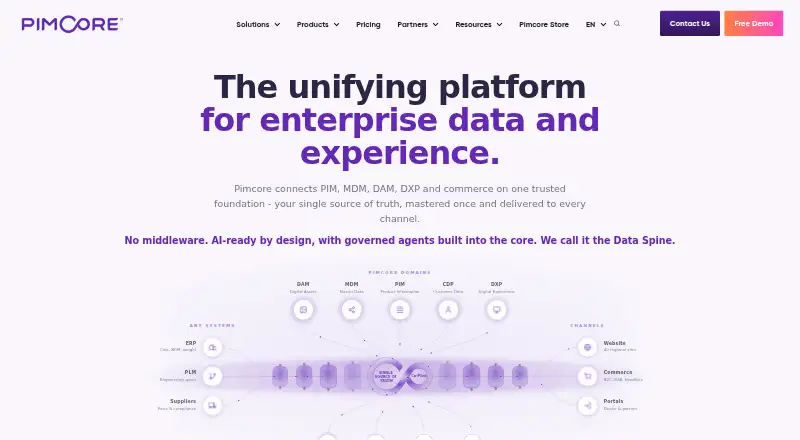
What Pimcore is
Pimcore is a platform for managing product information, master data, digital assets, digital experiences, and commerce on a shared data foundation. Its product information tools include data quality and completeness scoring, data modeling with 45+ field types, and publishing across channels. For digital assets, it provides metadata and rights management, approval workflows, and links between assets and products. Its experience management features cover multisite and multilingual management, personalization, targeting, and workflow approval. Pimcore offers cloud and on-premises deployment options; its Enterprise Edition can also run in a private data center. PaaS hosting lists AWS, GCP, and Azure, with managed infrastructure and 24x7 support. Community Edition has no commercial support, while Enterprise Edition includes long-term support and offers optional DirectConnect access to Pimcore’s core development team. Community Edition is described as suitable for non-production use, academic environments, non-profits, and businesses below EUR/USD 5 million annual revenue. The listed Professional plan is $9,900 a year, billed annually; Enterprise is $29,900 a year, billed annually.
Good
- Combines PIM, MDM, DAM, DXP, and commerce.
- Scores product data quality and completeness.
- Supports multilingual and multisite experience management.
- PaaS lists AWS, GCP, and Azure.
- No listed limits on products, assets, sites, or users.
Watch out
- Community Edition has no commercial support.
- Professional costs $9,900 a year.
- Enterprise costs $29,900 a year.
- More than four production instances require contacting Pimcore.
Who it suits
Pimcore suits organizations bringing product data, digital assets, and digital experiences together, particularly those needing multilingual management or approval workflows. Community Edition is aimed at non-production use, academic settings, non-profits, and businesses below EUR/USD 5 million in annual revenue.
Verdict
Pimcore brings product information, assets, experience management, and commerce into one platform, with cloud and on-premises deployment options. Its free Community Edition lacks commercial support, while the listed paid plans carry substantial annual prices.
Plans and prices
From Pimcore's own pricing page, checked 20 Sep 2026.
| Plan | Price | What it gives you |
|---|---|---|
| Professional Edition | $9,900 a year | On-premises deployment · Commercial licensing model · Access to Pimcore Store · Core Pimcore capabilities · billed annually |
| Enterprise Edition | $29,900 a year | On-premises deployment · Enterprise extensions · Long-term support · Optional 24/7 support · billed annually |
| PaaS | — | Fully managed hosting, operations, and support · 24/7 support · Profiling, monitoring, and alerting · Auto-scaling and zero-downtime deployments |
| Community Edition | Free | Free for non-production, academic and non-profit use, and companies with annual revenue under EUR/USD 5 million · no enterprise features or official commercial support |
| Professional | $9,900 a year | On-premises · no user-based, data-volume, or SKU-based pricing · per year |
| Enterprise | $29,900 a year | On-premises · unlimited organization-wide deployments and users · per year |
| Starter PaaS Edition | $39,900 a year | Smaller applications and POCs · moderate data and media management · single-channel experience delivery · Cost per year |
| Growth PaaS Edition | $57,900 a year | Complex data management and multiple integrations · regular traffic with occasional peaks · Cost per year |
| Performance PaaS Edition | $79,900 a year | Intricate data needs and real-time integrations · high traffic across multiple channels · Cost per year |
The facts
Each one read from Pimcore's own pages, with the date it was checked.
What it does
- Audience
- Pimcore describes Community Edition as suitable for non-production use, academic environments, non-profits, and businesses below EUR/USD 5 million annual revenue.checked 2 Oct 2026
- Community support
- Community Edition has no commercial support; the page points users to GitHub, community forums, and documentation.checked 2 Oct 2026
- Data quality rules
- Yeschecked 20 Sep 2026
- Deployment
- Enterprise Edition can be deployed on private or public cloud or in a private data center, while Community Edition supports cloud or on-premises deployment.checked 2 Oct 2026
- Digital asset management
- Yeschecked 20 Sep 2026
- Digital assets
- DAM capabilities include asset metadata and rights management, approval workflows, and product linkage.checked 2 Oct 2026
- Enterprise support
- Enterprise Edition includes Long-Term Support with regular patches and legacy support, and offers optional DirectConnect access to Pimcore's core development team.checked 2 Oct 2026
- Experience management
- DXP capabilities include multisite and multilingual management, personalization and targeting, and workflow approval.checked 2 Oct 2026
- Integrations
- Pimcore names Upsun, Shopware, iPaas.com, Productsup, and trbo among its Global Technology Alliances.checked 2 Oct 2026
- Localization support
- multilingualchecked 20 Sep 2026
- PaaS hosting
- Pimcore PaaS lists AWS, GCP, and Azure multi-cloud options and says it provides managed infrastructure and 24x7 support.checked 2 Oct 2026
- Product information
- PIM capabilities include data quality and completeness scoring, data modeling with 45+ field types, and multichannel publishing.checked 2 Oct 2026
- Security
- Pimcore says its PaaS includes automated security and identifies PCI, GDPR, HIPAA, SOC 2, FERPA, CCPA, BDSG, and PIPEDA compliance badges on the page.checked 2 Oct 2026
- Usage limits
- The pricing FAQ says there are no limits on products, assets, sites, or users, and asks customers needing more than four independent production instances to contact Pimcore.checked 2 Oct 2026
The company
- Company history
- Pimcore says it has been innovating since 2009 and reports more than 118,000 companies across 75 countries.checked 2 Oct 2026
- Founded
- 2013checked 23 Sep 2026
- Headquarters
- Salzburg, Austriachecked 23 Sep 2026
Money
- Free plan
- Yeschecked 20 Sep 2026
Where it runs
- Platform scope
- Pimcore combines PIM, MDM, DAM, DXP, and commerce on a shared data foundation.checked 2 Oct 2026
- Workflow and approvals
- Yeschecked 20 Sep 2026
The full review of Pimcore
Pimcore is a broad platform for managing product data, master data, digital assets, web experiences and commerce together. It suits organizations that need these disciplines connected across channels, especially those with the resources to deploy and support an enterprise system. Its breadth is compelling, but the paid editions start at $9,900 per year and the free Community Edition has no commercial support.
Overview
Rather than concentrating on a single catalog or content workflow, Pimcore builds product information management (PIM), master data management (MDM), digital asset management (DAM), digital experience management (DXP) and commerce on a shared data foundation. That connected scope can reduce the need to split related work across separate systems, but it also makes Pimcore a substantial choice for teams that only need one of those capabilities.
Pimcore is headquartered in Salzburg, Austria. Its company information says it has been innovating since 2009 and reports more than 118,000 companies across 75 countries; product facts give 2013 as its founding year.
It spans Product Information Management Software, Master Data Management Software and Content Management Systems, reflecting its mix of catalog, organizational data and experience tools.
Key features
Product information and data quality
Pimcore supports product data modeling with more than 45 field types, data quality and completeness scoring, configurable data quality rules, and multichannel publishing. Those tools suit teams handling varied product attributes and distributing catalog information through multiple channels; they are more than a small catalog needs.
Assets, workflows and experiences
The DAM tools manage asset metadata and rights, link assets to products, and support approval workflows. For teams coordinating imagery and product records, that relationship can keep assets within the same working environment rather than separating them from catalog processes.
DXP capabilities include multisite and multilingual management, personalization and targeting, and workflow approvals. These are useful when a business needs to manage varied digital experiences alongside product data, though organizations focused solely on product information may not need the added scope.
Deployment, hosting and support
Community Edition supports cloud or on-premises deployment. Enterprise Edition can run on private or public cloud or in a private data center. Pimcore PaaS offers managed infrastructure on AWS, GCP or Azure, with 24/7 support; its security offering includes automated security and compliance badges for PCI, GDPR, HIPAA, SOC 2, FERPA, CCPA, BDSG and PIPEDA.
Enterprise includes Long-Term Support with regular patches and legacy support, with optional DirectConnect access to Pimcore's core development team. Community Edition has no commercial support; help is through GitHub, community forums and documentation. That trade-off makes the free edition harder to recommend for production businesses that need a formal support relationship.
Pimcore names Upsun, Shopware, iPaas.com, Productsup and trbo among its Global Technology Alliances.
Pricing
Pimcore offers a free Community Edition and paid editions. Professional Edition costs $9,900 a year, billed annually. It includes on-premises deployment, a commercial licensing model, Pimcore Store access and core capabilities. A separate Professional plan is also priced at $9,900 a year, billed per year; it specifies on-premises deployment with no user-based, data-volume or SKU-based pricing. That makes the annual fee less restrictive for growing catalogs and teams than usage-based pricing, but it remains a significant entry cost.
Enterprise Edition costs $29,900 a year, billed annually, and includes on-premises deployment, enterprise extensions and long-term support, with optional 24/7 support. Enterprise is also offered at $29,900 a year, billed per year, with unlimited organization-wide deployments and users. It is the better fit for organizations that need enterprise extensions, formal lifecycle support or broad deployment rights, but its price is difficult to justify for a single limited-use case.
Community Edition is described for non-production use, academic environments, non-profits and businesses below EUR/USD 5 million in annual revenue. It has no listed price and no commercial support, so production users should weigh the savings against that support gap. Pimcore's pricing FAQ says there are no limits on products, assets, sites or users; customers needing more than four independent production instances should contact Pimcore.
PaaS pricing is custom for the general managed-hosting offer, which includes operations and support, 24/7 support, profiling, monitoring and alerting, auto-scaling and zero-downtime deployments. Its priced tiers are Starter PaaS Edition at $39,900 a year for smaller applications and proofs of concept, moderate data and media management, and single-channel delivery; Growth PaaS Edition at $57,900 a year for complex data management, multiple integrations and regular traffic with occasional peaks; and Performance PaaS Edition at $79,900 a year for intricate data needs, real-time integrations and high traffic across multiple channels. These tiers make managed hosting an option for teams that need operations support, but their costs place it firmly in enterprise budgets.
Platforms
Pimcore supports API, Linux, self-hosted and web deployments. Its range of cloud and on-premises options gives organizations deployment flexibility, while the best fit depends on whether they can operate it themselves or prefer managed PaaS.
Who it's for
Pimcore is best suited to organizations that need product, asset and experience data coordinated across multiple sites, languages or channels, and can budget for enterprise software or operate the unsupported Community Edition. It is less suitable for smaller teams seeking a focused PIM with low annual costs or commercial support included in a free plan.
Pros and cons
- Broad shared data platform: PIM, MDM, DAM, DXP and commerce work from a common foundation, suiting organizations that need connected data and experiences.
- Deep product modeling: More than 45 field types, completeness scoring and data quality rules support structured, varied catalogs.
- Production support in Enterprise: Long-Term Support and regular patches address lifecycle needs; optional DirectConnect adds access to the core development team.
- High paid entry costs: On-premises plans start at $9,900 a year, while the PaaS tiers start at $39,900 a year.
- Community Edition lacks commercial support: Documentation, forums and GitHub are the support routes, a material limitation for production teams needing vendor-backed help.
Alternatives
Choose PIMinto if a web, iOS or Android PIM with a free plan and free trial is a better fit; its Starter plan includes 1,000 SKUs, 1 GB storage and unlimited outputs. Akeneo PIM is an alternative for readers who want a dedicated open-source PIM with a free Community Edition for centralizing, enriching and distributing product information.
Plytix is worth considering for a web-based PIM with a free plan and defined SKU and API-call allowances: its Standard plan lists 500 SKUs and 5,000 API calls per hour, while Pro lists 50,000 SKUs and 15,000 API calls per hour. Choose Informatica Product 360 if its paid, API, self-hosted, web and Windows options fit better; pricing depends on data volume, modules, deployment, integrations and add-ons.
UnoPim is a free alternative with API, self-hosted and web platforms and plans that specify SKU, media, API, channel and locale allowances. Consider Acquia PIM as another paid alternative. WISEPIM offers a free plan capped at 100 products and 50 AI credits per month, so it may fit teams whose needs fall within those limits. Precisely EnterWorks is another paid option, with API, web and Windows platforms.
Verdict
Choose Pimcore when your organization needs product information, assets and digital experiences coordinated on one data foundation, and can support its substantial paid pricing or accept the Community Edition's lack of commercial support. Its breadth, modeling tools and deployment options are the strongest reasons to consider it. Look elsewhere if you need only a focused PIM, a modest annual commitment or vendor-backed support without stepping up to a paid edition.
Getting started
- Visit https://pimcore.com/en/.
- Choose Community Edition for cloud or on-premises deployment, or Enterprise Edition for private or public cloud or a private data center.
- Select a commercial plan if needed: Professional is $9,900 a year, or Enterprise is $29,900 a year, billed annually.
- For managed hosting, review PaaS, which lists AWS, GCP, and Azure options.
- Use GitHub, community forums, and documentation for Community Edition support.
Limits worth knowing
Community Edition is described as suitable for non-production use, academic environments, non-profits, and businesses below EUR/USD 5 million in annual revenue, and has no commercial support. The pricing FAQ says there are no limits on products, assets, sites, or users; customers needing more than four independent production instances are asked to contact Pimcore.
Questions
What does Pimcore combine?
It combines PIM, MDM, DAM, DXP, and commerce on a shared data foundation.
Does Pimcore have a free plan?
Yes. Community Edition has no listed price and supports cloud or on-premises deployment.
How much do the Professional and Enterprise plans cost?
Professional costs $9,900 a year, billed annually. Enterprise costs $29,900 a year, billed annually.
Where can Pimcore be deployed?
Community Edition supports cloud or on-premises deployment. Enterprise Edition can be deployed on private or public cloud or in a private data center.
What support comes with the editions?
Community Edition has no commercial support and points users to GitHub, forums, and documentation. Enterprise includes Long-Term Support with regular patches and legacy support, with optional DirectConnect access to Pimcore’s core development team.
Which integrations does Pimcore name?
Its Global Technology Alliances include Upsun, Shopware, iPaas.com, Productsup, and trbo.