UnoPim
UnoPim is an open-source product information management and digital asset management platform for organizing, enriching and sharing product data from one pla…
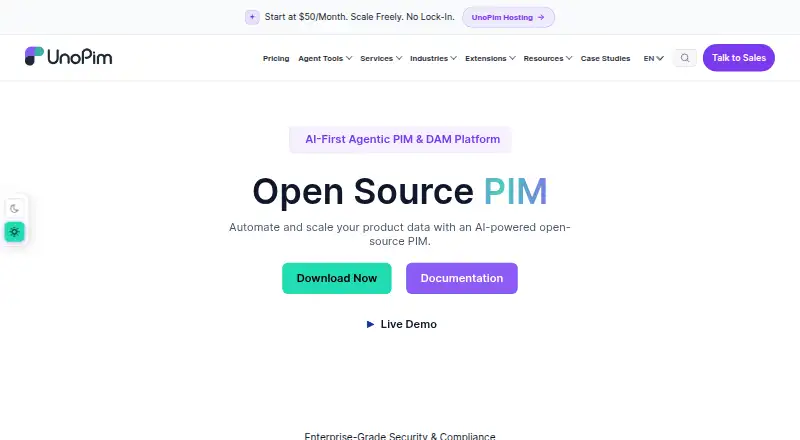
What UnoPim is
UnoPim is an open-source product information management and digital asset management platform for organizing, enriching and sharing product data from one place. It supports centralized catalog and category management, data quality rules, multilingual product information, and controls for sharing content across sales channels. Its Magic AI can generate product content, and its AI agent supports more than 32 catalog actions. Administrators can manage user access with role-based controls, while Maker Checker workflows support product and asset approvals. Data can be imported or exported in CSV, XLS and XLSX formats, and REST APIs and connectors link UnoPim with systems including Shopify, Magento 2, Odoo and WooCommerce. Cloud packs range from 10,000 SKUs to unlimited capacity, with storage and channel allowances varying by pack. Local installation requires Apache 2 or NGINX, PHP 8.2+, at least 8 GB RAM, Composer 2.2+ and a supported database.
Good
- Free, open-source platform with self-hosting option
- Supports multilingual catalogs and data quality rules
- Maker Checker enables role-based approvals
- Imports and exports CSV, XLS and XLSX
- Connectors include Shopify, Magento 2, Odoo and WooCommerce
Watch out
- Local installation requires at least 8 GB RAM
- Cloud pack capacity and allowances vary
Who it suits
UnoPim suits teams that need to manage product information, digital assets and channel publishing in one system. It may fit organizations seeking either self-hosting or cloud hosting, with catalog capacity and features that vary by pack.
Verdict
UnoPim combines catalog management, asset handling, localization and channel sharing in one open-source platform. Its free self-hosted option and paid cloud hosting give teams different deployment choices, but local installation has specific system requirements.
Plans and prices
From UnoPim's own pricing page, checked 28 Sep 2026.
| Plan | Price | What it gives you |
|---|---|---|
| Enterprise Pack | Priced on request | SKU up to 200,000 · media up to 75 GB · 25,000 API calls/hr · 15 channels · 20 locales · 99.95% uptime SLA · 15-day backups |
| Premium Pack | Priced on request | Unlimited SKUs · custom media storage · custom API calls/hr · unlimited channels and locales · 99.99% uptime SLA · real-time backups |
| Pro Pack | Priced on request | SKU up to 50,000 · media up to 25 GB · 10,000 API calls/hr · 5 channels · 10 locales · 99.9% uptime SLA · 15-day backups |
| Starter Pack | Priced on request | SKU up to 10,000 · media up to 15 GB · 5,000 API calls/hr · 3 channels · 5 locales · 99.5% uptime SLA · 30-day backups |
| UnoPim Cloud Hosting | $50 a month | Starting price |
| Free plan | Free | Free forever |
The facts
Each one read from UnoPim's own pages, with the date it was checked.
What it does
- Access control
- User management lets administrators control viewing and catalog permissions such as create, delete and update.checked 28 Sep 2026
- Admin controls
- The AI agent can view users, roles, permissions, channels, locales, and currencies.checked 28 Sep 2026
- AI actions
- The AI agent supports more than 32 automated catalog actions.checked 28 Sep 2026
- AI capabilities
- The platform provides Magic AI for product-content generation using large language models.checked 28 Sep 2026
- API
- UnoPim provides RESTful APIs and creates credentials for connecting the PIM with other systems.checked 28 Sep 2026
- API integrations
- UnoPim supports APIs, ERP, ecommerce platforms, search tools, marketplaces, and publishing channels.checked 28 Sep 2026
- Backup policy
- Cloud hosting includes automated backups, with listed retention from 15 to 30 days.checked 28 Sep 2026
- Catalog management
- UnoPim supports centralized product management, data enrichment and category management.checked 28 Sep 2026
- Channels
- The software lets users control and share product information across multiple sales channels from one place.checked 28 Sep 2026
- Cloud SKU capacity
- Cloud packs range from up to 10,000 SKUs to unlimited capacity.checked 28 Sep 2026
- Cloud users
- Cloud hosting lists unlimited users across the listed packs.checked 28 Sep 2026
- Compliance
- The maker lists ISO/IEC 27001:2022, CMMI Level 3, SOC 2 Type II, ISO 9001:2015 and GDPR alignment.checked 28 Sep 2026
- Data exchange
- Import and export are supported in CSV, XLS and XLSX formats.checked 28 Sep 2026
- Data quality rules
- Yeschecked 20 Sep 2026
- Deployment
- UnoPim can be deployed with one-click AWS hosting or installed locally with Composer or a downloadable package.checked 28 Sep 2026
- Digital asset management
- Yeschecked 20 Sep 2026
- Digital passports
- UnoPim v3.0 includes built-in Digital Product Passports without a third-party service.checked 28 Sep 2026
- Encryption security
- The platform advertises advanced encryption and continuous security monitoring.checked 28 Sep 2026
- Integrations
- Official extensions include Magento 2, Shopify, Odoo, WooCommerce, DAM, PDF Generator and Maker Checker.checked 28 Sep 2026
- Localization
- UnoPim supports different languages and regions and can translate product information into the interface.checked 28 Sep 2026
The company
- Company owner
- UnoPim is an open-source initiative by Webkul Software, registered in India and the USA.checked 28 Sep 2026
- Headquarters
- Noida, Uttar Pradesh, Indiachecked 28 Sep 2026
Money
- Free plan
- Yeschecked 20 Sep 2026
- Free tier
- The product is described as free forever.checked 28 Sep 2026
The full review of UnoPim
Overview
UnoPim is an open-source product information and digital asset management platform for teams that need to keep product data, media and channel content together. It suits retailers and brands with the technical capacity to manage a self-hosted system, or those that prefer to pay for managed cloud hosting. Its appeal is a broad catalog toolkit with a free self-hosted route; the trade-off is that local deployment has demanding system requirements and cloud capacity is divided into packs.
Key features
Centralized product and category management gives teams one place to enrich catalog records, apply data quality rules and manage product assets. CSV, XLS and XLSX import and export support bulk exchange, while user permissions control who can view or create, update and delete catalog data. This combination is useful for shared catalog work, though the stated product record limit is 10,000 apart from the higher capacities in cloud packs.
For businesses selling across markets, UnoPim handles multiple languages and regions, including translation of product information into the interface. Channel controls keep product sharing under central management, and Maker Checker provides role-based approval for products and assets. That is a meaningful safeguard for teams with review stages; cloud pack limits range from three channels and five locales to unlimited channels and locales.
Magic AI generates product content with large language models, and the AI agent can perform more than 32 catalog actions. Its tools are subject to the same role-based access controls as the rest of the platform, and administrators can control access to users, roles, permissions, channels, locales and currencies. This makes AI part of the catalog workflow rather than an unrestricted side channel, but teams should still decide what tasks fit their own approval process.
UnoPim offers RESTful APIs and extensions for Shopify, Magento 2, Odoo and WooCommerce, alongside extensions for DAM, PDF Generator and Maker Checker. Its integrations span ERP, ecommerce, search, marketplaces and publishing channels. Version 3.0 also includes built-in Digital Product Passports, avoiding the need for a separate third-party service for that capability.
The open-source platform is MIT licensed and can be deployed on a team's own infrastructure, through one-click AWS hosting or as a cloud-hosted service. The maker cites encryption in transit and at rest using AES-256, network segmentation, monitoring and tested backups, as well as ISO/IEC 27001:2022, CMMI Level 3, SOC 2 Type II, ISO 9001:2015 and GDPR alignment. These controls may matter to teams assessing security requirements, but they do not remove the operational responsibility that comes with self-hosting.
Pricing
The free plan is described as free forever, and self-hosting gives teams ownership of their infrastructure. It is the cost-conscious route for organizations able to install and maintain the software themselves; local installation requires Apache 2 or NGINX, PHP 8.2 or later, at least 8 GB of RAM, Composer 2.2 or later, and MariaDB, MySQL or PostgreSQL 16. Installation help is available through a support-ticket workflow.
UnoPim Cloud Hosting starts at $50 per month. Cloud packs include unlimited users, automated backups with retention from 15 to 30 days, and support options that range from a community forum and email to standard- and priority-level support. The packs set different operating limits:
| Pack | Catalog and service limits |
|---|---|
| Starter Pack | 10,000 SKUs, 15 GB media storage, 5,000 API calls per hour, 3 channels and 5 locales |
| Pro Pack | 50,000 SKUs, 25 GB media storage, 10,000 API calls per hour, 5 channels and 10 locales |
| Enterprise Pack | 200,000 SKUs, 75 GB media storage, 25,000 API calls per hour, 15 channels and 20 locales |
| Premium Pack | Unlimited SKUs, custom media storage and API calls per hour, unlimited channels and locales |
The cloud starting price is not a price for every pack: the listed capacities make clear that the entry point is a more bounded option, while larger catalogs and wider distribution need higher or custom capacity. Teams should match their channel, locale, media and API needs to the appropriate pack before choosing managed hosting.
Platforms
UnoPim supports web access, APIs and self-hosted deployment. Local installation suits teams that need control over their own infrastructure and can meet the listed software and memory requirements; teams seeking a hosted deployment can use its cloud option or one-click AWS hosting.
Who it's for
UnoPim is a strong fit for product teams that manage multilingual catalogs, digital assets and multiple sales channels, especially when approval workflows and AI-assisted content generation are useful. Its free, open-source route is most compelling for organizations with technical resources to operate it. Teams that want less infrastructure responsibility can choose cloud hosting, while small catalogs with simple distribution needs may not need its broader feature set or the work of setting up a local instance.
Pros and cons
- Pros: Free, MIT-licensed self-hosting gives technically capable teams ownership of their deployment without a stated subscription price.
- Pros: Catalog management, DAM, localization, data quality rules, approvals and channel sharing are combined in one system.
- Pros: Cloud packs include unlimited users, automated backups and capacity options up to unlimited SKUs, channels and locales.
- Pros: Role-based controls apply to the AI agent, while Maker Checker supports product and asset approvals.
- Cons: Self-hosting requires at least 8 GB RAM and a specific web server, PHP, Composer and database setup, which raises the operational bar.
- Cons: The cloud starting price is $50 per month, and SKU, media, API, channel and locale allowances vary by pack.
- Cons: The standard product record limit is 10,000, so larger catalogs require a cloud pack with higher capacity.
Alternatives
For a broader comparison, see Product Information Management Software. Choose Pimcore if its freemium model and Community Edition's non-production use for organizations under EUR/USD 5 million in annual revenue match your needs; its Professional Edition is $9,900 a year.
Akeneo PIM offers a free open-source Community Edition and a free trial, making it an alternative to consider if those options suit your evaluation or deployment needs. PIMinto has a free Starter plan capped at 1,000 SKUs and 1 GB storage, a better fit if a smaller catalog and web, iOS or Android access are priorities.
AtroPIM is another open-source option with a free core and import/export modules for teams running their own infrastructure. WISEPIM offers a free plan for up to 100 products, 50 AI credits per month and three languages, which may suit a very small multilingual catalog.
Ergonode has a free plan capped at 1,000 products, two users and 2 GB DAM storage, a more bounded starting point for smaller teams. Plytix offers plans with published SKU and API-call allowances, including a Standard plan at 500 SKUs and 5,000 API calls per hour; it may suit teams comparing catalog and API capacity.
Perfion PIM is a paid web and Windows option for teams considering a different platform.
Verdict
Choose UnoPim if your team needs product data, media, localization, approvals and channel distribution in one open-source system, and can either operate its own infrastructure or budget for cloud hosting. The free self-hosted option is its clearest advantage; look elsewhere if you need a simpler deployment, or if the cloud pack limits and starting cost do not fit your catalog and channel needs.