
Akeneo PIM
Akeneo PIM brings product information together so teams can enrich it and distribute it across sales channels.
What Akeneo PIM is
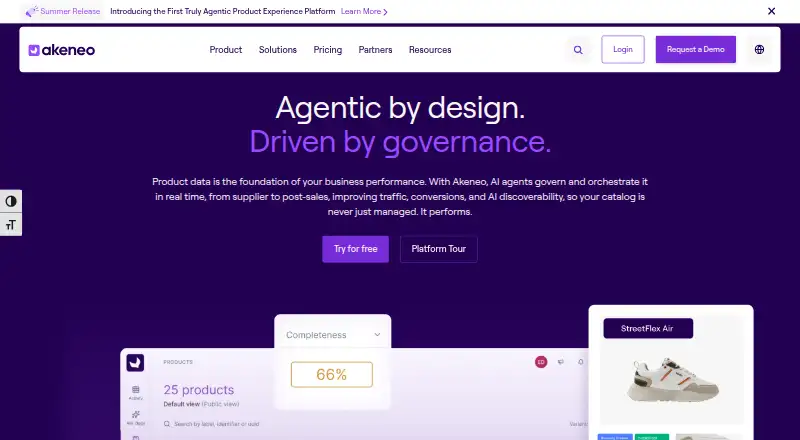
Akeneo PIM brings product information together so teams can enrich it and distribute it across sales channels. Its data model supports product variants, hierarchies, localization, business logic, and reference entities, making it suitable for catalogs with varied structures and multilingual content. Akeneo describes use across eCommerce, print catalogs, distributors, dealers, and direct sales. Listed capabilities include digital asset management, data quality rules, and workflow and approval tools. A dashboard tracks data quality and completeness and recommends ways to improve catalog scores. Teams can assign tasks, set role-based permissions, and use approval workflows and status indicators to manage product information. Akeneo’s App Store ecosystem includes 250+ apps, with integrations described for eCommerce platforms, DAMs, CRMs, and supplier management tools. Community Edition is an open-source PIM that users can download, install, host, and customize. Growth, Advanced, and Premium each include one activation channel. Akeneo states that it is ISO/IEC 27001:2022 certified and SOC 2 Type I compliant, supports GDPR and other applicable requirements, and encrypts customer data in transit and at rest. The service is available through web, API, and self-hosted deployment.
Good
- Supports product variants, hierarchies, localization, and reference entities.
- Includes digital asset management and data quality rules.
- Workflow tools include assigned tasks and approvals.
- App Store ecosystem includes 250+ apps.
- Community Edition can be downloaded and self-hosted.
Watch out
- Growth, Advanced, and Premium each include one activation channel.
- Community Edition users rely on peer or partner support for help.
Who it suits
Akeneo PIM suits teams managing product catalogs across multiple sales formats or markets, especially when product variants and multilingual information matter. Community Edition is intended for users who want to download, host, and customize an open-source PIM.
Verdict
Choose Akeneo PIM if you need to centralize and manage product information across sales channels, with catalog quality and approval workflows. Community Edition offers a self-hosted option; the listed SaaS packages each include one activation channel.
Plans and prices
From Akeneo PIM's own pricing page, checked 14 Oct 2026.
| Plan | Price | What it gives you |
|---|---|---|
| Community Edition | Free | free open-source PIM · limited to Community features · annually |
| Advanced | Priced on request | Growth features · collaboration workflows · advanced rights management · channel-ready governance |
| Growth | Priced on request | data modeling · AI description and asset extraction · one activation channel · SLA-backed support |
| Premium | Priced on request | Advanced features · PX Insights data source · enterprise governance · strategic CSM · 24/7 support |
The facts
Each one read from Akeneo PIM's own pages, with the date it was checked.
What it does
- Access controls
- Akeneo supports SSO using SAML 2.0 and OpenID Connect, and says it applies role-based access control using least-privilege principles.checked 4 Oct 2026
- AI enrichment
- Akeneo lists AI description generation, asset extraction, translation, data mapping, classification and data-quality recommendations.checked 14 Oct 2026
- Analytics
- PX Insights, business analytics, Data Quality Insights and product-usage/time-to-market insights are listed as optimization capabilities, with some requiring add-ons or higher tiers.checked 14 Oct 2026
- API architecture
- Akeneo provides REST APIs, OAuth 2.0 app authentication, events and webhooks for extensions and integrations.checked 14 Oct 2026
- Catalog modeling
- Features include composable products, product variations and bundles, attribute inheritance, family templates and product versioning.checked 14 Oct 2026
- Community Edition deployment
- Community Edition can be downloaded, installed, hosted, and customized by the user.checked 4 Oct 2026
- Community Edition support
- Akeneo says Community Edition users can get peer support from its community and contact certified solution partners for expert help.checked 4 Oct 2026
- Community scale
- Akeneo reports 400+ employees, 900+ enterprise customers, 80,000+ Community Edition downloads and 200+ partners.checked 14 Oct 2026
- Data modeling
- Its data model supports product variants, hierarchies, localization, business logic, and reference entities.checked 4 Oct 2026
- Data quality
- The product page describes a dashboard for monitoring data quality and completeness, with recommendations to improve catalog scores.checked 4 Oct 2026
- Data quality rules
- Yeschecked 20 Sep 2026
- Developer tooling
- Official tooling includes an OpenAPI specification, Postman collection, sandbox generation and a PHP REST API client.checked 14 Oct 2026
- Digital asset management
- Yeschecked 20 Sep 2026
- Documentation depth
- Official documentation covers system requirements, installation, migration, API authentication, permissions, pagination, filtering, updates and error responses.checked 14 Oct 2026
- Encryption
- Akeneo says customer data is encrypted in transit using TLS 1.2+ and at rest, including backups, using AES-256.checked 4 Oct 2026
- GraphQL availability
- The GraphQL API is supported for Enterprise SaaS but not for Community Edition.checked 14 Oct 2026
- Integrations
- Akeneo advertises more than 150 integrations covering ecommerce, DAM, CMS, print, syndication, translation and other systems.checked 14 Oct 2026
- Legal entity
- Crunchbase identifies the legal name as Akeneo, SAS and lists a 251–500 employee range.checked 14 Oct 2026
- License
- The Community PIM source repository identifies the license as the Open Software License version 3.0 (OSL-3.0).checked 14 Oct 2026
- Limit: asset management
- OMR reviewers say native asset management and product-model creation could be improved.checked 14 Oct 2026
Where it runs
- App marketplace
- The Akeneo App Store lists 138 apps and connectors, including Adobe Commerce/Magento, Shopify, Salesforce, Activation and DeepL.checked 14 Oct 2026
The company
- Company
- Akeneo describes itself as a Product Experience company offering a composable SaaS-based Product Cloud for orchestrating, activating, and optimizing product experiences across channels.checked 4 Oct 2026
- Company facts
- Akeneo is privately held, headquartered in Nantes, France, founded in 2013 and listed by LinkedIn at 201–500 employees.checked 14 Oct 2026
Money
- Free plan
- Yeschecked 20 Sep 2026
The full review of Akeneo PIM
Akeneo PIM is a product information platform for bringing catalog data together, improving it, and distributing it to sales destinations. It is a strong fit for organizations with complex product models and coordinated review needs. Its depth comes with a key trade-off: each SaaS package includes one activation channel.
Overview
Akeneo handles product information for eCommerce, print catalogs, distributors, dealers, and direct sales. Its data model accommodates variants, hierarchies, localization, business logic, and reference entities, which supports catalogs that need more structure than a simple list of products. Multilingual support makes it relevant to teams maintaining information for more than one market.
Deployment is a meaningful choice. Community Edition is open source and can be downloaded, installed, hosted, and customized by the user; Growth, Advanced, and Premium are SaaS packages. The self-hosted route gives teams control over their environment but also leaves operation to them. Community users can turn to peers or certified solution partners for help, while the SaaS packages include SLA-backed support and Premium adds 24/7 support.
Key features
Quality and approvals
A dashboard tracks data quality and completeness and recommends improvements to catalog scores. Role-based permissions, assigned tasks, approval workflows, and completeness and status indicators help teams coordinate ownership and review before distributing product information. These controls are especially useful when catalog work passes between contributors; they offer less value to a small operation with little need for formal approval.
Distribution and integrations
Akeneo supports product information across several kinds of sales activity, and its ecosystem includes more than 250 apps, with integrations described for eCommerce platforms, digital asset management, customer relationship management, and supplier management tools. That breadth can help connect catalog work to adjacent systems. The one activation channel included with each SaaS plan is the more immediate constraint for teams distributing to multiple destinations.
Security
Akeneo states that it is ISO/IEC 27001:2022 certified and SOC 2 Type I compliant, supports GDPR and other applicable requirements, and encrypts data in transit with TLS 1.2+ and at rest, including backups, with AES-256. It supports SSO through SAML 2.0 and OpenID Connect, with role-based access controls based on least privilege. These provisions matter to organizations with formal security and access requirements.
Pricing
Akeneo uses a freemium model, with Community Edition as its free open-source PIM. It covers centralizing, managing, enriching, and distributing product information, but requires the user to install, host, and customize it. Community support is peer-based, with certified partners as an option for expert help.
Growth, Advanced, and Premium have custom pricing, and each includes one activation channel. Growth and Advanced include SLA-backed support; Premium also has 24/7 support. Because pricing and other plan differences are not given, buyers should compare proposals directly rather than assume the higher tiers change particular quotas or capabilities.
A free trial is available. The plan details provide no trial length, seat limits, or renewal terms, so those should be confirmed before committing.
Platforms
Akeneo is available through the web, API, and self-hosted deployment. Community Edition is the self-managed option; the other named packages are SaaS. That makes it a candidate for teams that need either deployment control or a hosted service, though each route carries a different support model.
Who it's for
Akeneo suits organizations managing structured, multilingual catalogs across multiple sales contexts, particularly where data quality checks and approval responsibilities need to be coordinated. It is less compelling for teams seeking a low-maintenance free service, or for SaaS buyers whose distribution needs exceed one included activation channel.
Pros and cons
- Pros: Flexible modeling for variants, hierarchies, localization, business logic, and reference entities supports more involved catalogs.
- Pros: Quality monitoring, recommendations, assigned tasks, and approvals give teams concrete ways to manage catalog readiness.
- Pros: Community Edition provides a free, self-hosted route, while SaaS packages include SLA-backed support.
- Cons: Every SaaS package includes only one activation channel, a limiting starting point for businesses distributing broadly.
- Cons: Community Edition puts installation, hosting, and customization on the user, and support is peer- or partner-based.
- Cons: SaaS pricing is custom, making costs harder to compare without a proposal.
Alternatives
Compare product information management software if you want to weigh Akeneo against options across the category.
- Pimcore is another freemium choice with a free plan and self-hosted, Linux, web, and API platforms; consider it if that platform mix better matches your deployment needs.
- Acquia PIM is a paid option spanning web, API, Android, and iOS, with a custom demo offered.
- PIMinto offers a free plan and trial, with web and mobile apps; consider it if a stated free tier is important to your decision.
- Informatica Product 360 is a paid option available through web, API, Windows, and self-hosted deployment.
- IBM Product Master is a paid alternative with Linux, web, API, and self-hosted platforms.
- Salsify PXM is a paid alternative available through web and API.
- Agility PIM is a paid alternative spanning web, mobile, desktop, Linux, API, and self-hosted platforms.
- UnoPim is a free alternative with web, API, and self-hosted platforms.
Verdict
Choose Akeneo when your organization needs a structured home for complex product information, with catalog quality controls and approvals built into the workflow. Its free self-hosted edition and supported SaaS route make it adaptable, but the SaaS packages' single included activation channel and custom pricing give teams with broader distribution needs good reason to compare alternatives.
Getting started
- Visit https://www.akeneo.com/.
- Choose Community Edition, Growth, Advanced, or Premium.
- For Community Edition, download, install, and host the software yourself.
- Use the web, API, or self-hosted deployment route.
Limits worth knowing
Growth, Advanced, and Premium each include one activation channel. The listed facts give no quota or feature ceiling for Community Edition.
Questions
Is Akeneo PIM free?
Yes. Community Edition is described as a free, open-source PIM. A free plan and free trial are also listed.
What platforms does it support?
The listed platforms are web, API, and self-hosted.
Can I host Community Edition myself?
Yes. Community Edition can be downloaded, installed, hosted, and customized by the user.
How many activation channels do the paid packages include?
Growth, Advanced, and Premium each include one activation channel.
What integrations are available?
Akeneo describes an ecosystem of 250+ apps and integrations with eCommerce platforms, DAMs, CRMs, and supplier management tools.
What security measures does Akeneo describe?
Akeneo states that it is ISO/IEC 27001:2022 certified and SOC 2 Type I compliant, supports GDPR and other applicable requirements, and encrypts data in transit and at rest.