
Acquia PIM
Acquia PIM is a product information management tool for keeping product content together and sending it to sales and publishing destinations.
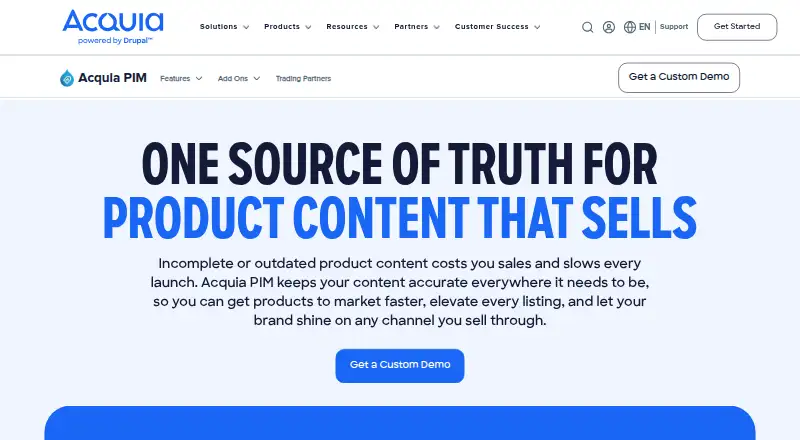
What Acquia PIM is
Acquia PIM is a product information management tool for keeping product content together and sending it to sales and publishing destinations. Its central hub can contain packaging, recipes, feature lists, training videos, and other product material. The platform syndicates that information to websites, marketplaces, sales teams, and other destinations. Syndicate has 150 automatic connections, with more described as being added. Its map-once approach supports adding destinations and categories in minutes, while destination validation previews how information will be transformed for retailer or marketplace requirements and surfaces deficiencies before submission.
The product includes digital asset management, multilingual support, and data quality rules, alongside automation and AI assistance throughout the content lifecycle. It can adapt assets for e-commerce, social media, and print, and automate task creation and notifications for writers and creatives. It also connects packaging and promotional workflows for launches and campaigns. Integration methods include native integrations, APIs, marketplace connectors, catalogs, and CSV exports. Pricing is on request.
Good
- Centralizes varied product materials in one content hub.
- 150 automatic connections, with more being added.
- Validates content against retailer and marketplace requirements.
- Supports multilingual content and data quality rules.
- Transforms assets for e-commerce, social, and print.
Watch out
- Pricing is available on request.
- No free plan or trial terms are stated.
- No refund policy is stated.
Who it suits
Acquia PIM suits teams managing product information across multiple destinations, particularly those needing multilingual content, asset management, or retailer-specific validation. Its automated workflows may also fit teams coordinating writers, creatives, packaging, and promotional work.
Verdict
Acquia PIM brings product content, assets, validation, and syndication into one system. Teams should request pricing and clarify trial and refund terms before choosing it.
Plans and prices
From Acquia PIM's own pricing page, checked 11 Oct 2026.
| Plan | Price | What it gives you |
|---|---|---|
| Acquia PIM | Priced on request | Custom demo offered; no public price shown |
The facts
Each one read from Acquia PIM's own pages, with the date it was checked.
What it does
- AI tools
- Syndicate includes AI translation for more than 50 languages and regions, an AI writing assistant, and AI-powered mapping suggestions.checked 11 Oct 2026
- Asset handling
- The Assets feature automates image matching, renaming, and resizing to meet channel requirements.checked 11 Oct 2026
- Asset optimization
- It transforms assets for e-commerce, social media, print, and other uses.checked 27 Sep 2026
- Automatic connections
- Syndicate has 150 automatic connections and is described as continuing to add more.checked 27 Sep 2026
- Automation and AI
- It provides automation tools and AI assistance throughout the product content lifecycle.checked 27 Sep 2026
- Catalogs
- Channel Portals lets teams create shareable product catalogs for retailers and sales teams, with channel-specific product and information selections.checked 11 Oct 2026
- Central content hub
- It centralizes product packaging, recipes, feature lists, training videos, and other product content.checked 27 Sep 2026
- Channel distribution
- Acquia says PIM can distribute content to more than 200 retailers and marketplaces, with more than 150 trading partner connections already built.checked 11 Oct 2026
- Channel syndication
- Acquia says Syndicate has over 150 automatic trading partner connections and keeps destination requirements updated.checked 11 Oct 2026
- Creative workflows
- It connects packaging, promotional, and other workflows for product launches and campaigns.checked 27 Sep 2026
- Data completeness
- Entries can identify missing product information and assets, as well as items needing approval.checked 11 Oct 2026
- Data modeling
- Teams can configure product data models to define what information is captured for each product.checked 11 Oct 2026
- Data quality rules
- Yeschecked 22 Sep 2026
- Destination validation
- It shows how data will be transformed for retailer or marketplace requirements and reveals deficiencies before submission.checked 27 Sep 2026
- Digital asset management
- Yeschecked 22 Sep 2026
- Distribution options
- Acquia lists native integrations, APIs, marketplace connectors, digital product catalogs, and CSV exports as ways to distribute content.checked 11 Oct 2026
- Getting started
- Acquia’s product page directs prospective customers to request a custom demo using their own product data and channels.checked 11 Oct 2026
- Global support
- Acquia describes support coverage across all time zones.checked 27 Sep 2026
The company
- Company
- Acquia says it was co-founded in 2007 and lists its Boston, Massachusetts office at 53 State Street.checked 11 Oct 2026
- Company address
- Acquia lists its address as 53 State Street, 10th Floor, Boston, MA 02109.checked 27 Sep 2026
- Company phone
- The page lists Acquia's phone number as 888-922-7842.checked 27 Sep 2026
- Founded
- 2007checked 19 Oct 2026
- Headquarters
- Boston, Massachusetts, United Stateschecked 19 Oct 2026
Money
- Free tier
- The supplied pages do not state a free plan or free-tier limits.checked 27 Sep 2026
The full review of Acquia PIM
Acquia PIM is a product information management platform for organizations coordinating product data and media across sales channels. It suits teams with complex catalogs and many retailer or marketplace destinations. Its central content hub and channel tools make it a strong fit for that work, while custom pricing makes it harder to assess cost before engaging with Acquia.
Overview
Acquia PIM brings product copy, photos, video and technical specifications into Entries, where teams can configure the fields each product needs and import specifications from ERP, PLM or MDM systems. That is useful when product information comes from several systems and needs to be brought together before publication. Entries can flag missing details, missing assets and content awaiting approval, and its activity history helps teams follow changes over time.
The breadth can suit organizations managing more than basic specifications: product records can include packaging, recipes, feature lists, marketing copy and training videos. Teams will get more from the system when they define clear data models and workflows; those controls require setup around the organization’s catalog and approval process.
Key features
Acquia combines digital asset management, data quality rules, workflow and approvals, and multilingual support with product information management. Custom triggers and variables can send notifications through the content lifecycle, while task automation helps writers and creatives keep work moving. Connecting packaging and promotional workflows can also support product launches and campaigns.
Syndicate prepares product content for retailer and marketplace requirements, previews how data will be transformed, and surfaces deficiencies before submission. Acquia says it can distribute content to more than 200 retailers and marketplaces, with more than 150 trading partner connections already built; named connections include Amazon, Google, Shopify, BigCommerce and Salesforce Commerce Cloud. The map-once approach is intended to make adding destinations and categories take minutes, and maintained outbound mappings help account for changes to channel templates. That reach is valuable for broad distribution, though teams with only a few destinations may not need this level of channel tooling.
Asset transformations adapt media for e-commerce, social, print and other uses. Distribution can also happen through native integrations, APIs, marketplace connectors, digital product catalogs and CSV exports, giving teams several ways to connect Acquia with their systems and channels. Automation and AI assistance are part of the product content lifecycle, but the specific assistance available is not defined here.
Pricing
Acquia PIM is paid software with custom pricing, and Acquia offers a custom demo. No public plan price or free tier is stated. Teams should request a quote to compare the cost with their catalog size, destination needs and workflow requirements.
Platforms
Acquia PIM is listed for Android, iOS, web and API access. The Acquia DAM product guide also describes iOS and Android mobile applications. The product’s integration options include native integrations, APIs, marketplace connectors, catalogs and CSV exports.
Who it's for
Acquia PIM is best suited to organizations with large or complex product catalogs, multiple content contributors and a broad mix of retailer or marketplace destinations. Its data modeling, upstream imports, completeness checks and approval workflows address the coordination work involved in preparing product information across teams. Companies that need multilingual content and asset transformations alongside syndication can use more of its combined toolkit. Smaller teams with simple catalogs or few channels may find the custom-priced system difficult to justify.
Pros and cons
- Pros: Product information, digital assets, approvals and data quality controls share one system, helping teams manage more than specifications alone.
- Pros: More than 150 built trading partner connections and distribution to over 200 retailers and marketplaces support wide channel coverage.
- Pros: Submission previews and deficiency checks expose channel issues before content is sent.
- Pros: ERP, PLM and MDM imports, plus APIs, integrations and CSV exports, give teams several ways to move product data.
- Cons: Custom pricing and no stated free tier make it harder for buyers to estimate cost or start with a small commitment.
- Cons: The broad workflow and channel capabilities may exceed the needs of a small catalog or a business publishing to only a few destinations.
Alternatives
Compare product information management software if you want to weigh Acquia against a wider set of tools. Consider Pimcore if a freemium option or Linux and self-hosted platforms matter; its Community Edition is limited to non-production use and annual revenue under EUR/USD 5 million, while its Professional Edition is listed at $9,900 a year. Akeneo PIM is another freemium option, with a free open-source Community Edition for centralizing, managing, enriching and distributing product information, plus a free trial.
PIMinto is worth considering for a free starting plan: its Starter tier includes 1,000 SKUs, 1 GB storage and unlimited outputs, and it offers a free trial. If you need a paid system whose price depends on data volume, modules, deployment, integrations and add-ons, consider Informatica Product 360. Salsify PXM, Agility PIM, UnoPim and IBM Product Master are also alternatives to compare.
Verdict
Choose Acquia PIM if your organization needs to coordinate rich product records, assets, approvals and distribution across many retail and marketplace channels. Its combination of configurable product data, completeness checks and channel syndication is the main reason to choose it. Look elsewhere if you need public pricing, a free entry point or clearly stated purchase terms before starting a sales conversation.
Getting started
- Visit the Acquia PIM product page.
- Request a custom demo from Acquia.
- Choose an integration or distribution method, such as an API, connector, catalog, or CSV export.
- Configure product data fields and import specifications from an ERP, PLM, or MDM system.
Questions
How much does Acquia PIM cost?
Pricing is on request, and no public price is shown.
Is there a free plan or trial?
The supplied product information does not state a free plan or trial terms.
Which platforms does Acquia PIM support?
Listed platforms are Android, iOS, web, and API.
What destinations can receive product content?
Acquia says it can distribute to more than 200 retailers and marketplaces, with more than 150 trading partner connections already built. Named connections include Amazon, Google, Shopify, BigCommerce, and Salesforce Commerce Cloud.
What integration and export methods are available?
Methods include native integrations, APIs, marketplace connectors, digital product catalogs, and CSV exports.
Who makes Acquia PIM?
The maker is Acquia PIM. Acquia says it was co-founded in 2007 and lists its Boston, Massachusetts office.
Alternatives to Acquia PIM
- 1
PIMinto
Free planAndroidiOSWeb8.5From $300 a month - 2

Akeneo PIM
Free planOpen sourceWebAPILinuxSelf-hosted8.1Free plan - 3

Pimcore
Free planWebAPILinuxSelf-hosted8.0From $9,900 a year - 4
UnoPim
Free planWebAPISelf-hosted7.9From $50 a month - 5

Catsy PIM
AndroidiOSWebAPI7.8 - 6
WISEPIM
Free planWebAPIExtension7.8Free plan