
jBPM
jBPM is a free, open-source toolkit for automating business processes, tasks, decisions, and rules.
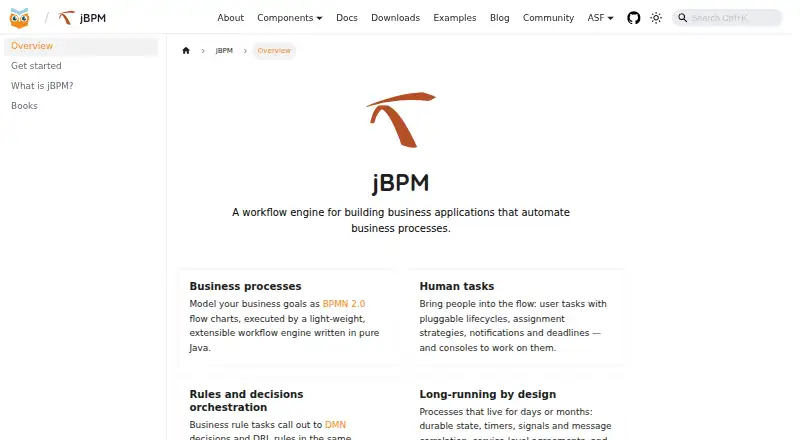
What jBPM is
jBPM is a free, open-source toolkit for automating business processes, tasks, decisions, and rules. It runs as Java libraries embedded in a service, not as a standalone server, and executes processes modeled with BPMN 2.0. Human tasks can use configurable lifecycles, assignment strategies, and deadlines. Process rule tasks can call DRL rules or DMN decisions evaluated by Drools in the same service. For long-running work, jBPM supports durable state, timers, signals, message correlation, service-level agreement tracking, and migration of active instances to a new process version. Persistence options include PostgreSQL and other JDBC databases, MongoDB, Infinispan, RocksDB, and the filesystem. Web and IDE modelers provide drag-and-drop process creation, while its visualization and workflow features include a visual builder, event triggers, automatic retries, and execution observability. For Apache KIE 10, the documented service approach uses Kogito on Quarkus or Spring Boot; BPMN models are compiled at build time, without a runtime deployment step or process repository. jBPM is written in Java and released under Apache License 2.0.
Good
- Free, open-source software under Apache License 2.0
- Executes BPMN 2.0 business processes
- Supports durable state, timers, and signals
- Offers drag-and-drop process modelers
- Provides event triggers and execution observability
Watch out
- Runs embedded in a service, not as a server
- Getting started lists JDK and Maven prerequisites
- Apache KIE is still undergoing incubation
Who it suits
jBPM suits developers building Java services that need BPMN-based business automation and long-running process support. It is aimed at teams comfortable with self-hosting and service integration.
Verdict
jBPM combines BPMN process execution with human tasks, decision rules, durable state, and several persistence choices. Its embedded-library model and Java service requirements make it most relevant to teams implementing and operating their own services.
Plans and prices
From jBPM's own pricing page, checked 9 Oct 2026.
| Plan | Price | What it gives you |
|---|---|---|
| Apache KIE (jBPM) | Free | Open-source Java workflow engine; Apache License 2.0 |
The facts
Each one read from jBPM's own pages, with the date it was checked.
What it does
- Compatibility
- The project says it is written in pure Java, runs on any JVM and is available from Maven Central.checked 9 Oct 2026
- Decisions and rules
- Process rule tasks can call DRL rules or DMN decisions evaluated by Drools in the same service.checked 9 Oct 2026
- Frameworks
- For Apache KIE 10, the documented way to build a service with jBPM is Kogito on Quarkus or Spring Boot.checked 9 Oct 2026
- Getting started requirements
- The current getting-started page lists an IDE, JDK 21 preferred or JDK 17, and Maven 3.9 or later as prerequisites.checked 9 Oct 2026
- Human tasks
- Human tasks support pluggable lifecycles, assignment strategies and deadlines.checked 9 Oct 2026
- License
- jBPM is open-source software released under the Apache License 2.0.checked 9 Oct 2026
- Long-running processes
- The product supports durable process state, timers, signals, message correlation, service-level agreement tracking and migration of running instances to a new process version.checked 9 Oct 2026
- Modeling tools
- Web-based and IDE-based modelers support graphical drag-and-drop process creation.checked 9 Oct 2026
- Persistence
- Pluggable persistence options listed include PostgreSQL and other JDBC databases, MongoDB, Infinispan, RocksDB and the filesystem.checked 9 Oct 2026
- Process standard
- The engine executes business processes modeled with BPMN 2.0.checked 9 Oct 2026
- Project status
- Apache KIE is undergoing incubation at the Apache Software Foundation and has not yet been fully endorsed by the ASF.checked 9 Oct 2026
- Purpose
- jBPM provides capabilities for business automation, including processes, tasks, decision tables and business rules.checked 9 Oct 2026
- Runtime deployment
- BPMN 2.0 models are compiled at build time, with no runtime deployment step or process repository to manage.checked 9 Oct 2026
- Support channels
- The project site lists user and developer mailing lists and a Zulip chat as community channels.checked 9 Oct 2026
- Workflow engine
- jBPM is a set of Java libraries embedded in a service, rather than a server.checked 9 Oct 2026
The full review of jBPM
jBPM is an open-source Java toolkit for embedding business-process automation inside application services. It is best suited to Java teams that need BPMN workflows, human tasks, rules and decisions in one codebase. Choose it when an embedded, self-hosted engine fits your architecture; look elsewhere if you want a ready-made workflow server.
Overview
jBPM runs as Java libraries inside your service instead of as a separate server. This keeps process execution close to application code and avoids operating a standalone process repository, but your team owns the service, infrastructure and runtime operations. BPMN 2.0 models are compiled at build time, so production has no separate process-deployment step.
The project is pure Java, runs on any JVM and is published through Maven Central. Apache License 2.0 permits use under open-source terms. Apache KIE is incubating at the Apache Software Foundation and has not received full ASF endorsement, which may matter to organisations with strict platform-governance requirements.
Key features
Web and IDE modelers provide graphical drag-and-drop BPMN creation. Event triggers, automatic retries and execution observability cover the practical needs of event-driven services, although teams still have to integrate those capabilities into their own application and operations stack.
Human tasks offer pluggable lifecycles, assignment strategies and deadlines. That flexibility suits approval, case and exception workflows where responsibilities and timing vary by process. Rule tasks can invoke DRL rules or DMN decisions through Drools in the same service, keeping business logic alongside workflow execution rather than splitting it across another runtime.
Long-running processes retain durable state and support timers, signals, message correlation, service-level agreement tracking and migration of running instances to a new process version. These are substantial safeguards for workflows that span days or months, but they make persistence design, upgrades and operational ownership part of the implementation rather than a managed-service concern.
Persistence is pluggable, with PostgreSQL and other JDBC databases, MongoDB, Infinispan, RocksDB and the filesystem among the listed choices. The breadth helps teams align storage with an existing Java platform, while the trade-off is more architecture and maintenance decisions. For Apache KIE 10, the documented service approach uses Kogito on Quarkus or Spring Boot.
Pricing
| Plan | Price | Includes | Best for |
|---|---|---|---|
| Apache KIE (jBPM) | free | Open-source Java workflow engine; Apache License 2.0 | Teams building and operating their own services |
There are no paid tiers, seat charges or stated usage quotas. The free plan is the product, not a restricted trial, so it fits prototypes and production deployments alike when your organisation can supply engineering, hosting and support resources. Support comes through user and developer mailing lists and Zulip chat rather than a paid service tier.
Platforms
jBPM is available for API, extension, Linux, macOS, self-hosted, web and Windows environments. Its Java and JVM compatibility, Maven Central distribution and self-hosted deployment model make it portable across infrastructure, but it is not a hosted workflow service that removes runtime administration.
Who it's for
Choose jBPM for Java teams embedding BPMN automation into Quarkus or Spring Boot services, especially when human work, Drools rules, DMN decisions and durable workflows must share one application boundary. It is also a strong fit where build-time compilation and selectable persistence match established delivery practices.
It is a poor fit for teams seeking a turnkey visual SaaS, a separate workflow server managed by a vendor, or non-Java implementation without JVM service ownership. The incubation status may also discourage organisations requiring a fully endorsed Apache project.
Pros and cons
Pros
- Combines BPMN 2.0 execution, human tasks, DRL rules and DMN decisions in one Java service.
- Durable state, timers, correlation, SLA tracking and version migration address genuinely long-running processes.
- Pluggable persistence and pure-Java JVM portability accommodate varied infrastructure.
- Apache License 2.0 and a free plan remove licensing fees and seat limits.
Cons
- Embedded-library deployment leaves hosting, scaling, upgrades and observability integration to your team.
- Build-time compilation removes runtime repository management but also requires a software delivery cycle for process changes.
- Java, JDK and Maven prerequisites narrow its appeal for teams without JVM engineering expertise.
- Apache KIE's incubation status may be unsuitable for governance policies requiring full ASF endorsement.
Alternatives
For a broader category comparison, see Workflow Orchestration Software and Business Process Management Software.
- Kestra is a free, Apache 2.0-licensed option with web and self-hosted platforms when you prefer its platform model.
- Argo Workflows is a free, Kubernetes-focused open-source workflow engine for teams standardising on Kubernetes.
- Bonita offers a freemium model and a free plan capped at 150 process instances per month, which may suit smaller process volumes.
- Workflow Engine has a perpetual free plan limited to 10 schemas, four execution threads and personal use.
- Camunda provides freemium self-managed options for teams comparing another BPM platform.
- Apache Airflow is a free Apache-licensed choice for API, Linux, macOS and self-hosted workflow deployments.
- Windmill offers a free open-source tier with workspace, user and storage caps for teams wanting those packaged limits.
- Hatchet provides a pay-as-you-go plan with 1 million runs and 1 million events per month free.
Verdict
jBPM is a strong recommendation for Java organisations that want BPMN, human work and business rules embedded in services they control, with no licensing cost and serious support for long-running execution. Look elsewhere if your priority is a managed workflow product, minimal infrastructure ownership or a project with fully established Apache Foundation status.
Alternatives to jBPM
- 1

Joget
Free planOpen sourceAndroidiOSWebAPI8.8Free plan - 2
Flowable
Free planOpen sourceAndroidiOSWebAPI8.7From $99 a month - 3
Nintex Process Platform
AndroidiOSWebAPI7.8From $25,000 a year - 4

AgilePoint NX
Free planAndroidiOSWebAPI7.6From $39 a month - 5

Camunda
Free planWebAPILinuxmacOS7.6Free plan - 6

HEFLO
Free planAndroidiOSWebAPI7.4Free plan