
Apache Airflow
Apache Airflow is a platform for authoring, scheduling, and monitoring workflows defined in Python.
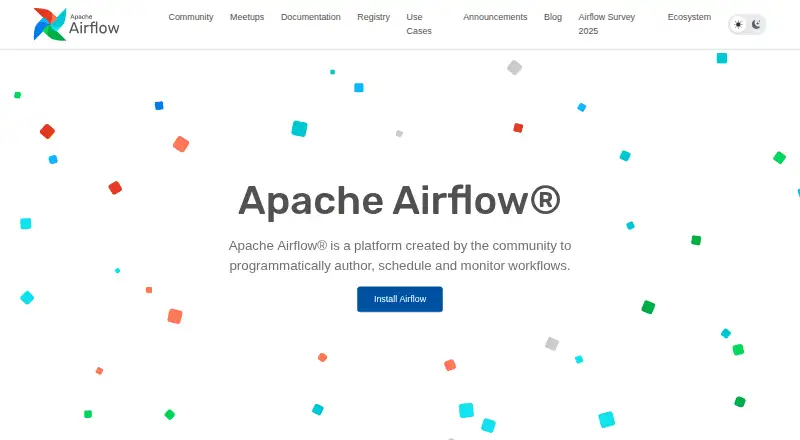
What Apache Airflow is
Apache Airflow is a platform for authoring, scheduling, and monitoring workflows defined in Python. It is intended for batch workflows with a clear start and end that run on a schedule. Through its web interface, users can schedule or manually trigger DAGs, inspect task status and logs, backfill runs, and rerun failed tasks.
Its modular architecture uses a message queue to coordinate workers and can support an arbitrary number of them. Built-in operators connect workflows to Google Cloud Platform, Amazon Web Services, Microsoft Azure, and other services. The community maintains more than 80 provider packages, which can be installed and upgraded or downgraded separately from Airflow core. Airflow can read connections, variables, and configuration from secret backends, but those integrations do not support writes. It uses JWT authentication for its public REST API and internal Execution API; in Airflow 3 and later, sensitive credentials are masked in logs, the interface, and API outputs. It is free to download and use under the Apache License.
Good
- Workflows are defined in Python
- Web interface supports logs and task status
- Operators connect to major cloud services
- More than 80 separately installable provider packages
- Free to download under the Apache License
Watch out
- Designed for scheduled batch workflows
- Secret backends do not allow writes
- Windows deployment is unsupported except WSL2 development
Who it suits
Airflow suits teams that define scheduled batch workflows in Python and want a web interface for managing runs and task logs. It is designed for self-hosted deployment in Linux-based environments; macOS is for local development, while Windows deployment is unsupported except for WSL2 development.
Verdict
Apache Airflow offers code-defined workflow scheduling and operational controls, with cloud operators and independently managed provider packages. It fits scheduled batch work, but its deployment guidance distinguishes Linux environments from local-development platforms.
Plans and prices
From Apache Airflow's own pricing page, checked 1 Oct 2026.
| Plan | Price | What it gives you |
|---|---|---|
| Apache Airflow | Free | download and use at no cost · Apache License source code |
The facts
Each one read from Apache Airflow's own pages, with the date it was checked.
What it does
- Authentication
- Airflow uses JWT authentication for its public REST API and internal Execution API.checked 1 Oct 2026
- Cloud integrations
- Built-in plug-and-play operators support Google Cloud Platform, Amazon Web Services, Microsoft Azure, and other third-party services.checked 1 Oct 2026
- Community support
- The project provides learning resources and community support through Slack and mailing lists.checked 1 Oct 2026
- Operations
- The web interface supports manually triggering DAGs, inspecting logs, monitoring task status, backfilling runs, and rerunning failed tasks.checked 1 Oct 2026
- Project history
- Airflow began in October 2014 at Airbnb and became an Apache Software Foundation top-level project in January 2019.checked 1 Oct 2026
- Provider releases
- Providers can be upgraded or downgraded independently of the Airflow core release.checked 1 Oct 2026
- Providers
- The community maintains more than 80 separately installable provider packages.checked 1 Oct 2026
- Purpose
- Apache Airflow is a platform for programmatically authoring, scheduling, and monitoring workflows.checked 1 Oct 2026
- Scalability
- Its modular architecture uses a message queue to orchestrate an arbitrary number of workers.checked 1 Oct 2026
- Secrets
- Airflow can read connections, variables, and configuration from secret backends instead of its database, but secret-backend integrations do not allow writes.checked 1 Oct 2026
- Sensitive data
- In Airflow 3 and later, sensitive credentials are masked in logs, the UI, and API outputs.checked 1 Oct 2026
- Web interface
- Its web application lets users monitor, schedule, and manage workflows and view task status and logs.checked 1 Oct 2026
- Workflow fit
- Airflow is intended for batch workflows with a clear start and end that run on a schedule.checked 1 Oct 2026
- Workflow language
- Airflow workflows are defined in Python code.checked 1 Oct 2026
Where it runs
- Deployment platforms
- Airflow officially supports Linux-based deployment environments; macOS is supported for local development and Windows is unsupported for deployment except WSL2 development.checked 1 Oct 2026
The company
- Founded
- 1999checked 28 Sep 2026
- Headquarters
- Wilmington, Delaware, U.S.checked 28 Sep 2026
The full review of Apache Airflow
Apache Airflow is a self-hosted platform for authoring, scheduling, and monitoring workflows defined in Python. It suits engineering teams running scheduled batch jobs that need control over execution and operations. Its appeal is extensible orchestration at no software cost; teams that want a hosted service or work centered on event-driven automation should look elsewhere.
Overview
Airflow treats workflow definitions as code and pairs them with a web application for day-to-day management. That combination is valuable for teams who want to manage workflow logic programmatically while operators can inspect task status and logs in a browser. The trade-off is that Airflow is self-hosted, so deployment and operations remain the team's responsibility.
Its intended workload is batch processing with a clear beginning and end that runs on a schedule. A modular architecture and message queue coordinate an arbitrary number of workers, giving deployments room to scale execution. That flexibility does not change the workload fit: teams whose central need is event-first automation should choose a tool built around that pattern instead.
Key features
Code-defined workflows and operational controls
Python definitions suit teams comfortable expressing workflow logic in code, but Airflow has no visual workflow builder. Its web interface lets operators trigger DAGs manually, inspect task status and logs, backfill runs, and rerun failed tasks. Automatic retries and execution observability help manage routine failures, while support for human approvals adds a checkpoint for work that should not proceed without review.
Integrations and provider packages
Built-in plug-and-play operators connect workflows with Google Cloud Platform, Amazon Web Services, Microsoft Azure, and other third-party services. More than 80 community-maintained provider packages can be installed separately, and their releases can be upgraded or rolled back independently of Airflow core. This gives teams flexibility to manage integrations on their own cadence; it also means providers are separate components to maintain.
Security and APIs
Airflow uses JWT authentication for its public REST API and internal Execution API. From Airflow 3 onward, sensitive credentials are masked in logs, the interface, and API outputs. Connections, variables, and configuration can be read from secret backends rather than Airflow's database, but those integrations do not support writes, so secret values must be managed outside that path.
Pricing
The Apache Airflow plan is free, with download and use at no cost under the Apache License. There is no software fee to budget for, but the self-hosted deployment means the team running it also takes on operating the platform. Airflow's free plan fits teams prepared to manage that responsibility; teams seeking a managed hosted service should look elsewhere.
| Plan | Price | What it includes |
|---|---|---|
| Apache Airflow | free | Download and use at no cost; Apache License source code |
Platforms
Airflow supports API and web access and can be self-hosted on Linux. Linux-based environments are the supported deployment target; macOS is for local development, and Windows is unsupported for deployment apart from WSL2 development. That distinction matters for teams planning production infrastructure: a macOS development setup does not make macOS a supported deployment platform.
Who it's for
Airflow is a strong fit for engineering teams with Python skills, scheduled batch workflows, and a need for operational controls such as backfills, retries, and task-level logs. Its worker architecture and independently managed providers also suit teams that want to scale execution and manage integrations separately.
It is a weaker fit for teams that need a visual builder, an officially supported Windows deployment, or a hosted service. It is also not the natural choice when workflows do not have a clear start and finish on a schedule.
Pros and cons
- Pro: Python-defined workflows make orchestration programmable, while the web interface provides status, logs, manual triggers, backfills, and failed-task reruns.
- Pro: More than 80 separately installable providers and independently managed provider releases offer integration flexibility without tying every provider change to a core release.
- Pro: The software is free under the Apache License, with no software charge for download and use.
- Con: There is no visual workflow builder, making Airflow less suited to teams that prefer assembling workflows graphically.
- Con: Linux is the supported deployment environment; macOS is limited to local development and Windows to WSL2 development.
- Con: Secret backends allow reads but not writes, limiting their role in managing secret values through Airflow.
Alternatives
For another free, self-hosted workflow option, Kestra has a free plan, a free trial, and broader listed platform support including Windows. DataKitchen TestGen may suit readers looking for a free starting point with a defined allowance of one user, one connection, and one project, plus unlimited tables and data volume.
Apache NiFi is another free Apache-licensed option for readers comparing open-source tools. Apache Hop is a free alternative for teams whose platform needs include Windows, with Java 21 required for release 2.19.0.
Metaflow is a free open-source option for teams prepared to provide their own cloud-account or Kubernetes infrastructure for production scaling. Luigi is a free Python package without registration walls for readers seeking a simpler open-source package choice.
Prefect offers a free Hobby plan capped at two users, one workspace, five deployments, 500 minutes per month on Prefect Serverless, and seven days of run retention; it may suit smaller teams comfortable with those limits. Keboola has a free plan with 120 compute minutes in the first month and 60 minutes per month thereafter, making it a different fit for readers willing to work within a metered compute allowance.
Browse DataOps Platforms, Workload Automation Software, and Workflow Orchestration Software for more options in adjacent categories.
Verdict
Choose Apache Airflow if your team can operate Linux infrastructure and wants Python-defined scheduled batch workflows with strong operational controls and extensible cloud integrations, without a software fee. Look elsewhere if you need hosted operations, a visual builder, or deployment support beyond Linux and WSL2 development.
Getting started
- Open the Apache Airflow website
- Download and use Airflow at no cost under the Apache License
- Deploy it in a Linux-based self-hosted environment
- Define workflows in Python code
- Use the web application to schedule or manually trigger DAGs
- Monitor task status and logs in the web interface
Limits worth knowing
Airflow is intended for batch workflows with a clear start and end that run on a schedule. Secret-backend integrations can read connections, variables, and configuration but cannot write them.
Questions
What does Apache Airflow cost?
The Apache Airflow plan is free, with download and use at no cost under the Apache License.
Which platforms does Airflow support?
Airflow supports API, Linux, macOS, self-hosted, and web access. Linux-based environments are officially supported for deployment; macOS is for local development, and Windows deployment is unsupported except WSL2 development.
How are Airflow workflows created?
Workflows are defined in Python code and are intended for scheduled batch processing.
Can Airflow connect to cloud services?
Built-in operators support Google Cloud Platform, Amazon Web Services, Microsoft Azure, and other third-party services. More than 80 provider packages can be installed separately.
Does Airflow provide monitoring and retries?
Its web interface shows task status and logs and supports manual triggers, backfills, and reruns of failed tasks. Automatic retries and execution observability are supported.
Alternatives to Apache Airflow
- 1

Windmill
Free planOpen sourceWebAPILinuxSelf-hosted8.3From $120 a month - 2

Flyte
Free planOpen sourceWebAPILinuxSelf-hosted8.0Free plan - 3

Kestra
Free planOpen sourceWebAPILinuxmacOS7.9Free plan - 4

ActiveBatch
AndroidiOSWebAPI7.6$10,000 one-time - 5
Apache DolphinScheduler
Free planOpen sourceWebAPILinuxSelf-hosted7.3Free plan - 6

Argo Workflows
Free planWebAPILinuxmacOS7.0Free plan