
Kestra
Kestra is a declarative platform for creating, running, and governing workflows across an organization.
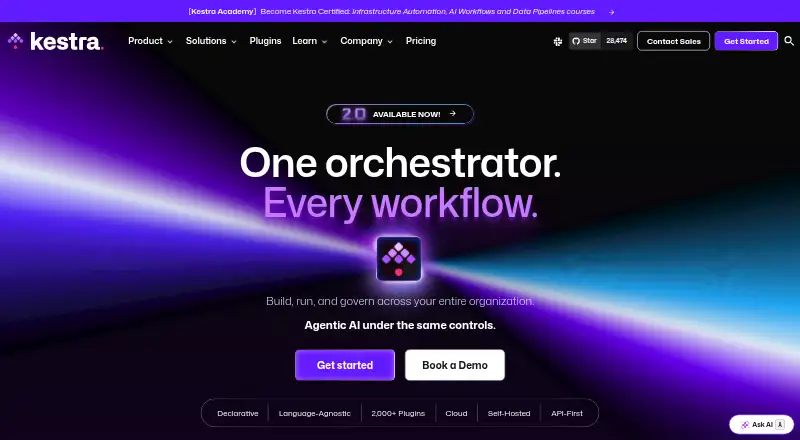
What Kestra is
Kestra is a declarative platform for creating, running, and governing workflows across an organization. Its workflows, called flows, are written in YAML and can combine tasks, dependencies, conditions, triggers, and runtime parameters. Execution controls include retries, failure policies, timeouts, concurrency limits, worker assignment, and log capture. Kestra advertises more than 2,000 plugins for connecting with external services and tools, including AWS, Azure, GitHub, Kafka, Kubernetes, Slack, and Snowflake. A flow can orchestrate SQL, Python, shell commands, APIs, Terraform, dbt, Spark, and custom tools. The platform also includes an MCP server for AI agents and allows flows to be exposed as tools for agents to call. Teams can self-host with Docker or Kubernetes; Enterprise Edition also supports cloud, on-premises, and air-gapped deployments. Kestra provides setup instructions for macOS, Windows, and Linux, and its listed platforms include web and API access. The Open Source plan has no price listed, and Kestra Cloud advertises a trial of up to two months while a team gets set up.
Good
- Flows support triggers, conditions, and runtime parameters.
- Execution controls include retries and timeouts.
- Advertises more than 2,000 plugins.
- Can orchestrate SQL, Python, shell, APIs, and more.
- Supports self-hosting and air-gapped enterprise deployment.
Watch out
- Open Source plan price is not listed.
- Enterprise features such as SSO are specific to Enterprise Edition.
- Cloud trial is limited to up to two months.
Who it suits
Kestra suits organizations building workflows that combine tasks and tools across different systems or programming languages. Its self-hosted and enterprise deployment options may appeal to teams with specific infrastructure or access-control needs.
Verdict
Kestra offers YAML-defined workflows with execution controls, broad plugin connectivity, and flexible deployment choices. The free plan and cloud trial provide entry points, while several access-control and support features are tied to Enterprise Edition.
Plans and prices
From Kestra's own pricing page, checked 19 Oct 2026.
| Plan | Price | What it gives you |
|---|---|---|
| Open Source | Free | Declarative workflows · 2,300+ plugins · event-driven scheduling · any-language business logic · code/no-code editors · MCP server · PostgreSQL/MySQL queues · unlimited flows and executions |
| Enterprise Edition | Priced on request | Unlimited flows/tasks/executions · SSO/LDAP/SCIM · RBAC · audit logs · multi-tenancy · worker groups · task runners · secrets manager · enterprise plugins · AI Copilot · SLA support · cloud/on-prem/air-gapped deployment · Annual subscription, per instance |
| Kestra Cloud | Priced on request | Managed hosting, upgrades and monitoring · automatic scaling · built-in security/governance · enterprise plugins · guided onboarding · SOC2 compliant · Usage-based; request access |
The facts
Each one read from Kestra's own pages, with the date it was checked.
What it does
- Adoption claim
- Kestra's Series A announcement says more than 30,000 organizations used the platform and more than 2 billion workflows were executed in 2025.checked 19 Oct 2026
- AI capabilities
- Kestra 2.0 adds AI Copilot, AI agents, RAG workflows, MCP server support and MCP tool triggers.checked 19 Oct 2026
- AI workflows
- The platform includes an MCP server for AI agents and supports exposing flows as tools for agents to call.checked 30 Sep 2026
- API authentication
- API requests can use bearer tokens created for users or service accounts, with token secrets stored only as salted SHA-512 hashes.checked 19 Oct 2026
- API-first design
- Workflow creation, execution, inspection and administration are available through HTTP APIs, with Terraform integration and CLI management through kestractl.checked 19 Oct 2026
- Cloud deployment differences
- Kestra Cloud is managed on PostgreSQL JDBC with managed worker pools, while Enterprise permits multiple queue backends, private networking and customizable storage.checked 19 Oct 2026
- Declarative workflows
- Workflows are defined in YAML with tasks, dependencies, conditions, triggers and runtime parameters.checked 19 Oct 2026
- Deployment
- Kestra can be self-hosted with Docker or Kubernetes, and Enterprise Edition also supports cloud, on-premises and air-gapped environments.checked 30 Sep 2026
- Deployment model
- hybridchecked 20 Sep 2026
- Docker support
- Official images support linux/amd64 and linux/arm64 and are based on Eclipse Temurin 21 JRE.checked 19 Oct 2026
- Documentation depth
- The documentation includes installation guides, configuration references, security hardening, migration guides, release notes and an API reference.checked 19 Oct 2026
- Enterprise access controls
- Enterprise features include SSO, audit logs, secret manager integration, end-to-end encryption, SCIM sync, multi-tenancy and role-based access control.checked 30 Sep 2026
- Enterprise governance
- Enterprise adds SSO, LDAP, SCIM, RBAC, policies, promotion workflows, audit logs, cases, multi-tenancy and storage isolation.checked 19 Oct 2026
- Examples
- The integrations page lists tools including Airbyte, AWS, Azure, BigQuery, dbt, Docker, GitHub, Kafka, Kubernetes, Slack, Snowflake and Terraform.checked 30 Sep 2026
- Execution controls
- The platform provides retries, failure policies, timeouts, concurrency limits, worker assignment, log capture and conditional error handling.checked 19 Oct 2026
- Funding
- Kestra announced an $8 million seed round on September 23, 2024, led by Alven with ISAI and Axeleo.checked 19 Oct 2026
- Funding: Series A
- Kestra announced a $25 million Series A on March 31, 2026 led by RTP Global, bringing stated total funding to $36 million.checked 19 Oct 2026
- Integrations
- The plugin catalog covers databases, warehouses, queues, cloud services, CI/CD and security tools, with more than 2,200 plugins advertised on the features page.checked 19 Oct 2026
- Languages
- Kestra can orchestrate SQL, Python, shell, APIs, Terraform, dbt, Spark and custom tools in the same workflows.checked 30 Sep 2026
Money
- Cloud trial
- Kestra Cloud advertises up to two months free with full access while a team gets set up.checked 30 Sep 2026
- Free plan
- Yeschecked 20 Sep 2026
The company
- Company founded
- LinkedIn lists Kestra as founded in 2022.checked 19 Oct 2026
- Company legal name
- Crunchbase lists the legal name as Kestra Technologies and founders Emmanuel Darras and Ludovic Dehon.checked 19 Oct 2026
- Company size and headquarters
- LinkedIn lists 51–200 employees and New York headquarters, with an additional Paris location.checked 19 Oct 2026
The full review of Kestra
Overview
Kestra is a workflow orchestration platform for teams coordinating jobs and services across an organization. It is best suited to technical teams comfortable defining workflows in YAML, particularly those working across multiple tools and runtimes. Its strongest case is the combination of execution controls and broad connectivity; teams that need enterprise access governance should weigh the Enterprise Edition requirements.
Key features
Define and control workflows
Flows use YAML to describe tasks, dependencies, conditions, triggers and runtime parameters. That gives technical teams a structured way to express workflow logic, though it is less suited to organizations that want workflow creation to rely only on a visual interface. A visual builder is also available.
Retries, failure policies, timeouts, concurrency limits, worker assignment and log capture provide meaningful control over how executions run and fail. Event triggers, execution observability and human approvals add ways to react to events and manage work. These features make Kestra relevant for workflows that need more than a simple sequence of scheduled tasks.
Connect tools, languages and AI agents
Kestra advertises more than 2,000 plugins, with integrations spanning tools such as AWS, Azure, BigQuery, dbt, Docker, GitHub, Kafka, Kubernetes, Slack, Snowflake and Terraform. It can coordinate SQL, Python, shell, APIs, Terraform, dbt, Spark and custom tools in the same workflows. That breadth is useful when an organization wants to coordinate work across existing systems rather than keep each process inside one runtime.
An MCP server lets AI agents call flows exposed as tools. This creates an option for teams building agent workflows, alongside Kestra's broader orchestration capabilities.
Deployment and security
Teams can self-host Kestra with Docker or Kubernetes. Kestra Cloud is the managed option, while Enterprise Edition adds cloud, on-premises and air-gapped deployments. The choice is valuable for organizations with varied infrastructure needs, but security and governance capabilities are not uniform across editions: SSO, audit logs, secret manager integration, end-to-end encryption, SCIM sync, multi-tenancy and role-based access control are Enterprise features.
Kestra Cloud advertises SOC 2 Type 1 and Type 2 and GDPR status through its Trust Center. Enterprise Edition also includes a customer success program and support with an SLA.
Pricing
Kestra identifies its pricing model as free and offers a free plan, but the plan names and included features matter more than that label alone. The Open Source plan has no listed price and includes declarative workflows, 1,200+ plugins, event-driven scheduling, and unlimited flows and executions. It is the clearest fit for teams seeking an open-source route without stated flow or execution caps.
Enterprise Edition has custom pricing. It adds LDAP, SCIM, custom RBAC, SSO, audit logs, multiple tenants, worker groups and task runners, with deployment options including cloud, on-premises and air-gapped environments. It is aimed at organizations that need centralized access controls, governance or a restricted deployment environment; those requirements come with a custom-priced plan.
Kestra Cloud is also custom pricing, with fully managed hosting, automatic scaling, built-in security and governance, SOC 2 compliance and a pay-as-you-scale model. Teams can get up to two months free with full access while they set up. That trial offers a way to evaluate the managed service, but no ongoing price or seat terms are stated.
Platforms
Kestra supports API, Linux, macOS, self-hosted, web and Windows. Setup instructions cover macOS, Windows and Linux, and Docker or Kubernetes can be used for self-hosting. Its hybrid deployment model gives teams a choice between self-managed infrastructure and managed cloud, with the broader on-premises and air-gapped options reserved for Enterprise Edition.
Who it's for
Kestra is a strong fit for engineering and data teams that need to coordinate workflows spanning different languages, services and infrastructure. Its YAML definitions and execution controls suit teams that want explicit workflow logic and operational control; its plugin catalog helps when processes cross many external tools. Enterprise Edition is the relevant option for organizations that require SSO, audit trails, multi-tenancy or air-gapped deployment.
It is less compelling for buyers who need a published cloud price before evaluation, or for teams that do not want to manage YAML-based workflows. The Open Source plan's unlimited flows and executions are notable, but Enterprise governance capabilities are not part of that plan.
Pros and cons
- Pro: YAML flows support dependencies, conditions, triggers and runtime parameters, giving technical teams precise control over workflow logic.
- Pro: Retries, failure policies, timeouts, concurrency limits, worker assignment and logs address practical execution-management needs.
- Pro: More than 2,000 plugins and support for multiple languages help connect workflows across diverse tools and runtimes.
- Pro: Open Source includes unlimited flows and executions, while the deployment choices extend from self-hosting to managed cloud.
- Con: Enterprise access controls, audit logs and support with an SLA require the custom-priced Enterprise Edition.
- Con: Kestra Cloud pricing is custom, so buyers cannot compare its recurring cost from a published price.
Alternatives
Consider Bonita if its free plan's 150 process instances per month and no-time-limit terms better match a bounded process workload.
Camunda is another workflow option with a free self-managed development plan for local development and testing; consider it when that stated development use is the priority.
Temporal may suit buyers who prefer a usage-based pay-as-you-go plan: its listed price is $50 a month, with no base monthly fee and usage-based billing.
Choose Apache Airflow if a free, Apache-licensed option is the main requirement; its plan is listed as free.
Windmill is worth comparing when its free plan's stated workspace, user and storage allowances fit the team.
Inngest may work better for teams whose needs fit its Free plan, which includes 5 seats, 50k executions, 500k ingested events and 24-hour trace history.
Prefect is a relevant alternative when a free plan with 2 users, 1 workspace, 5 deployments and 500 minutes per month of Prefect Serverless fits the workload.
AWS Step Functions is an option for buyers comparing a free tier that does not expire after the 12-month AWS Free Tier term and is available indefinitely to new and existing AWS customers.
Compare workflow orchestration products in Workflow Orchestration Software, Workload Automation Software and IT Orchestration Software. Data and integration teams can also browse DataOps Platforms and Integration Platform as a Service Software.
Verdict
Kestra is a strong choice for technical teams that need controlled workflows across many tools and languages, especially when unlimited flows and executions in the Open Source plan are a priority. Its main appeal is the combination of flexible orchestration and deployment choice. Look elsewhere if published cloud pricing is essential or if your organization needs enterprise access controls without moving to custom-priced Enterprise Edition.
Getting started
- Visit https://kestra.io/.
- Choose a setup route for macOS, Windows or Linux, or use the web or API platform.
- For self-hosting, deploy with Docker or Kubernetes.
- Start with the free plan, or use the Kestra Cloud trial of up to two months.
Questions
Is Kestra free?
Yes. Kestra offers a free plan. The Open Source plan includes declarative workflows, 1,200+ plugins, event-driven scheduling, and unlimited flows and executions.
Is there a free trial?
Kestra Cloud advertises up to two months free with full access while a team gets set up.
Where can Kestra run?
Platforms include API, Linux, macOS, self-hosted, web and Windows. Self-hosting is supported with Docker or Kubernetes; Enterprise Edition also supports cloud, on-premises and air-gapped environments.
Is Kestra open source?
The maker identifies the platform as released under the Apache 2.0 license.
What integrations does Kestra offer?
Kestra advertises more than 2,000 plugins. Examples include AWS, Azure, BigQuery, Docker, GitHub, Kafka, Kubernetes, Slack, Snowflake and Terraform.
What does Enterprise Edition add?
Enterprise features include SSO, audit logs, secret manager integration, end-to-end encryption, SCIM sync, multi-tenancy and role-based access control. Enterprise Edition also includes customer success and enterprise support with an SLA.
Alternatives to Kestra
- 1

Make
Free planAndroidiOSWebAPI8.9From $9 a month - 2

Azure Logic Apps
Free planWebAPILinuxmacOS8.7Free plan - 3

Informatica Intelligent Data Management Cloud
Free planWebAPIExtensionLinux8.6From £26,550 a year - 4
Workato Agent Studio
Free planiOSWebAPILinux8.6Free plan - 5

Nango
Free planOpen sourceWebAPISelf-hosted8.4Free plan - 6

Zapier
Free planWeb8.3From $19.99 a month