
Apache Hop
Apache Hop is a free, open-source platform for building data integration pipelines and orchestration workflows.
What Apache Hop is
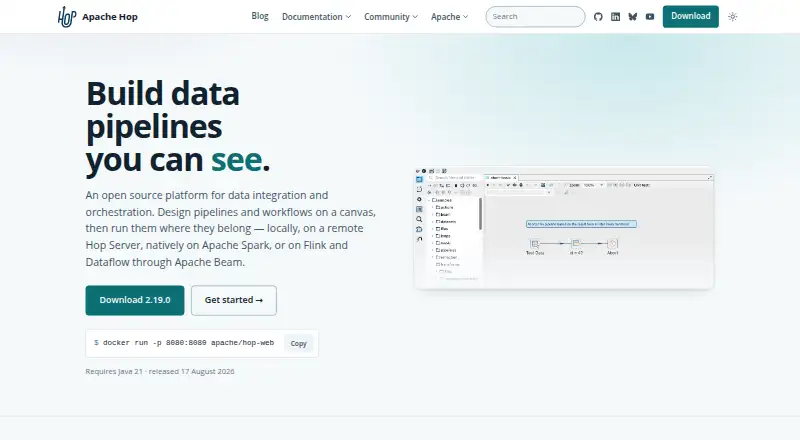
Apache Hop is a free, open-source platform for building data integration pipelines and orchestration workflows. Users create pipelines on a canvas, preview rows at each step, and view live data and metrics during execution. The same pipeline can run locally, on Hop Server, Apache Spark, or Flink and Dataflow through Apache Beam. Hop includes more than 250 pipeline transforms, over 80 workflow actions, and support for more than 40 database dialects. Listed integrations include PostgreSQL, MySQL, Oracle, SQL Server, Snowflake, BigQuery, Kafka, Salesforce, SAP, S3, REST, and SFTP. Projects can switch environments between development and production, while credentials can be kept out of pipelines. Hop runs on Windows, Linux, and macOS; Hop Web supports modern browsers. Version 2.19.0 requires Java 21. Docker images and a Kubernetes Helm chart are available, but Hop Web is work in progress and provided as-is. The project warns that operations may alter data in connected infrastructure, so appropriate permissions and restrictions matter.
Good
- Free under the Apache License 2.0.
- Visual pipelines include row previews and live metrics.
- Run pipelines locally, on Spark, or through Beam.
- Includes 250+ transforms and 80+ workflow actions.
- Credentials can be kept out of pipelines.
Watch out
- Version 2.19.0 requires Java 21.
- Hop Web is work in progress and provided as-is.
- Operations can alter or delete connected data.
- Community support cannot promise response times.
Who it suits
Hop suits data teams that want visual pipeline design and workflow orchestration across varied databases and execution environments. It is appropriate for users able to manage Java 21 for version 2.19.0 and carefully restrict destructive operations.
Verdict
Apache Hop combines visual data workflows with a broad set of transforms, actions, and execution options at no charge. Check the Java requirement and take care with permissions before running operations against production data.
Plans and prices
From Apache Hop's own pricing page, checked 15 Oct 2026.
| Plan | Price | What it gives you |
|---|---|---|
| Apache Hop | Free | open-source platform · desktop and web interfaces · optional plugins and commercial support available separately |
The facts
Each one read from Apache Hop's own pages, with the date it was checked.
What it does
- Built-in scale
- The homepage states that the distribution includes more than 250 pipeline transforms, 80 workflow actions and 40 database dialects.checked 15 Oct 2026
- Cloud runtimes
- Run configurations include Databricks, native Spark, Beam Spark, Beam Flink and Google Dataflow options.checked 15 Oct 2026
- Commercial listing
- The Apache Hop project says its commercial-support listing is informational and that it does not endorse, rank, or vet the listed companies.checked 29 Sep 2026
- Commercial support
- The commercial-support directory lists Avizing, know.bi and Yupiik, while stating that Apache does not endorse or vet them.checked 15 Oct 2026
- Configuration
- Projects can be moved between development and production by switching environments, and credentials can be kept out of pipelines.checked 29 Sep 2026
- Deployment
- The download page provides Docker images for Hop and Hop Web and a Helm chart for Kubernetes; Hop Web is described as work in progress and provided as-is.checked 29 Sep 2026
- Download
- The Apache archive lists source code and a 333 MB apache-hop-client-2.19.0.zip released on 17 August 2026.checked 15 Oct 2026
- Execution
- The same pipeline can run locally, on Hop Server, on Apache Spark, or on Flink and Dataflow through Apache Beam.checked 29 Sep 2026
- Included components
- The platform includes 250+ pipeline transforms, 80+ workflow actions, and 40+ database dialects.checked 29 Sep 2026
- Independent documentation criticism
- A 2025/2026 academic project report said limited official documentation can make developing plugins from scratch challenging.checked 15 Oct 2026
- Independent usage description
- An OpenSchoolMaps training document describes Hop GUI, Hop Run CLI and Hop Server REST execution as the three primary clients.checked 15 Oct 2026
- Integrations
- Listed integrations include PostgreSQL, MySQL, Oracle, SQL Server, Snowflake, BigQuery, Redshift, Databricks, MongoDB, Neo4j, Kafka, Cassandra, Salesforce, SAP, Parquet, Avro, S3, Azure Blob, Google Cloud Storage, REST and SFTP.checked 15 Oct 2026
- Java requirement
- Current Hop 2.19.0 documentation requires a 64-bit Java 21 runtime.checked 15 Oct 2026
- Java SDK
- A documented Hop SDK provides Java initialization APIs and supports loading plugins from configured folders.checked 15 Oct 2026
- Licence
- Apache Hop is released under the Apache License 2.0.checked 15 Oct 2026
- License
- The project says Hop is developed in the open under the Apache License 2.0.checked 29 Sep 2026
- Limit: CDC
- The CDC guide says Hop has no single CDC transform and no built-in Debezium or GoldenGate connector; users must choose among log, watermark or snapshot approaches.checked 15 Oct 2026
- Limit: connector parsing
- A Reddit commenter reported BigQuery connector problems parsing queries containing a LIMIT clause and difficulty scaling component-based designs.checked 15 Oct 2026
- Limit: maturity issues
- An independent migration article listed GUI path-reset problems, repeated GitHub credential prompts, Hop Server ID and metrics issues, and inability to copy transforms in Hop Web.checked 15 Oct 2026
- Limit: native Spark
- Native Spark does not support sorted Group By, Beam-only I/O, barriers, result-row hops, Kafka consumer or streaming windows.checked 15 Oct 2026
- Limit: scheduler
- A Reddit user reported that Hop has no built-in scheduler, requiring Cronicle, cron or another external scheduler for scheduling jobs.checked 15 Oct 2026
- Marketplace
- Optional plugins can be installed from Apache or Maven repositories through a GUI, CLI or declarative hop-env.yaml file.checked 15 Oct 2026
- Metadata injection
- Metadata injection lets one template pipeline receive runtime metadata so it can process many files or tables.checked 15 Oct 2026
The company
- Maker legal status
- The Apache Software Foundation is a U.S. 501(c)(3) nonprofit incorporated in 1999.checked 15 Oct 2026
The full review of Apache Hop
Overview
Apache Hop is an open-source platform for designing visual data pipelines and workflows for integration and orchestration. It best suits teams that want to build and move data workflows across local and distributed execution environments. Its breadth is a strong fit for technical data work, but Java 21 is required for release 2.19.0 and operations need carefully scoped permissions.
Key features
Pipeline designers work on a canvas, can preview rows at each step, and can watch live data and metrics during execution. That combination makes it easier to inspect a workflow as it takes shape, while the catalog of more than 250 transforms, 80 workflow actions, and 40 database dialects gives teams substantial scope without requiring every operation to be custom-built.
A pipeline can run locally, on Hop Server, on Apache Spark, or on Flink and Dataflow through Apache Beam. This execution range is useful when one design needs to move between environments or target different engines; it also means teams should choose and operate their execution infrastructure deliberately.
Out-of-the-box connections include PostgreSQL, MySQL, Oracle, SQL Server, Snowflake, BigQuery, Kafka, Salesforce, SAP, S3, REST, and SFTP. Projects can switch environments when moving from development to production, and credentials can be kept out of pipeline definitions. Incremental loading, change data capture, and custom-code transforms are supported, complementing the visual workflow for more specialized data movement.
Hop is developed under the Apache License 2.0. Docker images are provided for Hop and Hop Web, along with a Helm chart for Kubernetes. Hop Web remains a work in progress and is provided as-is, so teams wanting a settled web interface should factor that caveat into deployment decisions. The project also advises upgrading to a version that contains a security fix rather than expecting individual binary patches for vulnerabilities.
Pricing
Apache Hop is free: the Apache Hop plan costs nothing and is an open-source platform under the Apache License 2.0. There are no paid tiers or usage caps described for the plan. The main entry requirement is technical rather than financial: release 2.19.0 requires Java 21.
Community support is free and volunteer-based, with no promised response times. Organizations needing service commitments, training, or migration help can look to commercial providers for those services. The project describes its commercial-support listing as informational and does not endorse, rank, or vet the companies on it.
Platforms
Apache Hop supports Linux, macOS, Windows, and self-hosted deployment. The manual specifies Windows 7 or higher, Linux on x86_64 or ARM, and macOS; Hop Web targets modern browsers. Java 21 is required for version 2.19.0, so compatibility with that runtime belongs in any deployment plan.
Who it's for
Hop is a strong choice for data teams that need visual pipeline design, broad database and service connectivity, and the option to run workflows across local, server, Spark, or Beam-based environments. Environment switching and separate credential handling also suit teams promoting projects from development into production.
It is less appropriate for teams seeking guaranteed response times from free support or a fully mature web experience. Its transforms and actions can make destructive changes to databases, file systems, and other infrastructure; production operators should use appropriate permissions and restrictions rather than treating a visual workflow as inherently safe.
Pros and cons
- Pros: A broad built-in toolkit—250+ transforms, 80+ actions, and 40+ database dialects—can cover varied integration and orchestration work without assembling every component separately.
- Pros: The same pipeline can target several execution options, while environment switching and credential separation help structure development-to-production use.
- Pros: The Apache License 2.0 makes the platform free to use, with no paid plan tier described.
- Cons: Release 2.19.0 requires Java 21, which adds a runtime requirement teams must accommodate.
- Cons: Hop Web is work in progress and provided as-is, making it a weaker fit where a finished browser-based experience is essential.
- Cons: Volunteer support carries no response-time promise, and destructive actions demand disciplined access controls.
Alternatives
For a broader comparison, see ETL Software and DataOps Platforms. Consider these alternatives when their specific operating model or limits fit better:
- Keboola may suit teams wanting a freemium web, API, or self-hosted option; its free plan grants 120 compute minutes in the first month, then 60 minutes per month, with additional compute at $0.14 per minute and one project.
- Skyvia is a freemium web, API, and Windows option; its free plan is capped at 10k records per month and two scheduled integrations, with once-a-day scheduling and 30-day schedule expiration.
- Apache Beam is worth considering when the priority is an open-source programming model rather than Hop's visual platform; execution costs depend on the runner and infrastructure selected.
- Apache Spark may fit teams seeking an open-source distributed data analytics engine, with download, PyPI, Maven Central, and Docker options.
- EasyMorph offers a freemium desktop option, but its free plan is restricted to 20 actions per project and 20 loop iterations per project.
- Qlik Talend Cloud is a paid SaaS option for managed cloud pipelines and SaaS-source or database replication.
- Apache NiFi is another free Apache-licensed option for teams comparing open-source data-flow software.
- Google Cloud Data Fusion is a paid cloud option with a Developer plan priced at $0.35 a month, billed at $0.35 per instance hour by the minute, for development and exploration workloads with two concurrent users.
Verdict
Choose Apache Hop if your team wants a free, open-source visual platform with a wide set of data transforms, workflow actions, integrations, and execution choices. Its breadth is the clearest reason to adopt it; Java 21, the work-in-progress status of Hop Web, and volunteer-only community support are the clearest reasons to look elsewhere.
Alternatives to Apache Hop
- 1
EasyMorph
Free planWebAPISelf-hostedWindows7.7From $600 a year - 2
Oracle WebCenter Content
AndroidiOSWebAPI7.7$3,450 one-time - 3

Coalesce Catalog
Free planWebAPIExtension7.5From $150 a month - 4

dbt Semantic Layer
Free planWebAPIExtension7.5From $100 a month - 5

Soda
Free planWebAPILinuxSelf-hosted7.5From $750 a month - 6

AWS Glue DataBrew
WebAPI7.2