
Coalesce Catalog
Coalesce Catalog is a cloud data-catalog service for data engineers, analysts, and organizations that want shared data understanding.
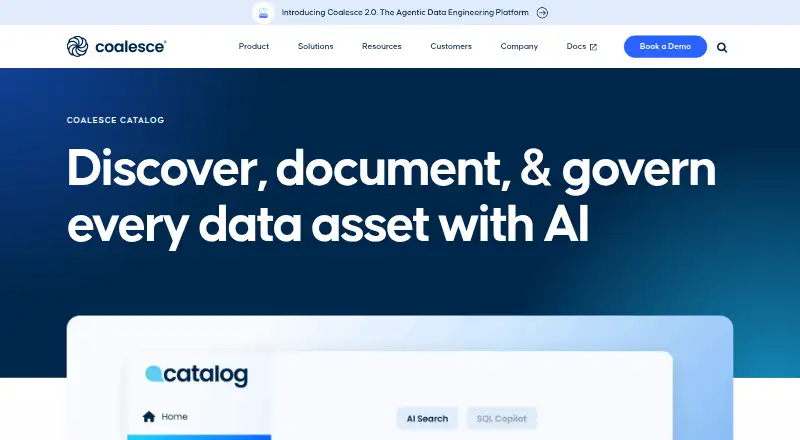
What Coalesce Catalog is
Coalesce Catalog is a cloud data-catalog service for data engineers, analysts, and organizations that want shared data understanding. It connects to warehouses, databases, business-intelligence tools, and services across a data stack. AI-assisted, natural-language search covers domains, dashboards, tables, and columns. Catalog maps end-to-end lineage at column level from source systems through BI tools, supporting impact analysis, pipeline lineage, and report lineage. Its metadata-based semantic layer enables collaborative cataloging and automated documentation; Coalesce says connected tools can help document up to 90% of a database in seconds. Governance capabilities include data-access monitoring, sensitive-data classification, modular role controls, and audit trails. Integrations include Snowflake, Databricks, BigQuery, Redshift, PostgreSQL, SQL Server, Salesforce, Tableau, Power BI, Looker, Sigma, Qlik Sense, Metabase, Airflow, dbt, Fivetran, Monte Carlo, Soda, Slack, Gmail, Okta, and Google SSO. The Public API reads and updates metadata such as tables, columns, dashboards, lineage, and quality tests. Coalesce says data is not stored at rest, data in motion is encrypted, and production refreshes run inside the customer’s data platform.
Good
- AI natural-language search across domains, dashboards, tables, and columns
- Column-level lineage from sources to BI tools
- Metadata-powered semantic layer and automated documentation
- Sensitive-data classification and role-based governance controls
- Public API supports metadata read and write scopes
- Production refreshes run within the customer’s data platform
Watch out
- Developer plan is limited to one user
- Developer plan allows 2,000 capped monthly actions
- Developer plan includes one project and one environment
- Starter costs $150 a month billed annually
Who it suits
Coalesce Catalog suits data engineers and analysts who need searchable documentation, lineage, and governance across connected data systems. Its organization-wide design is intended for people to use without training, while the integrations and API support teams managing varied platforms.
Verdict
Choose Coalesce Catalog if your team needs one place for discovery, column-level lineage, documentation, and governance across many data tools. Look elsewhere if the Developer limits do not fit or if you need more than one user, project, or environment without moving to a paid plan.
Plans and prices
From Coalesce Catalog's own pricing page, checked 15 Oct 2026.
| Plan | Price | What it gives you |
|---|---|---|
| Developer | Free | 1 user · Transform and Quality · 2,000 monthly actions · 1 project · 1 environment |
| Starter | $150 a month | Up to 4 Transform users · 15,000 monthly actions · 3 Catalog integrations · Full Transform, Catalog and Quality · 1 project · 1 environment · 24x5 support · billed annually |
| Business Critical | Priced on request | Everything in Enterprise · Private Networks · BAA HIPAA-ready · Advanced security and compliance · Custom deployment requirements |
| Enterprise | Priced on request | 5+ Transform users · 100,000 monthly actions · 5 Catalog integrations · Unlimited projects and environments · Priority support and enhanced SLAs · SSO |
The facts
Each one read from Coalesce Catalog's own pages, with the date it was checked.
What it does
- AI-assisted discovery
- The product supports natural-language and AI-assisted search across domains, dashboards, tables and columns.checked 15 Oct 2026
- API authentication
- API access uses bearer tokens with administrator-selectable Read Only or Read & Write scope, and separate EU and US base URLs.checked 15 Oct 2026
- API tooling
- The documentation provides a GraphQL reference with Try it panels and the application includes an API playground with autocomplete.checked 15 Oct 2026
- Audience
- Coalesce Catalog is intended for data engineers and analysts and is designed for everyone in an organization to use without training.checked 1 Oct 2026
- Authentication
- Coalesce supports Snowflake OAuth with periodically rotating access tokens and describes it as the preferred authentication method.checked 1 Oct 2026
- Cloud and CLI deployment
- The security documentation describes a cloud deployment model and an on-premise coa CLI for running transformations on customer infrastructure.checked 15 Oct 2026
- Column lineage
- Catalog automatically maps lineage at column level from data sources through business-intelligence tools.checked 15 Oct 2026
- Data discovery
- Catalog searches domains, dashboards, tables, and columns with AI assistance and natural-language search.checked 1 Oct 2026
- Data handling
- For browser Snowflake queries, Coalesce says SQL results are not stored and only the first 100 rows are returned to the browser for display.checked 15 Oct 2026
- Documentation coverage
- Coalesce Catalog says it can document up to 90% of a database in seconds by propagating documentation from several tools.checked 1 Oct 2026
- Documentation depth
- The documentation site includes user guides, onboarding, integrations, administration, developer material, API references, support content and a changelog.checked 15 Oct 2026
- Extension coverage
- The extension currently covers Domo, Looker, Looker Studio, Metabase, Power BI, Sigma, Strategy, Tableau and Qlik; Snowflake and BigQuery are listed as coming soon.checked 15 Oct 2026
- Funding
- The company timeline says Coalesce raised $26 million in Series A funding in 2022 and $50 million in Series B funding in 2024.checked 15 Oct 2026
- G2 Catalog review volume
- The G2 seller page lists Coalesce Catalog (formerly CastorDoc) with 64 reviews.checked 15 Oct 2026
- Governance
- The product includes controls for data access, governance, ownership, definitions and audit-oriented management.checked 15 Oct 2026
- Integrations
- Catalog integrations include warehouses and databases such as Snowflake, Databricks, BigQuery, Redshift, PostgreSQL, SQL Server, and Salesforce; BI tools such as Tableau, Power BI, Looker, Sigma, Qlik Sense, and Metabase; Airflow, dbt, Fivetran, Monte Carlo, Soda, Slack, Gmail, Okta, and Google SSO.checked 1 Oct 2026
- Limit: chat workflow
- A Gartner Catalog reviewer says the product lacks an internal chat workflow, relying instead on integrations such as Slack and planned Teams support.checked 15 Oct 2026
Where it runs
- Browser extension
- The Catalog extension works with Chrome and Edge and exposes metadata such as descriptions, owners and popularity inside supported BI tools and SQL editors.checked 15 Oct 2026
The company
- Company founding
- LinkedIn lists Coalesce.io as founded in 2020.checked 15 Oct 2026
- Company headquarters
- LinkedIn lists Coalesce.io headquarters in San Francisco, California.checked 15 Oct 2026
- Company history
- Coalesce’s company timeline says it acquired CastorDoc and introduced Coalesce Catalog in 2025.checked 1 Oct 2026
- Company legal name
- The documentation copyright identifies the maker as Coalesce Automation, Inc.checked 15 Oct 2026
- Company size
- LinkedIn places Coalesce.io in the 51–200 employee size band.checked 15 Oct 2026
- Founded
- 2020checked 28 Sep 2026
The full review of Coalesce Catalog
Coalesce Catalog is a cloud metadata catalog that connects warehouses, BI systems, and data pipelines in one searchable workspace. It is best suited to data engineers, analysts, and organizations that want non-specialists to find and understand governed data without training. Its unusually broad lineage and governance scope is compelling, but the no-cost tier is primarily for evaluation or a single-user setup.
Overview
Catalog brings together discovery, documentation, lineage, semantic context, and governance across an existing data stack. AI-assisted natural-language search covers domains, dashboards, tables, and individual columns, so users can look for business concepts rather than remember system-specific names. Automated discovery and documentation are central to the product: Coalesce says context from connected tools can document as much as 90% of a database in seconds. That can reduce catalog-maintenance work, although the quality of the result will reflect the metadata available in those source systems.
The service runs in the cloud and is available through web and API access. Coalesce says it does not store customer data at rest, encrypts data in transit, and performs production refreshes inside the customer’s data platform. Snowflake OAuth uses periodically rotating access tokens and is described as the preferred authentication method.
Key features
Lineage is a major strength. Catalog maps dependencies end to end at column level from data sources through BI tools, with pipeline lineage, report lineage, and impact analysis included. This is more actionable than a simple table map when a column changes and a team needs to identify affected reports or downstream processes.
A metadata-powered semantic layer combines collaborative cataloging with automated documentation. Governance tools cover data-access monitoring and control, sensitive-data classification, modular role-based permissions, and detailed audit trails. Together, these features make Catalog useful for operational governance as well as search.
Integrations span Snowflake, Databricks, BigQuery, Redshift, PostgreSQL, SQL Server, and Salesforce; Tableau, Power BI, Looker, Sigma, Qlik Sense, and Metabase; plus Airflow, dbt, Fivetran, Monte Carlo, Soda, Slack, Gmail, Okta, and Google SSO. Supported platforms also include Snowflake, Databricks SQL, Microsoft Fabric, Google BigQuery, and Amazon Redshift in private preview. The Catalog Public API can read and update metadata for tables, columns, dashboards, lineage, and quality tests, with bearer-token Read Only or Read & Write scopes.
Pricing
The Developer plan is free and includes one user, Transform and Quality, 2,000 capped monthly actions, one project, and one environment. It is useful for an individual evaluation, but the single-seat and single-project limits prevent it from serving as a shared catalog.
Starter costs $150 a month, billed annually. It supports up to four Transform users, 15,000 actions per month, three Catalog integrations, one project, one environment, and full Transform, Catalog, and Quality access. Onboarding workshops and 24x5 support make it the practical entry point for a small team, though the project, environment, and integration caps remain restrictive for a growing stack. A 30-day trial provides time to assess those limits.
Enterprise uses custom pricing and raises capacity to five or more Transform users, 100,000 monthly actions, five Catalog integrations, unlimited projects and environments, full product access, priority support, enhanced SLAs, and SSO. Business Critical adds private networks, a BAA suitable for HIPAA-ready deployments, advanced security and compliance, and custom deployment requirements. These tiers are intended for organizations with broader governance, security, or deployment obligations rather than casual catalog use.
Platforms
Coalesce Catalog is delivered as a cloud service through web and API interfaces. Its connectors reach the major warehouse, database, BI, orchestration, quality, collaboration, and identity systems named above, while several warehouse targets are in private preview.
Who it's for
Choose Catalog when data engineers and analysts need shared discovery, column-level dependency mapping, and governed definitions across many tools, with the wider organization able to consume the catalog without formal training. It is less suitable for a solo user who needs only lightweight documentation, or for a team that cannot fit its projects, environments, integrations, or action volume into the paid tiers.
Pros and cons
Pros
- Column-level, pipeline, and report lineage plus impact analysis gives change-management context beyond basic table relationships.
- Natural-language search and propagated documentation address both technical and business-user discovery.
- Broad integrations and a read/write metadata API support an established, multi-tool stack.
- Access controls, classification, monitoring, and audit trails provide a governance foundation.
- Enterprise and Business Critical add SSO, stronger support commitments, private networking, and compliance features.
Cons
- Developer is limited to one user, one project, one environment, and 2,000 monthly actions, so collaboration requires a paid plan.
- Starter still allows only one project and environment and three integrations, which can constrain a heterogeneous stack.
- Enterprise and Business Critical require custom pricing, making larger deployments harder to budget from the published plans.
- Documentation coverage depends on metadata propagated from connected systems, so automation does not remove the need for review.
Alternatives
Data Lineage Tools is the broader category to compare when lineage depth, deployment model, or vendor coverage matters more than Catalog’s integrated catalog and governance approach. Data Transformation Tools is the relevant list when transformation workflows are the primary requirement.
Atlas suits teams seeking an open-core database tool with a free plan and self-hosted or desktop platform options. Grai is a fully open-source, self-hosted alternative for organizations that want control of their data and hosting environment. OpenDataDiscovery Platform is a free, open-source platform available for self-hosted deployments. Databricks Notebooks fits users whose priority is notebook work in Databricks, with a free edition limited to one serverless workspace and constrained compute. Apache Atlas is free open metadata-governance software without stated paid plans or usage limits. Collate offers a freemium catalog with self-hosted options and an open-source OpenMetadata core. Amazon DataZone is a pay-as-you-go AWS service with usage-based charges and a free allowance. Egeria is a free option for teams evaluating an open metadata framework across self-hosted and web platforms.
Verdict
Coalesce Catalog is a strong choice for organizations that need one governed view of data discovery, definitions, and column-level lineage across a diverse stack. Its main reason to choose is the combination of automated documentation, detailed dependency analysis, and governance controls. Look elsewhere if Developer’s single-user limits are too tight, if your team needs several projects or environments before committing to a custom-priced tier, or if self-hosting and open-source control are more important than an integrated cloud service.
Getting started
- Open the Coalesce Catalog website
- Choose the free Developer plan or start the 30-day trial
- Connect supported warehouses, databases, BI tools, or services
- Use Snowflake OAuth
- Search catalog assets and configure metadata access through the Public API
Limits worth knowing
The free Developer plan includes one user, one project, one environment, and 2,000 capped monthly actions. Starter includes up to four Transform users, 15,000 actions per month, three Catalog integrations, one project, and one environment.
Questions
Is there a free plan?
Yes. The Developer plan is free and includes one user, one project, one environment, and 2,000 capped monthly actions.
How much does Starter cost?
Starter costs $150 a month when billed annually.
Does Coalesce offer a trial?
Yes. A 30-day trial is listed.
Which platforms does Catalog support?
Catalog is available through API and web. Coalesce also lists Snowflake, Databricks SQL, Microsoft Fabric, Google BigQuery, and Amazon Redshift in private preview.
Can the API change metadata?
Yes. The Public API reads and updates metadata, with Read Only or Read & Write bearer-token scopes.
What does Enterprise add?
Enterprise includes five or more Transform users, 100,000 monthly actions, five Catalog integrations, unlimited projects and environments, SSO, and priority support with enhanced service-level agreements.
Alternatives to Coalesce Catalog
- 1

Atlas
Free planOpen sourceWebAPILinuxmacOS8.3From $39 a month - 2
Microsoft Defender for Business
AndroidiOSAPImacOS7.5 - 3

Apache Atlas
Free planOpen sourceWebAPILinuxSelf-hosted7.2Free plan - 47.0From $1.15 a month
- 5

Dataedo
WebExtensionSelf-hostedWindows6.5From $18,000 a year - 6
OpenDataDiscovery Platform
Free planWebAPILinuxSelf-hosted6.5Free plan