
Apache Atlas
Apache Atlas is open-source server software for managing and governing metadata about data assets.
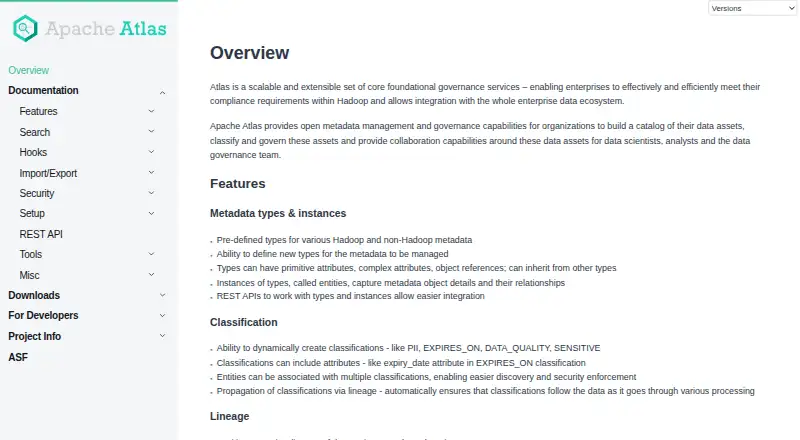
What Apache Atlas is
Apache Atlas is open-source server software for managing and governing metadata about data assets. It provides predefined metadata types and lets teams define their own types, entities, and relationships. Users can create classifications, attach them to multiple entities, and propagate them along data lineage. The interface displays lineage, while REST endpoints allow teams to access and update it. Search covers metadata types, classifications, attribute values, and free text, including a SQL-like query language. Fine-grained access controls apply to metadata entities and classification operations. Integration with Apache Ranger can use classifications for authorization and data masking. The architecture documentation names Hive, HBase, Sqoop, Storm, and Kafka as integrations. Atlas is installed in a self-hosted environment and can be built and packaged for deployment with HBase and Solr. It is listed for Linux, web, and API use. The software is free, with no paid plans or usage limits stated. Release artifacts are distributed through mirrors, with GPG signature or SHA checksum verification recommended.
Good
- Defines custom metadata types, entities, and relationships
- Propagates classifications through data lineage
- Searches by type, classification, attributes, or free text
- Fine-grained controls cover entities and classification operations
Watch out
- Deployment involves an environment with HBase and Solr
- Designed as server software for installation in a self-hosted environment
Who it suits
Atlas suits teams that need to catalog, classify, search, and govern metadata across data assets. It may also suit organizations seeking lineage access through a UI and REST APIs.
Verdict
Apache Atlas offers free metadata governance with classification, lineage, search, and access controls. Its server deployment and HBase and Solr environment requirements are important considerations for teams evaluating it.
Plans and prices
From Apache Atlas's own pricing page, checked 7 Oct 2026.
| Plan | Price | What it gives you |
|---|---|---|
| Apache Atlas | Free | Open metadata governance software · no paid plans or usage limits stated |
The facts
Each one read from Apache Atlas's own pages, with the date it was checked.
What it does
- API surface
- The published API includes discovery, entity, glossary, lineage, notification, relationship and type REST services.checked 14 Oct 2026
- Authentication
- Supported authentication methods include file credentials, Kerberos, LDAP or Active Directory, Keycloak OpenID Connect/OAuth2 and PAM.checked 14 Oct 2026
- Build requirements
- The project documents builds with Java 8, Java 11 or Java 17 and recommends 2 GB minimum and maximum Maven heap settings.checked 14 Oct 2026
- Classification
- Classifications such as PII, expiry and data quality can be created dynamically, attached to entities and propagated through lineage.checked 14 Oct 2026
- Community support
- The project lists user and developer mailing lists for community discussion.checked 7 Oct 2026
- Deployment
- The repository provides Docker build instructions and produces server, source and multiple hook distribution archives.checked 14 Oct 2026
- Documentation
- Official documentation covers architecture, type system, search, glossary, security, authentication, authorization, notifications, bridges and high availability.checked 14 Oct 2026
- Download integrity
- The downloads page says release artifacts are distributed through mirrors and recommends verifying them with GPG signatures or SHA checksums.checked 7 Oct 2026
- High availability
- For redundant Kafka notifications, Atlas recommends at least two brokers and topic replication of at least two.checked 14 Oct 2026
- Hive integration
- The Hive hook listens for create, update and delete operations and sends metadata changes through Kafka notifications.checked 14 Oct 2026
- Hive lineage
- The Hive bridge captures column-level lineage for simple, expression and script transformations, subject to a Hive 1.2.1 patch.checked 14 Oct 2026
- Import utilities
- An import-hive.sh command can initialize Atlas from selected tables, databases or all Hive databases and tables.checked 14 Oct 2026
- Integrations
- Documented metadata sources include Hive, Sqoop, Falcon, Storm and HBase.checked 14 Oct 2026
- Kafka extensibility
- Kafka-based messaging lets applications publish metadata to Atlas and consume metadata-change events.checked 14 Oct 2026
- Known limitation
- If HBase region servers hosting the Atlas table are unavailable, Atlas cannot store or retrieve metadata until they return.checked 14 Oct 2026
- Latest release
- Apache Atlas 2.5.0 was released on 2026-04-30.checked 14 Oct 2026
- Licence
- Apache Atlas is distributed under the Apache License 2.0.checked 14 Oct 2026
- Limit: implementation effort
- G2 reviewers repeatedly describe initial setup as resource-intensive and the learning curve as a barrier to using the full product.checked 14 Oct 2026
- Lineage
- Atlas provides a web lineage view and REST operations for reading and updating lineage.checked 14 Oct 2026
The company
- Founded
- 2015checked 28 Sep 2026
- Maker founded
- The Apache Software Foundation lists 1999 as its founding year.checked 14 Oct 2026
- Maker headquarters
- The Apache Software Foundation lists Wilmington, Delaware as its headquarters.checked 14 Oct 2026
- Maker legal name
- The Apache Software Foundation is a nonprofit software-development organization.checked 14 Oct 2026
- Maker size
- LinkedIn lists the foundation's company size as 5,001–10,000 employees.checked 14 Oct 2026
The full review of Apache Atlas
Apache Atlas is an open-source metadata governance platform for organizations that need to catalog and govern data assets. It is best suited to teams ready to deploy and operate their own data infrastructure. Its strongest case is the combination of a flexible metadata model, lineage, discovery, and fine-grained controls; the trade-off is operational responsibility.
Overview
Atlas provides predefined metadata types and lets teams create their own types, entities, and relationships. That flexibility can accommodate varied data environments, but it also puts the work of defining a useful catalog model on the organization. Automated discovery, column-level lineage, and pipeline lineage support teams that need more than a static inventory.
Classifications can be applied to multiple entities and propagated through data lineage, connecting governance labels with the relationships among assets. Search spans metadata type, classification, attribute value, and free text, with a SQL-like DSL for more structured queries. The result is a tool suited to teams that want cataloging, governance, and discovery in one system.
Key features
Lineage and discovery
The interface displays lineage, and REST endpoints let applications retrieve and update it. REST APIs also cover metadata types, entities, and discovery. This makes Atlas relevant both to people tracing data relationships and to engineering teams integrating metadata operations into their systems.
Classification and access controls
Fine-grained controls apply to metadata entities and classification operations. Integration with Apache Ranger can use Atlas classifications for authorization and data masking, an advantage for organizations already working with that ecosystem. Authentication support includes SSL, service authentication, and SPNEGO-based HTTP authentication, with Kerberos options.
Integration and deployment
Documented integrations include Hive, HBase, Sqoop, Storm, and Kafka. Atlas is installed as server software and can be built and packaged for deployment in an environment with HBase and Solr. That gives infrastructure teams control over deployment, but makes operating the supporting environment part of adopting Atlas rather than an optional concern.
Pricing
Apache Atlas is free open-source software. The Apache Atlas plan costs nothing and is described as open metadata governance software, with no paid plans or usage limits stated. There is no paid tier to unlock additional capabilities; teams should weigh the license cost against the work of deploying and maintaining the server environment.
Platforms
Atlas supports API, Linux, self-hosted, and web platforms. It is a server deployment rather than a hosted service, so it fits organizations able to manage the runtime environment. The project recommends verifying release downloads with GPG signatures or SHA checksums. User and developer mailing lists provide channels for community discussion.
Who it's for
Atlas is a strong fit for data and platform teams that need a customizable metadata model, lineage-aware classifications, and programmatic access to catalog operations. It is particularly relevant where Hive, HBase, Sqoop, Storm, or Kafka integrations and Apache Ranger-based controls matter. Organizations seeking a managed service or unwilling to run the supporting infrastructure should look elsewhere.
Pros and cons
- Pros: User-defined metadata types, entities, and relationships let teams model their own data assets.
- Pros: Classifications can propagate through lineage, while search supports structured and free-text discovery.
- Pros: REST APIs, fine-grained access controls, and Apache Ranger integration serve teams embedding governance in data workflows.
- Cons: Server deployment with HBase and Solr requirements puts infrastructure setup and operation on the adopting team.
- Cons: The range of modeling and integration capabilities may be more operational commitment than teams seeking a ready-to-use catalog need.
Alternatives
DataHub is another free, self-hosted option with API, Linux, and web support; consider it if its Core deployment model better suits your team. Aurelius Atlas is also open source and self-hosted, with optional consulting services, and is worth comparing for teams weighing that support route.
Ab Initio Data Platform is a paid alternative that requires a free proof of concept before purchase. OpenMetadata offers a free self-hosted plan, making it another option for teams comparing open-source deployments.
MetaKarta is a paid option with a Data Lineage Starter plan at $50 a year, capped at five concurrent users and five pre-selected connectors. Alation Data Intelligence Platform is another paid alternative, with consumption-unit pool sizing estimated with Alation.
Dawiso starts at €445 a month for five user seats, five contributor licenses, and 20 viewer licenses. Aristotle Metadata Registry has a Micro plan at $3 a month with 25 author licenses, 125 collaboration licenses, and 20,000 metadata storage.
Browse Metadata Management Software and Data Lineage Tools to compare further options.
Verdict
Choose Apache Atlas if your team needs open metadata governance with flexible modeling, lineage-aware classifications, and API access, and can operate the required server environment. Its free, open-source plan avoids licensing fees; teams that want to avoid managing infrastructure should consider a different approach.
Getting started
- Visit the Apache Atlas website.
- Build and package Atlas for deployment.
- Download release artifacts from a mirror and verify them with a GPG signature or SHA checksum.
- Use the user or developer mailing lists for community discussion.
Questions
Is Apache Atlas free?
Yes. The listed plan is free, and the project is open source.
Which platforms are listed?
The listed platforms are API, Linux, self-hosted, and web.
Does Atlas provide lineage?
Yes. The interface displays data lineage, and REST APIs can access and update it.
What integrations are named?
The architecture documentation names Hive, HBase, Sqoop, Storm, and Kafka. Apache Ranger integration enables authorization and data masking based on Atlas classifications.
How is Atlas deployed?
Atlas is installed as server software. It can be built and packaged for deployment in an environment with HBase and Solr.
How can users get community support?
The project lists user and developer mailing lists for community discussion.
Alternatives to Apache Atlas
- 1

Atlas
Free planOpen sourceWebAPILinuxmacOS8.3From $39 a month - 2

Coalesce Catalog
Free planWebAPIExtension7.5From $150 a month - 3
Microsoft Defender for Business
AndroidiOSAPImacOS7.5 - 47.0From $1.15 a month
- 5

Dataedo
WebExtensionSelf-hostedWindows6.5From $18,000 a year - 6
OpenDataDiscovery Platform
Free planWebAPILinuxSelf-hosted6.5Free plan