Aurelius Atlas
Aurelius Atlas is an open-source data governance platform that helps business users find, understand and manage information about organizational data.
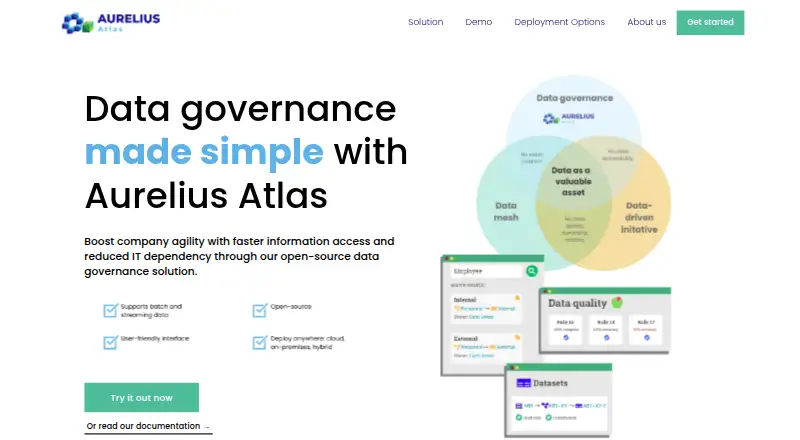
What Aurelius Atlas is
Aurelius Atlas is an open-source data governance platform that helps business users find, understand and manage information about organizational data. Its catalog records data meaning, quality, lineage, location and ownership. Lineage tracking follows processing and usage from the source to data consumers, while quality insights and impact analysis can highlight areas for improvement. Atlas represents business concepts such as domains, entities and attributes alongside technical assets such as systems, collections, datasets and fields. Documentation describes REST and lineage APIs for registering producers, consumers and transformations, and federated identity through Keycloak, including Azure Active Directory integration. Organizations can self-host Atlas on cloud platforms or local servers. Docker Compose is available for trying the platform but is not intended for production deployments. A hosted SaaS option is also described, with pricing based on cloud resource use and support level. The self-hosted plan is free; optional consulting is priced separately.
Good
- Catalog records meaning, quality, lineage, location and owners.
- Lineage traces data from origin to consumers.
- REST and lineage APIs are documented.
- Self-hosting is available on cloud platforms or local servers.
Watch out
- Docker Compose is not intended for production deployments.
- Hosted SaaS pricing depends on cloud resources and support level.
- Optional consulting services are priced separately.
Who it suits
Atlas suits organizations that need a catalog of data ownership, meaning, quality and lineage. Its self-hosting options and governance model may suit teams managing both business concepts and technical data assets.
Verdict
Atlas brings cataloging, lineage and quality insights into one governance platform. Teams considering deployment should distinguish the trial-oriented Docker Compose setup from its other deployment options.
Plans and prices
From Aurelius Atlas's own pricing page, checked 30 Sep 2026.
| Plan | Price | What it gives you |
|---|---|---|
| Self-hosted Aurelius Atlas | Free | Open-source; no licensing costs · optional consulting services priced monthly, annually, or once |
The facts
Each one read from Aurelius Atlas's own pages, with the date it was checked.
What it does
- Data catalog
- The catalog gives users information about data meaning, quality, lineage, location, and owners.checked 30 Sep 2026
- Data lineage
- Atlas captures lineage to trace data processing and usage from its origin to data consumers.checked 30 Sep 2026
- Data quality
- The platform includes data quality insights and impact analysis to help identify improvement areas.checked 30 Sep 2026
- Deployment
- Atlas can be self-hosted on cloud platforms or local servers, with Docker Compose and on-premises Kubernetes support described on the deployment page.checked 30 Sep 2026
- Deployment limit
- The documentation says Docker Compose is provided for trying Atlas and should not be used for production deployments.checked 30 Sep 2026
- Governance model
- It supports business entities such as data domains, entities, and attributes, and technical entities such as systems, collections, datasets, and fields.checked 30 Sep 2026
- Hosted options
- The SaaS option is hosted and maintained by the team, with pricing based on cloud resource usage and support level.checked 30 Sep 2026
- Identity
- The integration documentation describes federated identity with Keycloak, including Azure Active Directory integration.checked 30 Sep 2026
- Integrations
- The documentation describes an Apache Atlas REST API and a Lineage API for registering producers, consumers, and transformations.checked 30 Sep 2026
- Intended users
- The company says it created Atlas to help organizations in manufacturing, marine, mining, automotive, and other sectors improve data accessibility and usability.checked 30 Sep 2026
- License
- The FAQ states Aurelius Atlas is distributed under the Elastic License 2.0.checked 30 Sep 2026
- Purpose
- Aurelius Atlas is an open-source data governance platform that helps business users discover, understand, and manage governance information.checked 30 Sep 2026
- Support
- The support documentation says the team monitors its support email and aims to respond within 24–48 hours.checked 30 Sep 2026
The company
- Founded
- 2017checked 28 Sep 2026
- Headquarters
- Amsterdam, The Netherlandschecked 28 Sep 2026
The full review of Aurelius Atlas
Aurelius Atlas is an open-source data governance platform for organizations that need to connect business metadata with technical data assets. It is best suited to teams able to manage deployment and metadata practices themselves, or to consider the team-maintained SaaS option. Its core appeal is a broad catalog, quality context, and lineage without licensing costs.
Overview
Atlas links business concepts such as domains, entities, and attributes to technical assets such as systems, collections, datasets, and fields. That shared model can help business users make sense of data while giving technical teams a structure for managing it. The company targets organizations seeking better data accessibility and usability, including those in manufacturing, marine, mining, and automotive.
The catalog brings together meaning, quality, lineage, location, and ownership. Quality insights and impact analysis add context for identifying improvement areas and understanding potential downstream effects. This makes Atlas more useful for governance than a basic asset directory, provided an organization can keep its metadata and lineage meaningful.
Key features
Catalog, quality, and lineage
Atlas traces data from its origin through processing to consumers. Paired with impact analysis, that gives teams a way to consider which downstream uses may be affected by changes. Catalog entries also include quality, location, and ownership context, helping consumers assess more than just an asset's name.
Integration and identity
The platform documents an Apache Atlas REST API and a Lineage API for registering producers, consumers, and transformations. These interfaces are relevant to teams that need to connect data flows to the catalog rather than rely only on manual descriptions. Federated identity is supported through Keycloak, including Azure Active Directory integration.
Pricing
The Self-hosted Aurelius Atlas plan costs nothing and is open source with no licensing costs. It is the natural fit for organizations willing to operate the software themselves; the trade-off is that the license price does not remove the work of deployment and ongoing operations. Optional consulting services are priced monthly, annually, or as a one-time engagement.
A hosted SaaS option is hosted and maintained by the team, with pricing based on cloud resource usage and support level. That may suit organizations that prefer managed operation, while the usage-based model means cost depends on resource needs and support chosen. The free self-hosted plan does not establish a price for this hosted option.
Platforms
Atlas supports API access, web use, and self-hosting. Deployment documentation covers cloud platforms, local servers, and on-premises Kubernetes. Docker Compose is provided for trying the platform and is explicitly not intended for production, so teams planning a live deployment should choose another supported deployment route. The software is distributed under the Elastic License 2.0.
Support documentation says the team monitors its support email and aims to respond within 24–48 hours. That gives self-hosting teams a stated support channel, though it is not a substitute for planning operational ownership.
Who it's for
Atlas is a strong fit for organizations that need business and technical metadata in one governance model, particularly where lineage and data quality context are important. Its open-source, no-license-cost self-hosted plan suits teams with infrastructure capacity and an appetite for operating the platform. Organizations seeking a managed path can consider SaaS; teams expecting a production-ready deployment from the trial-oriented Compose setup should look elsewhere or plan for Kubernetes or another documented deployment approach.
Pros and cons
- Pros: Catalog entries combine meaning, quality, lineage, location, and ownership, giving consumers useful governance context.
- Pros: Business entities and technical assets share a model, while APIs support registering lineage producers, consumers, and transformations.
- Pros: Self-hosted use has no licensing costs, and deployment options include cloud, local servers, and on-premises Kubernetes.
- Cons: Docker Compose is for trying Atlas, not production, so teams need a more suitable deployment plan before going live.
- Cons: Self-hosting avoids license fees but leaves deployment and operations with the organization; SaaS costs vary with cloud resources and support level.
Alternatives
Browse Metadata Management Software for more options in the category. Choose DataHub instead if you want a free, open-source self-hosted catalog and are prepared to handle installation, configuration, upgrades, uptime, and troubleshooting yourself. Consider Ab Initio Data Platform if a paid platform with a required free proof of concept before purchase better fits your procurement process. MetaKarta is an option if you want a paid entry plan at $50 a year, with a five-concurrent-user maximum and up to five pre-selected connectors.
Alation Data Intelligence Platform is another paid alternative. Dawiso may suit teams seeking a paid plan with five user seats, five contributor licenses, 20 viewer licenses, unlimited connectors, and Slack forum support for €445 a month. Aristotle Metadata Registry offers a paid Micro plan at $3 a month with 25 author licenses, 125 collaboration licenses, and 20,000 metadata storage. Progress Semaphore is an alternative with a non-production Development subscription for demos, development, and capability evaluations. Collibra is a paid platform alternative.
Verdict
Choose Aurelius Atlas if your organization needs cataloging, lineage, and quality context across business and technical assets, and can support a self-hosted deployment or assess the managed SaaS route. Its strongest reason to choose is that this governance breadth is available without self-hosted licensing costs. Look elsewhere if you need a production deployment from Docker Compose or want to avoid operating infrastructure without taking on usage-based hosted costs.
Getting started
- Visit https://www.aureliusatlas.org/.
- Choose the self-hosted option or the hosted SaaS option.
- For self-hosting, use a cloud platform or local server.
- Use Docker Compose to try Atlas, or consider on-premises Kubernetes for deployment.
- Consult the deployment documentation for the selected route.
Limits worth knowing
Docker Compose is provided for trying Atlas and should not be used for production deployments. The hosted SaaS option is priced according to cloud resource use and support level.
Questions
Is Aurelius Atlas free?
The self-hosted plan is free and has no licensing costs. Optional consulting services are priced separately.
Is Aurelius Atlas open source?
Yes. The FAQ says it is distributed under the Elastic License 2.0.
Can Atlas be self-hosted?
Yes. It can be self-hosted on cloud platforms or local servers, with Docker Compose and on-premises Kubernetes described. Docker Compose is for trying Atlas, not production.
Is a hosted option available?
Yes. The SaaS option is hosted and maintained by the team. Pricing depends on cloud resource usage and support level.
What APIs and identity integrations are described?
Documentation describes an Apache Atlas REST API and a Lineage API for registering producers, consumers, and transformations. It also describes Keycloak federated identity, including Azure Active Directory integration.
Who is Atlas intended to help?
It is designed to help organizations improve data accessibility and usability. The company names manufacturing, marine, mining, and automotive among its intended sectors.
Alternatives to Aurelius Atlas
- 1
DataHub
Free planOpen sourceWebAPILinuxmacOS7.6Free plan - 2
Dawiso
AndroidiOSWebAPI7.5From €445 a month - 3

Apache Atlas
Free planOpen sourceWebAPILinuxSelf-hosted7.2Free plan - 4
Aristotle Metadata Registry
WebAPISelf-hosted6.9 - 5
MetaKarta
WebAPIExtensionLinux6.5From $50 a year - 6

Alex Solutions
WebAPISelf-hosted6.3