
Atlas
Atlas manages database schemas and migrations using declarative, versioned workflows, and is designed to work across programming languages.
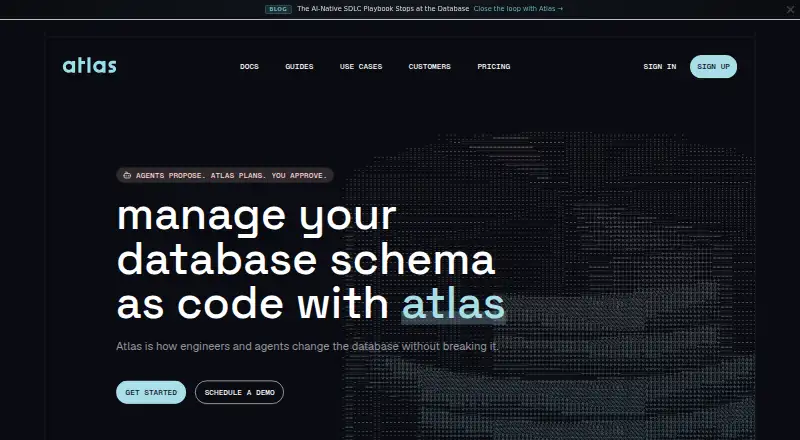
What Atlas is
Atlas manages database schemas and migrations using declarative, versioned workflows, and is designed to work across programming languages. It compares a database’s current state with a desired schema in HCL, SQL, or an ORM format, then can generate and execute a migration plan. Teams can lint and validate migrations, run safety checks, and test schemas and migrations. Atlas Starter is free and supports MySQL, MariaDB, PostgreSQL, and SQLite, with limited inspection and diffing and database support. The open version also supports TiDB and LibSQL; the Pro plan adds drivers including SQL Server, Oracle, Snowflake, and Databricks. Atlas describes its core engine as open source under Apache 2.0, with advanced features in proprietary versions. Integrations include Kubernetes, Terraform, several CI/CD services, and a Go SDK. Pro costs $9 a month per developer, plus usage-based pricing for CI/CD pipelines and databases, and new users can try Pro for 30 days. A separate Schema Monitoring plan costs $39 a month per monitored database.
Good
- Generates migration plans from desired schemas.
- Supports migration linting and safety checks.
- Core engine is available under Apache 2.0.
- Offers Linux, macOS, Windows, and self-hosted options.
Watch out
- Starter has limited inspection and diffing.
- Pro adds usage-based CI/CD and database charges.
- Pro trial lasts 30 days; continued use requires a license.
Who it suits
Atlas suits teams managing database schema changes through migration workflows, safety checks, and CI/CD integrations. Its Starter and Pro options differ in database support and cost structure.
Verdict
Atlas provides a free starting tier and a workflow for planning, checking, and applying schema changes. Compare the Starter database limits with Pro’s per-developer and usage-based costs.
Plans and prices
From Atlas's own pricing page, checked 15 Oct 2026.
| Plan | Price | What it gives you |
|---|---|---|
| Atlas Starter | Free | ORM integration · migration planning and execution · IDE support · limited inspection and diffing · limited database support · Free to use |
| Atlas Pro (Team) | $9 a month | Up to 50 seats · Atlas Registry up to 500 root objects · $9 per developer, per month, plus usage based pricing for CI/CD pipelines and databases |
| Atlas Schema Monitoring | $39 a month | Schema changelog · ERD and schema docs · Column-level data lineage · Security Graph and CVE scanning · Drift detection and alerts · $39/month per monitored databases |
| Atlas Schema Monitoring Pro | $39 a month | Schema changelog · ERD and schema docs · column-level lineage · security graph and CVE scanning · schema statistics · drift alerts · $39/month per monitored database |
| Atlas Pipelines Pro | $59 a month | Additional targets $39/month each · requires Atlas Pro seat per contributing developer · $59/month per project including 2 target databases |
| Atlas Enterprise | Priced on request | 20 databases starting point · customizable plans · enterprise SSO · premium support and custom SLA · air-gapped deployment · offline CI/CD licenses · Custom pricing |
The facts
Each one read from Atlas's own pages, with the date it was checked.
What it does
- CLI and API surface
- The public CLI includes schema inspection, diffing, planning, applying and registry push commands, with URL-based database and file inputs.checked 15 Oct 2026
- Cloud availability
- Atlas Cloud is described as using multi-availability-zone replication, automated failover, and daily encrypted backups, with 99.9% uptime.checked 30 Sep 2026
- Commercial licence
- The standard Atlas binary combines open-source code with proprietary code and is distributed under the Atlas MSA.checked 15 Oct 2026
- Community edition limits
- The Community Edition omits migration linting, declarative planning, drift detection, registry, testing, many database objects, extra drivers and integrations.checked 15 Oct 2026
- Complaint: login paywall
- Reddit commenters criticized requiring login for premium features and described migration linting and advanced objects as paywalled.checked 15 Oct 2026
- Complaint: pricing and feature gating
- A Reddit discussion reported that SQL Server support requires payment and complained that migration linting had moved behind a paid tier.checked 15 Oct 2026
- Data as code
- Atlas can declare reference data and synchronize it with insert, upsert or sync modes.checked 15 Oct 2026
- Database coverage
- The open edition supports PostgreSQL, MySQL, MariaDB, SQLite, TiDB and LibSQL, while Pro adds many enterprise and warehouse drivers.checked 15 Oct 2026
- Data operations
- Atlas Scripts support transactional backfills, deletions and reports with conditions, queries and expected-row checks.checked 15 Oct 2026
- Declarative workflow
- Users describe a desired schema in HCL, SQL or ORM models and Atlas computes the migration plan.checked 15 Oct 2026
- Deployment options
- Atlas is installable on macOS, Linux and Windows, and is distributed through shell script, Homebrew, Docker, CI and manual binaries.checked 15 Oct 2026
- Documentation depth
- The documentation contains getting-started material, database guides, workflow references, HCL and SQL syntax, ORM guides, testing, integrations and a full CLI reference.checked 15 Oct 2026
- Funding
- Ariga says it raised $18 million from Tiger Global and TLV Partners.checked 15 Oct 2026
- Independent review: positioning
- Big Iron describes Atlas as a single Go binary with declarative-first migrations, first-class drift detection and ORM integration.checked 15 Oct 2026
- Integrations
- Official integrations include Kubernetes Operator, Terraform Provider, GitHub Actions, GitLab CI, CircleCI, Bitbucket Pipes and Azure DevOps.checked 15 Oct 2026
- Limit: ecosystem
- Big Iron characterizes Atlas's ecosystem as smaller than Flyway or Liquibase, with fewer integrations and Stack Overflow answers.checked 15 Oct 2026
- Limit: generated SQL
- Big Iron warns that declarative or ORM-generated diffs can produce unsafe drop-and-recreate operations, so migrations need review.checked 15 Oct 2026
- Limit: learning curve
- Independent reviewers describe the declarative model and HCL as unfamiliar to teams used to imperative migrations.checked 15 Oct 2026
- Limit: rollback
- Big Iron says Atlas lacks Liquibase-style per-change rollback and generally requires manually written down migrations.checked 15 Oct 2026
- Migration safety
- Built-in analyzers check destructive changes, data-dependent changes, blocking table changes, concurrent-index issues and other hazards.checked 15 Oct 2026
- News: checksum verification
- The October 15, 2026 changelog lists SHA-256 verification in the install script before binary installation.checked 15 Oct 2026
The company
- Company size and headquarters
- LinkedIn lists Ariga (Atlas) as a privately held software company headquartered in New York with 11–50 employees.checked 15 Oct 2026
- Founded
- LinkedIn lists the company as founded in 2021.checked 15 Oct 2026
- Maker
- Atlas is built and operated by Ariga, which was founded by the creators of the Ent entity framework.checked 30 Sep 2026
The full review of Atlas
Overview
Atlas is a database schema and migration tool for teams that want to manage structural changes through declarative, versioned workflows. A desired schema can be expressed in HCL, SQL, or an ORM schema; Atlas compares it with the database’s current state, then generates and executes a migration plan. Its scope also includes schema diffs, rollback support, migration validation, safety checks, testing, and drift detection.
Built and operated by Ariga, Atlas follows an open-core model. The core engine is available under the Apache 2.0 license, while some advanced capabilities are proprietary. The open version supports PostgreSQL, MySQL, MariaDB, SQLite, TiDB, and LibSQL. Pro adds other database drivers, including SQL Server, Oracle, Snowflake, and Databricks.
Atlas lists integrations for Kubernetes, Terraform, GitHub Actions, GitLab CI, CircleCI, Bitbucket Pipelines, Azure DevOps, and a Go SDK. For category context, see Database Migration Tools, Database Testing Tools, and Data Lineage Tools.
Key features
Declarative, versioned schema workflows
Teams can specify the structure they want rather than treating each change only as a hand-authored sequence of migration steps. Atlas compares that target with the live database schema and derives a migration plan, which it can execute. The workflow accepts HCL, SQL, or ORM schemas.
Migration checks and rollback
Atlas can lint and validate migrations, run safety checks, and test schemas and migrations. It also supports rollbacks, giving teams a way to address reversals as part of migration management.
CI/CD and ecosystem connections
Atlas lists integrations with common infrastructure and delivery tools, including Kubernetes, Terraform, GitHub Actions, GitLab CI, CircleCI, Bitbucket Pipelines, and Azure DevOps. A Go SDK is also available. CI/CD automation is among its listed capabilities.
Database coverage and plan boundaries
The open version covers PostgreSQL, MySQL, MariaDB, SQLite, TiDB, and LibSQL, though the free Starter plan describes limited database support for MySQL, MariaDB, PostgreSQL, and SQLite. Pro expands driver coverage to databases such as SQL Server, Oracle, Snowflake, and Databricks. Atlas Pro’s Registry manages up to 500 root objects; nested items such as columns, indexes, foreign keys, and comments do not count toward that limit.
Pricing
Atlas has a free plan and paid plans. Starter is free to use, with limited inspection and diffing and limited database support. Atlas Pro is listed at $9 per developer, per month, plus usage-based pricing for CI/CD pipelines and databases. The plan includes 50 CLI seats and 90-day history retention. CI/CD projects cost $59/month, including two target databases; each additional target database costs $39/month.
Atlas Schema Monitoring is listed at $39/month per monitored database. Its listed capabilities include a schema changelog, ERD and schema documentation, column-level data lineage, Security Graph and CVE scanning, drift detection, and alerts. Enterprise pricing is custom, starts from 20 databases, and includes customizable plans, enterprise SSO, premium support with a custom SLA, air-gapped deployment, and offline CI/CD licenses.
New users can take a free 30-day Pro trial. A license is required to continue using Pro when the trial ends. Support varies by plan: Starter lists GitHub and Discord support, Pro lists business-hours support, and Enterprise offers a custom SLA.
Platforms
Atlas is listed for API, Linux, macOS, Windows, and self-hosted use. Teams can choose a self-hosted option, and Enterprise also lists air-gapped network deployment and offline CI/CD licenses.
Who it's for
Atlas is aimed at teams managing database schema changes across development and delivery workflows, particularly where migration checks, automation, and drift detection matter. Ariga says Atlas serves organizations from startups to Fortune 500 companies. Its listed industries include financial services, healthcare, cybersecurity, e-commerce, manufacturing, education, government, and cloud vendors.
Organizations evaluating schema lineage may also consider Grai, Coalesce Catalog, Databricks Notebooks, Collate, Dremio, Informatica Product 360, Cloudera Data Lake Service, and Spline.
Pros and cons
Pros
- Declarative workflows compare a desired schema with the current database state and produce a migration plan.
- Migration linting, validation, safety checks, testing, rollback support, and drift detection cover several parts of schema change management.
- The open core supports multiple databases, while Pro extends driver coverage and offers a Registry with a defined root-object allowance.
- Integrations include infrastructure, CI/CD, and a Go SDK.
Cons
- The free plan limits inspection, diffing, and supported databases.
- Pro adds per-developer fees and usage-based charges for CI/CD pipelines and databases; extra target databases have additional monthly charges.
- Advanced capabilities are available in proprietary versions, and continued Pro use after the trial requires a license.
Alternatives
For schema lineage and adjacent data-management needs, Grai, Coalesce Catalog, Databricks Notebooks, Collate, Dremio, Informatica Product 360, Cloudera Data Lake Service, and Spline are other options to consider.
Verdict
Atlas brings declarative schema comparison, migration planning, safeguards, and automation into one database-change workflow. Its open-core structure and free Starter plan provide an entry point, while database coverage, inspection limits, and Pro pricing are important distinctions to review when choosing a plan. Teams with broader driver needs or paid workflow requirements should weigh the per-developer price and usage-based CI/CD and database charges against their expected use.
Getting started
- Visit the Atlas website.
- Choose Atlas Starter or begin the 30-day Pro trial.
- Use the Linux, macOS, or Windows option, or choose API or self-hosted use.
- Connect Atlas to a supported database and describe the desired schema in HCL, SQL, or an ORM.
- Add Atlas to a listed integration such as GitHub Actions, GitLab CI, or Terraform if needed.
Limits worth knowing
Starter has limited inspection and diffing and supports MySQL, MariaDB, PostgreSQL, and SQLite. Pro is $9 per developer per month, plus usage-based CI/CD and database charges; its listed plan includes 50 CLI seats and up to 500 root objects. The 30-day Pro trial requires a license to continue using Pro afterward.
Questions
Is Atlas free?
Atlas Starter is free. It has limited inspection and diffing and supports MySQL, MariaDB, PostgreSQL, and SQLite.
How much does Atlas Pro cost?
Atlas Pro Team is $9 per developer per month, plus usage-based pricing for CI/CD pipelines and databases.
Is Atlas open source?
Atlas describes itself as open-core. Its core engine is available under the Apache 2.0 license, while advanced features are in proprietary versions.
Which databases does Atlas support?
The open version supports PostgreSQL, MySQL, MariaDB, SQLite, TiDB, and LibSQL. Pro adds drivers including SQL Server, Oracle, Snowflake, and Databricks.
Which platforms can run Atlas?
Atlas lists Linux, macOS, Windows, API, and self-hosted options.
Who makes Atlas?
Atlas is built and operated by Ariga, founded by the creators of the Ent entity framework.
Alternatives to Atlas
- 1

Coalesce Catalog
Free planWebAPIExtension7.5From $150 a month - 2
Microsoft Defender for Business
AndroidiOSAPImacOS7.5 - 3

Apache Atlas
Free planOpen sourceWebAPILinuxSelf-hosted7.2Free plan - 47.0From $1.15 a month
- 5

Dataedo
WebExtensionSelf-hostedWindows6.5From $18,000 a year - 6
OpenDataDiscovery Platform
Free planWebAPILinuxSelf-hosted6.5Free plan