OpenDataDiscovery Platform
OpenDataDiscovery Platform (ODD) is an open-source catalog for finding and governing data products and supporting work across data teams.
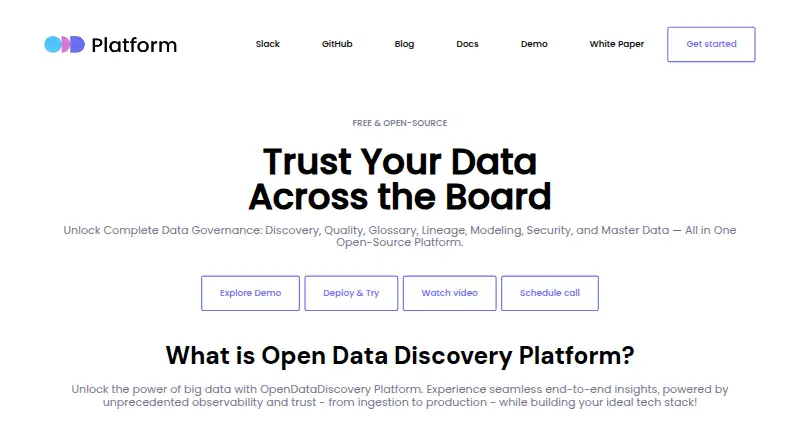
What OpenDataDiscovery Platform is
OpenDataDiscovery Platform (ODD) is an open-source catalog for finding and governing data products and supporting work across data teams. Its catalog lets users search and filter metadata by details such as source, owner, and tag, then explore ownership and links to related sources. ODD tracks lineage across data objects and microservices, imports data-quality test results, and displays dataset quality statuses. It also catalogs machine-learning experiment metadata and lineage and supports experiment logging. Listed integrations include MongoDB, ClickHouse, dbt, Snowflake, Tableau, BigQuery, Kafka, and PostgreSQL. Teams can deploy it with local Docker Compose, Kubernetes and Helm charts, or AWS Marketplace QuickLaunch, then use its interface or REST API to access collected metadata. ODD supports LDAP authentication and USER and ADMIN roles; its documentation advises against using simple login-form authentication in production. Metadata attachments are limited to 20 MB, though links can point to larger or remotely stored files. The platform is free and open source, with public development and support options including a dedicated team and community.
Good
- Search and filter by source, owner, and tag.
- Tracks data-object and microservices lineage.
- Displays imported dataset quality statuses.
- Supports Docker Compose, Kubernetes, and AWS deployment.
Watch out
- Metadata attachments are limited to 20 MB.
- Simple login-form authentication is discouraged for production.
Who it suits
ODD suits data teams of different sizes, including enterprises, small and midsize companies, and data science teams. It is relevant for teams that need catalog search, lineage, quality status, and machine-learning metadata in one discovery workflow.
Verdict
ODD combines catalog search with lineage, quality information, and machine-learning metadata for data discovery. Its attachment limit and production authentication guidance are important deployment considerations.
Plans and prices
From OpenDataDiscovery Platform's own pricing page, checked 11 Oct 2026.
| Plan | Price | What it gives you |
|---|---|---|
| Open-source platform | Free | Free and open-source; no price stated |
The facts
Each one read from OpenDataDiscovery Platform's own pages, with the date it was checked.
What it does
- Access control
- ODD defines USER and ADMIN roles, with ADMIN having all permissions by default.checked 11 Oct 2026
- Alerts
- The site says the platform alerts owners of affected entities after the first ETL execution.checked 11 Oct 2026
- Audience
- The platform targets data teams of any size, including enterprises, small and midsize companies, and data science teams.checked 11 Oct 2026
- Collaboration
- The platform treats ML entities as first-class parts of data discovery to support collaboration between data science and data engineering teams.checked 11 Oct 2026
- Data quality
- The platform supports integration with data quality tools and connects quality information to lineage and alerts.checked 11 Oct 2026
- Deployment
- The site offers local Docker Compose, Kubernetes deployment with Helm charts, and AWS Marketplace QuickLaunch.checked 11 Oct 2026
- Discovery
- Users can search data and explore tags, ownership details, and links to related sources.checked 11 Oct 2026
- Federated catalog
- The platform uses an open metadata collection standard to connect data catalogs, tools, and feature stores.checked 11 Oct 2026
- Integrations
- The product site lists integrations including MongoDB, ClickHouse, dbt, Snowflake, Tableau, BigQuery, Kafka, PostgreSQL, and others.checked 11 Oct 2026
- Interface and API
- The platform provides a user interface and REST API for collected metadata.checked 11 Oct 2026
- Lineage
- The platform provides automatic company-wide ingestion-to-product lineage to help identify issues and affected stakeholders.checked 11 Oct 2026
- Metadata cataloging
- The documentation says the platform catalogs ML experiment metadata and lineage generated by its collectors.checked 11 Oct 2026
- Notable limit
- Attachments to metadata entities are limited to 20 MB; links can be attached for larger or remotely stored files.checked 11 Oct 2026
- Open development
- The site describes the platform as forever open-source with public development.checked 11 Oct 2026
- Purpose
- ODD is an open-source data discovery platform for improving productivity, collaboration, and governance of modern data products and teams.checked 11 Oct 2026
- Reference data
- Lookup Tables support creating and maintaining reference data as part of data governance.checked 11 Oct 2026
- Search
- The catalog supports search and faceted filtering by attributes such as data source, owner, and tag.checked 11 Oct 2026
- Security
- ODD supports authentication through LDAP, and its documentation warns against using its simple login-form authentication in production.checked 11 Oct 2026
- Support
- The product site lists a dedicated team, a helpful team, and a community as support options.checked 11 Oct 2026
Where it runs
- Machine learning
- ODD catalogs ML experiment metadata and lineage, and supports logging experiments.checked 11 Oct 2026
The full review of OpenDataDiscovery Platform
OpenDataDiscovery Platform (ODD) is an open-source catalog for data assets and machine-learning metadata. It is best suited to teams that want to connect discovery across data engineering and data science. Its reach across search, lineage, quality, and experiments is a strong reason to consider it, provided your team can manage deployment and authentication.
Overview
ODD brings catalog search together with end-to-end data-object and microservices lineage, imported data-quality results, and machine-learning experiment metadata. Search filters include data source, owner, and tag; users can also inspect ownership and links to related sources. This is useful when finding an asset is only the first step and teams need to understand its dependencies and context.
An open metadata collection standard connects catalogs, tools, and feature stores. Lookup Tables let teams maintain reference data for governance, while owners of affected entities receive alerts after the first ETL execution. The alert timing is useful for follow-up after that run, though it does not describe a broader alert schedule.
Key features
Lineage, quality, and machine learning
Pipeline and report lineage, impact analysis, and lineage across data objects and microservices give teams several ways to trace relationships. ODD can import test results and show dataset quality statuses, so it can make existing quality checks easier to discover; it does not replace the process that produces those results. For data science and engineering teams, logging experiments and cataloging their metadata and lineage can bring ML work into the same discovery process as data assets.
Integrations and deployment
Integrations include MongoDB, ClickHouse, dbt, Snowflake, Tableau, BigQuery, Kafka, and PostgreSQL. A user interface and REST API expose collected metadata. Teams can deploy with local Docker Compose, Kubernetes Helm charts, or AWS Marketplace QuickLaunch, giving different hosting routes while leaving deployment operations with the team.
LDAP authentication is supported, and ODD defines USER and ADMIN roles, with ADMIN holding all permissions by default. Its documentation cautions against using simple login-form authentication in production, so production teams should plan an appropriate authentication setup. Attachments are capped at 20 MB; larger or remotely stored files can be linked instead.
Pricing
The Open-source platform plan is free. ODD is described as free and open source, with public development. The free plan has no stated seat or usage quota, and a free trial is also offered. There is no paid plan or renewal term described, so this is a natural fit for teams prepared to run and maintain the platform themselves.
Platforms
ODD supports API, Linux, self-hosted, and web use. Its Docker Compose, Kubernetes, and AWS Marketplace deployment options suit teams choosing their own operating environment.
Who it's for
ODD targets data teams of any size, including enterprises, small and midsize companies, and data science teams. It is particularly well matched to organizations that want data engineers and data scientists to share discovery of assets, lineage, quality status, and experiments. Teams that need a managed service or rely on attaching large files should weigh the operational work and 20 MB attachment cap.
Pros and cons
- Pros: Search, lineage, imported quality results, and ML experiment metadata cover more of the discovery process than a dataset index alone.
- Pros: Integrations, an API, and several self-hosted deployment routes give teams options for connecting and running the platform.
- Pros: Open-source development and a free plan make it possible to adopt without a software subscription.
- Cons: Production authentication needs planning because simple login-form authentication is discouraged for production use.
- Cons: Attachments stop at 20 MB, requiring links for larger files.
- Cons: Teams take on deployment and platform operations with the available deployment models.
Alternatives
For a broader comparison, see Data Lineage Tools. Choose Atlas if you want an open-core product with a freemium plan and platforms that include macOS and Windows. Grai is another free, open-source, self-hosted option for teams that want to retain control of their data and hosting environment.
Coalesce Catalog may suit a solo developer looking for a free plan with one user, one project, one environment, and 2,000 capped monthly actions; its paid Starter plan is $150 a month. Choose Databricks Notebooks when a web-based notebook and a free serverless workspace with limited compute better fit the need. Apache Atlas is a free alternative for teams seeking open metadata governance software.
Collate may fit teams considering an open-source core with a separately licensed UI and connectors. Amazon DataZone is an option for teams comfortable with pay-as-you-go charges tied to requests, metadata storage, compute, and AI recommendation tokens. Egeria is another free option.
Verdict
Choose ODD if your data team wants a free, open-source discovery platform that brings catalog search, lineage, quality results, and ML experiment metadata together. Its strongest case is shared visibility across data engineering and data science. Look elsewhere if your team cannot take on deployment and production authentication work, or if metadata attachments larger than 20 MB are central to your workflow.
Getting started
- Visit the OpenDataDiscovery website
- Choose Docker Compose, Kubernetes with Helm, or AWS Marketplace QuickLaunch deployment
- Connect supported data and tooling integrations
- Expose collected metadata through the web interface or REST API
- Configure LDAP authentication and assign USER or ADMIN roles
Limits worth knowing
Attachments to metadata entities stop at 20 MB; larger or remote files must be represented with links. The documentation warns against simple login-form authentication in production.
Questions
Is OpenDataDiscovery Platform free?
Yes. It is listed as free and open source, with a free plan.
Which platforms are supported?
The listed platforms are API, Linux, self-hosted, and web.
How can ODD be deployed?
Deployment options include local Docker Compose, Kubernetes with Helm charts, and AWS Marketplace QuickLaunch.
What integrations are listed?
Integrations include MongoDB, ClickHouse, dbt, Snowflake, Tableau, BigQuery, Kafka, and PostgreSQL, among others.
Does it support access control?
Yes. ODD defines USER and ADMIN roles, with ADMIN having all permissions by default.
Alternatives to OpenDataDiscovery Platform
- 1

Atlas
Free planOpen sourceWebAPILinuxmacOS8.3From $39 a month - 2

Coalesce Catalog
Free planWebAPIExtension7.5From $150 a month - 3
Microsoft Defender for Business
AndroidiOSAPImacOS7.5 - 4

Apache Atlas
Free planOpen sourceWebAPILinuxSelf-hosted7.2Free plan - 57.0From $1.15 a month
- 6

Dataedo
WebExtensionSelf-hostedWindows6.5From $18,000 a year