
dbt Semantic Layer
The dbt Semantic Layer centralizes metric definitions on dbt models and handles joins so downstream tools and applications can use metrics consistently.
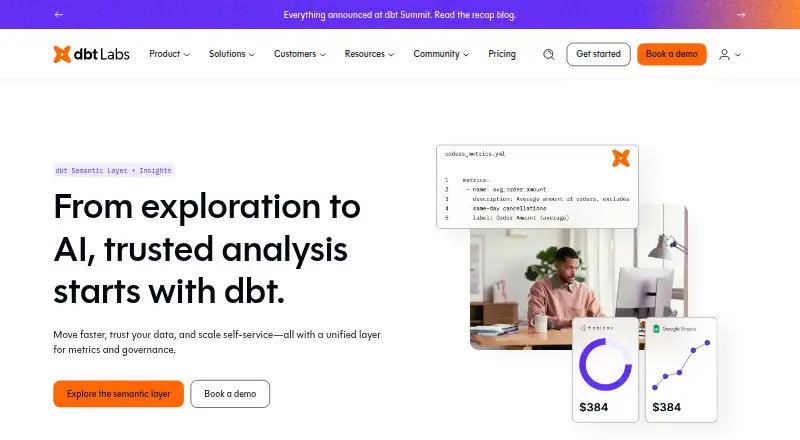
What dbt Semantic Layer is
The dbt Semantic Layer centralizes metric definitions on dbt models and handles joins so downstream tools and applications can use metrics consistently. MetricFlow generates SQL from semantic model and metric configurations at query time. Teams define models and metrics in YAML as version-controlled, lineage-aware code. MetricFlow can rewrite queries to reduce compute and latency, optimize joins, and cache repeated queries. The product offers an API, the dbt MCP Server, and integrations for BI, notebooks, spreadsheets, embedded analytics, and AI systems. GraphQL and JDBC APIs and a Python SDK provide ways to query metrics and dimensions; AI tools including Claude and ChatGPT can connect to governed metrics through the MCP server. Supported data platforms include Snowflake, BigQuery, Databricks, and Redshift. Defining and querying metrics requires a dbt Starter or Enterprise account. Starter costs $100 per user/month and includes 5,000 queried metrics per month; Enterprise and Enterprise+ each include 20,000. The free Developer plan does not list the Semantic Layer.
Good
- Metric definitions are version-controlled YAML.
- MetricFlow optimizes joins and caches repeated queries.
- GraphQL and JDBC APIs plus a Python SDK.
- Connects governed metrics to Claude and ChatGPT.
- Supports Snowflake, BigQuery, Databricks, and Redshift.
Watch out
- Requires a dbt Starter or Enterprise account.
- The free Developer plan does not include the Semantic Layer.
- Starter is $100 per user/month.
- Single-tenant accounts need setup and enablement.
Who it suits
The Semantic Layer suits data teams that need governed, consistent metrics for analytics, embedded applications, or AI use cases. It is for organizations already using dbt Starter or Enterprise accounts to define and query metrics.
Verdict
The dbt Semantic Layer gives teams a shared, code-defined home for metrics and query access across analytics and AI tools. Check account requirements and queried-metric allowances before adopting it.
Plans and prices
From dbt Semantic Layer's own pricing page, checked 15 Oct 2026.
| Plan | Price | What it gives you |
|---|---|---|
| Developer | Free | 1 developer seat · 3,000 successful models/month · 1 project |
| dbt State add-on | $0.09 a month | 30-day free trial · Daily Active Target Tables billing · pay-as-you-go per DATT |
| Starter | $100 a month | 5 developer seats · 15,000 successful models/month · 5,000 queried metrics/month · 1 project · Semantic Layer and API access · per user/month |
| Enterprise | Priced on request | Custom seats · 100,000 successful models/month · 20,000 queried metrics/month · 30 projects · caching · SSO/RBAC/SCIM |
| Enterprise+ | Priced on request | Custom seats · 100,000 successful models/month · 20,000 queried metrics/month · unlimited projects · PrivateLink · IP restrictions · hybrid projects |
The facts
Each one read from dbt Semantic Layer's own pages, with the date it was checked.
What it does
- Access controls
- The Semantic Layer applies access permissions and respects policies attached to the underlying warehouse credentials.checked 15 Oct 2026
- Access requirement
- Defining and querying Semantic Layer metrics requires a dbt Starter or Enterprise-tier account; single-tenant accounts need setup and enablement from their account representative.checked 3 Oct 2026
- AI access
- AI tools including Claude and ChatGPT can connect to governed metrics through the dbt MCP server.checked 3 Oct 2026
- AI connectivity
- Claude and ChatGPT can access governed metrics through the dbt MCP Server.checked 15 Oct 2026
- APIs
- The Semantic Layer provides GraphQL and JDBC APIs and a Python SDK for querying metrics and dimensions.checked 3 Oct 2026
- Authentication
- API access uses personal or service-account tokens, with service tokens linked to warehouse credentials.checked 15 Oct 2026
- Caching
- MetricFlow can rewrite queries and use caching to reduce latency, compute, and repeated warehouse work.checked 15 Oct 2026
- Deployment requirement
- Production metric deployment currently works through a deployment environment, while development-environment support is marked as coming later.checked 15 Oct 2026
- Documentation depth
- Documentation covers semantic models, entities, dimensions, metrics, CLI commands, manifests, deployment, credentials, tokens, and integrations.checked 15 Oct 2026
- Downstream destinations
- dbt lists integrations including Google Sheets, Hex, Mode, Preset, Sigma, Tableau, ThoughtSpot, Census, Hightouch, and Lightdash.checked 15 Oct 2026
- Governed definitions
- Metrics are version-controlled and lineage-aware because teams define them as YAML in dbt projects.checked 15 Oct 2026
- GraphQL API
- The Semantic Layer exposes GraphQL for querying metrics and dimensions.checked 15 Oct 2026
- Integrations
- The product page says the Semantic Layer offers an API, the dbt MCP Server, and dozens of out-of-the-box integrations for BI, notebooks, spreadsheets, embedded analytics, and AI systems.checked 3 Oct 2026
- Intended users
- The product is presented for data teams seeking governed, consistent metrics for analytics, embedded applications, and AI use cases.checked 3 Oct 2026
- JDBC API
- A JDBC driver supports metric and dimension queries plus standard metadata operations.checked 15 Oct 2026
- Licence
- The dbt Semantic Layer service and APIs are proprietary cloud software; MetricFlow and dbt-semantic-interfaces are Apache 2.0 licensed.checked 15 Oct 2026
- Limit: connectors
- A reviewer says the relatively new product needs more connector development.checked 15 Oct 2026
- Limit: error handling and alerts
- A reviewer requests easier error handling, more scheduling options, and more customizable alerts.checked 15 Oct 2026
- Limit: pricing uncertainty
- A reviewer worries that costs could rise substantially as usage grows.checked 15 Oct 2026
- Limit: upstream ETL
- A reviewer says dbt assumes information is already in the database, requiring separate ETL work for other sources.checked 15 Oct 2026
The company
- Company founding and headquarters
- LinkedIn lists dbt Labs as founded in 2016 and headquartered in Philadelphia, Pennsylvania.checked 15 Oct 2026
- Company size
- LinkedIn lists dbt Labs as privately held with 501–1,000 employees.checked 15 Oct 2026
- Founded
- 2016checked 28 Sep 2026
- Headquarters
- Oakland, California, United Stateschecked 28 Sep 2026
The full review of dbt Semantic Layer
dbt Semantic Layer centralizes metric definitions on dbt models and makes them available to analytics tools, applications, and AI systems. It is best suited to data teams that already work in dbt and need governed metrics shared across several destinations. Its code-based approach is compelling, but access requires a qualifying paid dbt account.
Overview
The Semantic Layer addresses a familiar analytics problem: the same business metric can be defined differently in different tools. Teams define metrics once on dbt models, and MetricFlow generates SQL and handles joins when those metrics are queried. That makes it a strong fit for organizations seeking consistent definitions across BI, embedded analytics, and AI, especially when dbt is already central to their data work.
This is a cloud-deployed product with API and web access. It supports Snowflake, BigQuery, Databricks, and Redshift. The main constraint is account eligibility: defining and querying metrics requires a dbt Starter or Enterprise-tier account. Single-tenant accounts also need setup and enablement from an account representative.
Key features
Semantic models and metrics are defined in YAML as version-controlled, lineage-aware code. This gives data teams a reviewable home for metric logic and can reduce the drift that comes from maintaining definitions separately in each consumer tool. The benefit is greatest when teams are prepared to manage metrics as part of their dbt development workflow.
MetricFlow converts those configurations into SQL at query time, handles joins, and rewrites queries to reduce compute and latency. It also optimizes joins and caches repeated queries. These mechanisms target efficiency as well as consistency; they do not remove the need to consider the workload against the monthly queried-metric allowance.
GraphQL and JDBC APIs, along with a Python SDK, provide ways to query metrics and dimensions. The product also offers an API, the dbt MCP Server, and out-of-the-box integrations for BI, notebooks, spreadsheets, embedded analytics, and AI systems. Claude and ChatGPT can connect to governed metrics through MCP, making this a relevant option for teams extending metric access to AI tools rather than leaving those tools to reconstruct business logic.
The dbt Labs Trust Center carries SOC 2 Type II, ISO 27001:2022, ISO 27017, ISO 27018, ISO 42001, GDPR, and CCPA badges. Starter includes 24x5 support; Enterprise offers priority support with SLAs.
Pricing
The Developer plan is free and includes one developer seat, one project, and 3,000 successful models per month. It does not include the Semantic Layer, so it is not a free way to use this product.
Starter costs $100 a month, billed per user/month. It includes five developer seats, one project, 15,000 successful models per month, and 5,000 queried metrics per month, as well as the Semantic Layer. This is the entry point for teams that need the product, but the per-user charge and metric cap matter as adoption grows.
Enterprise uses custom pricing and includes a custom developer seat count, 30 projects, 100,000 successful models per month, and 20,000 queried metrics per month. Enterprise+ also has custom pricing and the same model and metric allowances, but includes unlimited projects. These tiers suit larger deployments that need more projects or higher allowances than Starter provides; Enterprise+ is the clearer fit when project count cannot be kept within a fixed allocation.
A free trial is offered. Review the per-user Starter cost and queried-metric allowance against the expected number of consumers before committing.
Platforms
The Semantic Layer is available through web and API platforms and is deployed in the cloud. Its documented warehouse support covers Snowflake, BigQuery, Databricks, and Redshift.
Who it's for
Choose dbt Semantic Layer when a data team wants one governed, code-defined set of metrics for BI, applications, and AI access, and is willing to operate within dbt's account tiers and monthly query limits. It is less suitable for teams seeking a standalone free semantic layer: the free Developer plan does not include the product, and usage requires Starter or Enterprise-tier access.
Pros and cons
- Pro: YAML definitions are version-controlled and lineage-aware, giving teams a shared, reviewable basis for metric logic.
- Pro: MetricFlow handles SQL generation and joins, while APIs, SDK access, integrations, and MCP extend metrics across analytics and AI destinations.
- Pro: Starter includes the Semantic Layer and 24x5 support; Enterprise adds priority support with SLAs.
- Con: The free Developer plan excludes the Semantic Layer, so there is no free tier for using this capability.
- Con: Starter limits queried metrics to 5,000 per month and charges per user, which can constrain or raise the cost of broader adoption.
- Con: Single-tenant accounts require enablement by an account representative before use.
Alternatives
Cube is worth considering for teams that want API, Linux, self-hosted, and web options and a free tier capped at five workbooks, 1,000 daily requests, and one-day query-history retention.
Starburst Enterprise Context Layer may suit teams looking for a free option with up to three clusters and standard execution mode for ad hoc queries, plus a free trial.
Sema offers a free Sandbox with one connector, one user, 100 chat queries per month, and five saved reports, making it an alternative for a narrowly scoped chat-query setup.
Strata has a free plan with one developer, 25 users, two data sources per project, and unlimited projects and branches; consider it when those allowances match the team's needs.
Definite offers a free plan for two users and two connectors with 1 GB of storage, five credits per month, and daily sync.
Malloy is a free alternative available across API, extension, desktop, self-hosted, and web platforms.
Verdonz has a free guided workspace with sample data but no own business data, so it is an option for exploring a workspace rather than bringing business data into the free plan.
MetricFlow is free under the Apache 2.0 license and requires a working dbt project and dbt adapter; it is the alternative to consider for teams seeking the metric engine itself rather than dbt Semantic Layer's hosted product access.
For broader comparisons, see Semantic Layer Software, Database Documentation Tools, and Data Transformation Tools.
Verdict
dbt Semantic Layer is a strong choice for dbt-centered data teams that need governed metrics shared across analytics, applications, and AI. Its defining advantage is version-controlled metric logic paired with managed query access; look elsewhere if free use is essential or if the monthly allowances and dbt account requirement do not fit your deployment.
Getting started
- Open the dbt Semantic Layer website
- Select a Starter, Enterprise, or Enterprise+ account
- Define semantic models and metrics in YAML
- Connect through the API, GraphQL, JDBC, Python SDK, or dbt MCP Server
- Use an integration or supported warehouse for queries
Limits worth knowing
The free Developer plan does not list the Semantic Layer. Starter includes 5,000 queried metrics per month, while Enterprise and Enterprise+ include 20,000 each; defining and querying requires a Starter or Enterprise-tier account.
Questions
Is there a free plan?
Yes. The Developer plan costs nothing, but it does not list the Semantic Layer.
How much does Starter cost?
Starter costs $100 a month, billed per user/month, and includes the Semantic Layer.
Which APIs are available?
GraphQL and JDBC APIs are available, along with a Python SDK for querying metrics and dimensions.
Can AI tools use governed metrics?
Yes. Claude and ChatGPT can connect through the dbt MCP Server.
Which data platforms are supported?
Documentation identifies Snowflake, BigQuery, Databricks, and Redshift.
Alternatives to dbt Semantic Layer
- 1
MetricFlow
Free planOpen sourceWebAPILinuxmacOS8.1From $100 a month - 2

Cube
Free planOpen sourceWebAPILinuxSelf-hosted7.9From $40 a month - 3

Starburst Enterprise Context Layer
Free planWebAPISelf-hosted7.5$0.50 usage-based - 4
Sema
Free planWebAPISelf-hosted7.3From $49 a month - 5

Looker
AndroidiOSWebAPI6.9 - 6
Holistics
WebAPI6.8From $960 a month