
Cube
Cube is an analytics platform that gives business users and AI agents a shared semantic layer for working with data.
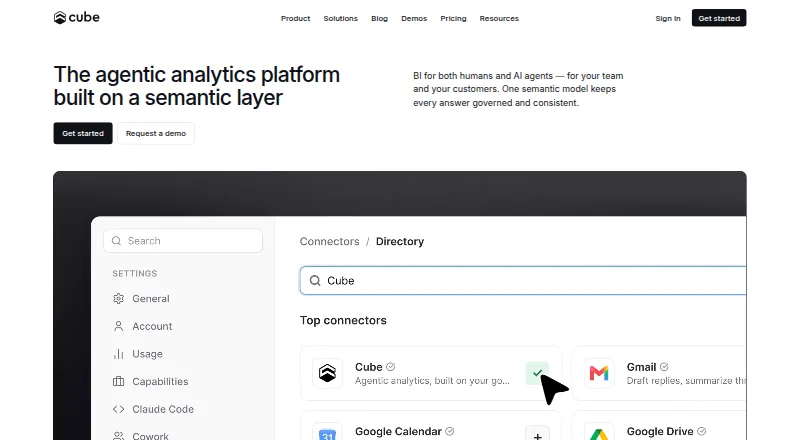
What Cube is
Cube is an analytics platform that gives business users and AI agents a shared semantic layer for working with data. That layer encodes governed business definitions so dashboards, embedded applications, and agent responses can use consistent metrics and concepts. Cube Cloud supports internal business intelligence and embedded analytics, while Cube Core is the open-source project alongside which the cloud service is built. The Free plan includes a semantic layer IDE, workbooks, dashboard publishing, semantic model and workbook agents, and analytics chat. Listed data sources include PostgreSQL, Snowflake, ClickHouse, Databricks, BigQuery, MySQL, Oracle, Redshift, MongoDB, and Trino; integrations include dbt, Dagster, Prefect, Airflow, and Coalesce.io. Cube Core can serve API requests from pre-aggregations held in Cube Store or from connected databases. Cube Cloud can run as a managed service, in a cloud VPC, or on a customer's cloud. Free is available, and Starter costs $40 a month per developer.
Good
- Free plan includes workbooks, dashboards, and analytics chat.
- Connects to a broad range of listed data sources.
- Supports dbt, Dagster, Prefect, Airflow, and Coalesce.io.
- Offers managed, VPC, and customer-cloud deployments.
- Cube states that Cube Cloud is SOC 2 Type II, HIPAA, and GDPR compliant.
Watch out
- Free allows up to 5 workbooks and 1,000 daily requests.
- Free query history retention is 1 day.
- Starter costs $40 per developer per month.
- Enterprise pricing is custom and not listed.
Who it suits
Cube suits teams building internal BI or embedded analytics that need governed business definitions shared across dashboards, applications, and AI agents. It also fits teams that want a free starting plan or cloud deployment choices.
Verdict
Cube combines a governed semantic layer with tools for BI and embedded analytics, and its Free plan includes several ways to build and explore analytics. Check plan request limits, retention, and deployment options against your team's needs before choosing a tier.
Plans and prices
From Cube's own pricing page, checked 14 Oct 2026.
| Plan | Price | What it gives you |
|---|---|---|
| Free | Free | up to 5 workbooks · 1,000 daily requests · 1-day query-history retention · community support · free forever |
| Starter | $40 a month | unlimited workbooks · 10K shared or 50K dedicated daily requests · production compute · Cube Store caching · limited chat and email support · per developer / month |
| Premium | $80 a month | unlimited queries · Explorer and Viewer roles · embedded dashboards and analytics chat · 99.950% uptime SLA · multi-cluster deployment · per developer / month |
| Enterprise | Priced on request | 99.990% uptime SLA · dedicated single tenant · BYOC · BYOLLM · SAML 2.0 SSO · workspace access control · custom annual order form |
The facts
Each one read from Cube's own pages, with the date it was checked.
What it does
- Access control
- Access policies are enforced in the semantic layer for every consumer, including row-level and tenant-aware rules written in Python or JavaScript.checked 14 Oct 2026
- AI agents
- AI agents can access Cube through its MCP server or Chat API while using the governed semantic model.checked 14 Oct 2026
- Analytics features
- The Free plan includes a semantic layer IDE, workbooks, dashboard publishing, semantic model and workbook agents, and analytics chat.checked 29 Sep 2026
- APIs and caching
- Cube Core processes API requests against pre-aggregated data in Cube Store or raw data in connected databases, and Cube Store stores pre-aggregations.checked 29 Sep 2026
- Caching
- Cube uses background-refreshed pre-aggregations stored in Cube Store and routes matching queries to those rollups.checked 14 Oct 2026
- Compliance
- Cube Cloud states SOC 2 Type II, HIPAA and GDPR compliance and offers audit logs across deployments.checked 14 Oct 2026
- Core and Cloud
- Cube Cloud is built alongside the open-source Cube Core project and provides a production-scale platform.checked 29 Sep 2026
- Current status
- Cube Cloud's status page reported a control-plane entry posted October 9, 2026, while the page states it provides incident history and current service status.checked 14 Oct 2026
- Deployment
- Cube Cloud can run as a managed multi-tenant service on AWS or GCP, in a VPC on AWS, GCP, or Azure, or on a customer's cloud through BYOC.checked 29 Sep 2026
- Deployment options
- Cube Cloud can run as managed multi-tenant cloud, VPC deployment on AWS, GCP or Azure, or customer-cloud BYOC.checked 14 Oct 2026
- Documentation depth
- The documentation covers administration, embedding, APIs, Cube Core, recipes, modeling, joins, measures, dimensions, pre-aggregations, integrations and MCP.checked 14 Oct 2026
- Downstream integrations
- Cube lists BI and analytics integrations such as Superset, Metabase, Power BI, Tableau, ThoughtSpot, Hex, Deepnote, Jupyter, Observable and Streamlit.checked 14 Oct 2026
- Funding and investors
- Crunchbase lists three funding rounds and 13 investors, including Eniac Ventures and Bain Capital Ventures; LinkedIn names Decibel, Databricks Ventures and Betaworks among backers.checked 14 Oct 2026
- Integrations
- Listed data sources include Snowflake, BigQuery, Redshift, Databricks, ClickHouse, PostgreSQL, MySQL, MongoDB, Trino, Presto and AWS Athena.checked 14 Oct 2026
- Limit: advanced setup and documentation
- G2 reviewers report that large-scale Cube Store and pre-aggregation setup is difficult, some documentation is confusing and JavaScript lacks a proper LSP or type checker.checked 14 Oct 2026
- Limit: integration and synchronization
- Software Advice summarizes recurring complaints about integration problems and slow data synchronization; reviewers also report manual uploads and ERP data discrepancies.checked 14 Oct 2026
- Limit: semantic-layer scope
- A G2 reviewer says Cube is not an all-in-one BI suite and lacks built-in data-catalog and visualization features.checked 14 Oct 2026
- Notable news: MCP connectors
- Cube's June 19, 2026 changelog announced MCP connectors for Notion, Linear, Sentry and Attio, with custom remote MCP endpoints supported.checked 14 Oct 2026
The company
- Company
- The company is Cube Dev, Inc.; its about page names Artyom Keydunov and Pavel Tiunov as co-founders.checked 29 Sep 2026
- Company legal name
- Crunchbase identifies the company as Cube Dev Inc., also known as Cube.js.checked 14 Oct 2026
- Company profile
- LinkedIn lists Cube as privately held, headquartered in San Francisco, with 51–200 employees and founded in 2019.checked 14 Oct 2026
- Founded
- 2019checked 23 Sep 2026
Money
- Limit: missing planning and dashboard depth
- Independent reviews mention a lack of robust headcount planning, limited Excel reporting flexibility and dashboards that could be more powerful.checked 14 Oct 2026
Where it runs
- Limit: query and platform issues
- G2 feedback cites query-history delays, occasional aggregation failures, process restarts that add schema-loading latency and a former 50,000-record serving limit.checked 14 Oct 2026
The full review of Cube
Overview
Cube is an analytics platform for teams that want dashboards, embedded products, and AI agents to work from the same governed business model. It suits data teams building shared metrics for internal or customer-facing analytics; its request quotas and short history retention make plan choice important.
Cube Cloud pairs a managed production platform with the open-source Cube Core project. Core processes API requests using pre-aggregated data in Cube Store or raw data in connected databases, giving teams a path to serve analytics through an API rather than only through a dashboard.
Cube was founded in 2019 by Cube Dev, Inc.; the company's co-founders are Artyom Keydunov and Pavel Tiunov.
Key features
- Governed semantic layer: Shared business definitions keep metrics consistent across dashboards, embedded applications, and AI agents. This is useful where teams need one model to serve multiple analytics surfaces, though it depends on investing in that model rather than defining terms independently in each tool.
- Free analytics tools: The Free plan includes a semantic layer IDE, workbooks, dashboard publishing, semantic model and workbook agents, and analytics chat. That is a substantial starting toolkit, but the 1,000 daily request cap and five-workbook limit constrain sustained or broader use.
- Data and transformation integrations: Sources include PostgreSQL, Snowflake, ClickHouse, Databricks, BigQuery, MySQL, Oracle, Redshift, MongoDB, and Trino. Transformation and orchestration integrations include dbt, Dagster, Prefect, Airflow, and Coalesce.io, making Cube relevant to teams already using those systems.
- API processing and caching: Cube Core can process requests against pre-aggregations in Cube Store or raw data in connected databases; Cube Store stores those pre-aggregations. This supports different query paths, but the Free plan's request allowance remains a practical ceiling.
- Security and deployment: Cube states that data is encrypted at rest, API access uses token-based security, and traffic is encrypted over SSL/TLS 1.2. Cube Cloud states SOC 2 Type II, HIPAA, and GDPR compliance. Deployment choices include managed multi-tenant AWS or GCP, a VPC on AWS, GCP, or Azure, and BYOC on a customer's cloud, which gives organizations options ranging from managed service to customer-cloud hosting.
Pricing
Cube uses a freemium model, with paid plans from $40/mo. The tiers differ not just in request volume but also in retention and support, so teams should weigh those limits against their analytics workload.
- Free — free, free forever: Up to 5 workbooks, 1,000 daily requests, 1 day of query history retention, and community support. It is a sensible way to build and explore analytics, but the request and workbook caps make it a constrained choice for wider production use.
- Starter — $40 a month, per developer / month: 10K daily requests shared or 50K dedicated, 1 day of query history retention, and limited chat and email support. It suits a small team that needs more request capacity, but shared capacity may be less predictable across users and retention remains at one day.
- Premium — $80 a month, per developer / month: Unlimited queries, 7 days of query history retention, separately priced Explorer and Viewer roles, and chat and email support. It fits teams whose request volume or history needs outgrow Starter; the additional separately priced roles matter when many people need to explore or view analytics.
- Enterprise — custom pricing: Custom query history retention, a dedicated single-tenant installation, and a dedicated CSM. This is the fit for organizations that need those deployment and support terms rather than the standard tiers.
Platforms
Cube supports API, Linux, self-hosted, and web environments. Cube Cloud's AWS and GCP managed service, VPC deployments on AWS, GCP, or Azure, and BYOC option make it more flexible than a cloud-only service, especially for teams with deployment constraints.
Who it's for
Cube is best suited to data teams that need governed metrics to power internal BI and embedded analytics from one semantic model, particularly when they want APIs and options for cloud or customer-cloud deployment. It is less compelling for a small or low-volume use case that can operate within simpler request needs, or for teams unwilling to manage shared definitions and choose a tier around retention and quotas.
Pros and cons
- Pro: One governed semantic layer can serve dashboards, embedded analytics, and AI agents, reducing the need to maintain separate definitions for each surface.
- Pro: The Free plan includes authoring, dashboard publishing, agents, and chat, offering a broad set of capabilities before a paid commitment.
- Pro: Managed, VPC, and BYOC deployment options address different cloud and hosting requirements.
- Con: Free is capped at 1,000 daily requests and five workbooks, with only one day of query history, limiting its headroom for growing use.
- Con: Starter keeps one-day retention, while Premium prices Explorer and Viewer roles separately, making the full cost and fit depend on usage and audience.
Alternatives
- Semantic Layer Software is a useful category comparison for teams evaluating the broader semantic-layer field.
- Data Transformation Tools is a relevant category for readers whose priority is transformation and orchestration rather than analytics delivery.
- Tableau is another freemium option with a Free plan; choose it when its creator and explorer licensing structure is a better fit for the team.
- Starburst Enterprise Context Layer offers a free tier with up to three clusters and standard ad hoc query execution; consider it when that cluster-based starting point better matches your needs.
- dbt Semantic Layer has a free Developer plan with one seat, 3,000 successful models per month, and one project; consider it when those limits suit the intended use.
- Sema has a Sandbox plan limited to one connector, one user, 100 chat queries a month, and five saved reports; it is an option when that bounded sandbox is enough.
- Strata offers a Free plan for one developer and 25 users, with two data sources per project; consider it when those allowances fit.
- AtScale offers Standard semantic models and BI-tool connectivity, making it an option for teams focused on those capabilities.
- Kyvos is a paid alternative with a free trial and cloud marketplace pricing at $0.41 a month, billed at $0.41 per core hour for the time used.
- Definite is another freemium option with a Free plan and web platform support.
Verdict
Choose Cube if your team needs one governed semantic model to power BI, embedded analytics, and AI-facing workflows, with deployment options beyond a single managed cloud setup. Look elsewhere if you need generous history retention on an entry tier or want to avoid request caps and separately priced viewer roles.
Getting started
- Visit https://cube.dev/.
- Choose the Free plan or a paid plan; Starter is $40 a month per developer.
- Select a listed data source such as PostgreSQL, Snowflake, or BigQuery.
- Connect transformation or orchestration tools such as dbt or Airflow if needed.
- Use the semantic layer IDE, workbooks, dashboard publishing, or analytics chat.
Limits worth knowing
The Free plan is free forever and allows up to 5 workbooks, 1,000 daily requests, 1 day of query history retention, and community support. Starter costs $40 a month per developer and provides 10K shared daily requests or 50K dedicated, 1 day of query history retention, and limited chat and email support. Premium costs $80 a month per developer and includes unlimited queries and 7 days of history; Explorer and Viewer roles are priced separately.
Questions
Is Cube free?
Yes. The Free plan is free forever and includes up to 5 workbooks and 1,000 daily requests.
What does Starter cost?
Starter costs $40 a month per developer.
Is Cube Core open source?
Yes. Cube Cloud is built alongside the open-source Cube Core project.
What platforms does Cube support?
Listed platforms are API, Linux, self-hosted, and web.
Which data sources does Cube list?
They include PostgreSQL, Snowflake, ClickHouse, Databricks, BigQuery, MySQL, Oracle, Redshift, MongoDB, and Trino.
What deployment options are available for Cube Cloud?
It can run as a managed multi-tenant service on AWS or GCP, in a VPC on AWS, GCP, or Azure, or on a customer's cloud through BYOC.
Alternatives to Cube
- 1

Bruin for Customer Success
Free planOpen sourceWebAPIExtensionLinux8.2$0.01 usage-based - 2

Apache Beam
Free planOpen sourceWebAPILinuxmacOS7.7Free plan - 3

Apache Hop
Free planOpen sourceWebAPILinuxmacOS7.7Free plan - 4

Coalesce Catalog
Free planWebAPIExtension7.5From $150 a month - 5

dbt Semantic Layer
Free planWebAPIExtension7.5From $100 a month - 6

AWS Glue DataBrew
WebAPI7.2