Tableau
Tableau is a data analytics platform for building dashboards, visualizations, and data apps.
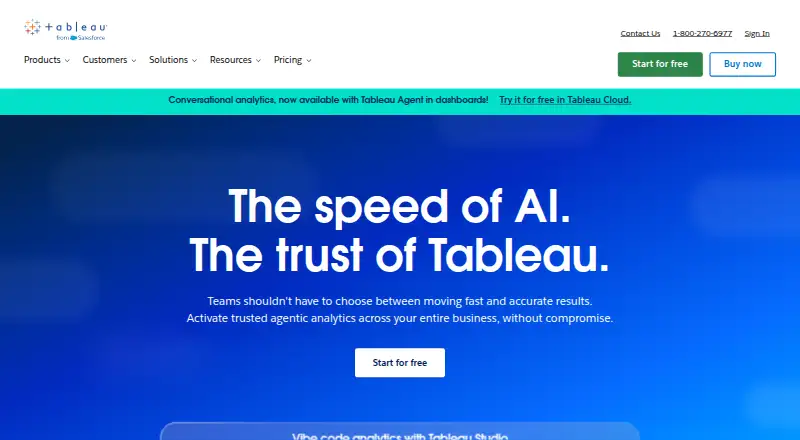
What Tableau is
Tableau is a data analytics platform for building dashboards, visualizations, and data apps. It offers hosted cloud and self-hosted server deployments, and dashboards and data apps can be brought into multiple work surfaces. Tableau Creator can connect to any type of data, while users can ask natural-language questions for AI-powered insights. Tableau Agent provides conversational analytics within dashboards; a knowledge engine and semantic layer support consistent metrics. Teams can publish and author content, share insights, schedule subscriptions, and send notifications. Tableau Cloud supports secure sharing, and row-level security and embedded analytics are also supported. Tableau Viewer includes mobile access. The product supports integrations and work surfaces including Slack, Teams, Claude, ChatGPT, CRM, and agent surfaces. Tableau has a free plan and free trial, and Tableau Desktop is free to download. Listed annual-billing prices are $15 a month for Viewer, $42 a month for Explorer, and $75 a month for Creator; the provided pages also say paid pricing requires contacting sales.
Good
- Creator can connect to any type of data
- Supports natural-language questions for AI-powered insights
- Offers hosted cloud and self-hosted server deployments
- Tableau Desktop is free to download
Watch out
- Listed paid prices are billed annually
- Creator, Explorer, and Viewer pricing may require contacting sales
- Free trial availability does not specify its duration
Who it suits
Tableau suits teams that need to build and share dashboards, visualizations, or data apps across cloud or self-hosted deployments. Natural-language analytics and mobile viewing may also suit users who want to explore or access insights in those ways.
Verdict
Tableau combines analytics, dashboard creation, and team sharing across hosted and self-hosted options. A free plan and free Desktop download are available, while paid prices are listed with annual billing and may require a sales contact.
Plans and prices
From Tableau's own pricing page, checked 22 Sep 2026.
| Plan | Price | What it gives you |
|---|---|---|
| Creator | $75 a month | Every new deployment requires a Creator license · 1 Creator license · billed annually |
| Explorer | $42 a month | 1 Explorer license · billed annually |
| Viewer | $15 a month | 1 Viewer license · billed annually |
| Enterprise Creator | $115 a month | Every deployment requires a Creator · 1 Creator license · billed annually |
| Enterprise Explorer | $70 a month | 1 Explorer license · billed annually |
| Enterprise Viewer | $35 a month | 1 Viewer license · billed annually |
| Tableau+ | — | Up to 50 sites |
| Tableau+ | Priced on request | Up to 50 sites |
| Tableau Creator | Priced on request | Contact for pricing |
| Tableau Desktop | Free | Now free; download for free |
| Tableau Explorer | Priced on request | Contact for pricing |
| Tableau Viewer | Priced on request | Contact for pricing |
The facts
Each one read from Tableau's own pages, with the date it was checked.
What it does
- AI Analytics
- Tableau Agent provides conversational analytics in dashboards.checked 27 Sep 2026
- Data Connections
- Tableau Creator can connect to any type of data.checked 27 Sep 2026
- Deployment
- hybridchecked 22 Sep 2026
- Deployment Options
- Tableau offers hosted cloud and self-hosted server deployments.checked 27 Sep 2026
- Embedded analytics
- Yeschecked 22 Sep 2026
- Knowledge Layer
- Tableau uses a knowledge engine and semantic layer for consistent metrics.checked 27 Sep 2026
- Mobile Access
- Tableau Viewer includes mobile access.checked 27 Sep 2026
- Natural Language
- Users can ask questions in natural language for AI-powered insights.checked 27 Sep 2026
- Natural-language queries
- Yeschecked 22 Sep 2026
- Paid from
- 15checked 22 Sep 2026
- Paid Pricing
- Creator, Explorer, and Viewer pricing requires contacting sales.checked 27 Sep 2026
- Refresh frequency
- real-timechecked 22 Sep 2026
- Regulated Industries
- Tableau Server is positioned for organizations in highly regulated industries.checked 27 Sep 2026
- Row-level security
- Yeschecked 22 Sep 2026
- Scheduled reports
- Yeschecked 22 Sep 2026
Where it runs
- App Integrations
- Tableau can operate across Slack, Teams, Claude, ChatGPT, CRM, and agent surfaces.checked 27 Sep 2026
Money
- Billing Terms
- The provided pages do not state a billing frequency or refund policy.checked 27 Sep 2026
- Free Desktop
- Tableau Desktop is now free to download.checked 27 Sep 2026
- Free plan
- Yeschecked 22 Sep 2026
- Free Trial
- A free trial is available for Tableau.checked 27 Sep 2026
The company
- Company Location
- Salesforce lists its address in San Francisco, United States.checked 27 Sep 2026
- Company Owner
- Tableau is a Salesforce company.checked 27 Sep 2026
- Founded
- 2003checked 23 Sep 2026
- Headquarters
- Seattle, Washington, United Stateschecked 23 Sep 2026
The full review of Tableau
Overview
Tableau is an analytics platform for turning data into dashboards, visualizations, and data apps, with hosted cloud and self-hosted server options. It suits teams that need to explore data and share governed insights across roles and work surfaces. Its breadth is a strength, but the role-based paid plans and sales-led pricing make it harder to assess the full cost before choosing.
Key features
Tableau supports real-time refresh, scheduled reports, subscriptions, notifications, and row-level security. Together, these capabilities suit teams that need current reporting and controlled access rather than static charts alone. Creator can connect to any type of data, while Explorer and Viewer plans divide authoring and consumption into distinct roles.
Dashboards, visualizations, and data apps can be brought into multiple work surfaces, including CRM, Slack, Teams, Claude, and ChatGPT. Tableau also supports embedded analytics and natural-language questions for AI-powered insights; Tableau Agent adds conversational analytics within dashboards. Its knowledge engine and semantic layer are intended to keep metrics consistent, a useful foundation when teams share analysis across tools.
Deployment flexibility is a meaningful advantage: Tableau Cloud supports secure sharing, while Tableau Server is positioned for organizations in highly regulated industries. Mobile access is included with Viewer. Tableau also provides help, knowledge-base, training, certification, and community resources.
Pricing
Tableau combines a free plan with paid role-based licenses. The available annual-billing prices are:
| Plan | Price | License detail |
|---|---|---|
| Creator | $75 a month (billed annually) | 1 Creator license; every new deployment requires a Creator license |
| Explorer | $42 a month (billed annually) | 1 Explorer license |
| Viewer | $15 a month (billed annually) | 1 Viewer license |
| Enterprise Creator | $115 a month (billed annually) | 1 Creator license; every deployment requires a Creator license |
| Enterprise Explorer | $70 a month (billed annually) | 1 Explorer license |
| Enterprise Viewer | $35 a month (billed annually) | 1 Viewer license |
Creator is the authoring-oriented choice for teams that need broad data connections, and its required license for each new deployment can raise costs as environments multiply. Explorer and Viewer provide lower-cost entry points for people in those roles, but they are not substitutes for Creator when a deployment needs its Creator license. Enterprise editions cost more across all three roles.
Tableau Desktop is free to download, and a free trial is available. Those offers provide ways to start without immediately buying a paid seat, but the free Desktop download should not be confused with a paid team deployment. Tableau+ is priced for up to 50 sites; Tableau Explorer, Tableau Creator, and Tableau Viewer plans require contacting sales. Tableau’s pricing model is freemium, while paid role-based prices are billed annually.
Platforms
Tableau offers cloud and server deployments, alongside integration across CRM, Slack, Teams, Claude, and ChatGPT. It is also described as self-hosted, making it relevant to organizations weighing hosted sharing against server deployment. Viewer includes mobile access. The listed platform support centers on these deployment and work surfaces rather than a broad list of standalone device operating systems.
Who it's for
Tableau is best suited to organizations that need analytics shared across creators, explorers, and viewers, especially when real-time refresh, row-level access controls, embedded dashboards, or multiple deployment options matter. Teams with regulated-industry requirements may find Server’s positioning relevant; teams that want insights to travel through collaboration and AI surfaces can use its integrations and conversational analytics.
It is a less natural fit for an individual seeking a simple, fully priced self-service purchase: the free Desktop download helps, but team deployment costs depend on role licenses and some offerings require a sales contact.
Pros and cons
- Pros: Real-time refresh, scheduled reports, subscriptions, notifications, and row-level security support recurring, controlled reporting.
- Pros: Cloud and self-hosted Server options give organizations a choice of deployment approach.
- Pros: Free Desktop download and a free plan lower the barrier to getting started.
- Cons: Every new deployment requires a Creator license, which can complicate budgets for multi-deployment setups.
- Cons: Annual billing and sales-contact pricing for several plans make total cost less straightforward to compare.
- Cons: The role-based license structure means cheaper Explorer and Viewer seats serve narrower roles than Creator.
Alternatives
Microsoft Power BI is worth considering for readers who want a free account for personal reports and dashboards, with Android, iOS, and Windows support; report sharing requires an upgrade to Pro or Premium.
Zoho Analytics may suit a small team that values a clearly bounded free tier: 2 users, 10,000 rows, and 5 workspaces. Its Basic plan is $24 a month billed annually.
Sisense is a paid alternative with a free trial and a self-serve plan that includes data connections, natural-language queries, auto-narratives, and an assistant.
Apache Superset is the alternative to consider for a free, open-source, self-managed data exploration and visualization platform.
Qlik Sense is a paid alternative with a free trial; its Starter plan is $300 a month for 10 users, billed annually.
ManageEngine Analytics Plus offers a free Personal plan for one user, with 10,000 rows and 5 workspaces.
Looker is a paid alternative with a free trial and a Standard plan that includes one production instance, 10 Standard Users, and 2 Developer Users.
Pyramid Analytics offers a free Community Edition for 3 users.
Readers comparing categories can also browse Business Intelligence Tools, Data Visualization Software, Data Preparation Software, Semantic Layer Software, Data Transformation Tools, and Infographic Software.
Verdict
Choose Tableau if your organization needs analytics that can be authored, governed, and shared across roles and cloud or server deployments. Its combination of real-time reporting, access controls, integrations, and free Desktop download is compelling for that use. Look elsewhere if you need a simple, predictable team price or a free tier with clearly stated user and data caps: Tableau’s role licenses and sales-led offerings make those comparisons harder.