
Apache Spark
Apache Spark is a free, open-source engine for large-scale data analytics.
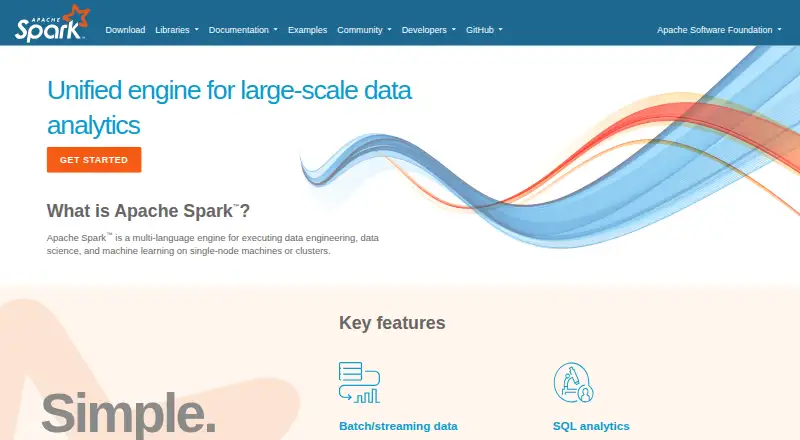
What Apache Spark is
Apache Spark is a free, open-source engine for large-scale data analytics. It handles batch workloads and real-time streams with Python, SQL, Scala, Java, or R. Spark SQL runs distributed ANSI SQL queries across structured tables and unstructured formats such as JSON or images; MLlib supplies machine-learning algorithms for local use or cluster scale. The project also describes exploratory analysis at petabyte scale without downsampling. Its ecosystem includes pandas, TensorFlow, PyTorch, scikit-learn, Apache Kafka, Kubernetes, Delta Lake, and Apache Iceberg. Deployment choices include standalone, Hadoop YARN, and Kubernetes. Spark runs on Windows, Linux, and macOS when a supported Java version is available. The 4.2.0 documentation lists Java 17, 21, or 25, Scala 2.13, Python 3.10+, and R 4.0+ (deprecated). Spark Connect enables remote client-to-cluster connectivity. Security features are not enabled by default, though TLS is supported for RPC and temporary local-disk data can be encrypted. The project is licensed under Apache License, Version 2.0.
Good
- Free, open-source analytics engine.
- Processes batch data and real-time streams.
- MLlib algorithms can scale from local use to clusters.
- Supports several deployment options, including Kubernetes.
- Spark Connect supports remote connectivity.
Watch out
- Security features are not enabled by default.
- R 4.0+ is listed as deprecated.
- Requires a supported Java version.
Who it suits
Spark suits teams working with large-scale batch or streaming analytics, SQL, or machine-learning workloads. It can fit environments using the listed languages, platforms, and deployment options.
Verdict
Apache Spark brings data processing, SQL, and machine-learning capabilities into one engine, with multiple deployment choices. Review its runtime requirements and plan security configuration before deployment.
Plans and prices
From Apache Spark's own pricing page, checked 30 Sep 2026.
| Plan | Price | What it gives you |
|---|---|---|
| Apache Spark | Free | Open-source distributed data analytics engine · download, PyPI, Maven Central, and Docker options |
The facts
Each one read from Apache Spark's own pages, with the date it was checked.
What it does
- Batch and streaming
- Spark processes data in batches and real-time streams using Python, SQL, Scala, Java, or R.checked 30 Sep 2026
- Client connectivity
- Spark Connect separates client applications from Spark clusters and supports remote connectivity.checked 30 Sep 2026
- Data science
- The project says Spark supports exploratory data analysis on petabyte-scale data without downsampling.checked 30 Sep 2026
- Deployment
- Spark documents standalone, Hadoop YARN, and Kubernetes deployment options.checked 30 Sep 2026
- Encryption
- Spark supports TLS encryption for RPC connections and encryption of temporary data written to local disks.checked 30 Sep 2026
- Integrations
- The listed ecosystem includes pandas, TensorFlow, PyTorch, scikit-learn, Apache Kafka, Kubernetes, Delta Lake, and Apache Iceberg.checked 30 Sep 2026
- License
- The project website states Apache Spark is licensed under the Apache License, Version 2.0.checked 30 Sep 2026
- Operating systems
- Spark runs on Windows and UNIX-like systems, including Linux and macOS, where a supported Java version is available.checked 30 Sep 2026
- Purpose
- Apache Spark is a unified engine for large-scale data analytics.checked 30 Sep 2026
- Release and runtime requirements
- The 4.2.0 documentation lists Java 17, 21, or 25, Scala 2.13, Python 3.10+, and R 4.0+ (deprecated).checked 30 Sep 2026
- Security
- Security features such as authentication are not enabled by default, and the documentation says deployments are not secure by default.checked 30 Sep 2026
- SQL
- Spark SQL executes distributed ANSI SQL queries and supports structured tables and unstructured data such as JSON or images.checked 30 Sep 2026
- Support
- The project directs users to mailing lists and community resources for help.checked 30 Sep 2026
The company
- Founded
- 2009checked 28 Sep 2026
Where it runs
- Machine learning
- MLlib provides machine-learning algorithms that can run locally and scale to clusters.checked 30 Sep 2026
The full review of Apache Spark
Apache Spark is a free, open-source engine for large-scale analytics, combining processing, SQL, streaming, and machine learning in one code-driven platform. It suits data teams that can operate distributed infrastructure; readers wanting a managed service with minimal administration should look elsewhere. The main attraction is workload breadth, while runtime planning and security configuration remain your responsibility.
Overview
Founded in 2009 and released under the Apache License, Version 2.0, Spark is designed to run analytics across large datasets. It supports batch jobs and real-time streams, incremental loading, change data capture, and custom-code transformations, so it can serve both data-integration pipelines and analytical workloads.
You can deploy it standalone, through Hadoop YARN, or on Kubernetes. Spark Connect separates client applications from clusters and provides remote connectivity, which is useful when applications and compute resources need to be managed independently. This flexibility is valuable for organizations with established cluster operations, but it also means choosing and maintaining an operating model rather than signing up for a hosted workspace.
Key features
Batch, streaming, and SQL
Spark processes data in batches or as real-time streams using Python, SQL, Scala, Java, or R. That common engine can reduce the need to build separate processing paths for scheduled and continuously arriving data. Spark SQL runs distributed ANSI SQL queries over structured tables and unstructured inputs, including JSON and images, making it practical for teams whose data is not limited to relational tables.
Machine learning and data science
MLlib provides machine-learning algorithms that can run on a local machine or scale across clusters. Spark also supports exploratory analysis on petabyte-scale datasets without downsampling, giving data scientists a route from investigation to larger production workloads. The trade-off is that users must bring the programming and operational expertise needed to design distributed jobs.
Ecosystem and connectivity
Integrations include pandas, TensorFlow, PyTorch, scikit-learn, Apache Kafka, Kubernetes, Delta Lake, and Apache Iceberg. This broad ecosystem helps teams connect Spark with familiar data-science tools, streaming infrastructure, and table formats instead of replacing every component. Spark runs on Windows and UNIX-like systems, including Linux and macOS, when a supported Java version is installed.
Security
Authentication and other security protections are not enabled by default, and deployments are not secure by default. Spark supports TLS for RPC connections and encryption for temporary data written to local disks, but administrators must configure those protections and the surrounding deployment correctly. That is a significant consideration for sensitive or network-accessible workloads.
Pricing
Apache Spark is free software with no free trial because the project itself is open source.
| Plan | Price | What you get |
|---|---|---|
| Apache Spark | free | Open-source distributed data analytics engine, with download, PyPI, Maven Central, and Docker options. |
There are no stated seat charges, usage quotas, or commercial tiers in this plan. The saving is substantial for teams able to supply their own compute and administration; infrastructure, deployment, and security work are not replaced by the zero software price.
Platforms
Spark is offered for API use, Linux, macOS, Windows, and self-hosted deployments. The 4.2.0 documentation lists Java 17, 21, or 25, Scala 2.13, Python 3.10 or newer, and R 4.0 or newer, with R marked deprecated. Check those runtime requirements before standardizing an environment.
Who it's for
Spark is a strong fit for engineering and data-science teams that need one engine for distributed SQL, batch pipelines, streaming, and machine learning, particularly when they already operate Kubernetes, Hadoop, or standalone clusters. It is also relevant to integration teams needing incremental loads, change data capture, and custom transformations. It is a poor fit for buyers seeking a turnkey hosted product, a graphical workflow-first experience, or security that is safe without explicit configuration. Project support is provided through mailing lists and community resources.
Pros and cons
- Pro: One engine covers batch and real-time streams, distributed SQL, and machine learning, reducing the need to split related workloads across products.
- Pro: Multiple language APIs and integrations with major data-science, streaming, orchestration, and table-format projects support varied existing stacks.
- Pro: Local execution can scale to clusters, allowing machine-learning and exploratory work to grow with data volume.
- Con: Authentication is off by default and deployments are not secure by default, so production use requires deliberate security administration.
- Con: Several deployment choices and strict runtime versions create operational work that a managed analytics service would absorb.
- Con: R support is deprecated, limiting its appeal for teams that depend on R as a primary production interface.
Alternatives
Choose Apache Beam when you want an open-source programming model whose execution costs depend on the runner and infrastructure you select. Apache NiFi is another free Apache-licensed option when its flow-oriented platform better matches your needs.
Skyvia is the better choice for a hosted, freemium workflow: its free plan allows 10,000 records per month, two scheduled integrations, once-daily scheduling, and 30-day schedule expiration. EasyMorph suits users wanting a desktop-oriented free tier, though its plan is restricted to 20 actions and 20 loop iterations per project.
Apache Hop provides another free open-source platform, while Keboola offers a freemium hosted approach with limited monthly compute and paid overage. Jitterbit Harmony is a paid integration platform with a free trial and stated connection and support tiers. Ab Initio Data Platform is a paid alternative requiring a free proof of concept before purchase.
Verdict
Choose Apache Spark if your team needs a broad, open-source foundation for distributed processing, SQL, streaming, and machine learning and can run the required infrastructure. Its free licensing and extensive ecosystem are the core reasons to adopt it. Look elsewhere if you want managed operations, default-secure deployment, or a simpler path from setup to production.
Alternatives to Apache Spark
- 1

Apache Beam
Free planOpen sourceWebAPILinuxmacOS7.7Free plan - 2
Apache Druid
Free planWebAPILinuxmacOS7.2Free plan - 3

Confluent Cloud
Free planWebAPILinux7.1From $385 a month - 4
Timeplus
Free planWebAPILinuxmacOS7.1From $199 a month - 5

Materialize
Free planWebAPILinuxSelf-hosted7.0From $1.50 a year - 6

RisingWave
WebAPILinuxmacOS6.7$0.23 usage-based