Apache Druid
Apache Druid is an open-source database for real-time analysis of streaming and batch data.
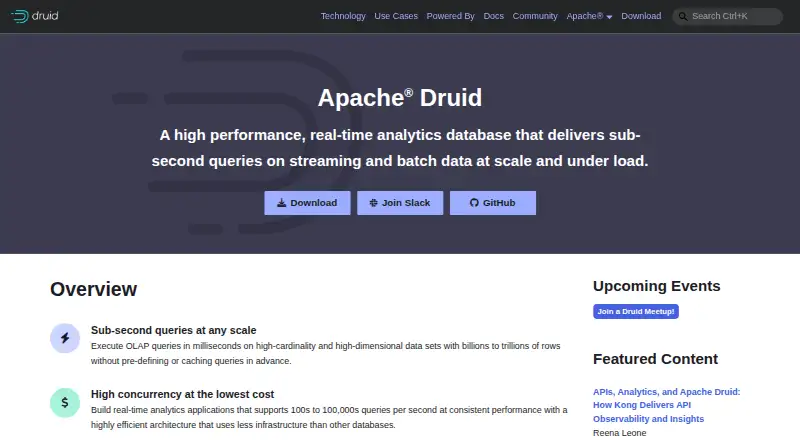
What Apache Druid is
Apache Druid is an open-source database for real-time analysis of streaming and batch data. It is designed to answer analytics queries in milliseconds, including on high-cardinality datasets with billions to trillions of rows. The project describes workloads ranging from hundreds to 100,000 queries per second. Native Kafka and Amazon Kinesis integrations support low-latency ingestion and querying as data arrives. Druid organizes ingested data into compressed, indexed columns, with time indexing and dictionary and bitmap indexes. Queries can use Druid SQL or JSON-over-HTTP native queries, and joins are supported during ingestion or at query time. Its web console can load data, manage datasources and tasks, show server status and segments, and run queries. Extensions connect to storage, databases, and file formats including S3, HDFS, Azure, PostgreSQL, Avro, ORC, and Parquet. Druid is free and self-hostable on Linux, macOS, and other Unix-like systems; Windows is not supported. The local quickstart requires at least 6 GiB of RAM and Java 17. Security controls are disabled by default, so production deployments need TLS, authentication, and authorization configured.
Good
- Free and open source, with self-hosting.
- Native Kafka and Kinesis integrations support streaming ingestion.
- Supports Druid SQL and JSON-over-HTTP queries.
- Web console manages data, tasks, and queries.
Watch out
- Windows is not supported.
- Quickstart requires at least 6 GiB RAM and Java 17.
- Production security controls require manual configuration.
Who it suits
Druid suits teams building user-facing analytics or working with streaming data that need low-latency, concurrent queries and quick visibility into incoming data. It can also serve ad hoc analysis of semi-structured data such as JSON.
Verdict
Apache Druid combines streaming ingestion with fast analytics queries and a web console for administration. Check the quickstart requirements and plan to configure production security before deployment.
Plans and prices
From Apache Druid's own pricing page, checked 2 Oct 2026.
| Plan | Price | What it gives you |
|---|---|---|
| Apache Druid | Free | Open source analytics database · Downloadable for self-hosting |
The facts
Each one read from Apache Druid's own pages, with the date it was checked.
What it does
- Architecture
- Loosely coupled ingestion, query, and orchestration components with deep storage support scale-up and scale-out.checked 1 Oct 2026
- Authentication options
- Documented authenticator extensions include HTTP Basic authentication, LDAP, and Kerberos.checked 2 Oct 2026
- Concurrency
- The project describes Druid as supporting workloads from hundreds to tens of thousands of queries per second at consistent performance.checked 2 Oct 2026
- Deployment
- Druid can run on commodity hardware in *NIX environments and is designed to run in AWS, GCP, Azure, and other cloud environments.checked 2 Oct 2026
- Extensions
- Core extensions add support for storage, metadata stores, formats, authentication, and other capabilities; examples include S3, HDFS, Azure, Kafka, and PostgreSQL.checked 2 Oct 2026
- Ingestion
- Druid integrates natively with Apache Kafka and Amazon Kinesis for low-latency streaming ingestion and query-on-arrival.checked 2 Oct 2026
- Integrations
- Core extensions support systems and formats including S3, HDFS, Google Cloud Storage, Azure, Kafka, Kinesis, Avro, ORC, Parquet, MySQL, and PostgreSQL.checked 1 Oct 2026
- Intended workloads
- The FAQ recommends considering Druid for user-facing applications, low-latency high-concurrency queries, instant data visibility, ad hoc exploration, and streaming data.checked 2 Oct 2026
- Latest release
- The latest stable release is Apache Druid 37.0.0, released May 8, 2026.checked 1 Oct 2026
- License
- Apache Druid and its documentation are licensed under the Apache License, Version 2.0.checked 1 Oct 2026
- Notable limitation
- The FAQ says Druid is not commonly used for full-text search over text logs, though it is often used to ingest and analyze semi-structured data such as JSON.checked 2 Oct 2026
- OLAP scale
- Druid executes OLAP queries in milliseconds on high-cardinality datasets containing billions to trillions of rows.checked 1 Oct 2026
- Operating systems
- The quickstart supports Linux, Mac OS X, and other Unix-like operating systems; Windows is not supported.checked 1 Oct 2026
- Purpose
- Apache Druid is a high-performance real-time analytics database for sub-second queries on streaming and batch data at scale.checked 1 Oct 2026
- Query languages
- Druid supports both Druid SQL and JSON-over-HTTP native queries.checked 1 Oct 2026
- Query performance
- The project says Druid can execute OLAP queries in milliseconds over datasets with billions to trillions of rows.checked 2 Oct 2026
- Reliability
- Druid provides continuous backup, automated recovery, and multi-node replication for high availability and durability.checked 1 Oct 2026
- Security
- Security features include TLS, authentication, and authorization, but they are disabled by default and the documentation says to configure them for production.checked 2 Oct 2026
- SQL and joins
- Druid provides a SQL API and supports joins during ingestion and at query time.checked 2 Oct 2026
- Storage and indexing
- Ingested data is columnarized, time-indexed, dictionary-encoded, bitmap-indexed, and compressed.checked 2 Oct 2026
- Storage format
- Druid automatically columnarizes, time-indexes, dictionary-encodes, bitmap-indexes, and compresses ingested data.checked 1 Oct 2026
- Streaming
- Native Apache Kafka and Amazon Kinesis integrations provide query-on-arrival, ingestion at millions of events per second, low latency, and guaranteed consistency.checked 1 Oct 2026
- Support
- The project directs users to its community network for help using Druid.checked 2 Oct 2026
- System requirement
- The local quickstart requires a machine with at least 6 GiB of RAM and Java 17.checked 1 Oct 2026
The full review of Apache Druid
Overview
Apache Druid is an open-source analytics database built for low-latency analysis of streaming and batch data. It targets workloads that need quick answers over large datasets, including user-facing applications, interactive exploration, and systems that must make new events available promptly.
The project describes OLAP queries running in milliseconds over high-cardinality data sets with billions to trillions of rows. Druid is designed to serve use cases ranging from hundreds to 100,000 queries per second while maintaining consistent performance. Those figures describe the system's stated capabilities, not a guarantee for every deployment: actual results depend on the data and infrastructure.
It combines ingestion, query, and orchestration components that can scale independently, with deep storage supporting scale-up and scale-out deployments. The project lists Apache Druid 37.0.0 as its latest stable release, released May 8, 2026. Its software and documentation use the Apache License, Version 2.0.
Key features
Streaming ingestion and query-on-arrival
Native integrations for Apache Kafka and Amazon Kinesis support low-latency streaming ingestion and queries on newly arriving data. Druid is designed for ingestion at millions of events per second with guaranteed consistency. It can also work with batch data, giving teams a database for both continuously arriving events and larger analytical datasets.
Indexed, columnar storage
As data is ingested, Druid automatically converts it to columnar form, indexes it by time, dictionary-encodes values, builds bitmap indexes, and compresses it. These structures are intended to support fast analytical queries, including searches across data with many distinct values.
Querying and management
Users can query through Druid SQL or native JSON-over-HTTP requests. SQL is the listed query language, and Druid supports joins both during ingestion and at query time. Its web console can load data, manage datasources and ingestion tasks, show server status and segments, and run SQL or native queries.
Extensions, recovery, and security
Core extensions connect Druid to storage systems, metadata stores, data formats, and other services. Supported examples include S3, HDFS, Google Cloud Storage, Azure, Kafka, Kinesis, Avro, ORC, Parquet, MySQL, and PostgreSQL. Reliability features include continuous backup, automated recovery, and multi-node replication.
Security needs deliberate setup: Druid's security features are disabled by default, so production deployments must configure TLS, authentication, and authorization. Documented authenticator extensions include HTTP Basic authentication, LDAP, and Kerberos.
Pricing
Apache Druid is free and open source. The listed plan is free, described as an open-source analytics database downloadable for self-hosting. No paid plan price is listed. The project directs users to Slack and GitHub for community help and lists Cloudera, Datumo, Deep.BI, Imply, and Rill Data as commercial support providers.
Platforms
Druid is available for self-hosted deployment and is listed for Linux, macOS, web, and API use. The local quickstart supports Linux, Mac OS X, and other Unix-like operating systems; Windows is not supported. Running the quickstart locally requires at least 6 GiB of RAM and Java 17. Druid can run on commodity hardware in *NIX environments and is designed for cloud deployments on AWS, GCP, Azure, and other providers.
Who it's for
Druid is aimed at teams building applications or analytics workflows that depend on low-latency queries, high concurrency, prompt visibility into new data, or ad hoc exploration. It is particularly relevant when streaming data is central to the workload, while its batch-data support broadens its use beyond live event pipelines.
It is less suited to full-text search over text logs, which the project says is not a common Druid use case. It can, however, ingest and analyze semi-structured data such as JSON. Deployment also calls for operational care: the local quickstart has defined Java and memory requirements, and production use requires configuring security rather than relying on defaults.
Pros and cons
Pros
- Built for low-latency OLAP queries over very large datasets.
- Native Kafka and Kinesis integrations support streaming ingestion and query-on-arrival.
- Automatic columnarization, time indexing, encoding, bitmap indexing, and compression prepare ingested data for analysis.
- Offers SQL and native JSON-over-HTTP queries, plus a web console for data and task management.
- Free, open-source software with a broad set of core extensions and cloud deployment options.
Cons
- Windows is not supported by the local quickstart.
- The quickstart requires Java 17 and at least 6 GiB of RAM.
- Security features are off by default and require configuration for production.
- Full-text search over text logs is not a typical use case.
Alternatives
For other streaming-oriented systems, consider Apache Beam, Apache Storm, Feldera, Timeplus, RisingWave, Materialize, or Confluent Cloud. Apache Spark is another option to explore for data processing needs.
For browsing by category, see Streaming Analytics Software, OLAP Databases, OLAP Software, Columnar Databases, and Database Software.
Verdict
Apache Druid is a focused choice for analytics systems where fast queries, substantial concurrency, and timely access to streaming data matter. Its SQL and native query interfaces, web console, storage indexing, and integration extensions make it suitable for a range of ingestion and analysis setups. It is not a turnkey choice for every environment: operators need to meet its local runtime requirements, configure production security, and select another approach if full-text log search is the primary requirement.
Getting started
- Visit https://druid.apache.org/
- Download Apache Druid for self-hosting on Linux, macOS, or another Unix-like operating system
- Prepare a machine with Java 17 and at least 6 GiB of RAM for the local quickstart
- Use the web console to load data, manage datasources and tasks, and run SQL or native queries
- Configure TLS, authentication, and authorization for a production deployment
Limits worth knowing
The local quickstart requires Java 17 and at least 6 GiB of RAM, and Windows is unsupported. Security features are disabled by default, so production deployments need TLS, authentication, and authorization configured.
Questions
How much does Apache Druid cost?
The listed plan is free. Apache Druid is open source under Apache License 2.0.
Can I use Apache Druid for free?
Yes. The listed plan is free and downloadable for self-hosting.
Which platforms does it support?
The listed platforms include API, Linux, macOS, self-hosted, and web. The quickstart supports Linux, Mac OS X, and other Unix-like systems; Windows is not supported.
What languages can I query it with?
Druid supports Druid SQL and native JSON-over-HTTP queries.
Which streaming systems does it integrate with?
Native integrations are provided for Apache Kafka and Amazon Kinesis. Core extensions also support systems including S3, HDFS, Google Cloud Storage, Azure, MySQL, and PostgreSQL.
What does the local quickstart require?
It requires Java 17 and a machine with at least 6 GiB of RAM.
Alternatives to Apache Druid
- 1

Apache Beam
Free planOpen sourceWebAPILinuxmacOS7.7Free plan - 2

Confluent Cloud
Free planWebAPILinux7.1From $385 a month - 3
Timeplus
Free planWebAPILinuxmacOS7.1From $199 a month - 4

Materialize
Free planWebAPILinuxSelf-hosted7.0From $1.50 a year - 5

RisingWave
WebAPILinuxmacOS6.7$0.23 usage-based - 6

Tinybird Cloud
Free planWebAPI6.7From $49 a month