Feldera
Feldera is an incremental view maintenance engine that keeps SQL views in sync as input data changes, alongside a lakehouse or warehouse.
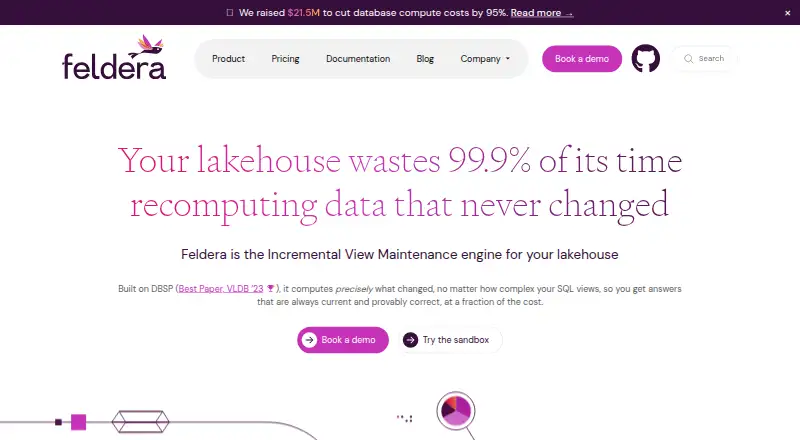
What Feldera is
Feldera is an incremental view maintenance engine that keeps SQL views in sync as input data changes, alongside a lakehouse or warehouse. Rather than recomputing an entire dataset after each change, it updates views in proportion to the change. SQL support includes window functions and recursive queries. Documented inputs include Kafka, Google Pub/Sub, NATS, PostgreSQL, AWS S3, Delta Lake, and Apache Iceberg. Outputs include Kafka, Delta Lake, PostgreSQL, Redis, DynamoDB, Snowflake, and Iceberg; some output connectors are marked experimental. The open-source edition is free and provides a single-node, single-container deployment, full SQL support, all connectors, datasets larger than memory, and community support through Slack. Docker is available for local development, testing, and prototyping, as is an online sandbox. Enterprise runs on a customer-provided cloud or Kubernetes cluster and adds multi-node deployments, fault tolerance, resource isolation, and dedicated support. Its documentation says enterprise data stays on the customer's premises. Enterprise pricing is custom, and pipeline scale-out is listed as coming soon.
Good
- Incremental updates avoid recalculating the full dataset.
- SQL support includes window functions and recursive queries.
- The open-source edition includes all connectors.
- A free online sandbox is available.
- Enterprise data stays on the customer's premises.
Watch out
- The open-source edition is limited to a single node.
- Several output connectors are marked experimental.
- Pipeline scale-out is listed as coming soon.
- Enterprise pricing is custom and not listed.
Who it suits
Feldera suits teams that need SQL views to stay current as source data changes, including those building real-time medallion architectures, fraud detection feature engineering, or fine-grained authorization. The free edition is suited to single-node use; enterprise deployments target teams needing multi-node capabilities and dedicated support.
Verdict
Feldera focuses on incremental SQL view maintenance, with a free single-node edition and a self-hosted enterprise offering. Check connector status and deployment needs against the capabilities of the tier you plan to use.
Plans and prices
From Feldera's own pricing page, checked 28 Sep 2026.
| Plan | Price | What it gives you |
|---|---|---|
| Open source edition | Free | Single node · single container · full SQL support · all connectors · datasets larger than memory · community support |
| Enterprise edition | Priced on request | Self-hosted on your Kubernetes clusters · multi-node deployments · multi-tenant isolation · dedicated support · Custom pricing |
The facts
Each one read from Feldera's own pages, with the date it was checked.
What it does
- Community support
- The open source edition provides community support through Slack.checked 28 Sep 2026
- Deployment
- Feldera offers Docker for local development, testing, and prototyping, a free online sandbox, and an enterprise offering for production.checked 28 Sep 2026
- Enterprise capabilities
- Enterprise adds multi-node clusters, pipeline and control-plane fault tolerance, resource isolation, and dedicated support; pipeline scale-out is listed as coming soon.checked 28 Sep 2026
- Enterprise hosting
- Enterprise runs on a customer-provided cloud or Kubernetes cluster, and the documentation says data never leaves the customer's premises.checked 28 Sep 2026
- Incremental updates
- When input tables change, Feldera incrementally updates views in proportion to the change rather than the full dataset.checked 28 Sep 2026
- Inputs
- Documented input connectors include Kafka, Google Pub/Sub, NATS, PostgreSQL, AWS S3, Delta Lake, and Apache Iceberg.checked 28 Sep 2026
- Outputs
- Documented output connectors include Kafka, Delta Lake, PostgreSQL, Redis, DynamoDB, Snowflake, and Iceberg; several are marked experimental.checked 28 Sep 2026
- Performance
- The product page says Feldera can process complex pipelines with millions of changes per second, including on a laptop.checked 28 Sep 2026
- Purpose
- Feldera is an incremental view maintenance engine that keeps SQL views in sync with changing data and works alongside a lakehouse or warehouse.checked 28 Sep 2026
- Security
- The Trust Center lists SOC 2 Type 1 and Type 2 compliance and offers access to security documentation, including a penetration test report and SOC 2 report.checked 28 Sep 2026
- SQL support
- Feldera supports SQL including window functions and recursive queries.checked 28 Sep 2026
- Use cases
- Feldera presents real-time medallion architectures, fraud detection feature engineering, and fine-grained authorization as use cases.checked 28 Sep 2026
The company
- Company history
- Feldera says its founders had worked on incremental computation challenges since 2018 and that its technology had run in production at VMware since 2021.checked 28 Sep 2026
The full review of Feldera
Overview
Feldera maintains SQL views as input data changes, for teams that need continuously updated results alongside a lakehouse or warehouse. Its strongest case is incremental SQL processing; production teams needing distributed deployment and dedicated support must choose the custom-priced enterprise edition.
It supports stateful processing and event-time windows, and SQL includes window functions and recursive queries. Feldera cites complex pipelines handling millions of changes per second, including on a laptop; that claim makes it worth evaluating, but workload requirements should determine whether it fits a particular deployment.
Key features
Incremental SQL processing
Rather than rebuilding a view from an entire dataset after each change, Feldera updates it in proportion to the input change. That is useful when continuously changing data would make repeated full recomputation costly, while support for window functions and recursive queries accommodates more involved SQL transformations.
Connectors and deployment
Documented inputs include Kafka, Google Pub/Sub, NATS, PostgreSQL, AWS S3, Delta Lake, and Apache Iceberg. Outputs include Kafka, Delta Lake, PostgreSQL, Redis, DynamoDB, Snowflake, and Iceberg; several output connectors are experimental. Teams relying on one of those outputs should account for that status before using it in a production design.
Docker supports local development, testing, and prototyping, and a free online sandbox provides another way to explore Feldera. The open-source edition is single-node and single-container; production enterprise deployments run on customer-provided cloud or Kubernetes infrastructure. Feldera says enterprise data never leaves the customer's premises.
Enterprise and security
Enterprise adds multi-node clusters, pipeline and control-plane fault tolerance, resource isolation, multi-tenant isolation, and dedicated support. Pipeline scale-out is coming soon, so teams should not treat it as an existing capability. The Trust Center lists SOC 2 Type 1 and Type 2 compliance and offers security documentation, including penetration-test and SOC 2 reports.
Pricing
Open source edition: free. It includes a single node in a single container, full SQL support, all connectors, datasets larger than memory, and community support. This is a substantial way to build and evaluate a single-node setup, but it does not include enterprise multi-node deployment, isolation, or dedicated support.
Enterprise edition: custom pricing. It is self-hosted on your Kubernetes clusters and includes multi-node deployments, multi-tenant isolation, and dedicated support. This is the relevant tier for production teams that need those capabilities; its custom pricing means the free edition is the only option with a stated price.
Community support for the open-source edition is through Slack. Feldera's enterprise offering also includes dedicated support.
Platforms
Feldera lists API, Linux, macOS, self-hosted, web, and Windows platforms. Its deployment model is hybrid: local Docker and an online sandbox serve development and exploration, while enterprise production runs in the customer's cloud or Kubernetes cluster.
Who it's for
Feldera suits data teams that want SQL views to stay current as source tables change, particularly for real-time medallion architectures, fraud-detection feature engineering, or fine-grained authorization. The free single-node edition can suit evaluation and smaller deployments; teams requiring multi-node production, fault tolerance, resource isolation, or dedicated support need enterprise. It is less suitable when a required output depends on an experimental connector or when pipeline scale-out is a prerequisite.
Pros and cons
- Incremental view updates: changes are applied in proportion to input changes, avoiding full-dataset recomputation for every update.
- Broad SQL expressiveness: window functions and recursive queries support more than basic transformations.
- Useful free-edition scope: full SQL, all connectors, and datasets larger than memory are included, though deployment remains single-node and single-container.
- Customer-controlled enterprise hosting: Kubernetes or cloud deployment keeps data on the customer's premises, with multi-node and isolation capabilities.
- Connector caveat: several outputs are experimental, which makes them a less certain foundation for production dependencies.
- Enterprise trade-off: multi-node deployment and dedicated support require custom pricing, and pipeline scale-out is still coming soon.
Alternatives
For a free, open-source streaming framework, consider Apache Storm. Apache Beam is a free open-source programming model, with execution costs dependent on the runner and infrastructure. Arroyo offers a free, Apache 2.0-licensed self-hosted engine as a single binary.
Kafka Streams is a free option available for download, without formal or commercial support. Timeplus has a free Apache 2.0 open-source streaming SQL engine as well as a free trial. Apache NiFi is free to download under Apache License 2.0. Apache Spark is a free open-source distributed data analytics engine with download, PyPI, Maven Central, and Docker options. AFL++ is a free tool offered under AGPL terms.
Browse Stream Processing Software and Streaming Analytics Software for more options by category.
Verdict
Choose Feldera if your team wants continuously maintained SQL views and can start with a single-node edition or justify custom-priced enterprise deployment. Incremental updates, broad SQL support, and a free edition make it a focused fit for changing data pipelines. Look elsewhere if you require established production support for an experimental output connector or immediate pipeline scale-out.
Getting started
- Visit the Feldera website and choose the free online sandbox or open-source edition.
- For local development, testing, or prototyping, use the Docker deployment.
- Connect documented input sources such as Kafka, PostgreSQL, or AWS S3.
- Define SQL views, including window functions or recursive queries as needed.
- Use the open-source single-node edition or contact Feldera about its custom-priced Enterprise offering for multi-node deployments.
Limits worth knowing
The free open-source edition is limited to a single node and a single container. Enterprise adds multi-node deployments, while pipeline scale-out is listed as coming soon.
Questions
Is Feldera free?
Yes. Its open-source edition is free and there is also a free online sandbox. Enterprise pricing is custom.
What does the free edition include?
It includes a single node, a single container, full SQL support, all connectors, datasets larger than memory, and community support through Slack.
Which SQL features does Feldera support?
Feldera supports SQL, including window functions and recursive queries.
Where can Feldera run?
Docker is available for local development, testing, and prototyping. Enterprise runs on a customer-provided cloud or Kubernetes cluster.
Which data systems can connect to Feldera?
Documented inputs include Kafka, Google Pub/Sub, NATS, PostgreSQL, AWS S3, Delta Lake, and Apache Iceberg. Outputs include Kafka, Delta Lake, PostgreSQL, Redis, DynamoDB, Snowflake, and Iceberg, with several marked experimental.
Is Feldera open source?
Yes. Feldera offers an open-source edition with community support through Slack.
Alternatives to Feldera
- 1

Apache Beam
Free planOpen sourceWebAPILinuxmacOS7.7Free plan - 2
Apache Druid
Free planWebAPILinuxmacOS7.2Free plan - 3

Confluent Cloud
Free planWebAPILinux7.1From $385 a month - 4
Timeplus
Free planWebAPILinuxmacOS7.1From $199 a month - 5

Materialize
Free planWebAPILinuxSelf-hosted7.0From $1.50 a year - 6

RisingWave
WebAPILinuxmacOS6.7$0.23 usage-based